I previously used this tumbleweed image (public domain) in a November post. At the time I had just emailed people at a number of companies, but discovered that three of the companies had ceased to exist.
I wonder how many emails would bounce if I sent a new email tomorrow.
Are you giving your prospects the silent treatment? This could have adverse consequences.
I’ve previously discussed SOC 2 and its governance in the Bredemarket blog, and I encountered SOC 2 again in a Wednesday webinar from Drata and Armanino, “Ask an Auditor: SOC 2 & ISO 27001 Tips, Tricks, and Pitfalls to Avoid.”
From Drata.
Armanino is the auditor, while Drata is an automation platform that assists companies in measuring conformance to SOC 2, ISO/IEC 27001, and other standards.
The webinar was in the form of an Ask Me Anything session, so naturally a comparison of SOC 2 and ISO/IEC 27001 came up.
As I previously mentioned, the SOC suite was developed by the Association of International Certified Professional Accountants. ISO standards are published by the International Organization for Standardization.
And ISO/IEC 27001 provides an actual certification, unlike SOC 2 which is an atteatation (or iBeta PAD testing, which indicates conformance).
“ISO/IEC 27001 is the world’s best-known standard for information security management systems (ISMS). It defines requirements an ISMS must meet.
“The ISO/IEC 27001 standard provides companies of any size and from all sectors of activity with guidance for establishing, implementing, maintaining and continually improving an information security management system….
“ISO/IEC 27001 promotes a holistic approach to information security: vetting people, policies and technology. An information security management system implemented according to this standard is a tool for risk management, cyber-resilience andoperational excellence.”
The term “money mule,” which first appeared around 2005, refers to a person who transfers illicit money for someone else—sometimes knowing that the activity is criminal, sometimes unknowingly.
“[Y]our job is to receive goods, often electronics that have been shipped to you, inspect them and then reship them to an address provided to you by your new employer.”
So the employee is being paid to inspect goods. What’s wrong with that?
“The problem is that these goods have been purchased with stolen credit cards and you have just become an accomplice to the crime when you ship them to someone else who will then sell them to turn the merchandise into cash.”
Trouble
And if the employee plays their cards wrong, they can end up on an Anti-Money Laundering blocklist.
“Among those who seek to disguise the illegal proceeds of their crimes are drug traffickers, terrorists, corrupt public officials, and organized criminal groups.”
A student job
And there are consequences for the money mules, knowing or not. A foreign student in the UK applied to a job ad with this job description:
“your job content is: use your mobile banking during daily part-time working hours, according to my requirements: help the company collect and transfer money, transfer to the account designated by the company, the company has every day Many orders.”
The company assured the student that everything was legal, so the student took the job. Things went well, until:
“And today my bank sent me a message saying they’ve frozen my account and will still do so unless i explain what certain transactions are for.”
Because the banks can also get in trouble if they violate AML laws.
If your strategy is solely based upon a single platform such as TikTok, CapCut, Substack, Canva, or any other, you’ve already lost by putting all your eggs in one social basket.
Social dependence
My Saturday TikTok post got me thinking about companies whose entire STRATEGY is based on TikTok.
Not tactics.
Strategy.
Even though the chance remains that TikTok may be banned in the United States, as it is already banned in India…and is not available in China.
Or the people that are so thrilled with Substack that they are stopping all other social media activity and concentrating solely on Substack.
Or the companies (I know of one) who base their strategy solely on Canva.
Or you can cite any other platform, dependence upon which could devastate your business overnight.
So own your own website and mailing list…right?
Well, at least Bredemarket doesn’t have to worry about losing access to my prospects and customers.
Even if I lose access to every single social media service, I still have my WordPress website and my MailChimp mailing list.
So I am 100% insulated, right?
Um, right?
OK, guess I’m threatened also.
Omnichannel distribution
In the biometric world, we talk about five factors of authentication and identity verification. If you depend upon a single factor, you’re in trouble. But using multiple factors lessens the risk.
Similarly, if you distribute your content via multiple channels, then a threat to any single channel doesn’t put you out of business.
(Sales pitch incoming)
And your distributed content can take multiple forms. Blogs. Case studies. White papers. Social content on multiple channels.
Assuming you actually create the content.
Or get someone to help you create it.
(Told you there would be a sales pitch.)
So rather than reading Bredemarket’s sales pitch (call to action), why don’t we work on creating yours? Click the image below and reserve a free meeting time.
In addition to becoming the biometric product marketing expert by studying the biometric modalities and non-biometric factors associated with a person…I’ve also studied the identification of non-person entities.
“[On June 18] the U.S. Department of the Treasury’s Financial Crimes Enforcement Network (FinCEN) held the 62nd semi-annual plenary meeting of the Bank Secrecy Act Advisory Group (BSAAG). Deputy Secretary of the Treasury Michael Faulkender delivered remarks at the event laying out guiding principles for BSA modernization.”
“The most eye-catching update is that the Treasury will attempt to “change the AML/CFT [Anti Money Laundering/Combating the Financing of Terrorism] status quo” so the BSA “explicitly permits financial institutions to de-prioritize risks” and direct resources towards higher-risk areas. The Treasury also intends to streamline reporting processes to minimize the SAR [Suspicious Activity Report] and CTR [Currency Transaction Report] burden on organizations.”
It was Sunday afternoon, and I was reading my LinkedIn feed. (Yes, I know; the first step is admitting you have a problem.)
Except that I was seeing stuff that was weeks old. Posts about “upcoming” trade shows that already took place. News about the “upcoming” Prism Project deepfake report that was released long ago.
I don’t know why LinkedIn’s algorithm thinks I need to read ancient history. What’s next…reports that Enron may be a fraud?
The chronological feed
So I decided to bypass the algorithm and access the tried and true chronological feed. You know, the way things used to work before we supposedly got “smart.”
(As an aside, I remember when FriendFeed would AUTOMATICALLY update the chronological feed when new content was posted. The way that the pitchforks were raised, you would have thought the world ended. As it turned out, the world wouldn’t end until August 10, 2009…or April 10, 2015. But I digress.)
Anyway, I went to the feed to look for the switch to swap to chronological…but could find no such switch.
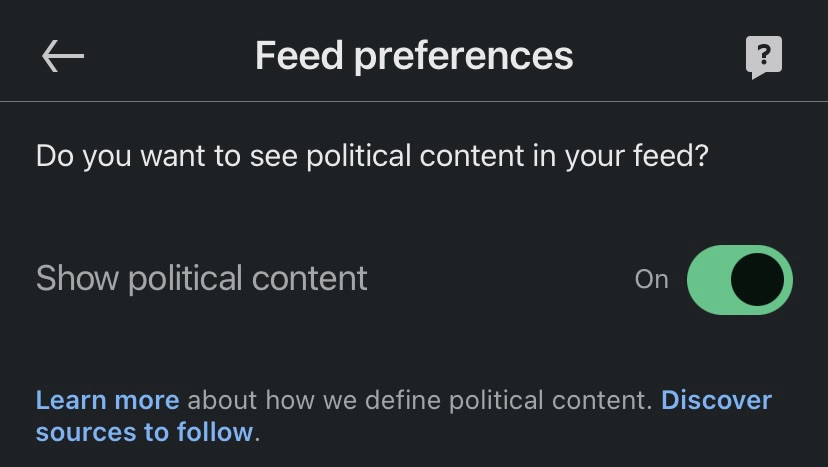
So I checked Google Gemini, and discovered that the “Most Recent” feed switch was buried in the Settings. For mobile LinkedIn users, it was in the “Account preferences” section, in the “Feed preferences.”
Except that it wasn’t.
Whack a Mole
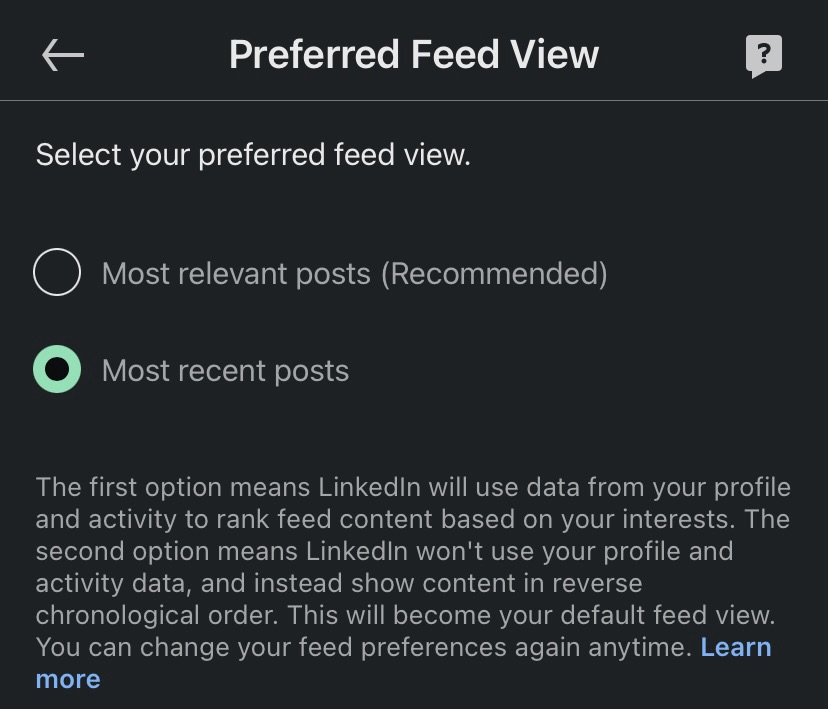
“Feed preferences” only governed display or non-display of political content. The option below “Feed preferences,” “Preferred feed view,” was the one I wanted.
Preferred feed view.
Color me conspiratorial, but I think everyone in the Really Big Bunch—Microsoft (LinkedIn), Meta (Facebook), and the others—likes to play “Whack a Mole” with the location of the chronological feed setting so that we give up and stick with the algorithmic feed of The Things We Are Supposed To See.
So the instructions here, written on June 22, 2025, may be invalid on June 22, 2026. Or July 22, 2025. Or June 23, 2025.
But for this moment I have the chronological feed set on LinkedIn, and since it takes effort to change it back, I don’t know when I will.
Update
When I returned to LinkedIn to share a LinkedIn version of this post, my preferred feed view had been reset to “most relevant.”
I even scheduled a Facebook event. Because Meta wants me to turn every Facebook post into an event, I set one up for Monday at 8 am (Pacific Daylight Time).
Nothing special at the event; I’m not even planning to go live. Just a time to check to see if the video is posted, and to spend 32 seconds watching it.





 Bredemarket