Check this article from cyberdaily.au regarding a reported third-party breach. This one is from Danish jewelry brand Pandora.
“The company said that impacted data includes names, birthdates and email addresses, but that financial information, government identifiers and passwords were not accessed by the threat actors.”
“While Pandora has not shared the name of the third-party platform, BleepingComputer has learned that the data was stolen from the company’s Salesforce database.”
Not that it’s necessarily Salesforce’s fault. Access could have been granted by a Pandora employee as part of a social engineering attack.
I’ve scheduled a post for Monday regarding Identity Assurance Level 3 (IAL3). I note that IAL2 is not enough for some government agencies, who have requirements that are…um…harder better faster stronger.
Monday’s post will include the “hands” video version of the Daft Punk song.
Health marketing leaders know that pharmacy product marketing can be complex because of the many stakeholders involved. Depending upon the product or service, your hungry people (target audience) may consist of multiple parties.
Pharmaceutical companies.
Pharmacists.
Medical professionals.
Insurance companies.
Partners who assist the companies above.
Consumers.
And the pharmacy product marketer has to create positioning and messaging for all these parties, for a myriad of use cases: fulfillment, approval, another approval, yet another approval. All the messaging can become a complex matrix. (I know. I’ve maintained a similar messaging matrix for an ABM marketing campaign for the financial services industry.)
To achieve your goals, health marketing leaders require a mix of strategy and tactics. And that’s where my extensive experience can help with your pharmacy product marketing program.
I seem to be on a kick on writing about case studies.
If you want your happy customers to say nice things about you, but don’t know where to begin to assemble your own case studies, maybe Bredemarket can help. Talk to me.
Six recent Bredemarket posts on case studies
In the meantime, read on to see where I’ve gotten my kicks lately.
1: Make your prospects stop and eat
Cool service. Have your happy customers tell prospects about it.
“Let Bredemarket help you take the blindfolds off. We can work together to fill your content black hole with blogs, articles, case studies, white papers, and other written words that make your prospects stop and eat.”
“Rather than arrange our case studies into four parts, my client and I agreed on a three-part outline that effectively combined “S” and “T.” Our outline? Problem, Solution, and Result. The STAR people were horrified, but we didn’t care. The client was a maverick anyway.”
You Have the Interview Transcript for a Case Study. Now What? – Bredemarket
5: Solutions that are specific
“Bredemarket is targeting tech CMOs with the specific problem of needing help, or a push, to create the marketing content their firms require. Before your competitors steal your prospects from you. You know what you need: perhaps awareness (who you are), perhaps consideration (why your competitors suck). And you will get it through through case studies, or blog posts, or white papers, or LinkedIn articles, or proposals, or something else.”
Pardon me while I leave my usual B2B and B2G comfort zone and enter the B2C world.
We think of buying in bulk—hauling the van (I almost said “station wagon”) to Costco or Sam’s Club—as a modern invention.
But it’s only new to those of us who are NOT incredibly wealthy.
As Ellen Hawley reminds us, rich people such as Samuel Pepys had goods problems during the Great Fire of London in 1666. The fire was leaving the City and approaching their homes—what to do? According to Pepys’ words, this is part of what he did:
“Sir W. Batten not knowing how to remove his wine, did dig a pit in the garden, and laid it in there; and I took the opportunity of laying all the papers of my office that I could not otherwise dispose of. And in the evening Sir W. Pen and I did dig another, and put our wine in it; and I my Parmazan cheese, as well as my wine and some other things.”
The “Parmazan” cheese is never mentioned again. As Hawley observes:
“Pepys’ house did not burn and in a later entry he writes about unearthing his wine but doesn’t mention the cheese. Since he didn’t complain about losing it, we can probably assume the fire didn’t turn it into a giant grilled cheese sandwich, minus the bread.”
Although a Parmesan cheese sandwich sounds foreign to me.
So why am I writing about 17th century fires and foods in the Bredemarket blog?
Although the lines inevitably blur, there is often a line between devices used at home and devices used at work.
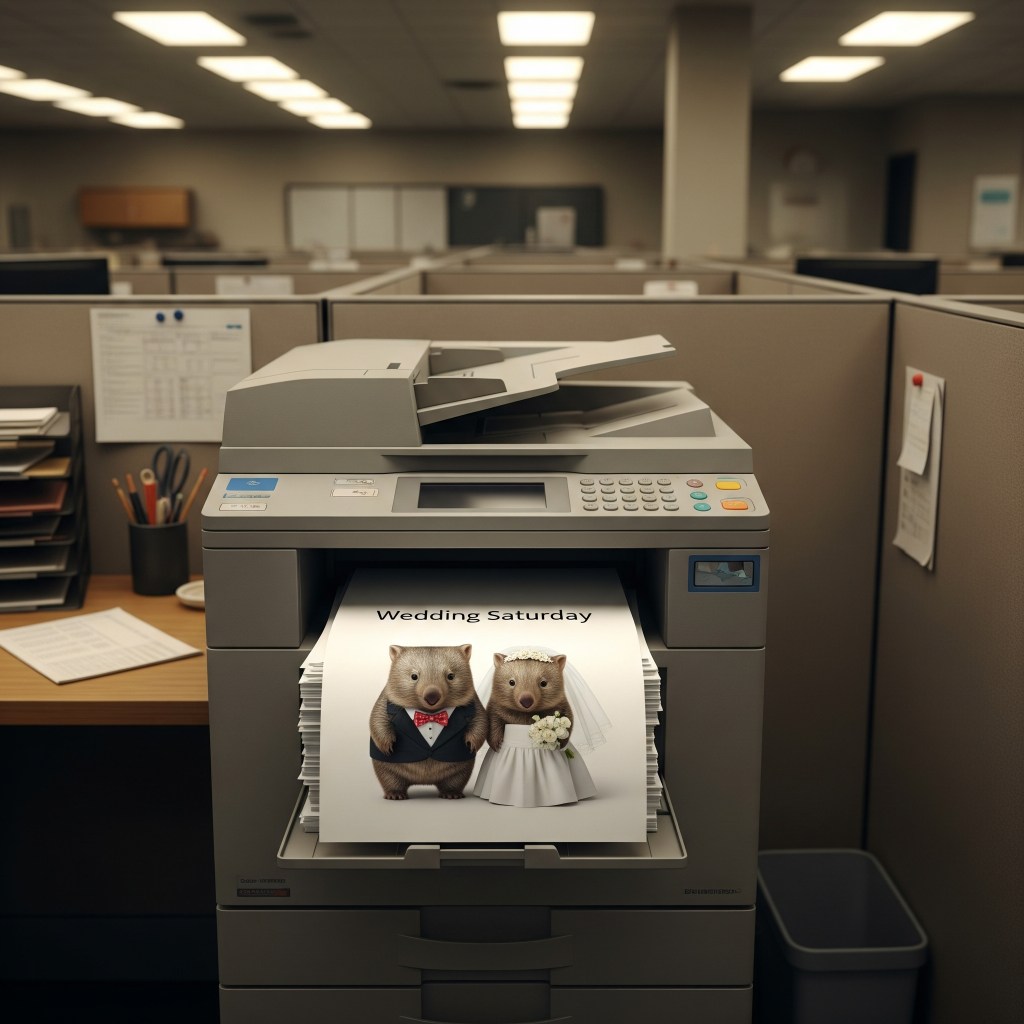
For example, if you work in an old-fashioned work office, you shouldn’t use the company photocopier to run personal copies of invitations to your wedding.
Similarly, if you have a personal generative AI account, you may cause problems if you use that personal account for work-related research…especially if you feed confidential information to the account. (Don’t do this.)
Not work related. Imagen 4.
The line between personal use and work use of devices may have been crossed by a Customs and Border Protection agent on June 30 in Los Angeles, according to 404 Media.
“A Customs and Border Protection (CBP) agent wore Meta’s AI smart glasses to a June 30 immigration raid outside a Home Depot in Cypress Park, Los Angeles, according to photos and videos of the agent verified by 404 Media.”
If you visit the 404 Media story, you can see zoomed in pictures of the agent’s glasses showing the telltale signs that these aren’t your average spectacles.
Now 404 Media doesn’t take this single photo as evidence to indicate that CBP has formally adopted Meta AI glasses for its work. In fact, a likely explanation is that these were the agent’s personal glasses, and he chose to wear them to work that day.
And 404 Media also points out that current Meta AI glasses do NOT have built-in facial recognition capabilities.
But even with these, the mere act of wearing these glasses causes potential problems for the agent, for Customs and Border Protection, and for Meta.
For the agent, he may have been in violation of Meta’s applicable Terms of Service, which state (Clause 2.1): “You may only use MPT Products for personal non-commercial purposes unless otherwise expressly permitted in these Supplemental Terms or authorized by us in writing.” Using the glasses during an immigration raid is NOT a personal purpose.
For Customs and Border Protection, this may be a political hot potato. Even within the group of supporters of Donald Trump, there is a clear division regarding the use of facial recognition technologies (not the case here, but it could be). Some are all for using any technology whatsoever without restraint. Others see these technologies as dangerous, never to be used. Congress is currently considering H.R. 3782, “To prohibit the Federal Government from using facial recognition technology as a means of identity verification, and for other purposes.” Some Members of Congress may have some questions for this CBP agent.
Take Grandma, who uses Meta to find those cute Facebook stories about that hunk Ozzy Osbourne (who appeals to an older demographic). If she finds out that her friend Marky Mark Zuckerberg is letting the Government use Meta technology on those poor hardworking workers who just want a better life, well, Grandma may stop buying those trinkets from Facebook Marketplace.
(Unauthorized) Homeland Security Fashion Show. AI-generated by Imagen 4. And no, I don’t know what a “palienza” is.
So the lesson learned? Don’t use personal devices at work. Especially if they’re controversial.
Californians, get the acronyms right: CCPA, CPRA, CPPA.
“Imagine having complete insight and control over how your personal information is collected, shared, and sold. That’s what the California Consumer Privacy Act (CCPA) brought in 2020. Then came the California Privacy Rights Act (CPRA), effective January 2023, expanding those rights and establishing the California Privacy Protection Agency (CPPA) to enforce them. These laws together position California at the forefront of privacy regulation in the United States.”









 Bredemarket