Pardon me while I leave my usual B2B and B2G comfort zone and enter the B2C world.
We think of buying in bulk—hauling the van (I almost said “station wagon”) to Costco or Sam’s Club—as a modern invention.
But it’s only new to those of us who are NOT incredibly wealthy.
As Ellen Hawley reminds us, rich people such as Samuel Pepys had goods problems during the Great Fire of London in 1666. The fire was leaving the City and approaching their homes—what to do? According to Pepys’ words, this is part of what he did:
“Sir W. Batten not knowing how to remove his wine, did dig a pit in the garden, and laid it in there; and I took the opportunity of laying all the papers of my office that I could not otherwise dispose of. And in the evening Sir W. Pen and I did dig another, and put our wine in it; and I my Parmazan cheese, as well as my wine and some other things.”
The “Parmazan” cheese is never mentioned again. As Hawley observes:
“Pepys’ house did not burn and in a later entry he writes about unearthing his wine but doesn’t mention the cheese. Since he didn’t complain about losing it, we can probably assume the fire didn’t turn it into a giant grilled cheese sandwich, minus the bread.”
Although a Parmesan cheese sandwich sounds foreign to me.
So why am I writing about 17th century fires and foods in the Bredemarket blog?
When marketers write content for Chief Information Security Officers, we need to ensure they’re listening. The content needs to speak to their concerns. Understanding their emotions helps us to do that.
Tapping into their emotions helps to ensure the CISOs are paying attention, and that the CISOs are not dismissing our content as unimportant and unworthy of their attention. (See what I did there, dear marketer?)
Are our prospects listening to us?
I’ve talked about emotions and content before. My approach is fairly simple, identifying the emotions encountered at two stages of the customer journey:
The negative emotions faced at the “problem” stage. Perhaps fear, anger, or helplessness.
The positive emotions faced at the “results” stage, after you have provided the customer with the solution to their problem. This could be the happiness or satisfaction resulting from hope, accomplishment, or empowerment.
What do CISOs fear?
I’m reworking a client piece targeted to Chief Information Security Officers (CISOs), and I needed to re-examine the things that keep CISOs up at night. I started with a rudimentary list.
Cyberattacks. (Duh.)
Technological complexity.
Resource constraints.
Corporate liability.
Job security.
A good list—well, I think so—but is it good enough? (Or big enough?) The elements are rather abstract, since you can discuss concepts such as “resource constraints” without FEELING them.
What do CISOs really fear?
Maslow’s famous hierarchy of needs is (literally) based upon physiological (survival) and safety needs. Can I translate the abstractions above into something more primal?
Loss of all our information, leaving us dumb and helpless.
Confusion and bewilderment in (as the AI bots are fond of saying) “the ever-changing landscape.”
Overwhelming burnout from too much to do.
No money after being sued into oblivion.
Wandering the streets homeless and starving after losing your job and your income.
How should we express those fears?
Now there are various ways to express those primal fears. I could go for maximum effect (will the wrong decision today leave you homeless and starving tomorrow?), or I could write something a little less dramatic (are you vulnerable to the latest cyber threats?). The words you choose depend on your company’s messaging tone, which is why I recently reshared my original brand archetypes post from August 2021. A Sage will say one thing, a Hero another.
Why?
Anyway, thank you for reading. Writing this helped me, and maybe it gave you some ideas. And if you want to know more about the seven questions I like to ask before creating content (emotions being the 7th), read my ebook on the topic.
Perhaps one of the biggest changes over the last several decades is that we no longer possess physical things.
Old and new music
When some of us were younger, we would always go to “the record store” to buy a CD or cassette or vinyl (the “record”) or maybe an 8 track. We would put the physical media on a playback device. And unless the media were damaged or stolen, you always had it. RCA wouldn’t come to your house and take your Elvis record.
Let me be your teddy wildebeest.
Then services from Napster 1.0 to Apple to Spotify started to provide music in digital form. And now your music COULD be taken away. When Neil Young got mad at Spotify, I couldn’t listen to Neil any more. (They subsequently kissed and made up.)
This is true of many other things: TV shows, movies, even computer software.
Which brings us to books.
Old and new books
You could once buy books at your local bookstore, or from an online bookstore called Amazon. But then Amazon developed the Kindle e-reader. And as The Verge points out, something on the Kindle today may not be there tomorrow.
“Amazon has occasionally removed books from its online store and remotely deleted them from Kindles or edited titles and re-uploaded new copies to its e-readers. In 2009, the company removed copies of George Orwell’s Nineteen Eighty-Four and Animal Farm, explaining the books had been mistakenly published. More recently, many of Roald Dahl’s books, including Charlie and the Chocolate Factory, were replaced with updated copies featuring modified language on various ebook platforms. It’s a reminder that you don’t actually own much of the digital content you consume, and without the ability to back up copies of ebooks, you could lose them entirely if they’re banned and removed.”
New and improved edition.
But there is a workaround. If your Kindle has a copy of Mein Kampf or a book about gay hotspots near the Gulf of Mexico and you don’t want to lose it, you can save it outside of the Amazon ecosystem.
“(The feature is) still accessible through Amazon’s website by accessing your “Content Library” while logged into your account. For purchased books you select the “More actions” menu, choose “Download & transfer via USB,” select a Kindle device you have registered, and a copy of the book will be downloaded to your computer.”
A nice feature…especially if you want to make sure you don’t lose your purchased content. And it’s really nice if you want to put your Amazon content on a non-Amazon e-reader. Because the Kindle only has a minuscule 72% share of the e-reader market, this is a gargantuan threat to Amazon’s ability to sell hardware.
You can see where this is going.
Ch-ch-ch-ch-changes
Amazon has made a change, according to The Verge:
“Starting February 26, 2025, the ‘Download & Transfer via USB’ option will no longer be available. You can still send Kindle books to your Wi-Fi enabled devices by selecting the ‘Deliver or Remove from Device’ option.”
February 25.
To clarify, you can still access your books on the Kindle app.
Just not outside of it.
How does this affect your content?
This serves as a reminder about technological change, walled gardens, and obsolescence.
Which ties in with one of Bredemarket’s favorite topics, repurposing.
Now Bredemarket doesn’t create videos for clients, but if you need your identity/biometric or technology text repurposed in another format, I can help.
Technology marketers, do you need written content?
If you don’t use written content to communicate with your prospects and clients, save yourself some time and stop reading this.
But if you realize that written content is essential for prospect awareness, consideration, and especially conversion…
And if you need someone adept at creating a variety of written content, from blog posts and articles to case studies and white papers to smartphone application content and scientific book chapters…
Bredemarket can help.
Technology marketers, do you need written content?
I have created all of these types of content, plus internal content such as market/competitor analyses and proposal templates. And I can create this content for your company.
I have worked with demand generation and growth marketing leader Gene Volfe, both as employees of the same company and as independent consultants working for other companies.
I asked him to review a short technology piece that I wrote, and he immediately found two gaps:
There may be a variety of reasons for this. Perhaps your current employees are too busy doing other things. Or perhaps writing terrifies them so much that they think ChatGPT-generated content is actually a GOOD thing. (Read the content. It isn’t good.)
So you’re thinking about outsourcing the work to a content writer. One who has created content for multiple technology firms, including 9 returning clients. Here are four examples.
But how does outsourced content writing work?
How Bredemarket works with you to create content
Maybe you need an outsourced content writer because your current textual content is not compelling to your prospects, or perhaps it’s non-existent (for example, a LinkedIn company page with zero posts).
If you approach Bredemarket with your outsourced content writing request, here’s how we will work together:
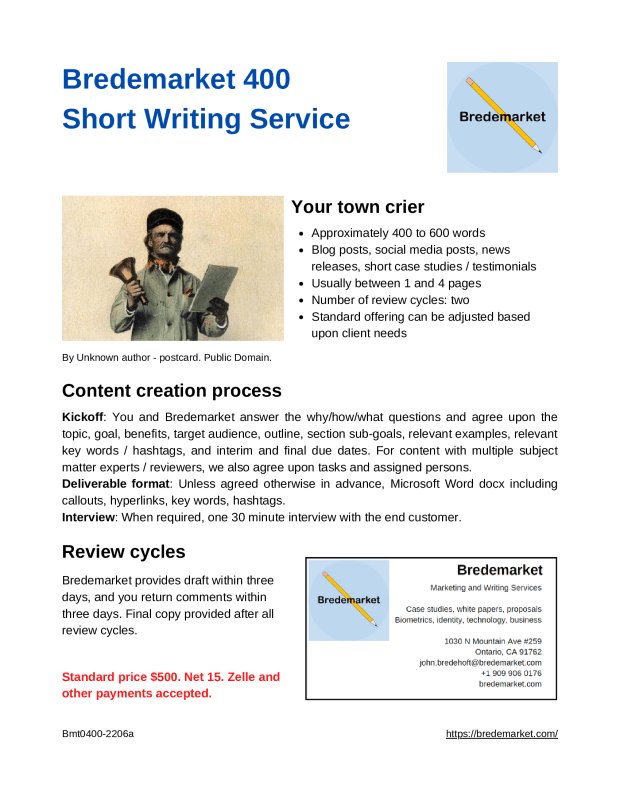
For this example, let’s assume that you need between 400 to 600 words of text to post to your company blog or to your company LinkedIn account, and therefore are purchasing my Bredemarket 400 Short Writing Service.
This is the most important step in the entire process, and I don’t write a word of text until you and I have some agreement on WHAT I am going to write.
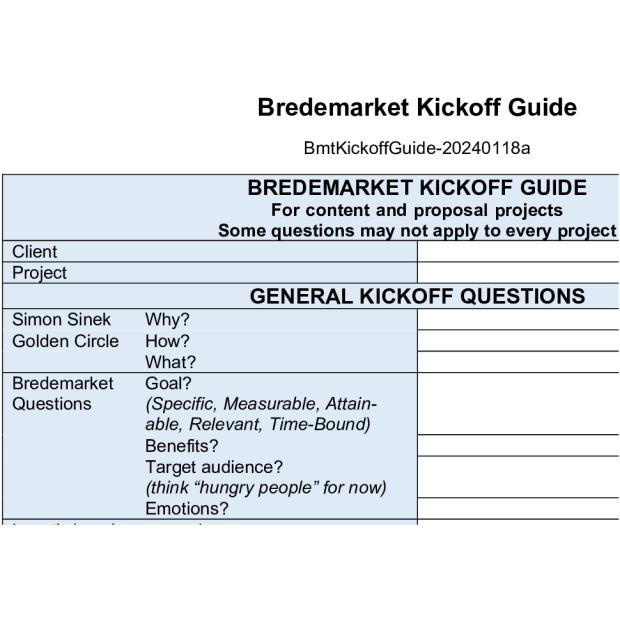
I start by asking seven questions about the content, your product, and your company.
Why?
How?
What?
Goal?
Benefits?
Target Audience?
Emotions?
I ask some additional questions which I won’t discuss in detail here. For example, you may specify the subject matter experts or articles I need to consult.
Once we’ve worked through ALL the questions, either in a synchronous meeting or asynchronously via email, I have a good idea of what the written content needs to say.
This benefits you because I love doing this, communicating your benefits to your prospects using the framework upon which we agreed in the kickoff.
Unless we agree on a different schedule, I get that first draft to you in three days for the next important step.
Step 3: First draft review
This is where you come in. Your task is to review my draft within three days and provide comments. And if I don’t hear from you within three days, you’ll hear from me. Why?
The first reason is my pure self-interest. The sooner I complete the project, the sooner I get paid. Those cold dead hands need some nice gloves.
The second reason is of mutual interest. We want to complete the project while we’re focused on thinking about it, and while it is critically important to us.
The third reason is for your own self-interest. You have a content gap, and it’s in your interest to fill that gap. If we get this draft reviewed and move forward, that gap will be filled quickly. If we don’t move forward, the gap will remain, your efforts to contract with Bredemarket will be for naught, and you’ll still have an uninteresting website and dead social media accounts.
Step 4: It depends
What happens after the first draft review varies from client to client.
Some of my clients love the first draft and don’t want to change a thing.
Some of my first drafts have embedded questions that you need to answer; once those questions are answered, the content is ready.
Some of my first drafts may need minor changes. In one case, I was asked to remove a reference to a successful hack that occurred at a well-known company; unbeknownst to me, the company was a customer of another division of the client in question. Whoops.
Occasionally more substantive changes are required, and I end up creating a second draft in three days, and you review it in three days.
In the end, we have a piece of content that is almost ready for publication.
Step 5: Finalize and publish
While the words may be ready, the entire piece is not.
I’m not a graphics person, and usually a written piece needs some accompanying images to drive the message home. I may suggest some images, or I may suggest that the client reuse an image from their website, or I may just ask the client to select an appropriate image.
Once the text and images are ready, you publish the piece. Normally I don’t have access to your website or social media accounts, so I can’t publish the piece for you. Only one client has given me such access, and even for that client I don’t have COMPLETE publishing permission.
For short projects such as a Bredemarket 400 project, I usually bill you when you publish the piece, although in certain circumstances I may bill you once the text is complete.
Are you ready to outsource your content marketing?
While other content marketers may work differently, we all have some type of process for our outsourced content writing.
If you’re ready to move forward with Bredemarket for outsourced content writing, contact me.
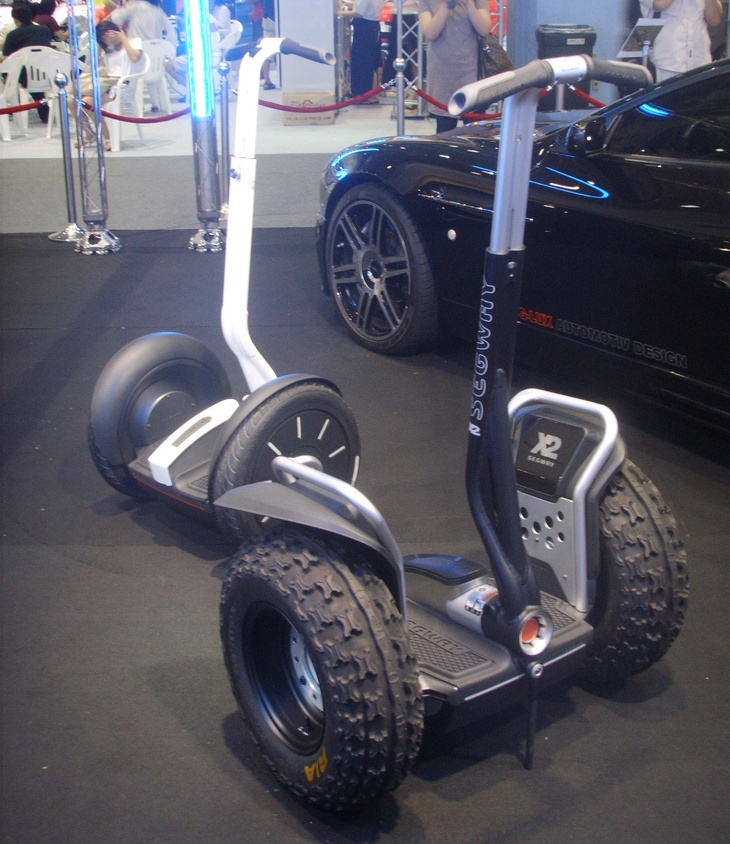
I recall one product in particular (not a Segway, but a biometric product housed in a tower) that was an impressive fusion of algorithmic and mechanical excellence. The complex design that went into developing the tower product resulted in a device that performed its function superbly.
The complex engineering also caused the product to have such a high price that no one would ever buy it…but I digress.
But there was another issue with the product. I was writing proposals at the time, and we certainly could have written up a product description that emphasized the product’s lengthy set of features.
But the people receiving our proposals wouldn’t have cared one bit.
Prospects don’t care about lengthy feature lists
You see, prospects don’t care about lengthy feature lists.
If your product stops terrorists from boarding airplanes, then and only then will they care about your company or your product.
If your product can’t stop terrorists from boarding airplanes, or if there is another product that is better at stopping terrorists from boarding airplanes, then your prospects won’t care about your product.
So how do you get prospects to care?
You don’t get prospects to care by talking about your extensive feature lists.
Let me give you a tip. If you find an employee at the prospect’s company who wants to spend a lot of time talking about your extensive feature lists, that employee probably DOESN’T have the authority to approve the purchase.
The people who DO have the authority to approve the purchase don’t have time to talk about extensive feature lists.
The approvers want to know, in 30 seconds or less, how your solution BENEFITS them.
Do you need help explaining your benefits?
Talking about benefits rather than features is just one tactic to successfully appeal to your prospects.
If you need help ensuring that your written materials (blog posts, white papers, web pages) resonate with your prospects, you can ask Bredemarket to help you.















 Bredemarket