When the United States was attacked on September 11, 2001—an attack that caused NATO to invoke Article 5, but I digress—Congress and the President decided that the proper response was to reorganize the government and place homeland security efforts under a single Cabinet secretary. While we may question the practical wisdom of that move, the intent was to ensure that the U.S. Government mounted a coordinated response to that specific threat.
Today Americans face the threat of fraud. Granted it isn’t as showy as burning buildings, but fraud clearly impacts many if not most of us. My financial identity has been compromised multiple times in the last several years, and yours probably has also.
But don’t expect Congress and the President to create a single Department of Anti-Fraud any time soon.
Because this is government-wide and necessarily complex, the bill will be referred to at least THREE House Committees:
“Referred to the Committee on Oversight and Government Reform, and in addition to the Committees on Financial Services, and Energy and Commerce, for a period to be subsequently determined by the Speaker, in each case for consideration of such provisions as fall within the jurisdiction of the committee concerned.”
“9 (9) The National Institute of Standards and 10 Technology (NIST) was directed in the CHIPS and 11 Science Act of 2022 to launch new work to develop 12 a framework of common definitions and voluntary 13 guidance for digital identity management systems, 14 including identity and attribute validation services 15 provided by Federal, State, and local governments, 16 and work is underway at NIST to create this guid 17 ance. However, State and local agencies lack re 18 sources to implement this new guidance, and if this 19 does not change, it will take decades to harden defi 20 ciencies in identity infrastructure.”
Even in the preamble the bill mentions NIST, part of the U.S. Department of Commerce, and the individual states, after mentioning the U.S. Department of the Treasury (FinCEN) earlier in the bill.
But let’s get to the meat of the bill:
“3 SEC. 3. IDENTITY FRAUD PREVENTION INNOVATION 4 GRANTS. 5 (a) IN GENERAL.—The Secretary of the Treasury 6 shall, not later than 1 year after the date of the enactment 7 of this section, establish a grant program to provide iden 8 tity fraud prevention innovation grants to States.”
The specifics:
The states can use the grants to develop mobile driver’s licenses “and other identity credentials.”
They can also use the grants to protect individuals from deepfake attacks.
Another purpose is to develop “interoperable solutions.”
A fourth is to replace vulnerable legacy systems.
The final uses are to make sure the federal government gets its money, because that’s the important thing to Congress.
But there are some limitations in how the funds are spent.
They can’t be used to require mDLs or eliminate physical driver’s licenses.
They can’t be used to “support the issuance of drivers licenses or identity credentials to unauthorized immigrants.” (I could go off on a complete tangent here, but for now I’ll just say that this prevents a STATE from issuing such an identity credential.)
The bill is completely silent on REAL ID, therefore not mandating that everyone HAS to get a REAL ID.
And everything else
So although the bill claims to implement a government-wide solution, the only legislative changes to the federal government involve a single department, Treasury.
But Treasury (FinCEN plus IRS) and the tangentially-mentioned Commerce (NIST) aren’t the only Cabinet departments and independent agencies involved in anti-fraud efforts. Others include:
The Department of Homeland Security, through the Secret Service and every enforcement agency that checks identities at U.S. borders and other locations.
The Federal Trade Commission (FTC).
The Social Security Admistration. Not that SSNs are a national ID…but they de facto are.
And that’s just one example of how anti-fraud efforts are siloed. Much of this is unavoidable in our governmental system (regardless of political parties), in which states and federal government agencies constantly war against each other.
What happens, for example, if the Secret Service decides that the states (funded by Treasury) or the FBI (part of Justice) are impeding its anti-fraud efforts?
Or if someone complains about NIST listing evil Commie Chinese facial recognition algorithms that COULD fight fraud?
Despite what Biometric Update and the Congresspeople say, we do NOT have a government-wide anti-fraud solution.
(And yes, I know that the Capitol is not north of the Washington Monument…yet.)
“It is clear that digital-first identity systems are unlikely to become standard. Most governments will still rely heavily on physical credentials through 2026. Physical documents, such as diver’s licenses and passports, have long life spans. Physical security is already a proven technology, making it essential for continued trust and accessibility in the wake of ever-more sophisticated attack methods. ABI Research cybersecurity analysts view mobile ID as more of a companion to physical credentials.”
Oh, and number 12.
“Interest in biometric payment cards has waned due to high costs and complex onboarding. Zwipe’s bankruptcy in March 2025 is emblematic of this latest trend. To extract returns from their prior investments in biometrics, digital payment providers are pivoting to other markets like secure access and cold wallets. Going forward, the technology will shift from mainstream ambition to specialty use cases, with fewer launches expected in 2026.”
To see what these and the other 11 predictions mean, read the ABI Research article.
I finally found a legitimate use for my California mobile driver’s license (mDL) this afternoon.
Ontario International Airport (ONT) allows people without tickets to reserve a day pass to see departing passengers off. The day pass functions as the equivalent of a real passenger’s boarding pass…with appropriate identification.
Both the day pass and my mDL were in my smartphone wallet, so all went smoothly. I wasn’t paying enough attention to know if the Transportation Security Administration (TSA) compared my live face to my mDL, but they probably did.
And I can confirm that Richard Reid rule is gone: no shoe removal required. Belts are another matter.
Normally when states adopt a new technology, one state will first adopt it, followed by other states, until eventually all states adopt it. (Take REAL ID.)
It’s rare that a state adopts an emerging technology and then trashes it.
“The Florida Smart ID applications will be updated and improved by a new vendor. At this time, the Florida Department of Highway Safety and Motor Vehicles is removing the current Florida Smart ID application from the app store. Please email FloridaSmartID@flhsmv.gov to receive notification of future availability.”
This year
But hey, I’m sure Florida is working behind the scenes to develop a new mDL. After all, digital identity remains a federal priority.
“At the forefront of the Trump administration’s cybersecurity shift is the categorical removal of Biden-era digital identity initiatives which had encouraged federal agencies to accept digital identity documents to access public benefit programs and promoted federal grants to help states develop secure mobile driver’s licenses.”
But if states aren’t receiving federal funding to develop mDLs, and if states decide that only physical driver’s licenses are in their interest, then will mDL adoption slow?
Or may other states follow Florida’s lead and let their contracts with mDL vendors expire?
Discovered a song about privacy (by John Maus) and had to create a reel that used the song. Note the mDL privacy-preserving features toward the end of the reel.
In my country, the issuance of driver’s licenses is performed at the state level, not the national level. This has two ramifications.
REAL ID
The U.S. government wanted to tighten down on identification cards to stop terrorists from hijacking planes and crashing them into buildings.
But it couldn’t.
When it told the states to issue “REAL ID” cards by 2008, the states said they wouldn’t be told what to do.
Today all of them support REAL ID cards as an option, but use of REAL IDs for federal functions such as plane travel won’t be enforced until 2027…if then.
mDLs
For years there has been a move to replace physical driver’s licenses with mobile driver’s licenses, or mDLs.
Again, in my country this has been pursued in a piecemeal basis on the state level. Louisiana has its own mDL, with a separate one in Oklahoma, one in California, others in other states, and none in other states. And one state (Florida) that had one, then didn’t have one.
Some mDLs are in custom wallets, while others are or are not in wallets from Apple, Google, and Samsung.
Oh, and don’t try using your Louisiana mDL to buy a beer in Arkansas.
Meanwhile, in the UK
Things are different in other countries. Amit Alagh shared a BBC article with me.
“Digital driving licences are to be introduced in the UK as the government looks to use technology to ‘transform public services’…. The new digital licences will be introduced later this year….”
Throughout the entire United Kingdom, including Scotland and Northern Ireland, apparently.
In part because when I first tried to get a mobile driver’s license (mDL), I used my OLD physical driver’s license AFTER I had renewed my driver’s license online (but before I received the new physical license). Data mismatch. Rejected.
And in part because I kept on forgetting to perform the additional steps to confirm my identity.
And in part because I didn’t truly NEED the mDL—I haven’t flown anywhere since April 2023, and for some strange reason no vendor of age-controlled products has insisted on carding me.
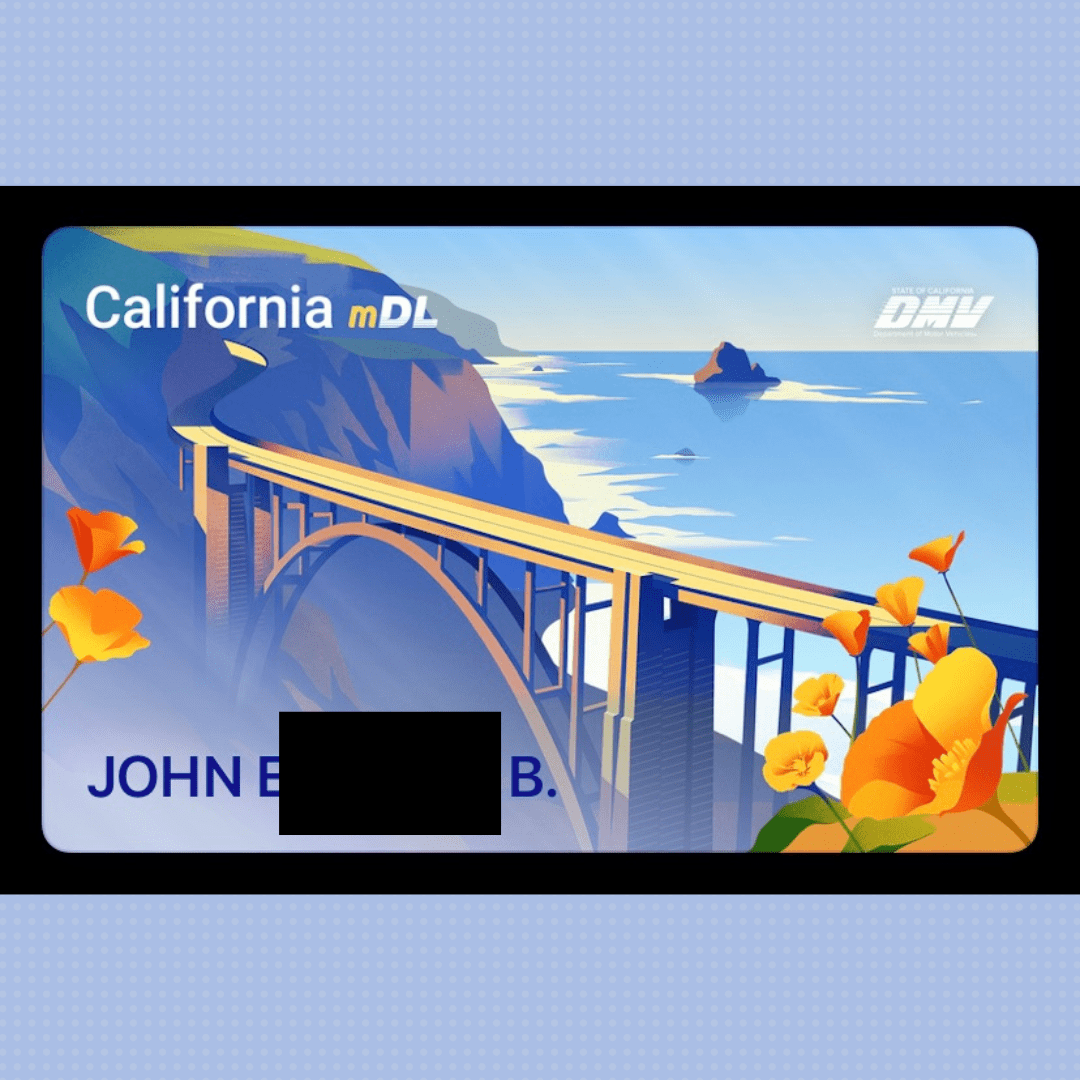
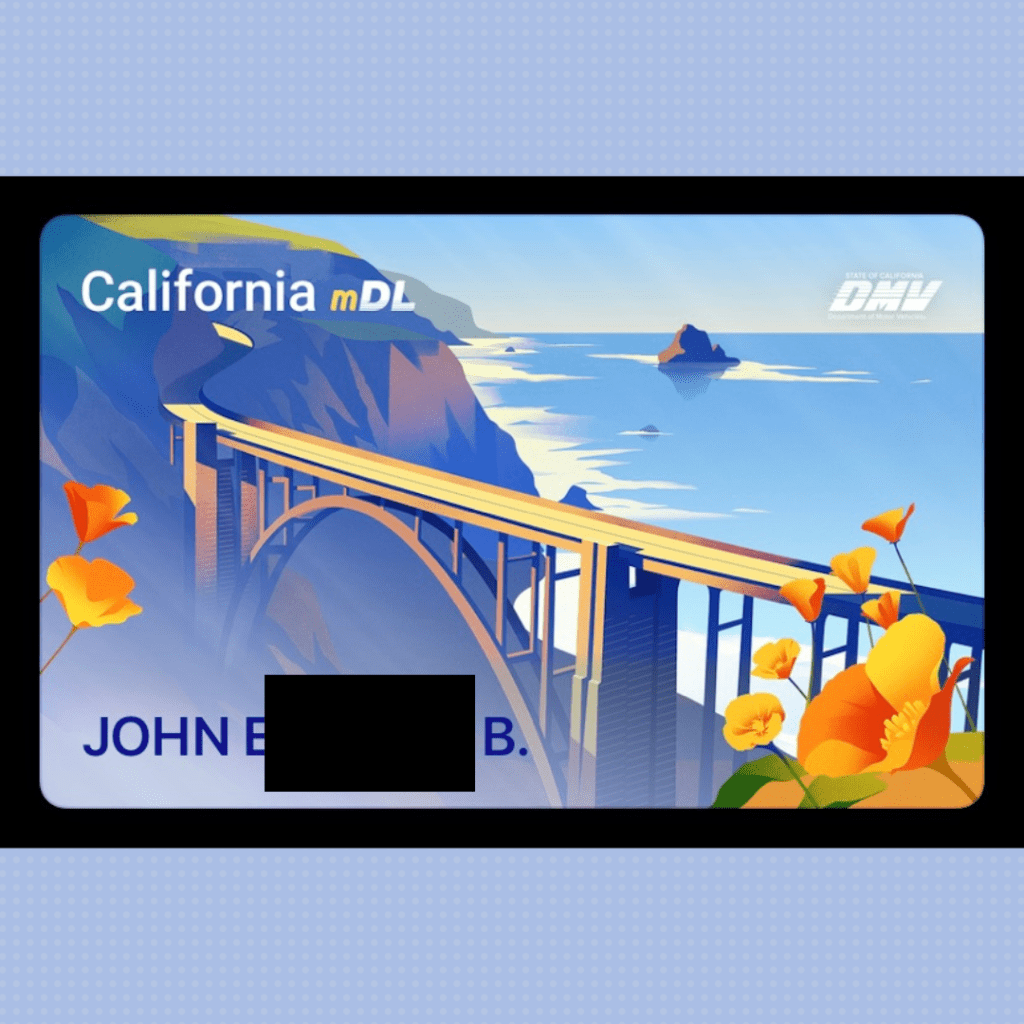
California mobile driver’s license (mDL).
But I now have a California mDL. After talking about mDLs for years as a former IDEMIA employee.
I’ve previously espoused the benefits of mDLs. For example, when a retailer DOES check my age before I buy a beer, the retailer doesn’t learn my address or my (claimed) height and weight. The retailer only needs to confirm that I am old enough to buy a beer.
Oddly enough, I had to block out certain information on my displayed mDL in the image above. Because MY privacy requirements obviously don’t conform to California’s privacy requirements.
When marketing digital identity products secured by biometrics, emphasize that they are MORE secure and more private than their physical counterparts.
When you hand your physical driver’s license over to a sleazy bartender, they find out EVERYTHING about you, including your name, your birthdate, your driver’s license number, and even where you live.
When you use a digital mobile driver’s license, bartenders ONLY learn what they NEED to know—that you are over 21.
I should properly open this post by stating any necessary disclosures…but I don’t have any. I know NOTHING about the goings-on reported in this post other than what I read in the papers.
However, I do know the history of Thales and mobile driver’s licenses. Which makes the recent announcements from Florida and Thales even more surprising.
Gemalto’s pioneering mobile driver’s license pilots
Back when I worked for IDEMIA from 2017 to 2020, many states were performing some level of testing of mobile driver’s licenses. Rather than having to carry a physical driver’s license card, you would be able to carry a virtual one on your phone.
Some of these states were working with the company Gemalto to create pilots for mobile driver’s licenses. As early as 2016, Gemalto announced its participation in pilot mDL projects in Colorado, Idaho, Maryland, and Washington DC. As I recall, at the time Gemalto had more publicly-known pilots in process than any other vendor, and appeared to be leading the pack in the effort to transition driver’s licenses from the (physical) wallet to the smartphone.
Thales’ operational mobile driver’s license
By the time Gemalto was acquired by and absorbed into Thales, the company won the opportunity to provide an operational (as opposed to pilot) driver’s license. The Florida Smart ID app has been available to both iPhone and Android users since 2021.
One of the most important pieces of new information was a revised set of Frequently Asked Questions (or “Question,” or “Statement”) on the “Florida Smart ID” section of the Florida Highway Safety and Motor Vehicles website.
The Florida Smart ID applications will be updated and improved by a new vendor. At this time, the Florida Department of Highway Safety and Motor Vehicles is removing the current Florida Smart ID application from the app store. Please email FloridaSmartID@flhsmv.gov to receive notification of future availability.
Um…that was abrupt.
But a second piece of information, a Thales statement shared by PC Mag, explained the abruptness…in part.
In a statement provided to PCMag, a Thales spokesperson said the company’s contract with the FLHSMV expired on June 30, 2024.
“The project has now entered a new phase in which the FLHSMV requirements have evolved, necessitating a retender,” Thales says. “Thales chose not to compete in this tender. However, we are pleased to have been a part of this pioneering solution and wishes it continued success.”
The new vendor and/or the State of Florida chose not to begin providing services when the Thales contract expired on June 30.
Thales and/or the State of Florida chose not to temporarily renew the existing contract until the new vendor was providing services in 2025.
This third point is especially odd. I’ve known of situations where Company A lost a renewal bid to Company B, Company B was unable to deliver the new system on time, and Company A was all too happy to continue to provide service until Company B (or in some cases the government agency itself) got its act together.
Anyway, for whatever reason, those who had Florida mobile driver’s licenses have now lost them, and will presumably have to go through an entirely new process (with an as-yet unknown vendor) to get their mobile driver’s licenses again.
I’m not sure how much more we will learn publicly, and I don’t know how much is being whispered privately. Presumably the new vendor, whoever it is, has some insight, but they’re not talking.
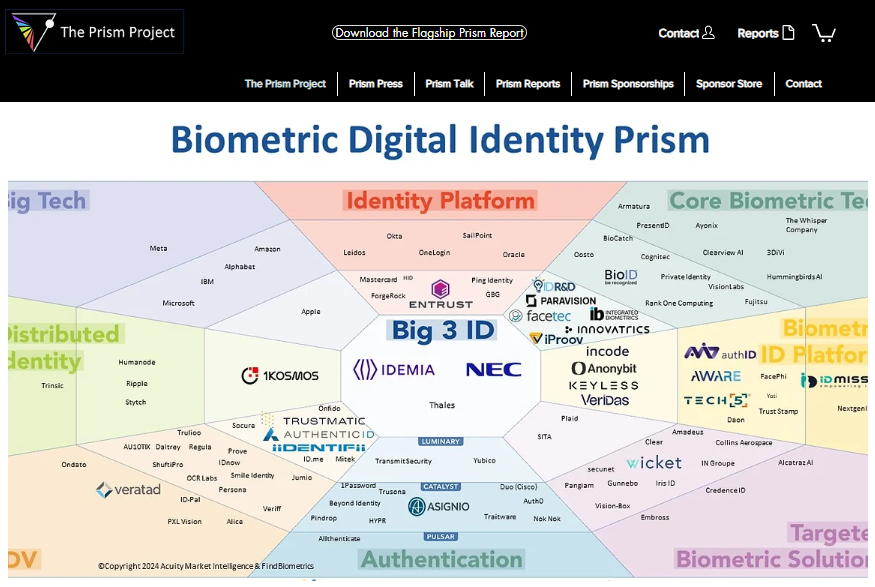
The Prism Project’s home page at https://www.the-prism-project.com/, illustrating the Biometric Digital Identity Prism as of March 2024. From Acuity Market Intelligence and FindBiometrics.
With over 100 firms in the biometric industry, their offerings are going to naturally differ—even if all the firms are TRYING to copy each other and offer “me too” solutions.
I’ve worked for over a dozen biometric firms as an employee or independent contractor, and I’ve analyzed over 80 biometric firms in competitive intelligence exercises, so I’m well aware of the vast implementation differences between the biometric offerings.
Some of the implementation differences provoke vehement disagreements between biometric firms regarding which choice is correct. Yes, we FIGHT.
Let’s look at three (out of many) of these implementation differences and see how they affect YOUR company’s content marketing efforts—whether you’re engaging in identity blog post writing, or some other content marketing activity.
The three biometric implementation choices
Firms that develop biometric solutions make (or should make) the following choices when implementing their solutions.
Presentation attack detection. Assuming the solution incorporates presentation attack detection (liveness detection), or a way of detecting whether the presented biometric is real or a spoof, the firm must decide whether to use active or passive liveness detection.
Age assurance. When choosing age assurance solutions that determine whether a person is old enough to access a product or service, the firm must decide whether or not age estimation is acceptable.
Biometric modality. Finally, the firm must choose which biometric modalities to support. While there are a number of modality wars involving all the biometric modalities, this post is going to limit itself to the question of whether or not voice biometrics are acceptable.
I will address each of these questions in turn, highlighting the pros and cons of each implementation choice. After that, we’ll see how this affects your firm’s content marketing.
(I)nstead of capturing a true biometric from a person, the biometric sensor is fooled into capturing a fake biometric: an artificial finger, a face with a mask on it, or a face on a video screen (rather than a face of a live person).
This tomfoolery is called a “presentation attack” (becuase you’re attacking security with a fake presentation).
And an organization called iBeta is one of the testing facilities authorized to test in accordance with the standard and to determine whether a biometric reader can detect the “liveness” of a biometric sample.
(Friends, I’m not going to get into passive liveness and active liveness. That’s best saved for another day.)
Now I could cite a firm using active liveness detection to say why it’s great, or I could cite a firm using passive liveness detection to say why it’s great. But perhaps the most balanced assessment comes from facia, which offers both types of liveness detection. How does facia define the two types of liveness detection?
Active liveness detection, as the name suggests, requires some sort of activity from the user. If a system is unable to detect liveness, it will ask the user to perform some specific actions such as nodding, blinking or any other facial movement. This allows the system to detect natural movements and separate it from a system trying to mimic a human being….
Passive liveness detection operates discreetly in the background, requiring no explicit action from the user. The system’s artificial intelligence continuously analyses facial movements, depth, texture, and other biometric indicators to detect an individual’s liveness.
Pros and cons
Briefly, the pros and cons of the two methods are as follows:
While active liveness detection offers robust protection, requires clear consent, and acts as a deterrent, it is hard to use, complex, and slow.
Passive liveness detection offers an enhanced user experience via ease of use and speed and is easier to integrate with other solutions, but it incorporates privacy concerns (passive liveness detection can be implemented without the user’s knowledge) and may not be used in high-risk situations.
So in truth the choice is up to each firm. I’ve worked with firms that used both liveness detection methods, and while I’ve spent most of my time with passive implementations, the active ones can work also.
A perfect wishy-washy statement that will get BOTH sides angry at me. (Except perhaps for companies like facia that use both.)
If you need to know a person’s age, you can ask them. Because people never lie.
Well, maybe they do. There are two better age assurance methods:
Age verification, where you obtain a person’s government-issued identity document with a confirmed birthdate, confirm that the identity document truly belongs to the person, and then simply check the date of birth on the identity document and determine whether the person is old enough to access the product or service.
Age estimation, where you don’t use a government-issued identity document and instead examine the face and estimate the person’s age.
I changed my mind on age estimation
I’ve gone back and forth on this. As I previously mentioned, my employment history includes time with a firm produces driver’s licenses for the majority of U.S. states. And back when that firm was providing my paycheck, I was financially incentivized to champion age verification based upon the driver’s licenses that my company (or occasionally some inferior company) produced.
But as age assurance applications moved into other areas such as social media use, a problem occurred since 13 year olds usually don’t have government IDs. A few of them may have passports or other government IDs, but none of them have driver’s licenses.
But does age estimation work? I’m not sure if ANYONE has posted a non-biased view, so I’ll try to do so myself.
The pros of age estimation include its applicability to all ages including young people, its protection of privacy since it requires no information about the individual identity, and its ease of use since you don’t have to dig for your physical driver’s license or your mobile driver’s license—your face is already there.
The huge con of age estimation is that it is by definition an estimate. If I show a bartender my driver’s license before buying a beer, they will know whether I am 20 years and 364 days old and ineligible to purchase alcohol, or whether I am 21 years and 0 days old and eligible. Estimates aren’t that precise.
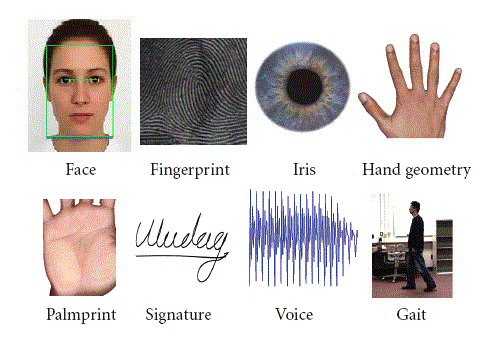
Fingerprints, palm prints, faces, irises, and everything up to gait. (And behavioral biometrics.) There are a lot of biometric modalities out there, and one that has been around for years is the voice biometric.
I’ve discussed this topic before, and the partial title of the post (“We’ll Survive Voice Spoofing”) gives away how I feel about the matter, but I’ll present both sides of the issue.
No one can deny that voice spoofing exists and is effective, but many of the examples cited by the popular press are cases in which a HUMAN (rather than an ALGORITHM) was fooled by a deepfake voice. But voice recognition software can also be fooled.
Take a study from the University of Waterloo, summarized here, that proclaims: “Computer scientists at the University of Waterloo have discovered a method of attack that can successfully bypass voice authentication security systems with up to a 99% success rate after only six tries.”
If you re-read that sentence, you will notice that it includes the words “up to.” Those words are significant if you actually read the article.
In a recent test against Amazon Connect’s voice authentication system, they achieved a 10 per cent success rate in one four-second attack, with this rate rising to over 40 per cent in less than thirty seconds. With some of the less sophisticated voice authentication systems they targeted, they achieved a 99 per cent success rate after six attempts.
Other voice spoofing studies
Similar to Gender Shades, the University of Waterloo study does not appear to have tested hundreds of voice recognition algorithms. But there are other studies.
The 2021 NIST Speaker Recognition Evaluation (PDF here) tested results from 15 teams, but this test was not specific to spoofing.
A test that was specific to spoofing was the ASVspoof 2021 test with 54 team participants, but the ASVspoof 2021 results are only accessible in abstract form, with no detailed results.
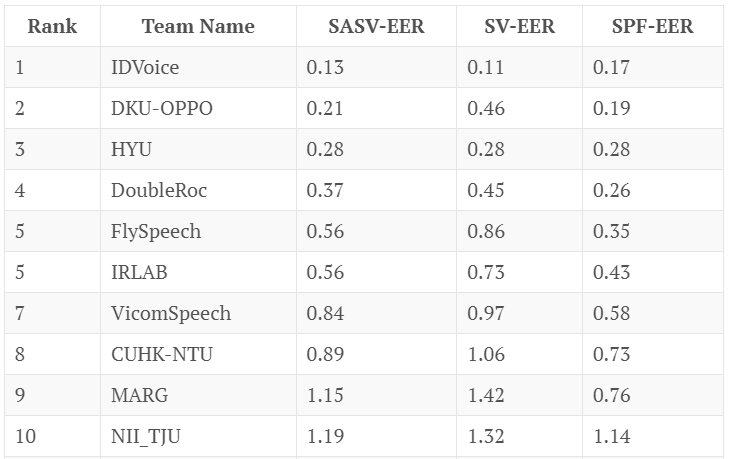
Another test, this one with results, is the SASV2022 challenge, with 23 valid submissions. Here are the top 10 performers and their error rates.
You’ll note that the top performers don’t have error rates anywhere near the University of Waterloo’s 99 percent.
So some firms will argue that voice recognition can be spoofed and thus cannot be trusted, while other firms will argue that the best voice recognition algorithms are rarely fooled.
What does this mean for your company?
Obviously, different firms are going to respond to the three questions above in different ways.
For example, a firm that offers face biometrics but not voice biometrics will convey how voice is not a secure modality due to the ease of spoofing. “Do you want to lose tens of millions of dollars?”
A firm that offers voice biometrics but not face biometrics will emphasize its spoof detection capabilities (and cast shade on face spoofing). “We tested our algorithm against that voice fake that was in the news, and we detected the voice as a deepfake!”
There is no universal truth here, and the message your firm conveys depends upon your firm’s unique characteristics.
And those characteristics can change.
Once when I was working for a client, this firm had made a particular choice with one of these three questions. Therefore, when I was writing for the client, I wrote in a way that argued the client’s position.
After I stopped working for this particular client, the client’s position changed and the firm adopted the opposite view of the question.
Therefore I had to message the client and say, “Hey, remember that piece I wrote for you that said this? Well, you’d better edit it, now that you’ve changed your mind on the question…”
Bear this in mind as you create your blog, white paper, case study, or other identity/biometric content, or have someone like the biometric content marketing expert Bredemarket work with you to create your content. There are people who sincerely hold the opposite belief of your firm…but your firm needs to argue that those people are, um, misinformed.














 Bredemarket