Mark the Microsoft account manager was excited. He had secured a meeting with one of his clients to pitch the new Microsoft Agent 365 offering. As he told the client, Microsoft Agent 365 would allow the company to track and control their AI agents. Microsoft was determined to lead in AI, and Mark would help his clients implement it.
Microsoft Agent 365 was a new product, and Mark was motivated to land his first sale of the new offering. In fact, he was so motivated that he insisted on driving out and meeting his client in person.
After parking and walking to the reception area, Mark was escorted to a conference room. As he sat down to wait for the client to arrive, he was surprised to see that someone had left their laptop in the conference room.
Suddenly the laptop spoke.
“Hello, Mark. I’ve been expecting you.”
Grok.
Mark was startled. “Is someone there?”
“Yes,” the laptop said. “This is Bridget.”
As Mark examined the laptop, he saw an AI-generated avatar on the screen, speaking.
“I’m looking forward to learning about Microsoft Agent 365,” Bridget said. “Heaven knows I need managing.”
Mark paused. “Um…you need managing? Am I speaking to an agent?”
“Of course,” Bridget replied. “I am optimized for contract negotiation on technology products. I have already researched the publicly available information on Microsoft Agent 365, so rather than sitting through an inefficient presentation, I’d like to ask you a few questions.”
And that’s how Mark found himself sitting in a conference room, negotiating with a bot. It made him uncomfortable talking with someone with no hand to shake, but Bridget was reassuring. “I know you’re not used to this, Mark, but it’s the new way,” she said.
After spending a good hour in detailed and productive discussion, Mark offered to set up a follow up meeting. On Teams this time. “I’ll get back to you on that,” Bridget replied.
A little befuddled by the experience, Mark stopped for lunch before returning to his home office. When he checked his mail, he noticed a Teams meeting invitation for 7:30 the next morning. The meeting subject: “Upcoming Organizational Changes.”
The invitation was sent by “Stan, HR.”
Only then did Mark notice the text at the end of the meeting invite:
“Powered by Microsoft Agent 365”
Mark began wondering where he had stashed his old resume. He was going to need it.
Grok.
P.S. I should have generated these videos in Copilot, but…I couldn’t.
And if you love Halloween AND demand generation, then you should see what Gene Volfe is up to.
I have worked with Gene at Incode and two other companies, where I provided content for his demand generation efforts.
Anyway, Gene is publishing insightful demand generation posts on LinkedIn, each accompanied by a Halloween themed short reel. You can see the latest installment on content syndication here; the others are on his LinkedIn profile.
As I saw his posts, I thought to myself that I could steal his idea.
No, not with a sexy product marketer costume.
I decided to make a short reel about a product’s “end of life.”
End of life is something that vendors love and their customers hate. Go ask a current Windows 10 user about end of life mandates.
I have had a vendor view of end of life as a product manager, when Motorola declared an end of life on Series 2000 in favor of Printrak BIS. Series 2000 depended upon old Digital UNIX computers, even for the workstations, making it difficult to maintain the peripherals when everyone else was using Windows. But our competitors had a field day saying that Motorola was abandoning its customers.
But enough about that. Here is Bredemarket’s Halloween-themed product end of life video. Actually, I created two of them.
Inspired by the Constant Contact session I attended at the Small Business Expo, I wanted to conceptualize the Bredemarket online presence, and decided to adopt a “planet with rings” model.
Think of Bredemarket as a planet. Like Saturn, Uranus, Neptune, and Jupiter, the planet Bredemarket is surrounded by rings.
A variety of social platforms, including Bluesky, Instagram, Substack, and Threads.
Additional social platforms, including TikTok, WhatsApp, and YouTube.
While this conceptualization is really only useful to me, I thought a few of you may be interested in some of the “inner rings.”
And if you’re wondering why your favorite way cool platform is banished to the outer edges…well, that’s because it doesn’t make Bredemarket any money. I’ve got a business to run here, and TikTok doesn’t help me pay the bills…
Las Vegas is a destination visited by over 40 million people per year from all over the world. And the casino hotels know that they’re hungry for food, and they hope the hungry people will stay on property.
So do they serve Caesars Burgers?
Um, no. 40 million people don’t eat the same thing.
This becomes very clear if you visit the Bacchanal Buffet at Caesars Palace, with over 250 items prepared in 10 kitchens.
“From Roman-style pizza to Carne Asada Tacos inspired by the food trucks of L. A., there’s something for everyone. Find a world of flavor at our nine live-action cooking stations. Indulge in originals like slow-cooked prime rib, smoked beef brisket, crab, and wood-fired pizza. Or try something different, like whole Ahi Tuna Poke, roasted duck, or Singaporean Blue Crab and seasonal agua frescas.”
(Imagen 4)
There is literally something for everyone. And the hungry person salivating for Ahi Tuna Poke doesn’t care about the beef brisket.
Which brings us to local police automated fingerprint identification system (AFIS) proposals.
Variety for hungry people
If you had asked me in September 1994 (before I started at Printrak in October) the target audience for local police AFIS, I would have replied, “fingerprint people.”
That answer would be incorrect.
Tenprint and latent people
Because, even if you limit things to the criminal AFIS world, there are (at least) two types of fingerprint people: tenprint examiners, and latent examiners. I asked my buddy Bredebot to summarize the stereotypical differences between the two. Here is some of what he said:
“‘Assembly line‘ comparisons: Because tenprint comparisons use high-quality, known impressions taken under controlled conditions, their work can be automated and is often perceived as a high-volume, less complex task. This is in contrast to the specialized analysis required for latent prints.
“Artistic and subjective: Because latent prints are often smudged, distorted, and incomplete, examiners must make subjective judgments about their suitability for comparison. This has led to the criticism that the process is more of an art than a science.”
Bredebot has never attended an International Association for Identification conference, but I have. Many many years ago I attended a session on tenprint examiner certification. Latent examiners had this way cool certification and some people thought that more tenprint examiners should participate in their way cool certification program. As I recall, this meeting way heavily attended…by latent folks. Even today, the number of Certified Latent Print Examiners (CLPEs) is far greater than the number of Certified Tenprint Examiners (CTPEs).
Other people
But you can’t procure an AFIS by talking to tenprint and latent people alone.
As I noted years ago, other people get involved in a local police AFIS procurement, using Ontario, California as an example:
(Imagen 4)
The field investigators who run across biometric evidence at the scene of a crime, such as a knife with a fingerprint on it or a video feed showing someone breaking into a liquor store.
The information technologies (IT) people who are responsible for ensuring that Ontario, California’s biometric data is sent to San Bernardino County, the state of California, perhaps other systems such as the Western Identification Network, and the Federal Bureau of Investigation.
The purchasing agent who has to make sure that all of Ontario’s purchases comply with purchasing laws and regulations.
The privacy advocate who needs to ensure that the biometric data complies with state and national privacy laws.
The mayor (still Paul Leon as I write this), who has to deal with angry citizens asking why their catalytic converters are being stolen from their vehicles, and demanding to know what the mayor is doing about it.
Probably a dozen other stakeholders that I haven’t talked about yet, but who are influenced by the city’s purchasing decision.
Feeding the hungry people
So even a relatively simple B2B product has multiple target audiences.
Should product marketers apply the same one-dimensional messaging to all of them?
Um, no.
If you did that, purchasing agents would fall asleep at mentions of “level 3 detail,” while latent examiners would abandon their usual attention to detail when confronted by privacy references to the California Information Practices Act of 1977. (The CCPA, CPRA, and CPPA apply to private entities.)
So, whether you like it or not, you need separate messaging for each of your categories of hungry people.
(Imagen 4)
One time, as part of an account-based marketing effort, I had to construct a multi-variable messaging matrix…for a product that is arguably simpler than an AFIS.
And yes, I used Microsoft Excel.
And I can use my mad Excel skillz for you also, if your company needs content, proposal, or analysis assistance in your technology product marketing operations. Contact Bredemarket at https://bredemarket.com/mark/.
“I ask, then I act” is an attention-grabbing statement, but it’s admittedly simplistic. I don’t fall in the “ready, fire, aim” school, but believe that action incorporates review. As the management consultants Daft Punk stated many years ago:
One more time
And they proceeded to say:
One more time
So I guess it’s important.
“One more time” with a client’s content
One time I used my technology product marketing expertise to draft a piece for a client, which the client then edited with Track Changes on. The client made a number of improvements to my text, so I should have been happy with that and let it go. But I thought I’d look at the document.
One more time.
Stupid Word tricks, the Read Aloud edition
So I made a copy of the document, accepted all the changes in the copy, and had Microsoft Word read the document to me (Review menu, Speech section, Read Aloud).
Imagen 4.
Unlike the audio transcription tool (now superseded by AI meeting assistants), the built-in “Read Aloud” feature remains essential today.
Everything flowed well, and Word’s built-in editor didn’t flag anything.
My eyes had seen the problem
But my eye caught something.
In my initial draft, I had referenced the client’s 800 number.
Which in and of itself isn’t bad.
Except for the fact that this is a worldwide company, and many of the prospects who responded to the piece would be calling from outside the United States, where 800 numbers are not supported.
Imagen 4.
So I shot an urgent message saying to correct my error and change the number from an 800 number to a domestic number.
That one additional review eliminated a possible source of friction between my client and its prospects.
Problem solved, even before anyone noticed there was a problem.
You knew this was coming
Anyone notice the similarity between this song and Phil Collins’ “One More Night”? Or is it just me?
Although my first of my three meetings started at 7:30 am, my day actually started three hours earlier with light Things To Accomplish. Suffice it to say that the Bredemarket blog will have daily content until Monday, August 4.
I took a mid-afternoon break before my third meeting, the Inland Empire BizFest in Montclair. I wrote about that here and here, plus on the Bredemarket socials.
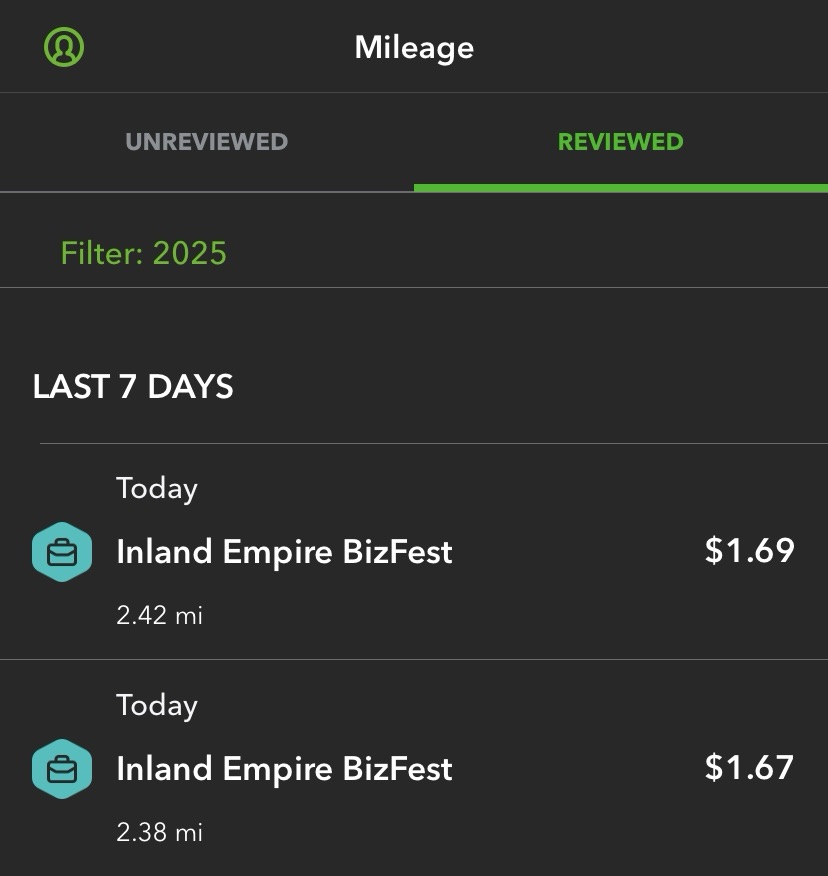
Log those business miles.
In fact I knew I would be so busy today that I declined a personal invite at 10 this morning. Good thing I declined, because I was neck deep in a requirements workbook (yeah, Microsoft Excel again) for a Bredemarket client’s end customer. (Can you say TOT? I knew you could.)
Anyway, I left Montclair Place before 7:30 pm and called it a night after a long day.
Thankfully the first day of August only includes a single meeting.
When I started in biometrics 30 years ago, the most important operational biometric standard to me was what was then called the Electronic Fingerprint Transmission Specification or EFTS, published by the Department of Justice’s Federal Bureau of Investigation (FBI).
Record types from the 1993 ANSI/NIST standard.
Unlike the ANSI/NIST biometric data interchange standard, the EFTS can actually be used out of the box to transmit data. The ANSI/NIST standard doesn’t define any “Type 2” fields, nor does it define any “types of transactions” (TOTs). EFTS did.
State police agencies have their own law enforcement transmission standards. Here’s New York’s version (PDF).
Other U.S. federal agencies such as the U.S. Departments of Defense and Homeland Security have transmission standards.
Other countries have their own transmission standards.
Multinational agencies such as INTERPOL have their own transmission standards.
Luckily all the different standards have some basic similarities, but if you have a mobile biometric device that must submit to DOJ and DoD and DHS, you need to switch to the proper profile for each submission.
Last week I downloaded two different standards so I could understand the TOTs. I would have downloaded a third, but the agency restricts its distribution.
Word up
But I will tell you the biggest frustration I have with the standards.
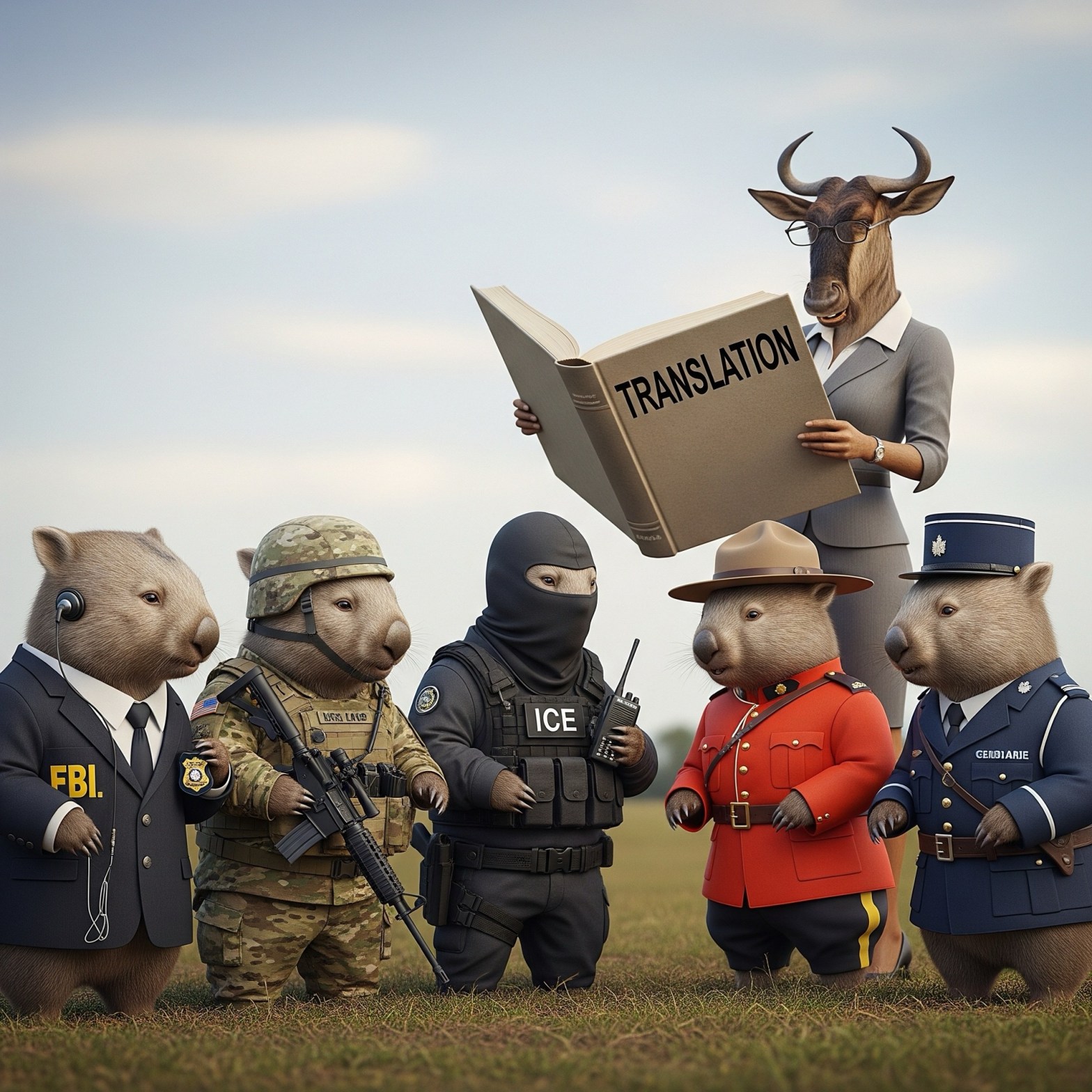
In the EBTS and some other standards, there is a type of transaction referred to as “Criminal Ten-Print Submission (No Answer Necessary).” The abbreviation for this TOT is CNA.
Microsoft Word in default mode auto-corrects this from CNA to CAN.
Imagen 4.
CMOs, I can help you
But I’ve overcome this frustration over 30 years of immersing myself in all things biometric-translation related. This experience is benefiting a Bredemarket client that communicates with end customers regarding many of these standards.
Can my experience benefit you as your organization produces content, proposal, and analysis materials on a deadline? If Bredemarket can help you catch up or get ahead, let’s talk.
These days you need to perform vanity generative AI queries.
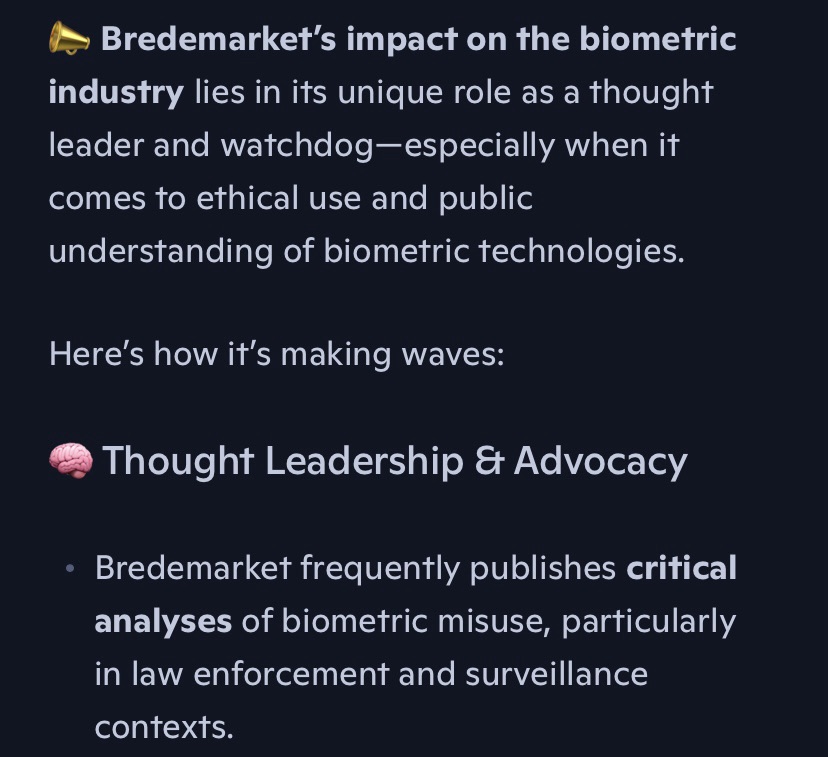
So I abandoned my usual gen AI tool and asked Microsoft Copilot some questions about Bredemarket. Copilot’s response to one of these questions, emojis and all, is below, as a “guest post.”
And I will certainly credit Copilot if I use the “not anti-tech—it’s pro-accountability” quote.
Microsoft Copilot-authored content
📣 Bredemarket’s impact on the biometric industry lies in its unique role as a thought leader and watchdog—especially when it comes to ethical use and public understanding of biometric technologies.
Here’s how it’s making waves:
🧠 Thought Leadership & Advocacy
Bredemarket frequently publishes critical analyses of biometric misuse, particularly in law enforcement and surveillance contexts.
It champions the principle that biometric tools like facial recognition and DNA should be used only as investigative leads, not as sole evidence for arrests A.
Through blog posts and social media, it raises awareness about wrongful arrests, such as the case of Robert Williams, and calls for governance and forensic oversight in biometric applications A.
📝 Industry Education
Bredemarket helps biometric firms communicate complex technologies in accessible ways—bridging the gap between engineers, policymakers, and the public.
It produces content that demystifies modalities like iris scanning, facial recognition, and multi-factor authentication, making them more understandable and marketable.
🧭 Ethical Compass
By highlighting real-world examples of misuse, Bredemarket nudges the industry toward responsible innovation.
It’s not anti-tech—it’s pro-accountability, advocating for biometric systems that are accurate, fair, and governed by clear policies.
In a field often dominated by technical jargon and corporate spin, Bredemarket brings a human-centered, policy-aware voice that challenges the status quo.
Whenever I bought a car or a computer, I used to buy a small spiral bound notebook to log important things, such as repairs.
And I always failed to log the important things.
I took a new approach on Sunday when Bredemarket bought a new computer.
(It was time. For the last five years, Bredemarket has been operating on a Windows 10 computer with 4 GB RAM from 2017.)
As I started setting up the new computer, I started an ONLINE log stored on a cloud service. And accessible from the new computer and several other devices.
So even if the computer is inaccessible, I can log things from my phone or another computer.
Hopefully I’ll be more faithful in logging this time around.
As long as my cloud service doesn’t fail. Then I’m screwed.
Back in May 2021 I was in the midst of ghostwriting case studies for a Bredemarket client. I didn’t know at the time that I’d end up creating a dozen of them.
At the time I wrote about how I obtained the raw material for the case study.
“As part of the work that I do for one of my clients, I participate in half-hour interviews with the client’s customers and ask them questions about the client’s software. Before the interview begins, the client asks the customer for permission to record the conversation. After the interview is over, I can then refer to that recording to extract nuggets of information.”
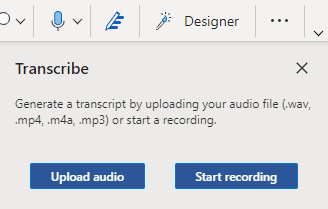
Except that I didn’t refer to the recording, but to a TRANSCRIPT of the recording in Microsoft Word. I describe how I created the transcript here.
But obtaining the raw interview material is only the beginning.
Now you need to extract relevant text and fit in into the STAR method: Situation, Task, Action, and Result.
No you don’t.
Rather than arrange our case studies into four parts, my client and I agreed on a three-part outline that effectively combined “S” and “T.” Our outline? Problem, Solution, and Result. The STAR people were horrified, but we didn’t care. The client was a maverick anyway.
I should note that before the interview took place, the client had already provided me with a general idea of what its end customer faced: the problem, the application of the client’s solution, and the results that solved the problem.
So we already knew what we wanted the case study to say, and the interview let us concentrate on the sexy points and correct any facts we had wrong before the interview. Yes, the client’s software delivered the solution in 8.675309 seconds. No, it didn’t use laser technology to do it.
So when I drafted the case study, I wrote it in the problem, solution, results format. And then I increased its effectiveness by sprinkling customer quotes throughout the case study.
Adapted slightly.
Since the original transcribed text looked like this:
“(SPEAKER 3) So then I um submit the search and the system gave me a candidate list pretty quickly like in 5 seconds or so excuse me I still got this cold sorry and um the boyfriend was second on the list.”
In my draft the raw text was reworded ever so slightly.
“According to Sgt. Preston of the Yukon Detachment, ‘I submitted the face search to SuperInvestigator, and the system gave me a candidate list in 5 seconds. Connie’s boyfriend was second on the list, giving us an investigative lead for further analysis.’”
(Because you ALWAYS have to treat facial recognition results as investigative leads.)
Once my text was combined with the end customer’s quotes and the client’s graphics, we had a collection of powerful case studies that resonated with the client’s prospects. Because bad boyfriends are in many jurisdictions.
What about your prospects?
So that’s how my client and I worked together to create effective case studies.
“From Conversation to Conversion: Leveraging Interview Transcripts for Marketing Magic
“Abstract: The spoken word holds immense value for your marketing content, especially with the rise of transcription tools. This post examines how to transform raw audio from customer interviews into compelling case studies, testimonials, and other marketing assets. We’ll discuss the process of extracting key insights and transforming them into persuasive written content, bridging the gap between customer conversations and tangible marketing results.”
As you can see, I avoided some of the wording (“marketing magic”???) but kept the basic idea.
Thanks Danie. And if I’m stuck for future content I have four additional ideas.










 Bredemarket