How 6 CFR 37 (REAL IDs) exhibits…federalism

The United States, like some other countries, reserves some responsibilities to lower subdivisions of the country, in this case the states. This concept is enshrined in the 10th Amendment to the Constitution:

The powers not delegated to the United States by the Constitution, nor prohibited by it to the States, are reserved to the States respectively, or to the people.

The 10th Amendment basically means that unless the Constitution explicitly speaks on a matter, the states can do whatever they want. However, the Federal government still has ways of making the states obey its will.

States are NOT mandated to issue REAL IDs

If you look at the Code of Federal Regulations, Title 6, Volume 1, Chapter I, Part 37 (one online source here), you will see the official laws that govern the issuance of REAL ID Driver’s Licenses and Identification Cards. Part 37 is divided into several subparts:

  • General.
  • Minimum Documentation, Verification, and Card Issuance Requirements.
  • Other Requirements.
  • Security at DMVs and Driver’s License and Identification Card Production Facilities.
  • Procedures for Determining State Compliance.
  • Driver’s Licenses and Identification Cards Issued Under section 202(d)(11) of the REAL ID Act.

A pretty comprehensive list here. But that very first section, “General,” begins with the following:

Subparts A through E of this part apply to States and U.S. territories that choose to issue driver’s licenses and identification cards that can be accepted by Federal agencies for official purposes.

Note the word “choose,” and the phrase “accepted by Federal agencies for official purposes.” In essence, it is incorrect to say that states are MANDATED by law to issue REAL IDs. States have the power to choose NOT to issue REAL IDs, and the Federal government has no Constitutional power to force them to do so.

So many states DIDN’T issue REAL IDs

And for many years, many states of various political persuasions adopted that view. Whether “red” or “blue,” many states held to the belief that REAL ID was an unconscionable imposition on state sovereignty, and that Bush or Obama or Trump didn’t have the power to tell states what to do with their state driver’s licenses.

I ran into this personally in my proposal work. There was a brief period of time in which MorphoTrak was bidding on driver’s license opportunities (thus competing with our sister company MorphoTrust), and I remember reviewing a Request for Proposal (RFP) issued by one of the states. I won’t reveal the state, but the opening section of its RFP made very clear that the state was NOT asking vendors to implement Federal REAL ID regulations, or asking vendors to help the state issue REAL IDs.

So some states declined to participate in REAL ID efforts for years…and years.

And the Federal government couldn’t dictate that states issue REAL IDs.

So the Federal government said that states don’t HAVE to issue REAL IDs, but…

But the Federal government COULD dictate which IDs could be “accepted by Federal agencies for official purposes.”

  • Accepted IDs included passports, Federal government-issued identification cards, various other national IDs…and REAL IDs issued by the states. Other IDs issued by the states were not acceptable.
  • Official purposes included visiting a military base (Federal control, not state control), visiting your Congressperson’s office (Federal control, not state control)…and the big one, entering the secure areas of an airport (again, Federal control, not state control).
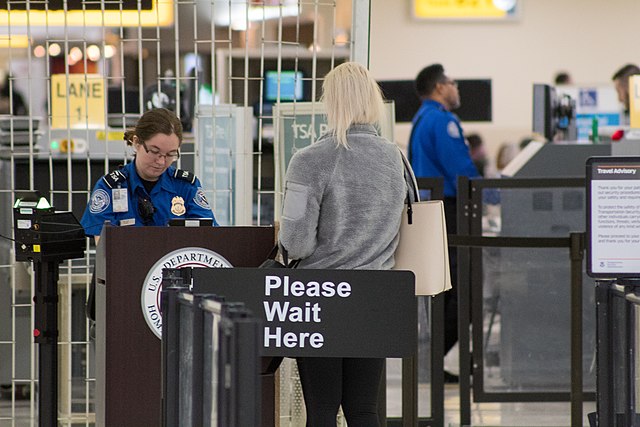
Transportation Security Administration Checkpoint at John Glenn Columbus International Airport. By Michael Ball – Own work, CC0, https://commons.wikimedia.org/w/index.php?curid=77279000

So it’s pretty simple. If you want to get on a plane, even for a domestic flight, you have to pay $100 or so to get a passport. Well, unless your state happens to be one of the states that issues REAL IDs.

(Now large states with multiple major cities such as California and Texas could conceivably try to get around this by setting up a whole system of intrastate airports that only flew within the state, but that would be costly.)

Even with this, the REAL ID implementation date has been delayed several times (most recently due to COVID), but as of today, all 50 states and most U.S. territories are finally issuing REAL IDs, including the unnamed state (and others) that refused to even consider issuing REAL IDs a decade ago.

And that, my friends, is how the Federal government gets what it wants.

Even Apple is moving to a service model. Biometric identity vendors are moving also.

Remember when you bought a big old hunk of hardware…and you owned it?

With cloud computing, significant portions of hardware were no longer owned by companies and people, but were instead provided as a service. And the companies moved from getting revenue from selling physical items to getting revenue from selling services.

From Apple Computer to Apple

Apple is one of those companies, as its formal name change from “Apple Computer” signifies.

Then “Apple Computer” circa 1978. From https://www.macrumors.com/2020/03/23/apple-computer-retail-sign/. Fair use.

Yet even as iTunes and “the” App Store become more prominent, Apple still made a mint out of selling new smartphone hardware to users as frequently as possible.

But Apple is making a change later in 2021, and Adrian Kingsley-Hughes noted the significance of that change.

The change?

So, it turns out that come the release of iOS 15 (and iPadOS 15) later this year, users will get a choice.

Quite an important choice.

iPhone users can choose to hit the update button and go down the iOS 15 route, or play it safe and stick with iOS 14.

Why is Apple supporting older hardware?

So Apple is no longer encouraging users to dump their old phones to keep up with new operating systems like the forthcoming iOS 15?

There’s a reason.

By sticking with iOS 14, iPhone users will continue to get security updates, which keeps their devices safe, and Apple gets to keep those users in the ecosystem.

They can continue to buy content and apps and pay for services such as iCloud.

Although Kingsley-Hughes doesn’t explicitly say it, there is a real danger when you force users to abandon your current product and choose another. (Trust me; I know this can happen.)

In Apple’s case, the danger is that the users could instead adopt a SAMSUNG product.

And these days, that not only means that you lose the sale of the hardware, but you also lose the sale of the services.

It’s important for Apple to support old hardware and retain the service revenue, because not only is its services business growing, but services are more profitable than hardware.

In the fiscal year 2019, Apple’s services business posted gross margins of 63.7%, approaching double the 32.2% gross margin of the company’s product sector. 

If current trends continue, Apple’s services (iCloud, Apple Music, AppleCare, Apple Card, Apple TV+, etc.) will continue to become relatively more important to the company.

The biometric identity industry is moving to a service model also

Incidentally, we’re seeing this in other industries, for example as the biometric identity industry also moves from an on-premise model to a software as a service (SaaS) model. One benefit of cloud-based hosting of biometric identity services is that both software and the underlying hardware can be easily upgraded without having to go to a site, deploying a brand new set of hardware, transferring the data from one set of hardware to the other, and hauling away the old hardware. Instead, all of those activities take place at Amazon, Microsoft, or other data centers with little or no on-premise fuss.

(And, as an added benefit, it’s easier for biometric vendors to keep their current customers because obsolescence becomes less of an issue.)

Is your biometric identity company ready to sell SaaS solutions?

But perhaps your company is just beginning to navigate from on-premise to SaaS. I’ve been through that myself, and can contract with you to provide advice and content. I can wear my biometric content marketing expert hat, or my biometric proposal writing expert hat as needed.

The “T” stands for technology. Or something. By Elred at English Wikipedia – Transferred from en.wikipedia to Commons by Moe_Epsilon., Public Domain, https://commons.wikimedia.org/w/index.php?curid=3812206

Obviously this involves more than just saying “we’re cloud-ready.” Customers don’t care if you’re cloud-ready. Customers only care about the benefits that being cloud-ready provides. And I can help communicate those benefits.

If I can help you communicate the benefits of a cloud-ready biometric identity system, contact me (email, phone message, online form, appointment for a content needs assessment, even snail mail).

(Bredemarket Premium) The drawbacks of a FOCI-mitigated subsidiary

Those portions of the U.S. government that deal with critical infrastructure are naturally concerned about foreign encroachment into U.S. Government operations, even from “friendly” nations. Therefore, the U.S. Government takes steps to mitigate the effects of “Foreign Ownership, Control or Influence” (FOCI).

I’ve worked for two companies that needed to undertake FOCI mitigation, and I know of others that have also done this. And while FOCI mitigation offers benefits to the United States, there are also drawbacks of which everyone involved should be aware.

Subscribe to get access

Subscribe to Bredemarket Premium to access this premium content.

  • Subscriptions just $5 per month.
  • Access Bredemarket’s expertise without spending hundreds or thousands of dollars.

The Pandora’s Box of the “passwords are dead” movement

I’ve previously commented on the “passwords are dead” movement, and why I don’t agree that passwords are dead. But I recently realized that the “logic” behind the “passwords are dead” movement could endanger ALL forms of multi-factor authentication.

If I may summarize the argument, the “passwords are dead” movement is based upon the realization that passwords are an imperfect authentication method. People use obvious passwords, people re-use passwords, individuals don’t guard their passwords, and even companies don’t guard the passwords that they store. Because of these flaws, many passwords have been compromised over the years.

From this indisputable fact, the “passwords are dead” advocates have concluded that the best thing to do is to refrain from using passwords entirely, and to use some other authentication method instead (choosing from the five authentication factors).

In my spiral of people connections, the most frequently suggested replacement for passwords is biometrics. As a biometric content marketing expert and a biometric proposal writing expert, I’m certainly familiar with the arguments about the wonderfulness of biometric authentication.

But wait a minute. Isn’t it possible to spoof biometrics? And when a biometric is compromised, you can’t change your finger or your face like you can with a compromised password. And the Internet tells me that biometrics is racist anyway.

So I guess “biometrics are dead” too, using the “passwords are dead” rationale.

And we obviously can’t use secure documents or other “something you have” modalities either, because “something you have” is “something that can be stolen.” And you can’t vet the secure document with biometrics because we already know that biometrics are spoofable and racist and all that.

So I guess “secure documents are dead” too.

Somewhere you are? Yeah, right. There are entire legitimate industries based upon allowing someone to represent that they are in one place when in fact they are in another place.

So I guess “geolocation is dead” too.

You see where this leads.

NO authentication method is perfect.

But just because an authentication method has imperfections doesn’t mean that it should be banned entirely. If you open the Pandora’s Box of declaring imperfect authentication methods “dead,” there will be NO authentication methods left.

Epimetheus opening Pandora’s Box. By Giulio Bonasone – This file was donated to Wikimedia Commons as part of a project by the Metropolitan Museum of Art. See the Image and Data Resources Open Access Policy, CC0, https://commons.wikimedia.org/w/index.php?curid=60859836

And before talking about multi-factor authentication, remember that it isn’t perfect either. With enough effort, a criminal could spoof multiple factors to make it look like someone with a spoofed face and a spoofed driver’s license is physically present at a spoofed location. Of course it takes more effort to spoof multiple factors of authentication…

…which is exactly the point. As security professionals already know, something that is harder to hack is less likely to be hacked.

“I don’t want to say multi-factor is terrible. All things considered, it is generally better than single-factor and we should strive to use it wherever it makes sense and is possible. However, if someone tells you something is unhackable, they’re either lying to you or dumb.”

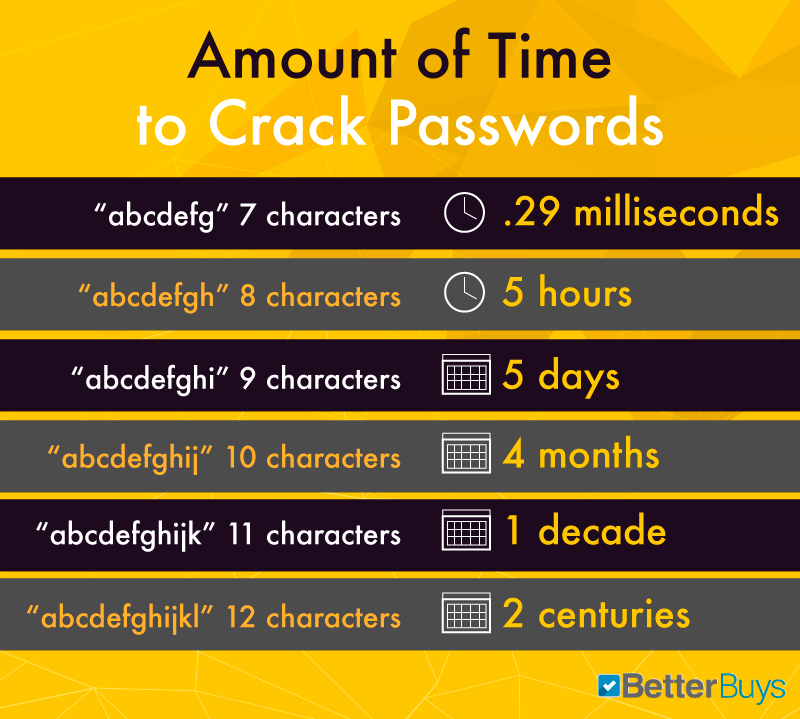
And heck, be wild and throw a strong password in as ONE of the factors. Even weak passwords of sufficient length can take a long time to crack, provided they haven’t been compromised elsewhere.

Feel free to share the images and interactive found on this page freely. When doing so, please attribute the authors by providing a link back to this page and Better Buys, so your readers can learn more about this project and the related research.

Luckily, my experience extends beyond biometrics to other authentication methods, most notably secure documents and digital identity. And I’m familiar with multi-factor authentication methods that employ…well, multiple factors of authentication in various ways. Including semi-random presentation of authentication factors; if you don’t know which authentication factors will be requested, it’s that much harder to hack the authentication process.

Do you want to know more? Do you need help in communicating the benefits of YOUR authentication mechanism? Contact me.

Shorter and sweeter? The benefits of benefits for identity firms

Repurposing is fun.

Remember the four posts that I wrote earlier this week about communicating benefits to identity customers? Well, I just summarized all four of the posts on a single page on the Bredemarket website, The benefits of benefits for identity firms.

(And now I’m repurposing that page into a single, short blog post. It’s a succinct way to establish my bona fides as an identity content marketing expert.)

The page concludes with a question:

Why is Bredemarket the best choice to help your identity firm communicate its benefits?

  • No identity learning curve.
  • I’ve probably communicated in the format you need.
  • I work with you.
  • I can package my offering to meet your needs.

For the complete page, click here. And if you are an identity firm that needs my services, contact me.

Communicating benefits (not features) to identity customers (Part 4 of 3)

[Link to part 1] | [Link to part 2] | [Link to part 3]

I knew I’d think of something else after I thought this whole post series was complete. But this post will be brief.

Benefit statements are not only affected by the target customers, but are also affected by the “personality” of the company stating the benefits.

As we all know, different companies use different tones of voice in their communications. A benefit statement from Procter & Gamble will read differently than a benefit statement from Apple, for example.

With that in mind, let’s turn to the example that I used in the third post in this series-namely, that the benefit of a one-second response time for computer aided dispatch (CAD) systems is that it keeps people from dying.

Death personified in Punch. By Punch Magazine – Original: Cartoon from Punch Magazine, Volume 35 Page 137; 10 July 1858 This copy: City and Water Blog, Public Domain, https://commons.wikimedia.org/w/index.php?curid=4465060

Not all companies are going to be that blunt about this particular benefit.

To my knowledge, SCC, Printrak, or Motorola have never explicitly talked about avoiding death as a benefit or their computer aided dispatch systems. Perhaps there IS a CAD company that does this, though.

This is why the development of benefit statements is often a collaborative affair, in part to ensure that the benefit statements align with the character of the company issuing them. Imagine the reaction if P&G promoted one of its soap products with a high-tech advertisement loudly proclaiming “PURPLE!” like the recent Apple ad.

Procter & Gamble ads are usually a bit more restrained.

Well, at least they used to be.

To be frank, Procter & Gamble is better at explicitly stating benefits than Apple is. Saving $100 a year on your energy bill is a benefit; purple is not. But Apple is communicating an implicit “Apple owners are cooler than mere mortals” benefit. Cold vs. cool, I guess, as well as an entirely different definition of “identity” that doesn’t rely on individualization. (If thousands of people have purple iPhones, this fact cannot be used to individually identify them.)

So you not only have to know your customer, but you need to know yourself so that you can describe benefits that are important to your customer in a voice that is accurate to your company’s “personality.”

This is why Bredemarket uses an iterative process in developing communications for its clients. If you’re an identity product/service provider that needs help in communicating customer benefits in proposals, case studies, white papers, blog posts, and similar written output, Bredemarket can implement such an iterative process to help you develop that output. Contact me.

Communicating benefits (not features) to identity customers (Part 3 of 3)

[Link to part 1] | [Link to part 2] | [Link to part 4]

(Updated 4/16/2022 with additional benefits information.)

NOTE: After publishing the second post in this series, but before publishing this third post, I ran across other people in the identity industry who were asking the “So what?” question, but from a strategic perspective rather than a sales enablement perspective. I discuss this in my personal JEBredCal blog, in this post.

This is a continuation of two previous posts. In the first and second posts in this series, I initially explained the difference between benefits and features, and why you sometimes have to act like an irritating two-year old to convert a feature into a benefit (the “so what?” test). I also explained how benefit statements need to be tailored to particular stakeholders, and how there can be many stakeholders even for a simple procurement.

I promised in the second post that I planned to dive into issues more specific to identity customers, such as when a two hour response time matters, when a one minute response time matters, and when a one second response time matters. Unfortunately, I spent so much time talking about all the stakeholders that I never got around to that particular question.

I promise that I’ll get into it right now.

Two hours vs. one minute vs. one second

You may remember that in the first post, I listed several things that some people thought were benefits, but were actually features. The final three items in that list were the following:

  • This product can complete its processing in less than two hours.
  • This product can complete its processing in less than a minute.
  • This product can complete its processing in less than a second.

These feature statements are very similar, yet at the same time very different. As you might have guessed, these feature statements are associated with three different products that are targeted to different markets.

Two hours: rapid DNA

I already alluded to the first of the three feature statements, two hour response time, in an earlier post in this series. Although I didn’t say so that the time, this is an important feature for the “rapid DNA” systems sold by Thermo Fisher Scientific and ANDE. These systems are used for multiple purposes, including

  • examining crime scene DNA evidence,
  • identifying deceased disaster victims, and
  • checking to see if arrested individuals are wanted for more serious crimes.

The two hour rapid DNA processing time offers different benefits for these different use cases.

  • As I previously stated in my first example of a “so what?” test, the ability to run rapid DNA at booking keeps dangerous criminals from being released by identifying those who are wanted for serious crimes.
  • A two hour processing time for crime scene evidence solves crimes more quickly, and again potentially puts dangerous criminals in jail more quickly.
  • A two hour response for disaster victim identification brings peace of mind to family members whose relatives may have perished in a disaster.

(4/16/2022: For additional information on benefits, click here.)

Depending upon the target audience, a rapid DNA vendor must tailor its benefit statements accordingly.

One minute: real time AFIS

Next, I want to look at the one minute response time, which is something that I used to talk about over twenty-five years ago when “real time AFIS” became a reality.

Because of the limitations of early computers, it used to take hours or days to compare the features from a latent fingerprint against the features of fingerprints in a database of known criminals. The old computers, even when souped up with special processing equipment such as hardware matchers and hardware fingerprint processors, took a long time to perform all of the calculations needed to compare a fingerprint’s features against hundreds of thousands of other fingerprint features.

Around the time that I joined Printrak, real time AFIS became a reality, where it became cost-effective and technologically feasible to size systems to deliver those fingerprint matching results in a minute. Today, the FBI’s Repository for Individuals of Special Concern (RISC) advertises that it can identify high-priority criminals within seconds.

At the time (1994), real time AFIS was a big deal, and the proposals that I helped to write emphasized that crimes could be solved more quickly (for latent/crime scene fingerprint searches), and individuals could be identified more quickly (for tenprint/booking searches).

One second: computer aided dispatch

To explain the third feature statement about one second response times, I have to fast forward three years to 1997, when the company then known as Printrak acquired the computer aided dispatch (CAD) and records management systems (RMS) unit of SCC Communications Corp. Printrak acquired other companies that year, but the SCC acquisition ended up being the most important, since it led to Printrak’s acquisition by Motorola.

(Allow me to go off on a tangent for a minute. When Motorola sold the biometric part of the business to Safran, it chose to retain the CAD and RMS portions, which remain part of Motorola Solutions’ portfolio today. One other tidbit: one of the key SCC people who joined Printrak at the time eventually left Motorola, and now works for rapid DNA vendor ANDE. As we Californians would say, it’s a small world after all.)

Now while there are some parallels between CAD and the systems then known as automated FINGERPRINT identification systems (AFIS), there are some key differences in the markets that the two products address. We on the AFIS side learned this the hard way when we introduced ourselves to our new colleagues.

“Hi, SCC folks, welcome to Printrak. You’re joining a company that sells REAL TIME AFIS that delivers results within one minute! Aren’t you impressed?”

A screenshot of computer-aided dispatch as being used by Toronto Fire Services. By Hillelfrei – Own work, CC BY-SA 4.0, https://commons.wikimedia.org/w/index.php?curid=88913432

The ex-SCC people responded, gently disabusing us of our pretensions to speed.

“Hello, new corporate overlords. We provide computer aided dispatch systems that send police, fire, and medical personnel to crime scenes and emergency sites as soon as possible. If our CAD systems took AN ENTIRE MINUTE to dispatch personnel, PEOPLE WOULD DIE. We use really powerful computers to get personnel dispatched in a second. Enjoy your real time AFIS…amateurs.”

So the company Printrak learned that it needed separate benefit statements, depending upon the product line the company was promoting at any given time. The CAD customers received one set of benefit statements, while the AFIS customers received a separate set.

Conclusion (finally)

In short, you have to know your customer so that you can describe benefits that are important to your customer.

And if you’re an identity product/service provider that needs help in communicating customer benefits in proposals, case studies, white papers, blog posts, and similar written output, Bredemarket can help. Contact me.

Communicating benefits (not features) to identity customers (Part 2 of 3)

[Link to part 1] | [Link to part 3] | [Link to part 4]

(Updated 4/16/2022 with additional information on benefits.)

This is a continuation of a previous post, in which I explained the difference between benefits and features, and why you sometimes have to act like an irritating two-year old to convert a feature into a benefit (the “so what?” test).

As I promised in that previous post, I plan to dive into issues more specific to identity customers, such as when a two hour response time matters, when a one minute response time matters, and when a one second response time matters.

Who are identity customers?

Before I dive into response times, let’s explain who identity customers are, because not all identity customers are alike.

When I use the term “identity” at Bredemarket, I am referring to any technology that can be used to identify an individual. This does not just relate to biometrics (fingerprint identification, facial recognition, etc.), but to any of the five factors of authentication that can identify an individual. A physical or digital driver’s license. A fob. A secret handshake. A geographic location. Even a password.

Obviously there are a ton of customers that use identification technologies, and they care about a ton of things.

Well, what if we focus our discussion and talk about a SINGLE product, such as automated biometric identification systems (ABIS)? We can market to all ABIS customers with a single set of benefit statements, right?

Um, no.

ABIS can be sold to all sorts of different customers, ranging from local police agencies to state welfare benefit administrators to national passport issuing agencies.

Well, what if we focus our discussion and talk about a SINGLE type of customer for a single product, such as the local law enforcement agencies that buy ABIS? We can market to all local law enforcement ABIS customers with a single set of benefit statements, right?

Um, no.

If I am going to sell an ABIS to the city of Ontario, California (sorry Thales), these are the types of customers (or target audiences) that I have to cover with separate benefit statements:

By FBI – http://www.fbi.gov/news/photos, Public Domain, https://commons.wikimedia.org/w/index.php?curid=18500900
  • The field investigators who run across biometric evidence at the scene of a crime, such as a knife with a fingerprint on it or a video feed showing someone breaking into a liquor store.
  • The examiners who look at crime scene evidence and use it to identify individuals.
  • The people who capture biometrics from arrested individuals at livescan stations.
  • The information technologies (IT) people who are responsible for ensuring that Ontario, California’s biometric data is sent to San Bernardino County, the state of California, perhaps other systems such as the Western Identification Network, and the Federal Bureau of Investigation.
  • The purchasing agent who has to make sure that all of Ontario’s purchases comply with purchasing laws and regulations.
  • The privacy advocate who needs to ensure that the biometric data complies with state and national privacy laws.
  • The mayor (Paul Leon as I write this), who has to deal with angry citizens asking why their catalytic converters are being stolen from their vehicles, and demanding to know what the mayor is doing about it.
  • Probably a dozen other stakeholders that I haven’t talked about yet, but who are influenced by the city’s purchasing decision.

As you can see, there are a ton of people who are going to read a proposal to provide an ABIS to a city, and they all have differing needs that need to be addressed…and different benefits that have to be emphasized.

Benefits of a feature are customer-dependent

Now let’s take one of my feature statements from my first post and try to convert it to a benefit for one or more of these stakeholders. I’m going to choose this one:

  • This product captures latent fingerprints at 1000 pixels per inch.

Right off the bat, I’ll tell you that 1000 ppi latent fingerprint capture doesn’t make a bit of difference to the majority of the stakeholders. Paul Leon isn’t going to care. The purchasing agent SHOULD care (1000 ppi data requires more storage than 500 ppi data, which translates to more cost), but probably isn’t going to know that he/she should care.

With the possible exception of the IT personnel, the only people that care about 1000 ppi capture are the examiners who use crime scene evidence and use it to identify individuals. And needless to say, the examiners that concentrate on face or iris or voice or DNA data aren’t going to care about a fingerprint capture specification.

So if I’m writing a proposal to the city of Ontario, California, I’m going to make sure that the latent fingerprint capture section of the proposal discusses my product’s ability to capture latent fingerprints at 1000 ppi.

Wait for it…

SO WHAT?

Absent the benefit of standards compliance that ensures that Ontario data can be processed by state and national systems, the chief benefit of 1000 ppi latent fingerprint capture is that it provides a higher probability that examiners can positively identify criminals and solve more crimes.

An explanation: because latent fingerprints are often of poor quality – the criminals don’t usually take the time to ensure that the fingerprint evidence they leave at crime scenes is readable – latent examiners often benefit from having higher-resolution 1000 ppi latent fingerprint images, rather than the lower-resolution 500 ppi latent fingerprint images that were common in 20th century fingerprint systems. This higher resolution can make it easier for a latent fingerprint examiner to match a latent to a criminal’s tenprint fingerprint from a previous arrest, leading to the “solve more crimes” benefit.

So you’re going to come up with separate benefit statements for examiners, separate ones for livescan operators, and separate benefit statements for each of the stakeholders. And each of these benefits will be enumerated in the section of the proposal that the individual stakeholder will read. (News flash: hardly anyone reads the entire proposal; they only read the section that pertains to them.)

(4/16/2022: For additional information on benefits, click here.)

What’s next?

Well, I never got around to my two hour vs. one minute vs. one second question, and this post is getting long, so I guess I’ll address that topic in a third post.

In the meantime, if you’re an identity product/service provider that needs help in communicating customer benefits in proposals, case studies, white papers, blog posts, and similar written output, Bredemarket can help. Contact me.

Communicating benefits (not features) to identity customers (Part 1 of 3)

[Link to part 2] | [Link to part 3] | [Link to part 4]

(Updated 4/16/2022 and 4/18/2022 with additional benefits and customer focus information.)

I wanted to take some time to specifically explain how to communicate benefits to identity customers. And I’ll take a lot of time, addressing the topic in three planned posts.

What are benefits?

When you write a proposal, case study, or other document that is targeted to identity customers, you need to communicate the benefits to the target audience.

But what are benefits?

It turns out that many people don’t know what benefits are.

Over the years I’ve had occasion to ask people to suggest some benefits to include in a document. Sometimes I’ve received responses that are similar to these:

  • This product is dual-purpose and supports both detection of speeders and detection of red light runners.
  • This product captures latent fingerprints at 1000 pixels per inch.
  • This product was a top tier performer in the recent NIST tests.
  • This product can complete its processing in less than two hours.
  • This product can complete its processing in less than a minute.
  • This product can complete its processing in less than a second.

These are all nice statements, but these aren’t BENEFIT statements.

These are statements of FEATURES.

The last three examples illustrate the issue. In certain markets, a two hour response time is very impressive In other markets, a one minute response time will result in getting somebody killed. (I’ll address the differences later.)

In my recent post about case studies, I linked to a Hubspot article that explained the difference between benefits and features. I didn’t dive into that article at the time, but I’ll do so now. Here is how Kayla Carmichael’s article explains the difference between the two.

Features describe what the product does, setting it apart from the competition. Benefits describe how the product can help the audience. For marketing messages, it’s typically better to go with a benefits-heavy approach, because benefits are what makes consumers purchase.

The “so what?” test

As you can see, benefits are customer-centric. In another Hubsport article, Aja Frost notes that one way to tell whether you’re dealing with a benefit or a feature is to ask the question “So what?”

(4/18/2022: For additional information on customer focus, click here.)

Let’s return to my first example above, “This product is dual-purpose and supports both detection of speeders and detection of red light runners.” Even if you’re a road safety customer, you may not care whether a particular device is dual-purpose or not.

Maybe you don’t care about both issues at a particular location on the road. If the road safety camera is placed on an interstate highway, red lights are obviously not an issue.

Maybe you don’t care about one of the issues at all. Perhaps local laws don’t allow for unmonitored devices that detect speeders.

Perhaps your agency doesn’t care if you have to put two devices—one for speed detection, one for red light detection—at the same location.

So if you encounter a statement that isn’t a benefit, you have to act like an irritating two-year old and ask “so what?” until you actually get a benefit statement.

By Mindaugas Danys from Vilnius, Lithuania, Lithuania – scream and shout, CC BY 2.0, https://commons.wikimedia.org/w/index.php?curid=44907034

This product can complete its processing in less than two hours.

SO WHAT?

“This product can complete its processing while the arrestee is still in custody, before the suspect is released.”

SO WHAT?

“This product can detect whether the arrestee is wanted for more serious charges while the arrestee is still in custody.”

SO WHAT?

“This product can identify arrestees who have outstanding warrants for murder before they are released to murder more people.”

That’s better.

(4/16/2022: For additional information on benefits, click here.)

What’s next?

Anyway, that’s the general concept of benefits vs. features. In a future post, I’ll dive into issues more specific to identity customers, such as when a two hour response time matters, when a one minute response time matters, and when a one second response time matters.

These differences make all the…um difference to identity customers.

Stay tuned.

In the meantime, if you’re an identity product/service provider that needs help in communicating customer benefits in proposals, case studies, white papers, blog posts, and similar written output, Bredemarket can help. Contact me.

The REAL ID deadline has been extended…again

Three days ago, I read a news item on LinkedIn that stated that the REAL ID deadline might be extended.

I reacted.

My response is a one-word response: “AGAIN?”

I admit to a bit of frustration. For years, some states resisted REAL ID because of federalism concerns. (When MorphoTrak was briefly trying to win driver’s license contracts by competing against our sibling MorphoTrust, I remember one state RFP that explicitly stated that the state would NOT comply with the REAL ID mandate.)

Finally, after hemming and hawing, all of the states agreed to become REAL ID compliant (15 years after the original mandate). Then, as people rushed to get REAL IDs, #covid19 hit and the driver’s license offices closed.

The offices are now open, but some people STILL haven’t gotten REAL ID.

Prediction: if the deadline is extended to 2022, significant numbers of people won’t have REAL IDs by 2022.

Well, I will never get the chance to see if my prediction was accurate, because in the end, the REAL ID deadline was NOT extended to 2022.

It was extended to 2023, according to sources. (As I write this, the DHS website has not yet been updated.)

The Department of Homeland Security will delay the requirement for air travelers to have a Real ID-compliant form of identification, pushing it back 19 months, DHS Secretary Alejandro Mayorkas said Tuesday.

The deadline was supposed to be Oct. 1, but it’s now being postponed until May 3, 2023. 

Here’s the rationale that Secretary Mayorkas provided.

“Extending the Real ID full enforcement deadline will give states needed time to reopen their driver’s licensing operations and ensure their residents can obtain a Real ID-compliant license or identification card.”

Of course, since may people object to REAL ID on principle, it could be extended again and again for ANOTHER fifteen-plus years and people STILL won’t get it.