Meta Verified is Worthless

I thought X’s blue checks were bad enough, but Meta has topped (or bottomed) Elon in the realm of meaningless identity verification.

The janeaustenpen Instagram account is Meta verified.

From janeaustenpen on Instagram: Meta Verified!

Even though Jane Austen is dead.

Come to think of it, Austen never had a driver’s license. How did she get verified?

But Meta’s AI creation isn’t dead.

And you can’t block “her.”

And probably can’t report “her” for impersonation.

I really dread what LinkedIn is planning. Will Henry Ford dispense advice? Steve Jobs?

Lack of Differentiation Limits Your Available Talent

I’ve talked about differentiation ad nauseam, and even created a video about it last spring.

And I’ve provided some examples of lack of differentiation from my own industry:

  • (Company I) “Reimagine trust.”
  • (Company J) “To protect against fraud and financial crime, businesses online need to know and trust that their customers are who they claim to be — and that these customers continue to be trustworthy.”
  • (Company M) “Trust is the core of any successful business relationship. As the digital revolution continues to push businesses and financial industries towards digital-first services, gaining digital trust with consumers will be of utmost importance for survival.”
  • (Company O) “Create trust at onboarding and beyond with a complete, AI-powered digital identity solution built to help you know your customers online.”
  • (Company P) “Trust that users are who they say they are, and gain their trust by humanizing the identity experience.”
  • (Company V) “Stop fraud. Build trust. Identity verification made simple.”

This isn’t effective. Trust me.

But prospective customers aren’t the only ones who are turned off by “me-too” messaging.

Further ramifications of lack of differentiation

What about prospective employees who don’t want to apply to your company because they see no compelling reason to do so?

I’ll grant that the tech job market is so out of balance right now that people are applying to ANYTHING.

But the more choosy ones are…more choosy in their applications. Just like choosy mothers choose…you know.

I recently received this message from a product marketer after I shared a particular identity/biometric job description with them.

Not so sure that company is well positioned for evolving identity landscape.

From a selfish perspective, this benefits me, because I DID apply for this position while they DIDN’T. Reducing the competition increases my chances of getting the job.

But the company (which I’m not naming) doesn’t benefit, because at least one experienced identity verification product marketer doesn’t want to work for them.

So be sure to differentiate…as long as the differentiation resonates with your hungry people (target audience). If your audience is repelled by your differentiation, then that’s a problem with your customer focus.

From the Gary Fly / Brooks Group article “7 Tips for Implementing a Customer-Centric Strategy,” at https://brooksgroup.com/sales-training-blog/7-tips-implementing-customer-centric-strategy/.

Now Bredemarket can’t help you with your job search, because I’m certainly not an expert in that. But I can ask you questions that help you create content that conveys that your product is great and your competitors’ products…are not so good.

Visit Bredemarket’s “CPA” page to learn how I can help your firm’s content (and analysis, and proposals), and to schedule a meeting.

Bredemarket’s “CPA.”

Identity/biometric CMOs, Are You Content With Silence?

(Part of the biometric product marketing expert series)

(Silence image Google Gemini)

If you’re a Chief Marketing Officer at an identity/biometric company, you are well aware that a challenging 2025 is just around the corner. How do you claim awareness for your products and services when your competitors are posting content?

I know how many firms approach this: silence, or saying nothing. It sounds like the wrong thing to do…and it is!

Bredemarket helps its clients say something, if they choose to speak. Some of Bredemarket’s prospects have opted to wait months before letting Bredemarket create content for them—blog posts, articles, case studies, white papers, proposals, analyses.

Some prospects never become clients, so I never create content for them. A few are no longer in business today. Correlation doesn’t equal causation, but maybe Bredemarket could have helped keep the doors open.

For these reasons, I think that saying something is better than silence.

But not just anything. Before Bredemarket writes a single word for its clients, I obtain the answers to seven questions about your content:

Then I work with you in an iterative fashion to create the content you need.

So don’t maintain silence. Schedule a free meeting with me to move forward now.

Know Your…Everyone

It all started with “Know Your Customer,” a shorthand phrase used by financial institutions and related entities who need to know who their customers are.

But then various governments, industries, and entities got into the act with their own variants, such as “Know Your Business.”

I was curious about how many of these “know your” variants I’ve discussed in the Bredemarket blog. Here’s what I found:

I’m sure I’ll come up with some others.

Title vs. Physical Possession of a Vehicle

(2002 Ford Excursion image public domain)

I’ve talked about non-person entities (NPEs) before, but usually about a computer, or a file (such as a top secret file).

What about sport utility vehicles (SUVs)? 

Or houses?

But I’m going to concentrate on sport utility vehicles here.

Because of their expense, certain NPEs such as vehicles and real estate are associated with title, or proof of ownership. 

Just because I have physical possession of a car or house doesn’t mean that I’m the lawful owner. Maybe I am house sitting. Or renting a car. Or I am a squatter or thief. When it comes to legal (and financial) title, possession is NOT 9/10ths of the law. Otherwise, Hilton and Hertz would be out of business.

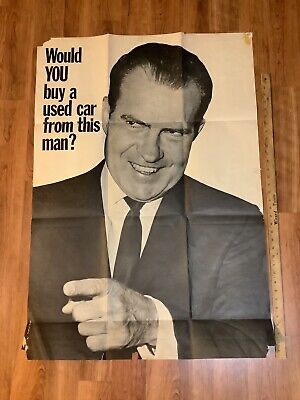
Old anti-Richard Nixon ad.

But what happens when the physical NPE and the title diverge? Two victims of now-convicted car salesman Ronald Johnson found out the hard way, according to KTTN:

“In 2022, Johnson orchestrated a scheme that led to a Pennsylvania buyer paying $41,750 for a 2002 Ford Excursion that he had already sold to a South Dakota buyer for $45,000. The South Dakota buyer received the title, while the Pennsylvania buyer was given the SUV, leaving the latter unable to register the vehicle lawfully.”

But how do you verify that the title is real? For vehicles:

“The title should have a watermark, a raised seal, a unique vehicle identification number, a unique title number, and the owner’s information.”

And as for the owner, my regular readers know how to verify THAT.

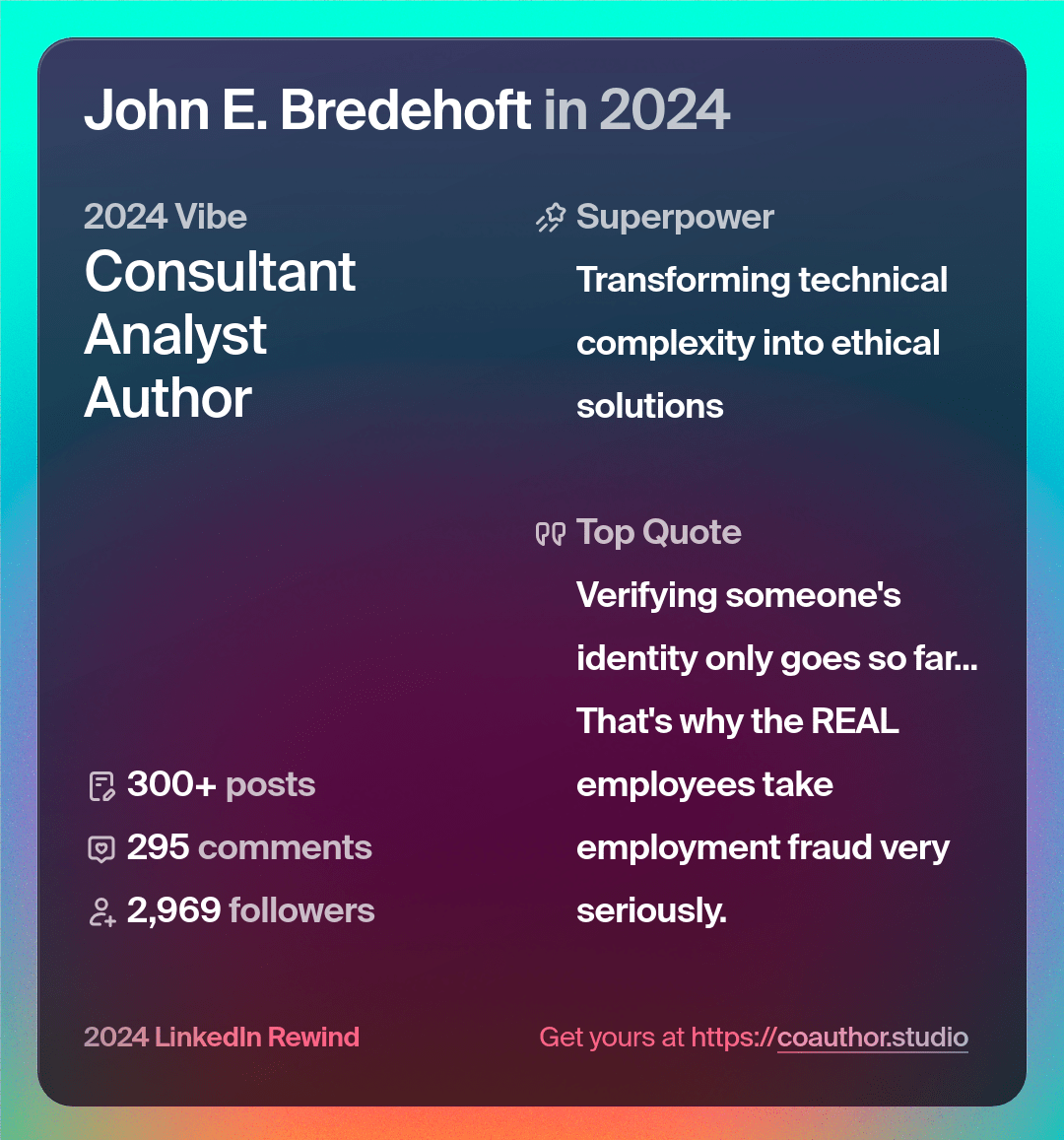
What Coauthor “Wrapped” About My LinkedIn Activity

So I checked out Coauthor’s me-too LinkedIn-themed copycat of Spotify Wrapped, like many of you did. Here’s the (unedited) post it wrote for me—not too bad:

= = =

Here’s my 2024 LinkedIn Rewind, by Coauthor.studio:

After 30 years in identity and biometrics, 2024 showed me that verification only goes so far. The real challenge isn’t just confirming who someone is – it’s understanding what they might do.

From employment fraudsters with verified credentials to healthcare imposters with stolen birthdates, this year proved that identity verification alone can’t prevent deception. But it also showed how combining technical expertise with human insight can help protect organizations and individuals.

Key observations from 2024:

  • Identity verification without intent analysis is incomplete
  • Employment fraud evolves faster than verification methods
  • Healthcare identity remains dangerously vulnerable
  • The best fraud prevention combines technology and psychology
  • Product marketing must address both verification and trust

Three posts that captured these themes:

“Employment Fraud and Identity Verification”

On why verifying someone’s identity only goes so far

https://www.linkedin.com/feed/update/urn:li:activity:7268454996734545921/

“Rich Powaza’s Disappearance” 

Real consequences of fraudulent behavior

https://www.linkedin.com/feed/update/urn:li:activity:7253092940393193472/

“Get Off My Lawn”

Changing workplace norms and responsibilities

https://www.linkedin.com/feed/update/urn:li:activity:7262320817898758145/

Through Bredemarket, I delivered over 100 content and analysis projects helping organizations navigate these challenges. I also conducted research on employment fraud tactics and moderated communities helping others avoid scams.

Looking ahead: 2025 will require even more sophisticated approaches to identity verification and fraud prevention. The fraudsters aren’t going away – but neither am I. I’ll continue helping organizations implement effective identity strategies while advocating for ethical AI use and employment practices.

To the wildebeests following along: remember that verification is just the start. The real value comes from understanding intent and building trust.

#fraud #identity #security #productmarketing

Get your 2024 LinkedIn Rewind! Go to coauthor.studio 

Oh BOI

Beneficial Ownership Information alert. From Proskauer:

“On December 23, 2024, the Fifth Circuit of the United States Court of Appeals (the “Fifth Circuit”) issued an order that has the effect of reinstituting the deadlines under the Corporate Transparency Act (the (“CTA”)….

“The CTA requires a range of entities, primarily smaller, otherwise unregulated companies, to file a report with the U.S. Department of the Treasury’s Financial Crimes Enforcement Network (“FinCEN”) identifying the entities’ beneficial owners—the persons who ultimately own or control the company—and provide similar identifying information about the persons who formed the entity.

“FinCEN has recognized that the timing of the order lifting the injunction may be particularly burdensome and has extended the reporting deadlines.  Accordingly, reporting companies created prior to January 1, 2024, that are not eligible for an exemption, are required to file beneficial ownership reports by January 13, 2025 (and not January 1, 2025).”

Know Your Teacher

Another KYx acronym from the educational identity realm: Know Your Teacher. A South Carolina school district didn’t:

“On Thursday, the Laurens County School District 55 Superintendent Jody Penland announced a teacher at Waterloo Elementary will “no longer serve” as a teacher at the school.”

Why? Because she wasn’t who she said she was.

“School officials discovered Bryia Lattimore Scott of Simpsonville was impersonating Viola Church in order to gain employment at Waterloo Elementary.”

Scott was arrested, and bond was set at $5,000.