What’s in a rename? (Or, what is an oosto?)

The naming, or renaming, of a company is an important step in a company’s journey. While one should rightly concentrate on mission statements and processes and the like, the first impression many people will have of a company is its name.

So it’s important to get it right.

How my company was named

Sometimes the naming of a company is a relatively simple affair. For example, the company name “Bredemarket” is a combination of the beginning of my last name, Bredehoft, with the word market (derived from marketing).

Certainly the name is open to confusion (not that I was planning on doing business in East Sussex), but the name does communicate what the company is about.

I guess I could have called the company Bredewrite, but Bredemarket has grown on me.

Sometimes the naming of a company gets a little more involved.

How my former employer was renamed

When Oberthur was merged with the Morpho portion of Safran, the combined company needed a name (Oberthur was ruled out). So the company adopted the name “OT-Morpho,” indicating the heritage of the two parts of the company.

However, OT-Morpho was never intended to be the permanent name of the company. Everyone knew that the company would be renamed at some point in the future.

A few months later, as part of a razzle dazzle event, the new name of the company was revealed to an in-person audience in France and to people watching remotely all over the world (including myself).

If you don’t want to watch the entire video, the new name was…IDEMIA.

Some thought went into this name, as the accompanying press release noted.

In a world directly impacted by the exponential growth of connected objects, the increasing globalisation of exchanges, the digitalisation of the economy and the consumerisation of technology, IDEMIA stands as the new leader in trusted identities placing “Augmented Identity” at the heart of its actions. As an expression of this innovative strategy, the group has been renamed IDEMIA in reference to powerful terms: Identity, Idea and the Latin word idem, reflecting its mission to guarantee everyone a safer world thanks to its expertise in trusted identities.

However, some people didn’t like the new name at the time, and there was a big ruckus about how to pronounce the name. But at least some thought went into the name, and potential customers at least made the connection between IDEMIA and identity, if not to the other influences.

IDEM means – The same, me too. No, IDEMIA didn’t want to position itself as a “me too” company, but as a company that asserted the identity of an individual. From http://acronymsandslang.com/definition/7720102/IDEM-meaning.html.

Some of IDEMIA’s corporate predecessors also had some stories behind their names.

  • My former employer MorphoTrak was the result of a merger between Tacoma-based Sagem Morpho and the Anaheim-based Biometric Business Unit of Motorola that was previously known as Printrak. In the same way that OT-Morpho represented the union of Oberthur and Morpho, MorphoTrak represented the union of Sagem Morpho and Printrak.
  • The Morpho in Sagem Morpho was an element of the name of the original French company that was founded in the 1980s, Morpho Systèmes. I don’t know exactly why the company was named Morpho, but the term can mean form or structure, or it can refer to a particular group of butterflies with distinct wing patterns.
  • And Printrak, a product name before it was a company name, was derived from the word fingerprint. (And presumably from the system that tracked the fingerprints.)

So even if you don’t like these names, at least some thought went behind them.

And then there are other cases.

How another company was renamed

Anyvision was a company that had been around for a while, specializing in using artificial intelligence and vision to provide security solutions. But recently the company decided to expand its focus.

[T]he company’s evolution and vision for the future…is shaped, in part, by a new collaboration with Carnegie Mellon University’s (CMU) CyLab Biometric Research Center. The CMU partnership will focus on early-stage research in object, body, and behavior recognition….

“Historically, the company has focused on security-related use cases for our watchlist alerting and touchless access control solutions….[W]e’re looking beyond the lens of security to include ways our solutions can positively impact an organization’s safety, productivity and customer experience.”

So with this expanded focus, Anyvision decided that its corporate name was too limiting. So the company announced that is was renaming itself.

The new name is…Oosto.

Now some of you may have noticed that the name “Oosto” does not convey the idea of object, body, or behavior recognition in English, Latin, Hebrew (Anyvision started in Israel), or any other known language. As far as I know. (And yes, I saw what The Names Dictionary says.)

So why Oosto? According to Chris Burt at Biometric Update:

The new name was chosen because it is short, easy to pronounce, and free from pre-existing associations….

Well, at least you don’t have to worry about how to say Oosto, unlike Eye DEM ee uh or Eye DEEM e uh or Ih dem EE uh or whatever.

And it’s short.

And it’s obviously extremely free from pre-existing associations.

Which unfortunately means that people have no idea what an “oosto” is.

But it will probably grow on us over time, just as people now use the word “IDEMIA” without a second thought.

Hopefully there isn’t a market in East Sussex named Oosto.
Monitoring the #connectid hashtag

I have a long history with hashtags.

A LONG history.

Fires and parades

How long?

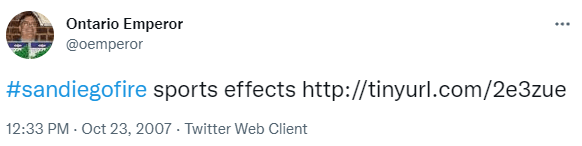
Back on October 23, 2007, I used my then-active Twitter account to tweet about the #sandiegofire. The San Diego fire was arguably the first mass adoption of hashtags, building upon pioneering work by Stowe Boyd and Chris Messina and acted upon by Nate Ritter and others.

From https://twitter.com/oemperor/status/358071562. Frozen peas? Long story.

The tinyurl link directed followers to my post detailing how the aforementioned San Diego Fire was displacing sports teams, including the San Diego Chargers. (Yes, kids, the Chargers used to play in San Diego.)

So while I was there at the beginning of hashtags, I’m proudest of the post that I wrote a couple of months later, entitled “Hashtagging Challenges When Events Occur at Different Times in Different Locations.” It describes the challenges of talking about the Rose Parade when someone is viewing the beginning of the parade while someone else is viewing the end of the parade at the same time. (This post was cited on PBWorks long ago, referenced deep in a Stowe Boyd post, and cited elsewhere.)

Hashtag use in business

Of course, hashtags have changed a lot since 2007-2008. After some resistance, Twitter formally supported the use of hashtags, and Facebook and other services followed, leading to mass adoption beyond the Factory Joes of the world.

Ignoring personal applications for the moment, hashtags have proven helpful for business purposes, especially when a particular event is taking place. No, not a fire in a major American city, but a conference of some sort. Conferences of all types have rushed to adopt hashtags so that conference attendees will promote their conference attendance. The general rule is that the more techie the conference, the more likely the attendees will use the conference-promoted hashtag.

I held various social media responsibilities during my years at MorphoTrak and IDEMIA, some of which were directly connected to the company’s annual user conference, and some of which were connected to the company’s attendance at other events. Obviously we pulled out the stops for our own conferences, including adopting hashtags that coincided with the conference theme.

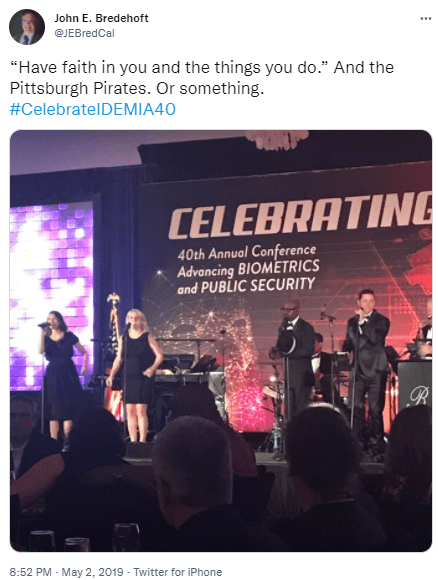
A tweet https://twitter.com/JEBredCal/status/1124159756157849600 from the last (obviously celebratory) night of IDEMIA’s (Printrak’s) 40th conference in 2019. Coincidentally, this conference was held in San Diego.

And then when the conference organizers adopt a hashtag, they fervently hope that people will actually USE the adopted hashtag. As I said before, this isn’t an issue for the technical conferences, but it can be an issue at the semi-technical conferences. (“Hey, everybody! Gather around the screen! Someone used the conference hashtag…oh wait a minute, that’s my burner account.”)

A pleasant surprise with exhibitor/speaker adoption of the #connectID hashtag

Well, I think that we’ve finally crossed a threshold in the biometric world, and hashtags are becoming more and more acceptable.

As I previously mentioned, I’m not attending next week’s connect:ID conference in Washington DC, but I’m obviously interested in the proceedings.

So I turned to Twitter to check if anyone was using a #connectID hashtag in advance of the event. (Helpful hint: hashtags cannot include special characters such as “:” so don’t try to tweet #connect:ID; it won’t work and will appear as #connect.) Using the date-sorted search https://twitter.com/search?q=%23connectid&src=typed_query&f=live, I was expecting to see a couple of companies using the hashtag…if I was lucky.

I was pleasantly surprised to see that nearly two dozen exhibitors and speakers were using the #connectID hashtag (or referenced via the hashtag) as of the Friday before the event, including Acuity Market Intelligence, Aware, BIO-key, Blink Identity, Clearview AI, HID Global, IDEMIA, Integrated Biometrics, iProov, Iris ID, Kantara, NEC and NEC NSS, Pangiam, Paravision, The Paypers, WCC, WorldReach Software/Entrust, and probably some others by the time you read this, as well as some others that I may have missed.

And the event hasn’t even started yet.

At least some of the companies will have the presence of mind to tweet DURING the event on Tuesday and Wednesday.

Will yours be one of them?

But company adoption is only half the battle

While encouraging to me, adoption of a hashtag by a conference’s organizers, exhibitors, and speakers is only the beginning.

The true test will take place when (if) the ATTENDEES at the conference also choose to adopt the conference hashtag.

According to Terrapin (handling the logistics of conference organization), more than 2,500 people are registered for the conference. While the majority of these people are attending the free exhibition, over 750 of them are designated as “conference delegates” who will attend the speaking sessions.

How many of these people will tweet or post about #connectID?

We’ll all find out on Tuesday.

connect:ID 2021 is coming

I have not been to an identity trade show in years, and sadly I won’t be in Washington DC next week for connect:ID…although I’ll be thinking about it.

I’ve only been to connect:ID once, in 2015. Back in those days I was a strategic marketer with MorphoTrak, and we were demonstrating the MorphoWay. No, not the Morpho Way; the MorphoWay.

At connect:ID 2015.

Perhaps you’ve seen the video.

Video by Biometric Update. https://www.youtube.com/watch?v=mqfHAc227As

As an aside, you’ll notice how big MorphoWay is…which renders it impractical for use in U.S. airports, since space is valuable and therefore security features need a minimum footprint. MorphoWay has a maximum footprint…just ask the tradespeople who were responsible for getting it on and off the trade show floor.

I still remember several other things from this conference. For example, in those days one of Safran’s biometric competitors was 3M. Of course both Safran and 3M have exited the biometric industry, but at the time they were competing against each other. Companies always make a point of checking out the other companies at these conferences, but when I went to 3M’s booth, the one person I knew best (Teresa Wu) was not at the booth. Later that year, Teresa would leave 3M and (re)join Safran, where she remains to this day.

Yes, there is a lot of movement of people between firms. Looking over the companies in the connect:ID 2021 Exhibitor Directory, I know people at a number of these firms. Obviously people from IDEMIA, of course (IDEMIA was the company that bought Safran’s identity business), but I also know people at other companies, all of whom who were former coworkers at IDEMIA or one of its predecessor companies:

  • Aware.
  • Clearview AI.
  • GET Group North America.
  • HID Global.
  • Integrated Biometrics.
  • iProov.
  • NEC.
  • Paravision.
  • Rank One Computing.
  • SAFR/RealNetworks.
  • Thales.
  • Probably some others that I missed.

And I know people at some of the other companies, organizations, and governmental entities that are at connect:ID this year.

Some of these entities didn’t even exist when I was at connect:ID six years ago, and some of these entities (such as Thales) have entered the identity market due to acquisitions (in Thales’ case, the acquisition of Gemalto, which had acquired 3M’s biometric business).

So while I’m not crossing the country next week, I’m obviously thinking of everything that will be going on there.

Incidentally, this is one of the last events of the trade show season, which is starting to wind down for the year. But it will ramp up again next spring (for you Northern Hemisphere folks).

Bredemarket remembers the Southern Hemisphere, even though Bredemarket only does business in the United States. https://www.youtube.com/watch?v=HtZCQiN3n50

Regardless of where you are, hopefully the upcoming trade show season will not be adversely impacted by the pandemic.

Today’s “biometrics is evil” post (Amazon One)

I can’t recall who recorded it, but there’s a radio commercial heard in Southern California (and probably nationwide) that intentionally ridicules people who willingly give up their own personally identifiable information (PII) for short-term gain. In the commercial, both the husband and the wife willingly give away all sorts of PII, including I believe their birth certificates.

While voluntary surrender of PII happens all the time (when was the last time you put your business card in a drawing bowl at a restaurant?), people REALLY freak out when the information that is provided is biometric in nature. But are the non-biometric alternatives any better?

TechCrunch, Amazon One, and Ten Dollars

TechCrunch recently posted “Amazon will pay you $10 in credit for your palm print biometrics.

If you think that the article details an insanely great way to make some easy money from Amazon, then you haven’t been paying attention to the media these last few years.

The article begins with a question:

How much is your palm print worth?

The article then describes how Amazon’s brick-and-mortar stores in several states have incorporated a new palm print scanner technology called “Amazon One.” This technology, which reads both friction ridge and vein information from a shopper’s palms. This then is then associated with a pre-filed credit card and allows the shopper to simply wave a palm to buy the items in the shopping cart.

There is nothing new under the sun

Amazon One is the latest take on processes that have been implemented several times before. I’ll cite three examples.

Pay By Touch. The first one that comes to my mind is Pay By Touch. While the management of the company was extremely sketchy, the technology (provided by Cogent, now part of Thales) was not. In many ways the business idea was ahead of its time, and it had to deal with challenging environmental conditions: the fingerprint readers used for purchases were positioned near the entrances/exits to grocery stores, which could get really cold in the winter. Couple this with the elderly population that used the devices, and it was sometimes difficult to read the fingers themselves. Yet, this relatively ancient implementation is somewhat similar to what Amazon is doing today.

University of Maryland Dining Hall. The second example occurred to me because it came from my former employer (MorphoTrak, then part of Safran and now part of IDEMIA), and was featured at a company user conference for which I coordinated speakers. There’s a video of this solution, but sadly it is not public. I did find an article describing the solution:

With the new system students will no longer need a UMD ID card to access their own meals…

Instead of pulling out a card, the students just wave their hand through a MorphoWave device. And this allows the students to pay for their meals QUICKLY. Good thing when you’re hungry.

This Pay and That Pay. But the most common example that everyone uses is Apple Pay, Google Pay, Samsung Pay, or whatever “pay” system is supported on your smartphone. Again, you don’t have to pull out a credit card or ID card. You just have to look at your phone or swipe your finger on the phone, and payment happens.

Amazon One is the downfall of civilization

I don’t know if TechCrunch editorialized against Pay By Touch or [insert phone vendor here] Pay, and it probably never heard of the MorphoWave implementation at the University of Maryland. But Amazon clearly makes TechCrunch queasy.

While the idea of contactlessly scanning your palm print to pay for goods during a pandemic might seem like a novel idea, it’s one to be met with caution and skepticism given Amazon’s past efforts in developing biometric technology. Amazon’s controversial facial recognition technology, which it historically sold to police and law enforcement, was the subject of lawsuits that allege the company violated state laws that bar the use of personal biometric data without permission.

Oh well, at least TechCrunch didn’t say that Amazon was racist. (If you haven’t already read it, please read the Security Industry Association’s “What Science Really Says About Facial Recognition Accuracy and Bias Concerns.” Unless you don’t like science.)

OK, back to Amazon and Amazon One. TechCrunch also quotes Albert Fox Cahn of the Surveillance Technology Oversight Project.

People Leaving the Cities, photo art by Zbigniew Libera, imagines a dystopian future in which people have to leave dying metropolises. By Zbigniew Libera – https://artmuseum.pl/pl/kolekcja/praca/libera-zbigniew-wyjscie-ludzi-z-miast, CC BY-SA 3.0, https://commons.wikimedia.org/w/index.php?curid=66055122.

“The dystopian future of science fiction is now. It’s horrifying that Amazon is asking people to sell their bodies, but it’s even worse that people are doing it for such a low price.”

“Sell their bodies.” Isn’t it even MORE dystopian when people “give their bodies away for free” when they sign up for Apple Pay, Google Pay, or Samsung Pay? While the Surveillance Technology Oversight Project (acronym STOP) expresses concern about digital wallets, there is a significant lack of horror in its description of them.

Digital wallets and contactless payment systems like smart chips have been around for years. The introduction of Apple Pay, Amazon Pay, and Google Pay have all contributed to the e-commerce movement, as have fast payment tools like Venmo and online budgeting applications. In response to COVID-19, the public is increasingly looking for ways to reduce or eliminate physical contact. With so many options already available, contactless payments will inevitably gain momentum….

Without strong federal laws regulating the use of our data, we’re left to rely on private companies that have consistently failed to protect our information. To prevent long-term surveillance, we need to limit the data collected and shared with the government to only what is needed. Any sort of monitoring must be secure, transparent, proportionate, temporary, and must allow for a consumer to find out about or be alerted to implications for their data. If we address these challenges now, at a time when we will be generating more and more electronic payment records, we can ensure our privacy is safeguarded.

So STOP isn’t calling for the complete elimination of Amazon Pay. But apparently it wants to eliminate Amazon One.

Is a world without Amazon One a world with less surveillance?

Whenever you propose to eliminate something, you need to look at the replacement and see if it is any better.

In 1998, Fox fired Bill Russell as the manager of the Los Angeles Dodgers. He had a win-loss percentage of .538. His replacement, Glenn Hoffman, lasted less than a season and had a percentage of .534. Hoffman’s replacement, true baseball man Davey Johnson, compiled a percentage of .503 over the next two seasons before he was fired. Should have stuck with Russell.

Anyone who decides (despite the science) that facial recognition is racist is going to have to rely on other methods to identify criminals, such as witness identification. Witness identification has documented inaccuracies.

And if you think that elimination of Amazon One from Amazon’s brick-and-mortar stores will lead to a privacy nirvana, think again. If you don’t use your palm to pay for things, you’re going to have to use a credit card, and that data will certainly be scanned by the FBI and the CIA and the BBC, B. B. King, and Doris Day. (And Matt Busby, of course.) And even if you use cash, the only way that you’ll preserve any semblance of your privacy is to pay anonymously and NOT tie the transaction to your Amazon account.

And if you’re going to do that, you might as well skip Whole Foods and go straight to Dollar General. Or maybe not, since Dollar General has its own app. And no one calls Dollar General dystopian. Wait, they do: “They tend to cluster, like scavengers feasting on the carcasses of the dead.”

I seemed to have strayed from the original point of this post.

But let me sum up. It appears that biometrics is evil, Amazon is evil, and Amazon biometrics are Double Secret Evil.

Telos enters the touchless fingerprint market

Years before COVID became a thing, the U.S. government had a desire to encourage touchless fingerprint technologies. This began many years ago with a concerted effort to capture a complete set of fingerprints in less than 15 seconds. By 2016, this had evolved to a set of Cooperative Research and Development Agreements (CRADA) entered into by the National Institute of Standards and Technology and several private companies.

For purposes of this post, I’m going to concentrate on just one of the listed mobile fingerprint capture technology solutions. The mobile fingerprint capture technologies from these companies were intended to support the capture of fingerprints from a standard smartphone without any additional capture equipment. (Compare this to the portal/kiosk category, which employed specialized capture equipment.)

One of NIST’s CRADA partners for mobile fingerprint capture was a company called Diamond Fortress Technologies.

Via our CRADA  relationship (Cooperative Research and Development Agreement), Diamond Fortress is currently working with NIST to develop standards dealing with best practices, certification methodology, data formatting and interoperability with legacy contact-based and inked print databases for optical acquisition systems. This will support future certification for purchase on the Government Certified Products lists.

Fast forward a few years, and Diamond Fortress Technologies’ offering is back in the news again.

Telos Corporation has acquired the ONYX touchless fingerprint biometric software and other assets of Diamond Fortress Technologies (DFT), and appears to be targeting new verticals with the technology.

Now that happened to catch my eye for one particular reason.

You see, my former employer IDEMIA used to have a monopoly on the TSA PreCheck program. If you wanted to enroll in TSA PreCheck, you HAD to go to IDEMIA. This provided a nice revenue stream for IDEMIA…well, perhaps not so nice when all of the airports lost traffic due to COVID.

Anyway, the Congress decided that one provider wasn’t optimal for government purposes, so in early 2020 other vendors were approved as TSA PreCheck providers.

WASHINGTON – Transportation Security Administration (TSA) today announced that TSA PreCheck™ enrollment services will now be provided by Alclear, LLC; Telos Identity Management Solutions, LLC; and Idemia Identity & Security USA, LLC, expanding the opportunities that enable travelers to apply for TSA PreCheck.

Just to clarify, the company then known as Alclear is better known to the general public as CLEAR.

And the third company is Telos.

Which is now apparently moving into the touchless fingerprint space.

Now THAT is going to have an impact on enrollment.

(Bredemarket Premium) The mechanics of acquisitions

During my years in biometrics, my employer was acquired by another firm three times:

  • Printrak was acquired by Motorola in 2000.
  • Part of Motorola was acquired by Safran in 2009.
  • Part of Safran was acquired by Oberthur in 2017. (The combined entity was named IDEMIA.)

Acquisitions always cause a lot of changes, but one of these three acquisitions caused more changes than any of the others.

Subscribe to get access

Subscribe to Bredemarket Premium to access this premium content.

  • Subscriptions just $5 per month.
  • Access Bredemarket’s expertise without spending hundreds or thousands of dollars.

(Bredemarket Premium) The drawbacks of a FOCI-mitigated subsidiary

Those portions of the U.S. government that deal with critical infrastructure are naturally concerned about foreign encroachment into U.S. Government operations, even from “friendly” nations. Therefore, the U.S. Government takes steps to mitigate the effects of “Foreign Ownership, Control or Influence” (FOCI).

I’ve worked for two companies that needed to undertake FOCI mitigation, and I know of others that have also done this. And while FOCI mitigation offers benefits to the United States, there are also drawbacks of which everyone involved should be aware.

Subscribe to get access

Subscribe to Bredemarket Premium to access this premium content.

  • Subscriptions just $5 per month.
  • Access Bredemarket’s expertise without spending hundreds or thousands of dollars.

What is an “antimicrobial” contact fingerprint reader? And what is it NOT?

(Part of the biometric product marketing expert series)

In the COVID and (soon) post-COVID area, people don’t want to touch things. That impacts how identity products are marketed, including biometric readers.

Why contactless biometrics are “better” than contact biometrics

In the biometric world, this reluctance to touch things has served to promote CONTACTLESS biometric technologies, such as facial recognition, other other technologies. The loser in this has been fingerprint-based technologies, as several facial and iris vendors have made the claim that face/iris biometrics are contactless, while fingerprint biometrics are NOT contactless.

Well, my friends at my former employer IDEMIA might take issue with that claim, since you literally do NOT touch the fingerprint reader in IDEMIA’s MorphoWave product. IDEMIA does not (to my knowledge) make any medical claims about MorphoWave, but the company does emphasize that its contactless fingerprint reader allows for fast capture of four-finger slaps.

To protect their premises, organizations need access control solutions that are efficient, fast, and convenient. A contactless fingerprint scanner provides an optimum answer high throughput workplaces. IDEMIA’s MorphoWave contactless fingerprint solution scans and verifies 4 fingerprints in less than 1 second, through a fully touchless hand wave gesture. Thanks to the simplicity of this gesture, the throughput can reach up to 50 people per minute.

An antimicrobial contact fingerprint reader?

But what if there were a CONTACT solution that allowed you to capture prints with a reduced fear of “bad things”?

That’s what Integrated Biometrics appears to be claiming.

Integrated Biometrics (IB), the world leader in mobile, FBI-certified biometric fingerprint scanners, and NBD Nanotechnologies (NBD Nano), the surface coating experts, today announced the inclusion of NBD’s RepelFlex MBED transparent coating on IB’s entire line of fingerprint scanners.

An ultra-thin, transparent coating, RepelFlex MBED is designed to provide outstanding antimicrobial, anti-scratch, and anti-stain protection to devices. Long-lasting and multi-functional, RepelFlex MBED is ideal for surfaces that must stand up to high throughput and harsh conditions without compromising accuracy.

So what exactly does “antimicrobial” mean?

cluster of Escherichia coli bacteria magnified 10,000 times. By Photo by Eric Erbe, digital colorization by Christopher Pooley, both of USDA, ARS, EMU. – This image was released by the Agricultural Research Service, the research agency of the United States Department of Agriculture, with the ID K11077-1 (next)., Public Domain, https://commons.wikimedia.org/w/index.php?curid=958857

Let’s see how NBD Nano describes it.

Preventing the presence and growth of microbials on surfaces is becoming increasingly important. Antimicrobial performance is especially critical on surfaces that are accessible to the public in order to prevent the spread of stain and odor causing bacteria and microbes.

And if you drill further down in NBD Nano’s website, you find this information in a technical data sheet (PDF).

Antimicrobial Performance: Japanese Industrial Standard (JIS) Z 2801 – PASS*
*as tested by Microchem Laboratory, Round Rock, TX

Now since I’m not up to date on my Japanese Industrial Standards, I had to rely on the good folks at the aforementioned Microchem Laboratory to explain what the standard actually means.

The JIS Z 2801 method tests the ability of plastics, metals, ceramics and other antimicrobial surfaces to inhibit the growth of microorganisms or kill them. The procedure is very sensitive to antimicrobial activity and has a number of real world applications anywhere from the hospital/clinical environment to a household consumer company concerned with the ability of a material they have to allow bacterial growth.

The JIS Z 2801 method is the most commonly chosen test and has become the industry standard for antimicrobial hard surface performance in the United States.

It may be antimicrobial, but what about preventing the “C” word?

Now you may have noticed that Microchem Laboratory, NBD Nano, and Integrated Biometrics did not make any medical claims regarding their products. None of them, for example, used the “C” word in any of their materials.

There’s a very, very good reason for that.

If any of these product providers were to make specific MEDICAL claims, then any sales in the United States would come under the purview of the U.S. Food and Drug Administration.

This is something that temperature scanner manufacturers learned the hard way.

Digression: if fever scanners are fever scanners, does that mean they are fever scanners?

Remember “fever scanners”? Those devices that were (and in some cases still are) pointed at your forehead as you enter a building or another secure area? I won’t get into the issues with these devices (what happens when the scanner is placed next to a building’s front entrance on a hot day?), but I will look at some of the claims about those scanners.

About a year ago, John Honovich of IPVM began asking some uncomfortable questions about the marketing of those devices, especially after the FDA clarified what thermal imaging systems could and could not do.

When used correctly, thermal imaging systems generally have been shown to accurately measure someone’s surface skin temperature without being physically close to the person being evaluated….

Thermal imaging systems have not been shown to be accurate when used to take the temperature of multiple people at the same time. The accuracy of these systems depends on careful set-up and operation, as well as proper preparation of the person being evaluated….

Room temperature should be 68-76 °F (20-24 °C) and relative humidity 10-50 percent….

The person handling the system should make sure the person being evaluated…(h)as waited at least 15 minutes in the measurement room or 30 minutes after exercising, strenuous physical activity, bathing, or using hot or cold compresses on the face.

Let’s stop right there. For any of you who have undergone a temperature scan in the last year: how many of you have waited in a measurement room for at least 15 minutes BEFORE your temperature was taken?

Last summer I had a dentist appointment. My dentist is in Ontario, California, where the summers can get kind of hot. The protocol at this dentist’s office was to have you call the office from your car when you arrived in the parking lot, then wait for someone from the office to come outside and take your temperature before you could enter the building.

I was no dummy. I left my car and its air conditioner running while waiting for my temperature to be taken. Otherwise, who knows what my temperature reading would have been? (I also chose NOT to walk to the dentist’s office that day for the same reason.)

Back to John Honovich. He had read the FDA advice on the medical nature of thermal imaging systems, and then noted that some of the manufacturers of said systems were sort of getting around this by stating that their devices were not medical devices.

Even though the manufacturers still referred to them as “fever cameras.”

For example, one vendor (who has since changed its advertising) declared at the time that “thermal temperature-monitoring technology assists in reducing the spread of viral diseases,” even though that vendor’s device “is not a medical device and is not designed or intended for diagnosis, prevention, or treatment of any disease or condition.”

Fever scanners, testosterone supplements…and fingerprint readers

Yes, that language is similar to the language used by providers of natural supplements that, according to anecdotal evidence, work wonders. The FDA really polices this stuff.

So you really don’t want to make medical claims about ANY product unless you can back them up with the FDA. You can say that a particular product passed a particular antimicrobial standard…but you’d better not say anything else.

In fact, Integrated Biometrics only mentions the “antimicrobial” claim in passing, but spends some time discussing other benefits of the NBD Nano technology:

The inclusion of RepelFlex MBED coatings enable IB’s scanners to deliver an even higher level of performance. Surfaces are tougher and more difficult to scratch or stain, increasing their longevity while maintaining print quality even when regular cleaning is not possible due to conditions or times of heavy use.

So the treated Integrated Biometrics products are tough…like those famous 1970s crime fighters Kojak, Columbo, and Danno and the other people from Five-O. (Not that Sherlock and Watson were slouches.)

Book ’em, Danno! By CBS Television – eBay item photo front photo back, Public Domain, https://commons.wikimedia.org/w/index.php?curid=19674714

Four of my identity information sources that I have created over the years, including one that you can access in the next ten seconds

How many of us keep on doing the same thing, but just use different tools to do it?

For example, I am going to provide four examples of ways…I mean, for example, I am going to list four ways in which I have disseminated identity information to various internal and external audiences over the last fifteen years. Three of these methods had restricted access and some are no longer available, but the last one, Bredemarket Identity Firm Services, is publicly available to you TODAY.

You can get to this information source in ten seconds if you like. If you’re a TL;DR kind of person, click here.

For the rest of you, read on to see how I used COMPASS (most of you haven’t heard of COMPASS), SharePoint (you’ve heard of that), email (you’ve definitely heard of that), and LinkedIn (ditto) to share information.

Take One: Using Motorola Tools

For the first identity information source, let’s go back about fifteen years, when I was a product manager at Motorola (before The Bifurcation). Motorola had its own intranet, called COMPASS, which all of us Motorolans would use to store information except when we didn’t.

Using this intranet, I created a page entitled “Biometric Industry Information,” in which I pasted links and short descriptions of publicly-available news items. I’m not sure how useful this information source was to others, but I referred to it frequently.

Eventually Motorola sold our business unit to Safran, and “Biometric Industry Information” was lost in the transition. For all I know it may be available on some Motorola Solutions intranet page somewhere, though I doubt it.

Take Two: An Industry-Standard Tool and an Expanded Focus

The second identity information source was created a few years later, when I was an employee of MorphoTrak. Two things had changed since the Motorola days:

  • MorphoTrak’s parent company Safran didn’t use the Motorola intranet solution. Instead, it used an industry-standard intranet solution, SharePoint. This was tweaked at each of the individual Safran companies and regions, but it was pretty much a standard solution.
  • The second change was in the breadth of my interests, as I realized that biometrics was only part of an identity solution. Yes, an identity solution could use biometrics, but it could also used the driver’s licenses that MorphoTrak was slated to produce (but didn’t), and other security methods besides.

So when I recreated my Motorola information source, the new one at MorphoTrak was a Microsoft SharePoint list entitled “Identity Industry Information.”

Again, I’m not sure whether others benefited from this, but I certainly did.

Take Three: Taking Over an Email List

The third iteration of my information source wasn’t created by me, but was created about a decade ago at a company known as L-1 Identity Solutions. For those who know the company, L-1 was a conglomeration of multiple small acquisitions that provided multiple biometric solutions, secure document solutions, and other products and services. Someone back then decided that a daily newsletter covering all of L-1’s markets would be beneficial to the company. This newsletter began, and continued after Safran acquired L-1 Identity Solutions and renamed it MorphoTrust.

MorphoTrust and my company MorphoTrak remained separate entities (for security reasons) until Oberthur acquired some of Safran’s businesses and formed IDEMIA. In North America, this resulted in the de facto acquisition of MorphoTrak by MorphoTrust, and some significant shifting in organizational charts and responsibilities.

As a result of these changes, I ended up taking over the daily newsletter, tweaking its coverage to better meet the needs of today, and (in pursuit of a personal annual goal) expanding its readership. (This email was NOT automatically sent to everyone in the company; you had to opt in.)

Now some may believe that email is dead and that everyone should be on Volley or Clubhouse, but email does serve a valid purpose. As a push technology, emails are provided to you every day.

OK, every five seconds.

But modern email systems (including those from Microsoft and Google) provide helpful tools to help you manage your email. This allowed people to prioritize their reading of my daily newsletter, or perhaps de-prioritize it.

Two years later IDEMIA underwent another organizational change, and I was no longer responsible for the daily newsletter. Last I heard, the daily newsletter still continues.

Take Four: Market Me, Benefit You

Eventually I left IDEMIA and started Bredemarket, and the identity industry became one of the industries that I targeted for providing Bredemarket’s services. To build myself as an identity industry authority, and to provide benefits to identity industry firms, I needed to market specifically to that segment. While my online marketing outlets were primarily focused on my website, I was also marketing via LinkedIn and Facebook. My LinkedIn marketing was primarily though the Bredemarket LinkedIn company page.

In late November, I decided to create a LinkedIn Showcase page entitled Bredemarket Identity Firm Services. While the page was initially created for other reasons, I eventually settled into a routine of sharing identity industry information via the page.

Like I’ve done one thousand times before.

I’m trying to add new content to Bredemarket Identity Firm Services on a daily basis. It’s primarily content from other sources, but sometimes my own content (such as this post) will find its way in there also. And, as in the example above, I’ll occasionally include editorial comments on others’ posts.

So if you’re on LinkedIn and would find such content useful to you, go to the showcase page and click the “Follow” button.

P.S. I have a technology showcase page also.