Differentiating the DNA of Twins?

(Part of the biometric product marketing expert series)

There are certain assumptions that you make in biometrics.

Namely, that certain biometrics are unable to differentiate twins: facial recognition, and DNA analysis.

Now as facial recognition algorithms get bettter and better, perhaps they will be able to tell twins apart: even identical twins.

But DNA is DNA, right?

Twins and somatic mutations

Mike Bowers (CSIDDS) links to an article in Forensic Magazine which suggests that twins’ DNA can be differentiated.

For the first time in the U.S., an identical twin has been convicted of a crime based on DNA analysis.

The breakthrough came from Parabon Nanolabs, who’s scientists used deep whole genome sequencing to identify extremely rare “somatic mutations” that differentiated Russell Marubbio and his twin, John. The results were admitted as evidence in court, making last week’s conviction of Russell in the 1987 rape of a 50-year-old woman a landmark case.

Twin DNA.

Parabon Nanolabs (whom I briefly mentioned in 2024) applied somatic mutations as follows:

Somatic mutations are DNA changes that happen after conception and can cause genetic differences between otherwise identical twins. These mutations can arise during the earliest stages of embryonic development, affecting the split of the zygote, and accumulate throughout life due to errors in cell division. Somatic mutations can be present in only one twin, a subset of cells, or both, potentially leading to differences in health and even developmental disorders—and in this case, DNA.

The science behind somatic mutations is not new, and is well-researched, understood and accepted. It’s just uncommon for DNA to lead to twins, and even more uncommon for somatic mutations to be able to distinguish between twins.

Note that “well-researched, understood and accepted” part (even though it lacks an Oxford comma). Because this isn’t the only recent story that touches upon whole genome sequencing.

Whole genome sequencing and legal admissibility

Bowers also links to a CNN article which references Daubert/Frye-like questions about whether evidence is admissable.

Evidence derived from cutting-edge DNA technology that prosecutors say points directly at Rex Heuermann being the Gilgo Beach serial killer will be admissible at his trial, a Suffolk County judge ruled Wednesday….

Heuermann’s defense attorney Michael Brown had argued the DNA technology, known as whole genome sequencing, has not yet been widely accepted by the scientific community and therefore shouldn’t be permitted. He said he plans to argue the validity of the technology before a jury.

Meanwhile, prosecutors have argued this type of DNA extraction has been used by local law enforcement, the FBI and even defense attorneys elsewhere in the country, according to court records.

Let me point out one important detail: the fact that police agencies are using a particular technology doesn’t mean that said technology is “widely accepted by the scientific community.” I suspect that this same question will be raised in other courts, and other judges may hold a different decision.

And after checking my blog, I realize that I have never written an article about Daubert/Frye. Another assignment for Bredebot, I guess…

Your identity/biometric product marketing needs to assert the facts rather than old lies,

Bredemarket can help.

Today’s Acronym is PIA (Privacy Impact Assessment)

(Imagen 4)

(Part of the biometric product marketing expert series)

Do U.S. government agencies simply run roughshod over your privacy rights?

Not exactly.

Government agencies are required to issue Privacy Impact Assessments (PIAs) for their projects.

The Federal Bureau of Investigation alone has issued over 60 PIAs.

For example, here is the PIA for CODIS, the Combined National Deoxyribonucleic Acid (DNA) Index System (CODIS).

And if anything needs a PIA, it’s CODIS, since it potentially contains your personally identifiable information…and the personally identifiable information of your relatives.

The PIAs themselves are detailed. The CODIS PIA includes 8 sections with 19 pages of questions and responses. For example, here is the response in section 8 regarding privacy:

The type, quantity, and sources of information collected by FBI CODIS are necessary to identify crime scene offenders, missing persons, or unidentified human remains, or to link multiple crime scenes. Such information is only further disseminated for these purposes. Moreover, NDIS does not store State Identification Number/Universal Control Number or otherwise collect, handle, disseminate, or store contributors’ names. Therefore, CODIS DNA profiles and pedigrees can only be matched to a named individual by the submitting Criminal Justice Agency forensic laboratory, independent of NDIS.

  • The privacy risks associated with the collection and maintenance of FBI CODIS information are inaccurate information, unauthorized access, and unauthorized disclosures.
  • The privacy risks associated with the access and use of FBI CODIS information are unauthorized access, unauthorized (or overly broad) disclosures, and loss of data.
  • The privacy risks associated with the dissemination of FBI CODIS information are the risks of unauthorized disclosures and loss of data.

The risks of unauthorized access, unauthorized disclosures, loss of data and inaccurate information are mitigated by the quality assurance standards promulgated by the FBI pursuant to the Federal DNA Identification Act. These risks are further mitigated by the system, physical access, network-infrastructure, auditing and quality assurance controls, as described more specifically in Sections 6.1 and 6.2, which are in compliance with FIPS Publication 199, as applicable.

The risk of inaccurate information is also specifically mitigated through the identity verification process performed by participating Criminal Justice Agency forensic laboratories to confirm a potential match. The identity must be confirmed prior to the disclosure of any personally identifiable information to the law enforcement entity who submitted the DNA sample.

Lastly, notice is provided as described in Section 5.1.

Frictionless Friction Ridges and Other Biometric Modalities

I wanted to write a list of the biometric modalities for which I provide experience.

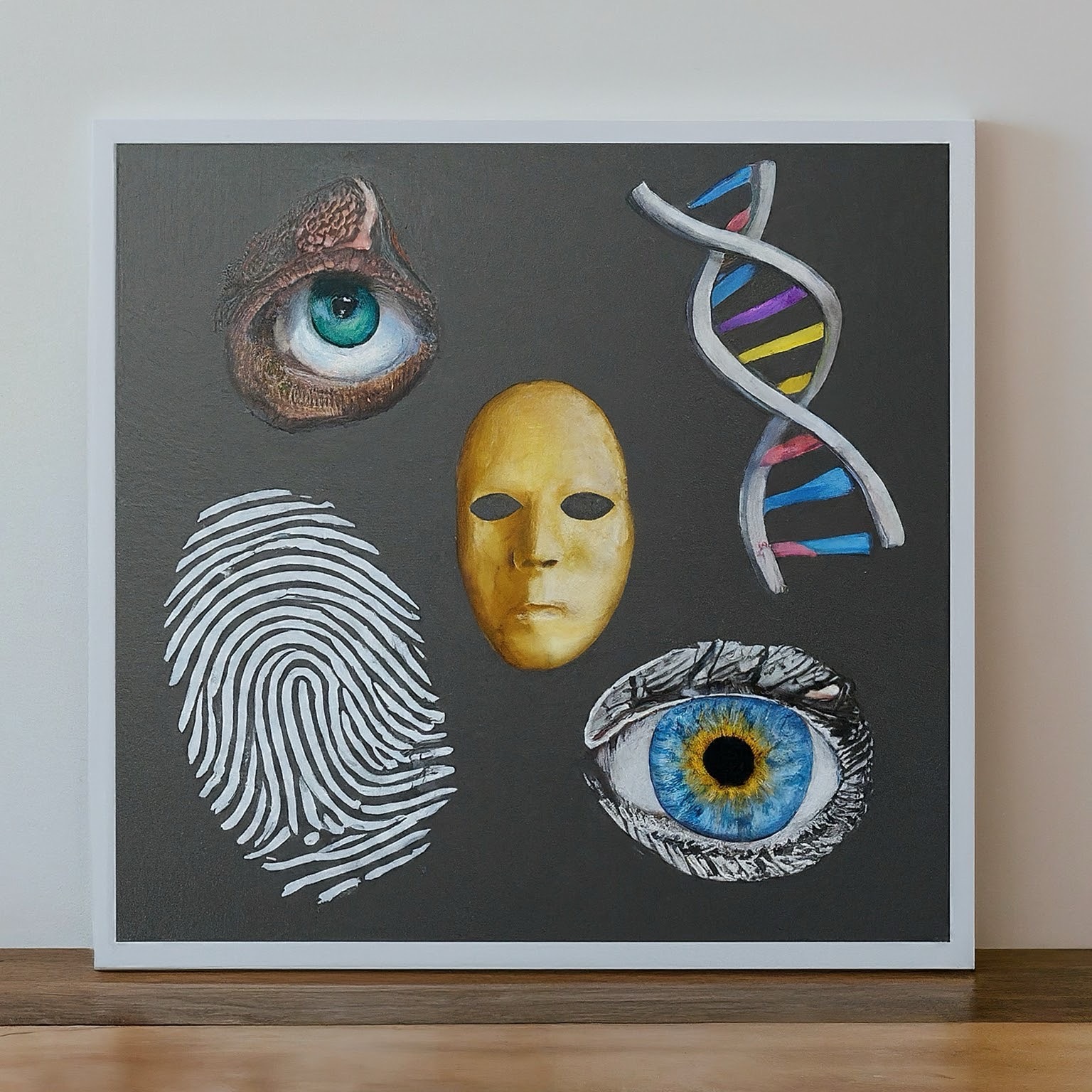
So I started my usual list from memory: fingerprint, face, iris, voice, and DNA.

Then I stopped myself.

My experience with skin goes way beyond fingerprints, since I’ve spent over two decades working with palm prints.

(Can you say “Cambridgeshire method”? I knew you could. It was a 1990s method to use the 10 standard rolled fingerprint boxes to input palm prints into an automated fingerprint identification system. Because Cambridgeshire had a bias to action and didn’t want to wait for the standards folks to figure out how to enter palm prints. But I digress.)

So instead of saying fingerprints, I thought about saying friction ridges.

But there are two problems with this.

First, many people don’t know what “friction ridges” are. They’re the ridges that form on a person’s fingers, palms, toes, and feet, all of which can conceivably identify individuals.

But there’s a second problem. The word “friction” has two meanings: the one mentioned above, and a meaning that describes how biometric data is captured.

No, there is not a friction method to capture faces.
From https://www.youtube.com/watch?v=4XhWFHKWCSE.

No, there is not a friction method to capture faces. Squishing 

  • If you have to do something to provide your biometric data, such as press your fingers against a platen, that’s friction.
  • If you don’t have to do anything other than wave your fingers, hold your fingers in the air, or show your face as you stand near or walk by a camera, that’s frictionless.

More and more people capture friction ridges with frictionless methods. I did this years ago using MorphoWAVE at MorphoTrak facilities, and I did it today at Whole Foods Market.

So I could list my biometric modalities as friction ridge (fingerprint and palm print via both friction and frictionless capture methods), face, iris, voice, and DNA.

But I won’t.

Anyway, if you need content, proposal, or analysis assistance with any of these modalities, Bredemarket can help you. Book a meeting at https://bredemarket.com/cpa/

MFB = Multi Factor Biasification?

There’s a paper from Itiel Dror that I need to read. Its title is “Biased and Biasing: The Hidden Bias Cascade and Bias Snowball Effects.”

Here is a portion of the abstract:

“Cognitive bias…impacts each and every aspect of the justice and legal systems, from the initial engagement of police officers attending the crime scene, through the forensic examination, and all the way to the final outcome of the jurors’ verdict and the judges’ sentencing. It impacts not only the subjective elements in the justice and legal systems but also the more objective scientific elements, such as forensic fingerprinting and DNA….[S]uch errors in the final outcome rarely occur because they require that the shortcomings in each element be coordinated and aligned with the other elements. However, in the justice and legal systems, the different elements are not independent; they are coordinated and mutually support and bias each other, creating and enabling hidden bias cascade and bias snowball effects.”

Examples of Biometric Technology Misuse

If I become known for anything in biometrics, I want to be known for my extremely frequent use of the words “investigative lead.” 

Whether you are talking about DNA or facial recognition, these types of biometric evidence should not be the sole evidence used to arrest a person.

For an example of why DNA shouldn’t be your only evidence, see my recent post about Amanda Knox.

Facial recognition misuse in law enforcement

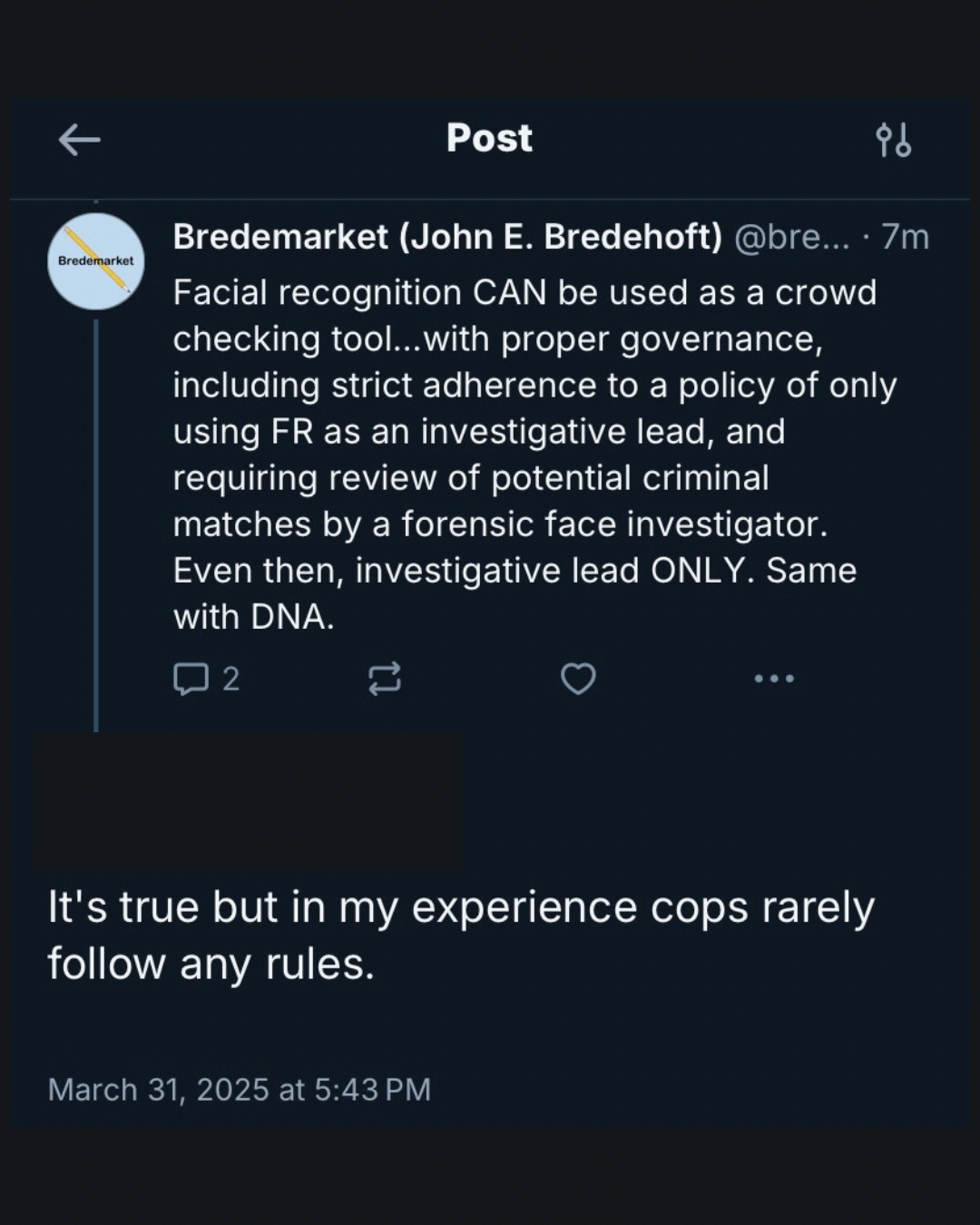
Regarding facial recognition, I wrote this in a social media conversation earlier today:

“Facial recognition CAN be used as a crowd checking tool…with proper governance, including strict adherence to a policy of only using FR as an investigative lead, and requiring review of potential criminal matches by a forensic face investigator. Even then, investigative lead ONLY. Same with DNA.”

I received this reply:

“It’s true but in my experience cops rarely follow any rules.”

Now I could have claimed that this view was exaggerated, but there are enough examples of cops who DON’T follow the rules to tarnish all of them. 

Revisiting Robert Williams’ Detroit arrest

I’ve already addressed the sad story of Robert Williams, who was “wrongfully arrested based upon faulty facial recognition results.”

At the time, I did not explicitly share the circumstances behind Williams’ arrest:

“The complaint alleges that the surveillance footage is poorly lit, the shoplifter never looks directly into the camera and still a Detroit Police Department detective ran a grainy photo made from the footage through the facial recognition technology.”

There’s so much that isn’t said here, such as whether a forensic face examiner made a definitive conclusion, or if the detective just took the first candidate from the list and ran with it.

But I am willing to bet that there was no independent evidence placing Williams at the shop location.

Why this matters

The thing that concerns me about all this? It just provides ammo to the people who want to ban facial recognition entirely.

Not realizing that the alternative—manual witness (mis)identification—is far more inaccurate and far more racist.

But the controversy would pretty much go away if criminal investigators only used facial recognition and DNA as investigative leads.

DNA Contamination Has Consequences. Ask Amanda Knox.

(Part of the biometric product marketing expert series)

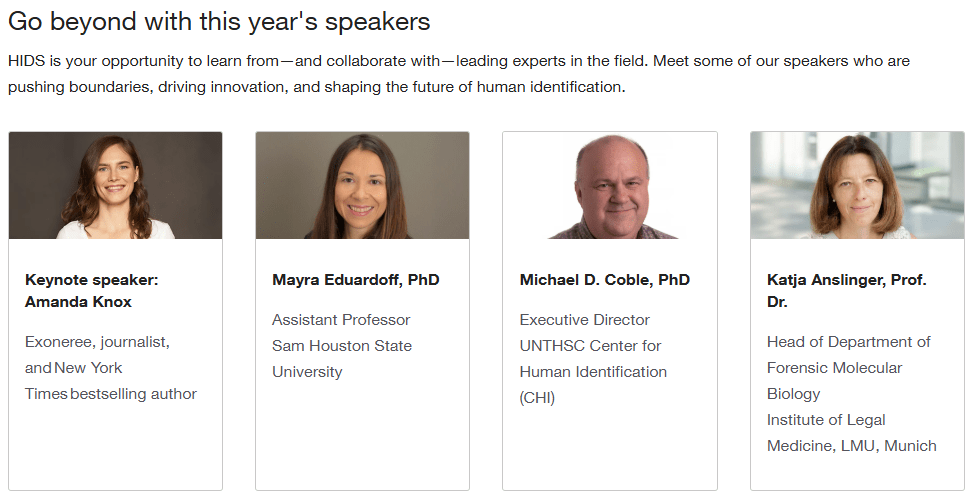
When Thermo Fisher Scientific announced Amanda Knox as one of its speakers at the HIDS 2025 conference (image from the HIDS 2025 conference page), I wondered why. All of knew of Knox was that she was imprisoned for a murder in Italy that she didn’t commit.

I then found the details.

Prosecution Exhibit #36 was a knife discovered in the kitchen drawer of Raffaele Sollecito’s apartment on November 6, 2007. The police claimed this knife, 31 m long with a 17.5 cm blade, to be the murder weapon. It was the only physical evidence linking Amanda Knox to the murder. The Scientific Police claimed to have found Knox’s DNA on the handle and [murder victim Meredith] Kercher’s DNA on the blade and called the knife the “double DNA knife.”

Because DNA proves all, Knox was sent off to prison.

Only there was one problem.

Later re-evaluation of the knife left little doubt that the DNA found on the knife was the result of contamination.

You see, DNA evidence is examined in a lab. So if someone takes DNA from a knife blade and compares it to DNA taken from Amanda Knox, and if the samples have a high probability of a match, then you can make a determination.

But what if there were a mixture of the DNA, and Knox’s sample was mixed with the knife sample at some point, or misidentified? Then Knox’s DNA would match to Knox’s DNA, but that may have nothing to do with the DNA that was originally on the knife.

And you know nothing.

Clean Fast Contactless Biometrics

(Image from DW)

The COVID-19 pandemic may be a fading memory, but contactless biometrics remains popular.

Back in the 1980s, you had to touch something to get the then-new “livescan” machines to capture your fingerprints. While you no longer had messy ink-stained fingers, you still had to put your fingers on a surface that a bunch of other people had touched. What if they had the flu? Or AIDS (the health scare of that decade)?

As we began to see facial recognition in the 1990s and early 2000s, one advantage of that biometric modality was that it was CONTACTLESS. Unlike fingerprints, you didn’t have to press your face against a surface.

But then fingerprints also became contactless after someone asked an unusual question in 2004.

“Actually this effort launched before that, as there were efforts in 2004 and following years to capture a complete set of fingerprints within 15 seconds…”

This WAS an unusual question, considering that it took a minute or more to capture inked prints or livescan prints. And the government expected this to happen in 15 seconds?

A decade later several companies were pursuing this in conjunction with NIST. There were two solutions: dedicated kiosks such as MorphoWave from my then-employer MorphoTrak, and solutions that used a standard smartphone camera such as SlapShot from Sciometrics and Integrated Biometrics.

The, um, upshot is that now contactless fingerprint and face capture are both a thing. Contactless capture provides speed, and even the impossible 15 second capture target was blown away. 

Fingers and faces can be captured “on the move” in airports, border crossings, stadiums, and university lunchrooms and other educational facilities.

Perhaps Iris and voice can be considered contactless and fast. 

But even “rapid” DNA isn’t that rapid.

DNA Chain of Custody

(Part of the biometric product marketing expert series)

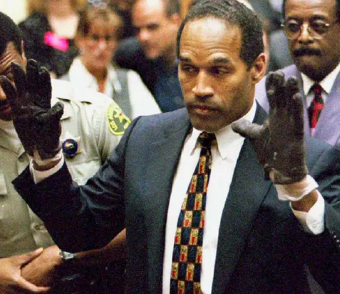
Gloves can play a big part in a variety of criminal investigations…including the ones that DON’T result in live coverage and international headlines.

The phrase of the day is “chain of custody,” because DNA evidence can be incredibly accurate…until it isn’t.

H/T CSIDDS for this story.

Sydney Criminal Lawyers shared the story of a police officer sent to prison for falsifying evidence.

“A property in Cairnlea, Melbourne, was identified as a safe house for…drugs, with police finding pieces of evidence — including a pair of gloves that had a man’s DNA on them. Despite only having the one source of DNA on the gloves, (former police detective Jye) Symes falsely reported that he found a woman’s DNA on the gloves.”

For the misconduct, Symes received “a full term of 3 years imprisonment with an 18-month non-parole period.”

Don’t mess with the evidence.

Don’t Miss the Boat

Bredemarket helps identity/biometric firms.

  • Finger, face, iris, voice, DNA, ID documents, geolocation, and even knowledge.
  • Content-Proposal-Analysis. (Bredemarket’s “CPA.”)

Don’t miss the boat.

Augment your team with Bredemarket.

Find out more.

Don’t miss the boat.

In Case You Missed My Incessant “Biometric Product Marketing Expert” Promotion

Biometric product marketing expert.

Modalities: Finger, face, iris, voice, DNA.

Plus other factors: IDs, data.

John E. Bredehoft has worked for Incode, IDEMIA, MorphoTrak, Motorola, Printrak, and a host of Bredemarket clients.

(Some images AI-generated by Google Gemini.)

Biometric product marketing expert.