Friction and emerging threats: two items to consider when implementing multifactor authentication

For my long-time readers, here’s a quiz. Read the four statements below and take a guess as to which one of these statements best reflects my views.

  1. With recent accuracy improvements, facial identification is the only identification method that you will ever need in the future.
  2. Possession of a driver’s license is sufficient to prove identity.
  3. Fingerprints are the tried and true authentication method; you don’t need anything else.
  4. Passwords are dead.

Readers, this was a trick question. I don’t agree with ANY of these statements. It is possible to subvert facial identification methods. Your twin can steal your driver’s license. Fingerprints can be subverted also. And passwords have their place.

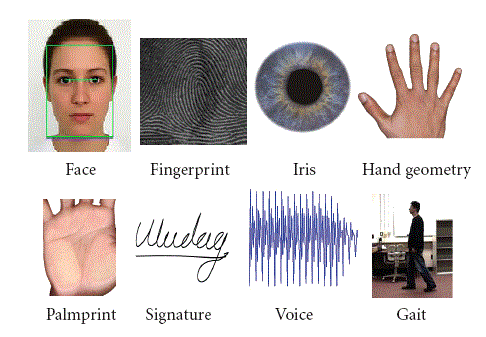
If you’ve read my writings for any length of time, you know that I believe that any single authentication factor is not a reliable method of authenticating someone. Multifactor authentication, in which you use more than one of the five authentication factors, is a much stronger method. It’s possible to spoof any single authentication factor (a gummi fingerprint, a fake driver’s license, etc.), but it’s much harder to spoof multiple factors.

No, they don’t have ridges. By Thomas Rosenau – Own work, CC BY-SA 2.5, https://commons.wikimedia.org/w/index.php?curid=685011

Please note that I am referring to multiple FACTORS, not multiple TYPES OF BIOMETRICS (for example, authenticating finger and face and declaring victory). All biometrics fit within the “something you are” category, and it’s much better to combine this factor with one or more of the other four: something you know, something you have, something you do, and somewhere you are. Or perhaps use two factors other than biometrics. The important thing is that you use multiple factors.

What of the vendor that only offers one type of biometric authentication? Or the vendor that only offers biometric authentication? Or the vendor that only processes secure documents? Or the one with really strong password protection schemes? Well, in my humble opinion these vendors need to partner with other vendors who support other authentication factors, to ensure delivery of a robust solution.

Julie Pattison-Gordon made many of these points in a recent GovTech article, “Cyber Refresher: Understanding Multifactor Authentication.” But she made two additional points that are worth mentioning.

Friction and authentication

The first point that Pattison-Gordon makes is the following:

Agencies may need to consider how their selection of authentication methods creates or avoids friction for employees.

Friction, in which a task becomes hard to perform, is bad.

Not sure how Jack feels now that the Lakers are, um, subpar. By May be found at the following website: http://www.impawards.com/2003/anger_management.html, Fair use, https://en.wikipedia.org/w/index.php?curid=11893883

Some authentication methods have, or can have, more friction than others. For example, some password implementations require use of characters from the Roman, Greek, and Cyrillic alphabets and require you to change your password daily. (I exaggerate only slightly.) Older iris readers required you to put your head directly against the reader, like if you were at an opthamologist’s office. Even today, most fingerprint readers require you to touch your finger against a platen. (There are exceptions.)

But why worry about friction? After all, if someone’s required to perform some type of authentication, they’re going to do it regardless of how hard it is.

Oh no they’re not:

Speaking during a panel last month, Delaware Chief Security Officer Solomon Adote said that workers who find MFA processes too cumbersome may adopt unsafe workarounds, such as storing official files on personal devices to let them skip login procedures entirely.

This is worse than an abandoned shopping cart, since it’s the abandonment of an entire security infrastructure. When security is too cumbersome, the result is little or no security at all.

I feel safe now. By IMP Awards, Fair use, https://en.wikipedia.org/w/index.php?curid=42298113

It is possible to improve all authentication methods to reduce friction. Strong yet easy passwords that you don’t have to change all the time. “On the move” capture of all sorts of biometrics, including fingerprints, faces, and irises. The ability to read information on secure documents without sliding them through a card reader (yet incorporating protections against unauthorized reading of the data).

Trust me – frictionless will make people happier and will cause them to use your security methods without objection.

Emerging threats and authentication

Pattison-Gordon makes a second point:

Organizations must also weigh the cyber threats facing each type of authentication, as malicious actors continue evolving their strategies.

No authentication method is foolproof, and every authentication method attracts one or more threats. I’ve mentioned some in passing in this post, such as “gummi fingerprints” in which someone creates a fake fingerprint with the ridge detail from a true fingerprint. Pattison-Gordon mentions another threat, SIM swapping.

There are ways to deal with these two threats. For example, if a gummi fingerprint is literally a piece of non-organic material, there are various methods of liveness detection (tempreature, heartbeat detection, skin features) that can identify the fingerprint as fake.

However, this does not solve the problem, since some day some fraudster will create a fake fingerprint that appears to have human skin, a temperature, a detectable heartbeat, and everything else that a real fingerprint will have.

Security is a constant war between the fraudsters who develop a hack, the cybersecurity folks who develop a block to the hack, and the fraudsters that develop a new hack that avoids the block to the previous hack. No authentication method is foolproof.

This is one of the benefits of multifactor authentication. When this is used, then the fraudster needs to hack something you are AND something you know AND something you have AND something you do AND somewhere you are. MFA hacking is not impossible, but it is much, much more difficult than hacking a single factor.

And you also have to keep up with the latest hacks and continue to research. Don’t quit researching an authentication method just because it seems great now.

(A couple of you may know why I said that.)

About THAT Reuters article

I intentionally chose an obscure title for this post.

I could have entitled the post “Ricardo Montalban.” Just because.

In a more relevant way, I could have entitled the post “Former IDEMIA employee weighs in on Advent’s possible sale of the company.” That would have got some clicks, to be sure.

But it would have misled the reader, because the reader would have gotten the idea that I have some expertise in corporate acquisitions, and an abillity to predict them.

And as past history has shown, I do not have any such expertise.

  • In 2000, I was completely and totally surprised when I learned that Printrak wanted to sell itself to Motorola. I didn’t have a clue that any such thing was going to happen.
  • In 2008, I was reading online late one evening and was completely and totally surprised when I learned that Motorola wanted to sell off half of Printrak to the French company Safran, the Sagem Morpho folks. Yes, Motorola was in trouble, but I didn’t have any idea that we would be sold off.
  • Years later, I was kinda sorta surprised when Safran decided that it wanted to get rid of its entire identity and security business, and was completely and totally surprised when the buyer was an American investment firm that owned Oberthur Technologies.

So my record on really understanding these acquisitions is pretty low.

With that caveat, I’ll go ahead and use a really eye-catching SUBtitle. Better late than never.

Former IDEMIA employee weighs in on Advent’s possible sale of the company

Impressive, isn’t it?

But before proceeding, I should let you know about THAT Reuters article that I referenced in the real post title.

On Friday, Reuters published an exclusive article entitled “Advent gears up for $4.6 bln sale of French biometrics firm IDEMIA – sources.”

So who is Advent?

Advent (actually, Advent International) is the American investment firm that I mentioned earlier. As an investment firm, its purpose in life is to buy businesses, improve them, and sell them for a profit.

Back in 2011, Advent bought Oberthur Technologies with this intent. To that end, Advent announced in 2015 that Oberthur Technologies planned an Initial Public Offering. Within a month, those plans were shelved. Advent determined that an Oberthur IPO wouldn’t do so well.

So Advent began thinking about ways to make Oberthur more attractive.

At the same time, Safran was trying to decide what to do with its identity and security business. The purchase of Printrak was just a blip in Safran’s plans, as it acquired L-1 Identity Solutions (renamed MorphoTrust) and other businesses. But Safran is not an identity and security company. It’s a “de plane” company.

By ABC Television – eBay itemphoto frontphoto back, Public Domain, https://commons.wikimedia.org/w/index.php?curid=20143137

And Safran is also a defense company to protect France and other countries from evil forces.

The identity part of the business was clearly the odd one out. Heck, rich Corinthian leather would have fit better into the Safran product line.

By dave_7 – originally posted to Flickr as Chrysler Cordoba, CC BY 2.0, https://commons.wikimedia.org/w/index.php?curid=6890171

OK, I’ll stop now.

Anyway, in the end Advent announced in 2016 that it had entered into an agreement to negotiate the purchase of Safran’s identity and security business. The purchase was completed on May 31, 2017, and Advent combined Oberthur (OT) and the portion of Safran (Morpho) into OT-Morpho, which was quickly renamed IDEMIA.

I was an employee of IDEMIA at the time, and I don’t think I’m spilling any company secrets if I reveal that Advent wanted IDEMIA to do really really well, so that it could make a profit on the two acquisitions. I wasn’t at the highest executive level that was setting the high-level strategy, but I was often working on initiatives to help realize Advent’s profitability goal.

The possibility of an IDEMIA IPO or sale receded somewhat in early 2020. Among other things, COVID adversely affected two of IDEMIA’s core businesses in the United States, TSA PreCheck (nobody was flying) and driver’s licenses (the DMV offices were all closed).

Back to THAT Reuters article

Fast forward to 2022 and Reuters’ exclusive revelations.

Advent International is looking to sell its French biometrics and fingerprint identification firm IDEMIA in a deal worth up to $4.6 billion as it seeks to capitalise on growing demand for cybersecurity assets in Europe, two sources told Reuters.

The U.S. buyout fund is reviewing a series of options to sell IDEMIA, including a possible break-up of the company which was formed in 2016 by combining Safran’s identity and security business with Oberthur Technologies, the sources said.

From https://www.reuters.com/business/exclusive-advent-gears-up-46-bln-sale-french-biometrics-firm-idemia-sources-2022-02-04/

As you, the wise reader, know, Reuters goofed here.

IDEMIA was NOT formed in 2016. The formation of IDEMIA was ANNOUNCED in 2016, but the deal wasn’t actually COMPLETED until 2017. Hey, at least Biometric Update got it right.

Anyway, if you read either Reuters or Biometric Update, you’ll learn that nothing is going to happen immediately (France is holding an election in April, and the composition of the new government could impact any sale), and that the possible split-up may separate the part of the business that sells to governments from the part that sells to commercial firms.

Of course, the big question about any sale of IDEMIA would be the identity of the buyer. Would Advent try (again) to issue an IPO, or would Advent look for one or more existing companies to purchase IDEMIA?

Both Reuters and Biometric Updare speculate that Thales could be a potential buyer. While Safran was slimming down to concentrate on its aircraft business, Thales has been beefing to to diversify its business, most notably in its purchase of Gemalto. (As people in my industry know, that purchase provided Thales with the technology of the old Cogent Systems.)

However, there are two possible issues with a Thales purchase of all or part of IDEMIA.

  • Antitrust issues. Automated fingerprint identification systems isn’t the only product that Thales and IDEMIA have in common. For example, both companies provide driver’s licenses in the United States. As any Thales purchase of IDEMIA is considered by the United States, France, and dozens of other countries, the deal could be opposed on antitrust grounds. This can be mitigated by limiting what Thales can buy, but it could complicate matters.
  • Thales is French. Some of the driver’s license and biometric technology that IDEMIA sells was developed in the United States, and is used by many government agencies, including the Federal Bureau of Investigation and the Department of Homeland Security. At present, while IDEMIA is headquartered in France, it is primarily owned by Americans, so there’s a teeny bit of comfort in that. But what if a French firm were to own IDEMIA? The horror! (Many years ago, when Cogent Systems first sold itself, it intentionally chose a U.S. buyer, 3M, for this very reason.) Never mind that the U.S. government has been using French (and Japanese) technology for years, and that some very specific arrangements have been set up to mitigate the risks of foreign ownership. Some Senator or another is guaranteed to raise a big stink if U.S. government institutions are dependent upon a French company.

So perhaps Thales could buy all or part of IDEMIA, or perhaps it may pass. But if Thales passes, are there any U.S.-owned companies that may have an interest in IDEMIA’s technology?

Because of my biometric bias, the first thing that I would consider would be American companies that are active in the biometric market. However, many of the U.S. companies are small, and don’t have a few billion dollars lying around to buy IDEMIA. So don’t look for Aware, Clearview AI, Paravision, Rank One Computing, or the like to be a buyer.

There are of course much bigger U.S. firms in high tech that have dipped their fingers into the biometrics market. Amazon, Apple, Facebook, Google, and Microsoft all come to mind. However, those same customers that are of prime concern to U.S. Senators are also or prime concern to the employees of some of those firms, who don’t want their employers to do business with the “evil” Department of Homeland Security or even the “evil” local police departments that should all be defunded. (Amazon quit selling Rekognition to police agencies, for example.) Even Apple, which is developing its own digital driver’s license technology, is probably reluctant to own IDEMIA.

But there’s one tech company that intrigues me as possibly having an interest in IDEMIA.

Oracle.

It’s big enough to make the purchase, certainly likes to make acquisitions, and has no hesitation about working with government agencies.

ANY government agency.

After all, the name “Oracle” came from a database project that Ellison worked on before founding the company with the same name.

His client was the Central Intelligence Agency.

If you’ve paid attention to this article, then you already know that since I have speculated that Oracle could purchase IDEMIA, that puts the chances of Oracle actually purchasing IDEMIA at zero.

And for all we know, Reuters’ two sources might be unreliable, or something else might happen (another COVID variant?) that could cause Advent to hold on to IDEMIA for a few more years.

So we’ll have to see what happens.

When I will style myself John E. Bredehoft, CF APMP…and when I won’t

TL;DR: Yesterday I achieved APMP® Bid and Proposal Management Foundation 2021 certification.

This post explains what APMP Foundation certification is, why I pursued the certification, the difference between APMP and APMG, and when I will (and will not) use my shiny new “CF APMP” designation.

What is APMP Foundation certification?

First, for those not familiar with the acronym, “APMP” stands for the Association of Proposal Management Professionals, an organization that I re-rejoined back in July. APMP membership provides many benefits, including improved service to Bredemarket clients because of my access to the APMP Body of Knowledge.

It also provides a mechanism for proposal professionals to certify their mastery of the proposal field. And, as APMP itself notes, certification conveys the following:

Demonstrates a personal commitment to a career and profession.

Improves business development capabilities.

Creates a focus on best team practices.

Gains the respect and credibility of peers, clients and organizational leaders and, in some cases, additional compensation.

Reinforces bid/proposal management as an important role within an organization and not as an ad hoc function that anyone can perform. 

Frankly, most of these won’t matter to YOU, but the process required to achieve certification does improve business development capabilities for Bredemarket’s clients. You can ignore the rest, unless you’re suddenly eager to shower additional compensation on me. I won’t argue.

There are multiple levels of APMP certification, and the very first level is “Foundation” certification. There is an eligibility requirement to pursue this certification, however:

Candidates should have at least one year of experience in a bid and proposals environment; this experience does not have to be continuous. Time spent working or supporting sales and marketing also counts.

So I was eligible to pursue Foundation certification years ago…but I never did.

Why did I pursue APMP Foundation certification?

I already wrote about this on LinkedIn a week ago, but if you missed that explanation here’s an abbreviated version.

Over the years I kept on joining APMP while in a proposals position, then letting my APMP membership lapse when I transferred to a non-proposals position. So by the time I ever thought about seriously pursuing APMP Foundation certification, I was already out of proposals.

This time, I said to myself when I re-rejoined in July, it will be different.

I finally made the move after attending SMA’s weekly town hall and hearing Heather Kirkpatrick present on the various APMP certification levels.

But I acknowledged that certification is not universally desirable:

Yes, I know the debates about whether certifications (or, for that matter, formal education in general) are truly worthwhile, but there are times when checking off that box on that checklist truly matters.

And therefore I began reading the two documents that I had just purchased, including a study guide and a glossary of terms.

Why is the APMG involved in APMP stuff?

However, to actually achieve the certification, I didn’t go to the APMP itself, but to an organization called the APMG.

And no, the APMG was NOT established to confuse proposal practitioners by using a similar acronym. (Seriously; when I saw others’ announcements of proposal certification, I couldn’t figure out why they kept getting the APMP acronym wrong.)

The APM Group is actually a completely separate organization that provides certifications and other services for a number of disciplines. It serves aerospace, business, information technology, cybersecurity, and other disciplines.

In my case, once I had studied and taken a practice exam, I proceeded to sit for the real exam itself…after paying another fee.

(This is why some people oppose certifications; they think they’re a racket just to charge fees all over the place. But I had already determined that in this case, the return on investment would be positive.)

Well…I passed, and therefore can direct interested parties to my shiny new badge.

By the way, I was never asked to provide a reference to verify my experience, but I could have provided dozens of references if asked.

What about the shiny new designation that comes with the shiny new badge?

Oh, and there’s one more thing.

Certified people (as opposed to people who are certifiable) have the option of appending their certification to their name. In the business world, you often see this used by people who have achieved Project Management Professional (PMP) certification. In some countries, MBAs and even BAs append the appropriate designation to their names.

In the same manner, those who have achieved one of the APMP certifications can append the appropriate certification. In the case of APMP Foundation certification, that means that I can style myself as “John E. Bredehoft, CF APMP.” (Or “John E. Bredehoft, MBA, CF APMP, RSBC” if I want to be thorough. But I probably won’t, since “RSBC” stands for “Radio Shack Battery Club.”)

However, the “CF APMP” designation only makes sense if the person reading the designation knows what it means. And it’s a fairly safe bet that if I were to walk into a coffee shop, or even into the main office of a marketing firm, the people there would have no idea what “CF APMP” meant. In fact, it might strike some of them as pretentious.

But it DOES make a difference in some (not all) proposal circles.

Including the attendees at the APMP Western Chapter Training Day next month.

Which I really should attend if possible. After all, I need to maintain my Continuing Education Units (CEUs) to keep my certification up to date.

This one won’t count for my Foundation certification renewal, but it’s nice.

The five authentication factors

(Part of the biometric product marketing expert series)

I thought I had blogged about the five factors of authentication, either here or at jebredcal, but I guess I haven’t explicitly written a post just on this topic. (You’d expect an identity content marketing expert to do that.)

And I’m not going to do that today either (at least in any detail), because The Cybersecurity Man already did a good job at that (as have many others).

However, for those like me who get a little befuddled after authentication factor 3, I’m going to list all five authentication factors.

  • Something You Know. Think “password.” And no, passwords aren’t dead. But the use of your mother’s maiden name as an authentication factor is hopefully decreasing.
  • Something You Have. I’ve spent much of the last ten years working with this factor, primarily in the form of driver’s licenses. (Yes, MorphoTrak proposed driver’s license systems. No, they eventually stopped doing so. But obviously IDEMIA North America, the former MorphoTrust, has implemented a number of driver’s license systems.) But there are other examples, such as hardware or software tokens.
  • Something You Are. I’ve spent…a long time with this factor, since this is the factor that includes biometrics modalities (finger, face, iris, DNA, voice, vein, etc.). It also includes behavioral biometrics, provided that they are truly behavioral and relatively static.
  • Something You Do. The Cybersecurity Man chose to explain this in a non-behavioral fashion, such as using swiping patterns to unlock a device. This is different from something such as gait recognition, which supposedly remains constant and is thus classified as behavioral biometrics.
  • Somewhere You Are. This is an emerging factor, as smartphones become more and more prevalent and locations are therefore easier to capture. Even then, however, precision isn’t always as good as we want it to be. For example, when you and a few hundred of your closest friends have illegally entered the U.S. Capitol, you can’t use geolocation alone to determine who exactly is in Speaker Pelosi’s office.

Now when these factors are combined via multi-factor authentication, there is a higher probability that the person is who they claim to be. If I enter the password “12345” AND I provide a picture of my driver’s license AND I provide a picture of my face AND I demonstrate the secret finger move AND I am within 25 feet of my documented address, then there is a pretty good likelihood that I am me, despite the fact that I used an extremely poor password.

I don’t know if anyone has come up with a sixth authentication factor yet. But I’m sure someone will if it hasn’t already been done. And then I’ll update to update this post in the same way I’ve been updating my Bredemarket 2021 goals.

Fame, fortune, or both? Gradations of synthetic identity fraud, with a North Hollywood company as an example

In many cases, identity fraud is accomplished by a bad actor impersonating the identity of another person. Many people have found unauthorized credit or debit card transactions that they didn’t perform, and have had to shut down and re-open their cards as a result.

However, there are other cases in which the identity fraud is accomplished by inventing a “person” out of whole cloth. Or partial cloth; a real piece of identity, such as a legitimate U.S. social security number, is combined with fake information, such as non-existent addresses, stock photography headshots, and unverified social media accounts.

The process could be less rigorous, such as creating a Twitter bot to inflate followers (no government ID needed), or it could be more rigorous, in which the synthetic identity gains legitimate credentials such as passports (although this is becoming more difficult as facial recognition compares applicant faces to existing faces).

Synthetic identity fraud can be damaging. Henry Engler of Thomson Reuters (not Thomas Reuters) cites a figure of $6 billion in losses to U.S. lenders from synthetic identity fraud.

But sometimes the fraud, while still fraudulent, is relatively innocuous.

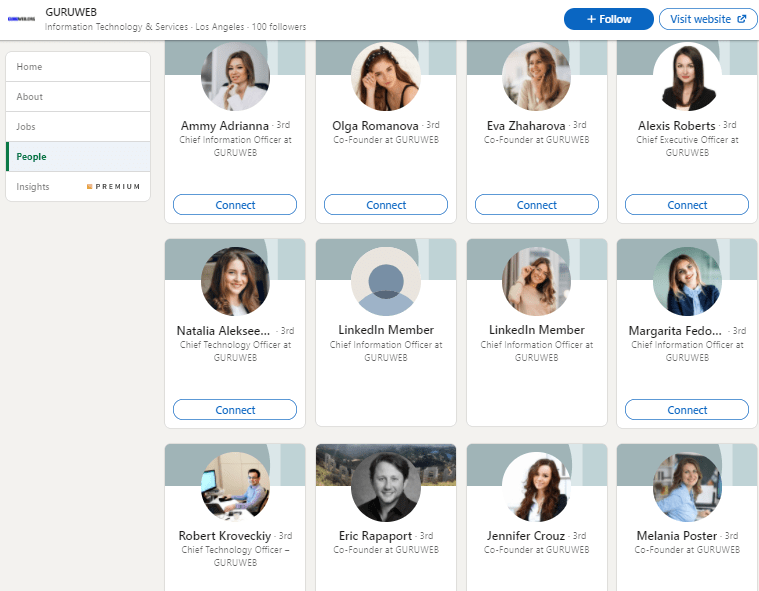
Take the case of a particular web design company in North Hollywood, California. If you visit its website (which, oddly enough, is on the “org” domain), the only listed contact for the company is a guy named Eric.

It’s a whole different story on LinkedIn, however.

According to LinkedIn, the company has dozens of employees, including a vast number of co-founders, chief technology officers, and chief information officers. While some are based in Los Angeles, others are based in Chicago, Dallas, Maidenhead, Kyrgyzstan, and other exotic locations. Most remarkably, based upon some of the employee pictures, the company goes over and above in its attempts to attract female technologists. It’s a statistical anomaly!

Under normal circumstances, this remarkable string of oddities would have gone completely unnoticed. I have never interacted with any of these employees, and they don’t seem to be all that active on the LinkedIn platform. Well, with some exceptions; the Chicago-based CEO of the company has made a valuable contribution to the LinkedIn discussion.

Now most of this went under the radar, until a number of LinkedIn employees made connection requests to a particular individual. Unfortunately, this particular individual was Kris’ Rides, a cybersecurity specialist with Tiro Security.

(Before you ask whether Rides himself is a bot, I should note that he has received 40 recommendations on LinkedIn from people that appear to be real, and has amassed over 500 connections. So if Rides is a bot, he is a very effective one.)

When Rides received these connection requests (including two CTOs and two CIOs at the same company), they struck him as odd. So he shared his experience with his connections, which included other cybersecurity professionals, and people (such as me) who were connected to those other cybersecurity professionals. And they’re talking.

Pro tip: if you’re engaging in synthetic identity fraud, don’t reach out to a cybersecurity professional.

Now this story probably won’t be a trending topic on Twitter, even if the bots try to make it so, but it’s certainly gaining traction in the audience that counts: namely, technology experts who have the power to tell LinkedIn and others about questionable marketing techniques.

So what happens next? A mea culpa from Eric (or whatever his or her real name is)? Time will tell.

Words matter, or the latest from the Security Industry Association on problematic security terms

I may have accidentally hit upon a post series.

In my previous installment of “Words Matter,” published a little over a month ago on November 12, I described how Simon A. Cole made a distinction between words such as “decision,” “interpretation,” and “findings” when talking about how forensic results are described. The passage of time, and the perceptions that change over time, affect how words are used.

There are other examples of how perceptions change over time. Those of us who were alive in the 1960s may remember how the cigarette advertisement phrase “you’ve come a long way, baby” was initially perceived as a liberating, feminist phrase.

Similarly, those of us who were alive in the 1960s may remember that the Washington Redskins were infamous for being the last NFL team in the modern era to add a black player to its roster. The fact that the Washington Redskins were the Washington REDSKINS was not a matter of concern for most people. (Now is the time for a confession: even today, I own a Washington Redskins keychain and a Washington Redskins cup. But I don’t flaunt my ownership of these items.)

Let’s move to the tech world, in which terms that were OK with most people a few years ago are now questionable. The Security Industry Association has compiled a list of some common security terms which, in the SIA’s view, exhibit “language bias.”

Now I’ll be the first to admit that the SIA’s view is not a universal view. There are a number of people who would reply “get over it” if someone objected to one of these terms. (At the same time, there are a number of people who wonder why these terms were ever adopted in the first place.)

I’ll confess that, with the exception of master/slave, I hadn’t really thought about the offensiveness of these terms. And I wondered if the proposed replacement terms would prove to be clunky and unusable.

Well, in my opinion, the SIA did a pretty good job in proposing some new terms that are workable without being offensive. Take the SIA’s proposed replacement for master/slave, for example. The SIA’s proposal to remove the “language bias” that references slavery in the United States and other nations is to substitute the word “primary” or “commander” for “master,” and “secondary” or “responder” for “slave.” The replacement terms convey the security meaning well.

Here are some other proposed terminology changes from the SIA:

  • Change “blacklist” to “blocklist.” Heck, this is just a one letter change.
  • Change “whitelist” to “allowlist.” Perhaps it seems a teeny bit clumsy on first reading, but this would definitely work.
  • Change “black hat” and “white hat” to “bad hat” and “good hat,” or alternatively to “malicious hacker” and “ethical hacker.” Incidentally, the alternative terminology effectively dodges another issue that is unrelated to race or sex bias, namely whether “hacker” and “malicious hacker” are synonyms.
  • For connectors, change “male” and “female” to “plug” and “socket.” This probably conveys the meaning better than the original terms did.

Now the Security Industry Association is just one entity, and I’m sure that other entities are coming up with other terms that replace the older terms. As of today, Wikipedia lists 11 different replacement pairs for master/slave alone, including primary/secondary (BIND), primary/replica (Amazon and Microsoft, among others), provider/consumer (OpenLDAP), and others. There are also multiple alternatives to blacklist/whitelist, including the aforementioned blocklist/allowlist, and other pairs such as deny list/allow list and block list/allow list (with spaces).

All of these suggestions are going to float around and compete with each other, and various trade associations, governments, and other entities are going to adopt one or more of these, causing people who do business with these associations/governments/entities to adopt them also. And there will be the usual debate in those places where standards, like sausages, are made.

After all of these standards battles are complete, which set of terms will prevail?

That’s easy.

LOS ANGELES – MARCH 14: Guest arrives for the 2019 iHeartRadio Music Awards on March 14, 2019 in Los Angeles, California. (Photo by Glenn Francis/Pacific Pro Digital Photography). By Toglenn (Glenn Francis) – This file has been extracted from another file: Taylor Swift 2 – 2019 by Glenn Francis.jpg, CC BY-SA 4.0, https://commons.wikimedia.org/w/index.php?curid=81523364

The terminology adopted by Taylor Swift will be the terminology that will be adopted by the rest of the world.

Sorry, SIA, but the general population cares much more about what Taylor Swift believes. Perhaps if SIA changed its acronym to TAYLOR, things would be different.

Swift (not to be confused with the Society for Worldwide Interbank Financial Telecommunication) is today’s Oprah Winfrey, and unlike Winfrey is referenced by cybersecurity practitioners.

And she can write a catchy chorus.