After creating my textual “Customer Focus and Employee Focus,” I used Facebook to repurpose the Imagen 3-created images as a short reel, “Do your prospects believe your claimed employee focus?”
See my original post for the answers to these and following questions:
Do J.P. Morgan Chase’s employees matter to Jamie Dimon?
Do Meta’s employees matter to Mark Zuckerberg?
Do federal employees matter to Elon Musk and Donald Trump?
Do Virgin employees matter to Richard Branson?
The song is Nick Gallant’s “Gonna Need A Little Help.”
Do your prospects believe your claimed employee focus?
When you market to your prospects and customers, will they believe what you say? Or will you be exposed as a liar?
The Bredemarket blog has talked incessantly about customer focus from a marketing perspective, noting that an entity’s marketing materials need to speak to the needs of the customer or the prospect, not the selling entity.
But customer focus alone is not enough. When the customers sign up, they have to deal with someone.
Unless the customer is stuck in answer bot hell (another issue entirely), they will deal with an employee.
The expendables
And some employees are not happy, because they feel they are expendable.
“Every area should be looking to be 10% more efficient. If I was running a department with a hundred people, I guarantee you, if I wanted to, I couldn’t run it with 90 and be more efficient. I guarantee you, I could do it.”
So J.P. Morgan Chase is doing very well, Dimon is doing very well, but he’s implicitly saying that his people suck.
“This is going to be an intense year, and I want to make sure we have the best people on our teams. I’ve decided to raise the bar on performance management and move out low performers faster.”
You may have noticed my intentional use of the word “entity” at the beginning of this post. Because while businesses have attracted much attention in the current culture of “layoffs will continue until morale improves,” these businesses are themselves “low performers” in the shedding people category. Chief DOGE Elon Musk, fresh from reducing X’s headcount, is coordinating layoffs in the public sector.
“Federal agencies were ordered by Donald Trump to fire mostly probationary staff, with as many as 200,000 workers set to be affected and some made to rush off the premises.”
Zuckerberg could only dream of saying “you’re fired” to 200,000 people. That dream would certainly increase his masculine energy, but for now Musk has trumped Zuckerberg on that front.
Do J.P. Morgan Chase’s employees matter to Jamie Dimon?
Do Meta’s employees matter to Mark Zuckerberg?
Do federal employees matter to Elon Musk and Donald Trump?
Regardless of the answer (and one could assert that they like the “good” employees and don’t want them to be harmed by the bad apples), their views are not universal.
The other extreme
Richard Branson (reportedly) does not put his needs first at the Virgin companies he runs.
Nor does he prioritize investors.
Oh, and if you’re one of Virgin’s customers…your happiness isn’t critically important either.
“So, my philosophy has always been, if you can put staff first, your customer second and shareholders third, effectively, in the end, the shareholders do well, the customers do better, and yourself are happy.”
You could argue that this is a means to an end, and that employee focus CAUSES customer focus. What if employee focus is missing?
“If the person who’s working for your company is not given the right tools, is not looked after, is not appreciated, they’re not gonna do things with a smile and therefore the customer will be treated in a way where often they won’t want to come back for more.”
Think about this the next time you have a problem with your Facebook account or at a Chase Bank or with your tax return.
Whether back office issues matter to customers
Of course I may be over reading into this, because I have said that the customer doesn’t care about your company. If you solve their problems, they don’t care if you’re hiring 200,000 people or firing 200,000 people.
If you solve their problems.
I can’t cite the source or the company, but I heard a horror story about an unhappy customer. The company had heavily bought into the “layoffs will continue until morale improves” philosophy, resulting in turnover in the employees who dealt with customers. When the customer raised an issue with the company, it made a point of saying that employee John Jones (not the employee’s real name) could have solved the customer’s problem long ago if the company hadn’t removed Jones from the account.
What about your company’s marketing?
So think about this in your marketing. Before you brag about your best places to work award, make sure that your prospect will see evidence of this in the employees they encounter.
“Our 8th annual LinkedIn Top Companies list highlights the 50 best large workplaces to grow your career in the U.S. right now. Fueled by unique LinkedIn data, the methodology analyzes various facets of career progression like promotion rates, skill development and more among employees at each company.”
Number 1 on LinkedIn’s April 2024 list? J.P. Morgan Chase.
You probably have meetings with potential customers. The common term for these meetings is the “discovery call.”
Because I’m contrarian, I never use the term “discovery call,” and instead just refer to a “30 minute content needs assessment.” I should add, a “FREE 30 minute content needs assessment.” (Although 99% of these initial meetings are free anyway.)
Whatever you call the meeting, your job in the meeting isn’t to be like Christopher Columbus and chart new lands and persist in the mistaken belief that you’re in China.
There is a well-known marketer who starts every one of their webinars with a five-minute introductory video that describes how great the marketer is. After sitting through a few of these introductions, I resolved to intentionally attend the next webinar five minutes later so that I didn’t have to sit through that again. But as time passed, I found I wasn’t attending any of the marketer’s webinars at all.
Another in-vogue term is “pain points,” and that’s a term that I actually DO use. The potential customer has a problem, and maybe Bredemarket can help solve it, or maybe Bredemarket can’t.
And I’m not going to know that if I don’t let the potential customer speak.
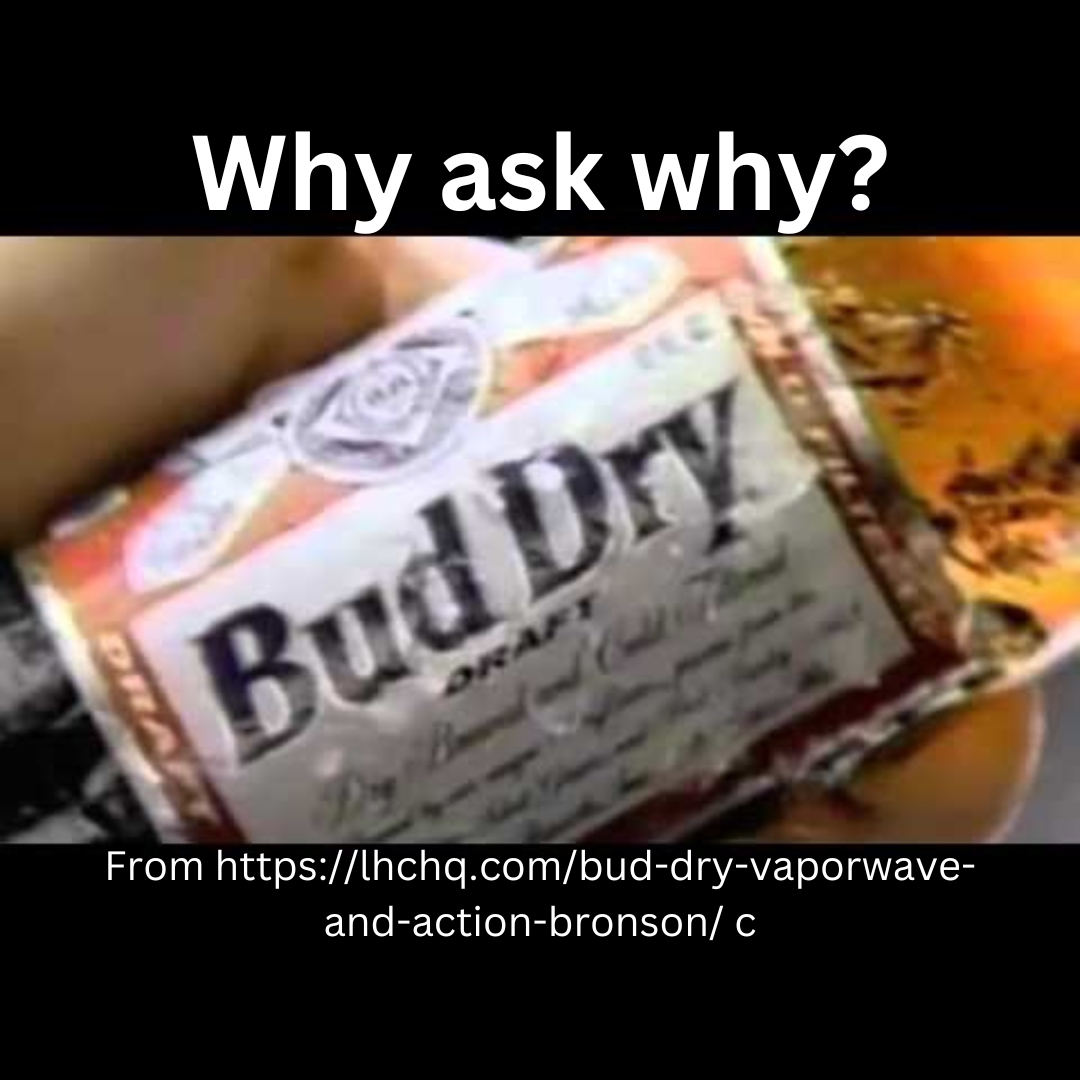
If you don’t remember, “Why ask why? Try Bud Dry” was a short-lived advertising tagline from a short-lived Budweiser product from some short-lived part of the early 90s…
But “why ask why” is not just an old advertising slogan. It’s also an excellent question in its own right.
If you’ve read my writing for any length of time, you know I spend a lot of time on the questions why, how, and what.
Heck, I even wrote a book about those (and three other) questions. Then I rewrote the book when I came up with a seventh question.
But during the last few years I failed to realize one true power of these interrogative questions—and other interrogative questions such as who (an important question for identity folks).
Due to the nature of my business, Bredemarket doesn’t usually get involved in strategy. The clients set the strategy, and I fill the tactical holes to execute that strategy.
But I recently welcomed the opportunity to envision a strategy to achieve a strategy, and in the process defined seven essential strategy documents to kick off a product marketing or general marketing program.
Depending upon how you define product marketing, one of these seven goes above and beyond the product marketing function. I included it anyway, because if you ask 20 people what “product marketing” is, you will get 21 answers.
There’s a reason I dated this. I may want to refine it in the future. For example, some of you may recall how my “six questions your content creator should ask you” eventually became seven questions.
The seven strategy and process documents
Go-to-Market Process. I’ve talked about this before, but it bears repeating. You can’t just slap a few things together in three days and say your go-to-market is complete. You need a plan on how you will go to market, including the different tiers of go-to-market efforts (you won’t spend four months planning materials for your 5.0.11 software release), the types of internal (employee) content you will release in each tier, and the types of external (prospect/customer) content you will release in each tier.
Performance Report. I listed this near the top because you need to quickly establish your metrics, define them, and how you will gather them. For example, if you want to measure “engagement,” you need to define exactly what engagement is (likes on a blog post? reshares on a LinkedIn post?), and ensure that you have a way to capture that data. Preferably automated data capture; manual tabulation is horrendous.
Product and Competitive Analysis. Plan how you will perform these duties. Even in my simplest analyses when I was still with IDEMIA, I planned exactly what data I needed, what data I wanted to capture, and how I was going to distribute it. I refined this during my time at Incode, when a team of four released battlecards in a standard format, with data that highlighted items important to Incode. My subsequent analyses for Bredemarket, which were more comparative rather than stand-alone, refined things still further.
Brand Strategy. I must confess that I have never created a formal brand book. But it’s important that you define your branding, at least informally, so that your products and services are presented consistently on all platforms. And so you spell things correctly (it’s NOT “BredeMarket”).
Customer Feedback. If you want to institute a customer focus, you need information from your prospects and customers. What information do you need? How much? (Shorter surveys get more responses.) How will you get it? What will you do with it? (“Trash it” is not an option.)
Positioning and Messaging Book. Once you’ve created the brand strategy, you need a set of consistent positioning (internal) and messaging (external) content. The positioning and messaging matrix can get pretty complex if you are supporting multiple products, personas, industries, use cases, and geographies. I will again confess that I do not have a standard messaging statement for Bredemarket 400 prospects who are Chief Marketing Officers who need blog posts in the identity/biometric industry discussing privacy concerns in the European Union. My loss.
Demand Generation and Content Marketing Parameters. Now in many organizations, demand generation and/or content marketing are separate from product marketing. But sometimes they’re not. What are your plans for demand generation? How will you achieve your goals? What content is necessary?
So what?
As I said, I recently had the opportunity to envision these strategies for a prospect, and have scheduled a meeting with the prospect to discuss these. (Note to “prospect”: these are iterative, and I fully expect that up to 90% of this may change by the time of implementation. But I think it’s a good starting point for discussion.)
The prospect may secure my services, or they may not.
And if they don’t, I can develop these same documents for others.
Do YOU need help defining strategies for your business? If so, let’s talk.
Bredemarket’s services are grouped into two distinct and separate functions: content marketing (blog posts, white papers, etc.) and proposals (RFI responses, RFP responses, sole source letters, etc.).
My division of my services makes sense in the real world. After all, in some employment situations, content marketing and proposals employ distinct and separate sets of employees.
But other companies are different. In fact, I’ve seen employment ads seeking marketing/proposals managers. Sounds like a lot of work, unless the company submits few proposals or performs minimal marketing.
And in many companies there are NOT dedicated proposals specialists. Which is why Bredemarket makes its money by helping the salespeople at these firms get the documents out.
Time for the truth
And if we’re truthful with ourselves, content marketing and proposals are pretty much the same thing.
I know this angers some people, who insist that they are content marketing professionals or proposal professionals, with all the proper certifications that a mere mortal could never attain. Or they did attain it, but it lapsed. Or is about to lapse unless I renew it in time.
But hear me out. I’m going to list four aspects of a particular document, and you tell me whether I’m talking about a piece of marketing content, or a proposal.
The document describes benefits the customer will realize.
The document targets one or more sets of people hungry for the solution.
The document shall be in Aptos 12 point, single spaced, with 1 inch margins, and shall not exceed 20 pages.
Guess what? From that description you CAN’T tell if it’s a piece of content or a proposal.
Yes, I know some of you thought item 4 was a dead giveaway because it sounded like an RFP requirement, but maybe some company’s brand guidelines dictate that the firm’s white papers must conform to that format. You never know.
And I know that when you get into the minutiae, there are certain things that proposal writers do that content marketers don’t have to worry about, and vice versa.
But at a high level, the content marketer already knows 90% of the things they need to know to write proposals. And vice versa.
During the 1980 Presidential campaign, when candidate Ronald Reagan was criticized for not knowing the difference between a recession and a depression, Reagan commented:
“Recession is when your neighbor loses his job. Depression is when you lose yours. And recovery is when Jimmy Carter loses his.”
From the perspective of Reagan and his supporters in 1980, technical definitions of recession vs. depression made no difference when you’ve lost your own job. “It’s only a recession, not a depression” doesn’t feed your family.
Remember to apply this customer focus when talking to your prospects. They have a particular way of looking at the world, and as far as they’re concerned it’s the right way. They may be wrong, but you may or may not be able to convince them of this. If you can, focus on things from the customer’s perspective.
Last week I prepared a presentation for a conference organizer, thinking that I would give the presentation at the conference in question. Instead, the organizer emailed the presentation slides to selected conference attendees. The attendees probably liked it that way.
But I still wanted to give the presentation.
And I also wanted to generalize the presentation so that it applied to ALL technology companies, not just the ones who were attending the conference.
So I recorded myself giving the presentation “Differentiating Your Company and Your Products/Services.” It’s ten minutes long, and you can view it now.
Differentiating Your Company and Your Products/Services (April 9, 2024)
If you’re watching this video on your laptop, be sure to keep your smartphone handy because at the end of the video I display a QR code to obtain more information. Just point your phone at the QR code.
Of course, if you’re watching this video on your smartphone, you can’t read the displayed QR code. So just go to https://bredemarket.com/drive-tech/ instead.
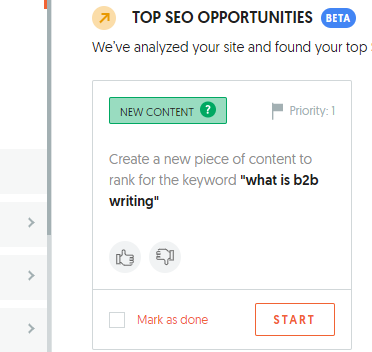
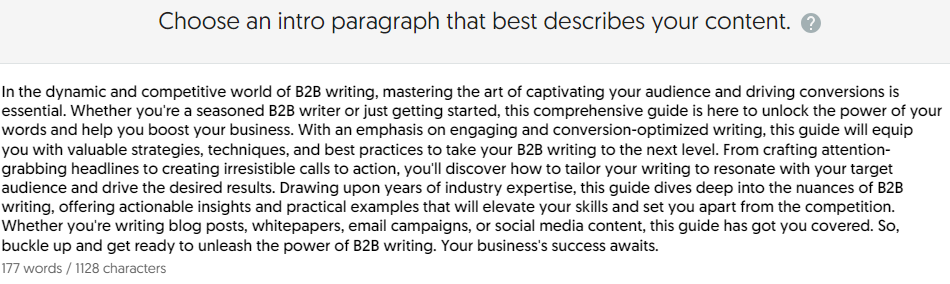
Um, thanks but no thanks. When the first sentence doesn’t even bother to define the acronym “B2B,” you know the content isn’t useful to explain the topic “what is B2B writing.”
Before I explain what B2B writing is, maybe I’d better explain what “B2B” is. And two related acronyms.
B2B stands for business to business. Bredemarket, for example, is a business that sells to other businesses. In my case, marketing and writing services.
B2G stands for business to government. Kinda sorta like B2B, but government folks are a little different. For example, these folks mourned the death of Mike Causey. (I lived outside of Washington DC early in Causey’s career. He was a big deal.) A B2G company, for example, could sell driver’s license products and services to state motor vehicle agencies.
B2C stands for business to consumer. Many businesses create products and services that are intended for consumers and marketed directly to them, not to intermediate businesses. Promotion of a fast food sandwich is an example of a B2C marketing effort.
I included the “B2G” acronym because most of my years in identity and biometrics were devoted to local, state, federal, and international government sales. My B2G experience is much deeper than my B2B experience, and way deeper than my B2C expertise.
Let’s NOT make this complicated
I’m sure that Ubersuggest could spin out a whole bunch of long-winded paragraphs that explain the critical differences between the three marketing efforts above. But let’s keep it simple and limit ourselves to two truths and no lies.
TRUTH ONE: When you market B2B or B2G products or services, you have FEWER customers than when you market B2C products or services.
That’s pretty much it in terms of differences. I’ll give you an example.
If Bredemarket promoted its marketing and writing services to all of the identity verification companies, I would target less than 200 customers.
If IDEMIA or Thales or GET Group or CBN promoted their driver’s license products and services to all of the state, provincial, and territorial motor vehicle agencies in the United States and Canada, they would target less than 100 customers.
If McDonald’s resurrects and promotes its McRib sandwich, it would target hundreds of millions of customers in the United States alone.
The sheer scale of B2C marketing vs. B2B/B2G marketing is tremendous and affects how the company markets its products and services.
But one thing is similar among all three types of writing.
TRUTH TWO: B2B writing, B2G writing, and B2C writing are all addressed to PEOPLE.
Well, until we program the bots to read stuff for us.
This is something we often forget. We think that we are addressing a blog post or a proposal to an impersonal “company.” Um, who works in companies? People.
(Again, until we program the bots.)
Whether you’re marketing a business blog post writing service, a government software system, or a pseudo rib sandwich, you’re pitching it to a person. A person with problems and needs that you can potentially solve.
So solve their needs.
Don’t make it complex.
But what IS B2B writing?
Let’s return to the original question. Sorry, I got off on a bit of a tangent. (But at least I didn’t trail off into musings about “the dynamic and competitive world.”)
When I write something for a business:
I must focus on that business and not myself (customer focus). The business doesn’t want to hear my talk about myself. The business wants to hear what I can do for it.
I must acknowledge the business’ needs and explain the benefits of my solution to meet the business needs. A feature list without any benefits is just a list of cool things; you still have to explain how the cool things will benefit the business by solving its problem.
My writing must address one, or more, different types of people who are hungry for my solution to their problem. (This is what Ubersuggest and others call a “target audience,” because I guess Ubersuggest aims lasers at the assembled anonymous crowd.)




















 Bredemarket