
Thank you.
Tag Archives: customer focus
We Don’t Need Customer Focus Because Our Product Is So Great
It’s always good to question previous thoughts, and that’s what I’m doing right now.
In the past, I’ve stated that the best way to attract awareness (and eventually revenue) is to focus on customers and their needs.
But what if I’m wrong? (I’ve been wrong before.)
The benefits of product focus
What if a stellar product is all that is needed to attract business and gain revenue?

After all, aren’t the benefits of a great product obvious at first glance?
If we stop with the claptrap of understanding our target audiences and pain points and stuff, and just focus on ourselves and our great product, we’ll have a clearly focused message…
…um…
…that no one will give a hoot about.
“OK, I’m glad that your Super Duper Gizmo is so great, but so what? What’s in it for me? Why should I care?”
I guess I was right when talking about customer focus.
Sure, talk about your product, but start with the customer first and their needs. Then say how your product benefits the customer, exceeds their needs, and delights them.
(So why did I write this piece of content? Neil Patel’s Ubersuggest…um, suggested that my website needed yet another article on customer focus. I thought I’d do something a little different this time.)
When You Wear a Blindfold, You Cannot See
I know that “when you wear a blindfold you cannot see” is one of those seemingly obvious truths, like “the heat was hot” (the band America) or “water is wet” (a preschool teacher).
You would never intentionally blindfold yourself while driving a car, or while performing any other activity that requires your vision.

But when we conduct business, do we unintentionally blindfold ourselves when we don’t focus on our customers’ needs?
The client who lost $100 million
Sometimes we are oblivious of our own actions.
Ali Al-Faraj wrote a LinkedIn post about the importance of cultural awareness. He started the post as follows:
I had a client who lost a $100M investment–
Because of slamming his hand on a table.
From https://www.linkedin.com/posts/alfaraj_i-had-a-client-who-lost-a-100m-investment-activity-7042162614579163137-VyDr/
Al-Faraq’s client was a “hardcore” American salesperson who was presenting to a Middle Eastern investment firm. His hardcore presentation didn’t go well, especially when he started slamming his hand on the table.
To see how the investment firm reacted, see the original post. (Although I guess you already figured out that the client didn’t get the money. Al-Faraq didn’t bury the lede.)
What the client did BEFORE he slammed his hand on the table
But when I read Al-Faraq’s description of the meeting, I realized that his client lost his audience long before the client pounded the table. Al-Faraq’s post includes this key sentence.
He dove into the presentation.
From https://www.linkedin.com/posts/alfaraj_i-had-a-client-who-lost-a-100m-investment-activity-7042162614579163137-VyDr/
Middle Easterners value cultivating relationships. In fact, this source asserts that “[i]nitial meetings are all about relationship building.” Diving into a presentation during the first meeting before your audience knows about you is understandably upsetting.
But this is not limited to business with Middle Easterners.
Diving into a presentation without understanding your audience is a serious mistake in any culture.
The Work Lady does her homework
Many years ago, before Motorola Solutions and Motorola Mobility were formed, there was one Motorola. And one year when I was at Motorola, our Biometric User’s Conference engaged Jan McInnis, The Work Lady, as one of our speakers.
When she spoke at our conference, McInnis did not just dive into her morning presentation unprepared. Before her session, she spent some time with the conference organizers and asked questions about her audience, so that she could understand them better and why this “AFIS” thing was so important to these people.
She didn’t just do that for us. It’s a standard part of her process.
Prior to the event, Jan has a conference call with your conference committee to incorporate specific challenges your group is facing into her keynote!
From https://theworklady.com/
Her homework makes all the difference for her audiences.
Focus on the customer
McInnis, Al-Faraq, and many of you understand that to have success with a customer, you have to understand the customer. As Ali Al-Faraq says: “Knowing your audience is key!”
Don’t intentionally blindfold yourself before approaching your customer.
How Bredemarket’s Six Questions Support Strategic Content Marketing
(UPDATE OCTOBER 23, 2023: “SIX QUESTIONS YOUR CONTENT CREATOR SHOULD ASK YOU IS SO 2022. DOWNLOAD THE NEWER “SEVEN QUESTIONS YOUR CONTENT CREATOR SHOULD ASK YOU” HERE.)
Just for fun, I’m going to challenge my assertion that there are six questions that your content creator must ask you before creating content.
I ought to know about these six questions. As a content marketing expert, I wrote the book on the topic.
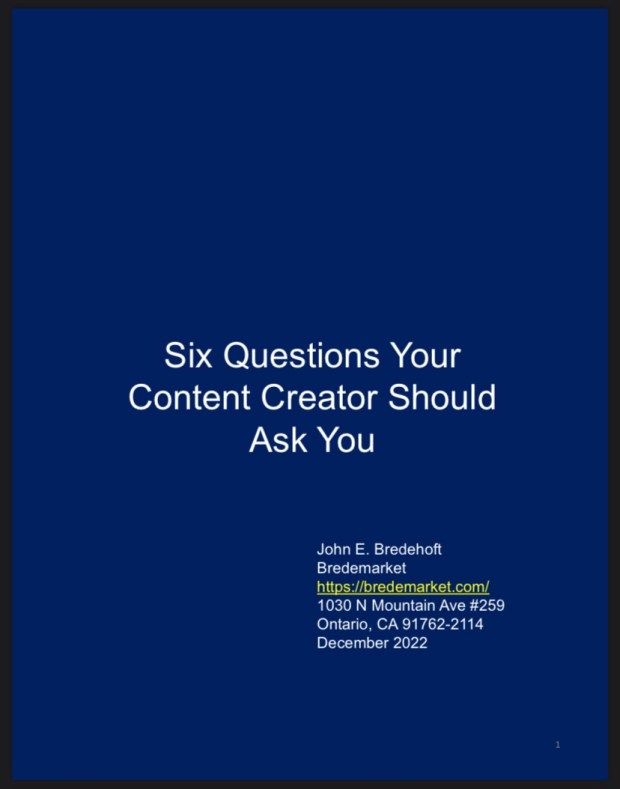
If you haven’t read the e-book, the six questions are:
- Why?
- How?
- What?
- Goal?
- Benefits?
- Target Audience?
The idea is that your content creator hosts a kickoff session, asks you the six questions, and only then starts to create the content in question—the blog post, case study, or whatever.
Are the six questions overkill?
But simplicity advocates may argue that those six questions are five questions too many.
Analysis paralysis may prevent you from moving forward at all, much less realizing your content creation goal. Perhaps you should be more efficient and just put pen to paper and, as the shoe people say, just do it.
I found a content marketing expert who agreed with this assertion, and wrote a post entitled “In marketing, move quickly.”
That content marketing expert was…well, it was me.
I ran across a local company (which I will not name) that issued a press release in December 2021. In part, the press release mentioned the local company’s new dedication to the marketing function.
From https://bredemarket.com/2022/03/23/in-marketing-move-quickly/
The company had hired an international marketing firm “to develop comprehensive marketing strategies….We expect their work to incorporate a website redesign, brand refresh, new strategic messaging and content, as well as focused video and digital campaigns.”
So, when I wrote the “In marketing, move quickly” post three months later, what had this international marketing firm accomplished in the interim?
The website has a full slew of data sheets on the company’s products, and I found a 2017 brochure that effectively served as a white paper. But that’s it; no other white papers, and no case studies describing happy customers’ experiences.
The company’s YouTube channel has two videos from 2021.
The company’s Facebook page hasn’t posted anything since 2017.
Neither of the company’s LinkedIn pages (yes, the company has two LinkedIn pages) has any posts.
From https://bredemarket.com/2022/03/23/in-marketing-move-quickly/
Now I have no visibility into this particular company, but I’ve been around the block to guess that the international marketing firm was probably still in the analysis stage, optimizing synergies according to “out of the box” criteria, to ensure bleeding-edge revenue maximization.
No, the six questions aren’t overkill
After reviewing what I wrote before in that blog post, I realize that my e-book lacks a very important point.
Don’t spend three months answering the six questions.
I shouldn’t HAVE to say this, but perhaps it’s safer to explicitly say it.
Now practices can very from consultation to consultation, but it’s very likely that a content creator and their client can breeze through those six questions in half an hour or less.
Or maybe the client can answer the questions on their own before the meeting.
If your content marketing expert schedules six one-hour meetings (or worse still, workshops) to address the six questions, run away!
(Is the content marketing expert billing by the hour?)
And the six questions create a content strategy
There’s something else that I failed to explicitly say in my e-book.
Not only do the answers to the six questions benefit that one piece of content, but they benefit everything else that your company does.
For example, let’s say that a content marketing expert is working with a gourmet ice cream shoppe (not a shop, but a shoppe), and the proprietor (Jane Cold) answers the “how” question as follows:
At Jane’s Gourmet Ice Cream Shoppe, we keep the internal dining temperature below 50 degrees Fahrenheit to ensure that our guests enjoy ice cream as it was meant to be enjoyed. We inform our guests of our temperature policy beforehand to ensure they bring proper attire.

Now let’s say that the piece of content in question is a social media post describing a new farkleberry ice cream flavor. (Thanks, Live Eat Learn.)

While the content marketing expert will use the answer to the “how” question to create the content, the ramifications go far beyond the social media post itself.
- Perhaps the new flavor could be branded “Frigid Farkleberry” to suggest how the ice cream should best be enjoyed.
- Maybe in addition to branding, the “how” answer may even influence pricing. Perhaps prices incorporate the number “32,” as in a single-scoop price of $4.32. (Yes that price is high, but after all this is an ice cream shoppe.)
And what of future social media posts?
Let me clue you in on a little secret: once your content marketing expert has asked the six questions for the first piece of content, the kickoff is much quicker for subsequent pieces of content.
Chances are the basic “why” and “how” won’t change, although some of the later questions such as the target audience could change for each individual piece of content.
So without explicitly trying to do so, the six questions have created a de facto content marketing strategy. After creating five pieces of content, you’ve essentially defined your company’s mission, purpose, and differentiators, and may have defined as many as five separate vertical markets along the way.
Not a bad investment of thirty minutes of time.
(But a terrible investment of three months of time.)
An exercise for you
Normally this is the point where I’d tell you to contact me if you want to use Bredemarket’s content marketing expertise. But this time I’m going to do something different.
- Why don’t you think of a piece of content you want to create?
- Once you’ve decided on that, why don’t you ask yourself the six questions?
- Once you have the answers, why don’t you see what type of overall content marketing strategy you can shape, solely based on those six responses?
Lockheed Martin’s Anti-biofouling Customer Focus
Businesses exist to serve their customers, something Lockheed Martin says when talking about itself.
Lockheed Martin’s customer-first mentality is a big way the company stands out from its competitors.
From https://www.lockheedmartin.com/en-us/news/features/2020/how-lockheed-martin-anticipates-customer-needs.html
It’s nice to claim a “customer-first mentality,” but Lockheed Martin has provided an example of how it demonstrates customer focus.
The problem
Here’s how Lockheed Martin defined the problem that one of its customers was facing.

Biofouling is the buildup of barnacles and microorganisms on ocean-going vessels such as ships and unmanned underwater vehicles (UUVs). This buildup is a naturally occurring process which can increase drag and decrease ship fuel economy, ultimately costing customers hundreds of millions of dollars. The United States Navy needs to eliminate biofouling growth along the underside of its ships, which involves a cleaning process that requires a ship to be out of commission for up to 18 months and hundreds of hours of manual labor.
From https://www.lockheedmartin.com/en-us/news/features/2020/how-lockheed-martin-anticipates-customer-needs.html
Maybe your customers aren’t quite as big as the United States Navy, but your customers have problems also, and they’re relying on you to solve them.
A solution from nature
For aeronautical engineer Joseph Keegan, the solution to the Navy’s problem lay in the sea snake.

Because defense contractors think about sea snakes all the time. Or at least Keegan did.
Keegan decided to apply for funding for a project that mimicked how a sea snake mitigates biofouling growth. The sea snake has a clever way to mitigate growth by organically shedding its skin to rid itself of biofouling growth and disease when the growth begins to affect its movement.
From https://www.lockheedmartin.com/en-us/news/features/2020/how-lockheed-martin-anticipates-customer-needs.html
OK, an ocean vessel isn’t going to literally shed its hull. But that’s why Keegan needed research funding. And the researchers came up with a solution, and started to test it.

A Lockheed Martin team took the idea from paper to prototype and went to Ventura Harbor, California to conduct static testing of a multilayer mylar skin on various surfaces including fiberglass, steel and aluminum. After leaving the prototype in the harbor for a little over a month, results confirmed that the films were effective in demonstrating that biofouling growth could be easily removed by peeling a layer of the film. The test was also successful in proving that the films did not allow for biofouling growth to occur between the multiple layers of film or underneath the four-layer prototype. No degradation to the films has been observed in the five months of testing.
From https://www.lockheedmartin.com/en-us/news/features/2020/how-lockheed-martin-anticipates-customer-needs.html
Anticipated benefits
While Lockheed Martin’s write-up includes the common researcher statement “further efforts are needed to successfully implement this biofouling film technology,” it looks like the project is moving forward.
And Lockheed Martin has already identified the benefits of the completed project. Not the benefits to Lockheed Martin, but the benefits to its customer, the U.S. Navy.
With the potential to reduce the time a Navy ship remains out of commission for cleaning, this nature-inspired design idea could…save money and enable greater mission readiness…
From https://www.lockheedmartin.com/en-us/news/features/2020/how-lockheed-martin-anticipates-customer-needs.html
Saving money and getting ships out to battle more quickly. Stuff that the Navy likes.
Of course this benefits Lockheed Martin also, but the company kept the focus on the Navy.
How does this apply to my company?
Even if your customers don’t battle biofouling barnacles, and even if your customers don’t face problems that put their equipment out of commission for 18 months or cost hundreds of hours in labor, there’s a lesson to be learned from Lockheed Martin’s customer focus.
- Keep your focus on your customer, not you.
- Describe the problem your customer faces.
- Define your solution to the problem.
- List the benefits your customer receives from your solution.
If your solutions benefit your customers, then you’ll receive benefits also.

Six questions your content creator should ask you
If you want a content marketing expert to write for your business, do you just say “Write this, and make it viral”?

Six words of instruction will not result in great content.
Even if you just say “Write this” and leave off the viral part, this will not work either.
You and your content creator have to have a shared understanding of what the content will be.
For example, as I indicated in a previous post, you and your content creator have to agree on the tone of voice to use in the content. The content creator could write something in a tone of voice that may not match your voice at all, which would mean that the content would sound horribly wrong to your audience.
Imagine a piece for financial executives written in the style of Crazy Eddie. Ouch.
And that’s just one thing that could go wrong when you and your content creator are not on the same…um, page.
Bredemarket’s content creation process includes six questions
When Bredemarket works with you to create content, I use a content creation process. I’ve revised my original content creation process several times, and I’m sure I’ll revise it more as I work with more of you.
But as of today, Bredemarket’s kickoff meetings with clients begin with six high-level questions that set the scene for everything that follows.
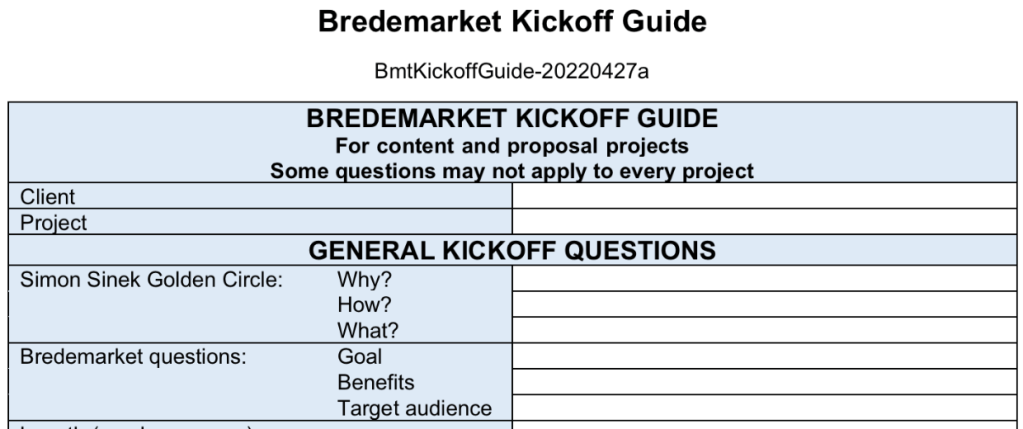
Question One: Why?
As I noted in my Simon Sinek post, the “why?” question needs to be answered before any other question is asked.

Before you ask a content creator to write a case study about how your Magnificent Gizmo cures bad breath, you need to understand why you’re in the good breath business in the first place. Did you have an unpleasant childhood experience? Were you abandoned at the altar? WHY did you care enough to create the Magnificent Gizmo in the first place?
(As I write this post, I’m going to look at how each of these six questions can be answered for the post itself. After all, it’s fair to ask: Why does Bredemarket do what it does? Short answer: because I write. You can pry my keyboard out of my cold dead hands. For the longer answer, read the “Who I Am” page on the Bredemarket website.)
Question Two: How?
You also need to make sure your content creator can explain how you do what you do. Have you created your own set of algorithms that make breath good? Do you conduct extensive testing with billions of people, with their consent? How is your way of doing things superior to that of your competitors?
(Now if you’re asking the “how” of Bredemarket, my content creation process is the “how.” After these initial six questions, there are other things that I do, and things that you do. Here’s how I create content of 400 to 600 words. Here’s how I create content of 2,800 to 3,200 words.)
Question Three: What?
Once these are clear in your mind, you’re ready to talk about the “what.” As Sinek notes, many people start with the “what” and then proceed to the “how,” and may or may not even answer the “why.” But when you ask the “why” first and the “how” second, your “what” description is much better.
(Again, you may be asking what Bredemarket does. I craft the words to communicate with technical and non-technical audiences. For additional clarification, read “What I Do,” which also notes what I don’t do. Sorry, finger/face/ID document vendors.)
Question Four: Goal?
Once the Golden Circle is defined, we’re ready to dig a little deeper into the specific piece of content you want. We’re not ready to talk about page count and fonts, yet, though. There’s a few other things we need to settle.
What is the goal of the content? Simple awareness of the product or service you provide? Or are you ready for consideration? Or is it time for conversion? The goal affects the content dramatically.
(In the case of this post, the goal is primarily awareness, but if you’re ready for conversion to become a paying customer, I won’t turn you away.)
Question Five: Benefits?
I’ve written ad nauseum on the difference between benefits and features, so for this question five about benefits I’ll just briefly say that written content works best when it communicates how the solution will help (benefit) the customer. A list of features will not make a difference to a customer who has specific needs. Do you meet those needs? Maintain a customer focus.
(Bredemarket’s primary benefit is focused content that meets your needs. There are others, depending upon your industry and the content you require.)
Question Six: Target Audience?
This one is simple to understand.
- If you’re a lollipop maker and you’re writing for kids who buy lollipops in convenience stores, you’ll write one way.
- If you’re a lollipop maker and you’re writing to the convenience stores who could carry your lollipops, you’ll write another way.
Now sometimes content creators get fancy and create personas and all that (Jane Smith is a 54 year old single white owner of a convenience store in a rural area with an MBA and a love for Limp Bizkit), but the essential thing is that you understand who you want to read your content.
(This particular piece is targeted for business owners, executives, directors, and managers, especially in California’s Inland Empire, who have a need to create focused content that speaks to their customers. The target audience not only affects how I am writing this post, but also how I will distribute it.)
What if you use a different content creator?
I am forced to admit that not everyone chooses Bredemarket to create their content.
- Maybe you create your content yourself.
- Maybe you already have access to content creators.
- Or maybe you have a limited budget and can only pay a penny a word to your content creator. Let’s face it, a five dollar blog post does sound attractive.
But that doesn’t mean that you can’t use these six questions. I did publish them, after all, and they’re based on questions that others have asked.
If you create your own content, ask yourself these six questions before you begin. They will focus your mind and make your final content better.
If you have someone else create your content, make sure that you provide the answers for your content creator. For example, if you seek a content creator on Upwork or Fiverr, put the answers to these questions in your request for quotes. Experienced writers will appreciate that you’re explaining the why, how, what, goal, benefits, and target audience at the very beginning, and you’ll get better quotes that way. If someone knows your target audience is crime scene examiners, then you’ll (hopefully) see some quotes that describe the writer’s experience in writing for crime scene examiners.
And if you provide the answers to those six questions and your content creator says, “That doesn’t matter. I write the same for everyone,” run away.

Maybe the resulting content will even go viral. (The good viral.)
What if you want to use Bredemarket?
Or perhaps you’ve decided that you don’t want to trust your content to someone on Upwork and Fiverr, and you want to work with me instead. After all, I can help you with white papers, case studies, blog posts, proposal responses, or other written content. (Well, unless the written content involves finger, face, driver’s license, or related identity services. There’s the day job, you know.)
Ah, we’ve moved from awareness to consideration. Great.
If I can work with you to create your written content, please contact me.
- Send me an email at john.bredehoft@bredemarket.com.
- Or go to calendly.com/bredemarket to book a Saturday morning meeting with me.
- Or go to bredemarket.com/contact/ to use my contact form.
And to make our meeting even smoother, start thinking about the answers to the six questions I posed above.
Users are not stupid; systems are
For years, I have been working with computer systems that are used by people. Sometimes I forget that, but then someone like Mike Rathwell reminds me of this fact. Just like Jake Kuramoto reminded me of that fact 12 years ago. It’s all about customer focus, after all.
Mike Rathwell says that users are not stupid
Mike, a former coworker of mine whom I’ve mentioned before, just wrote an article fpr Modus Create entitled “Why ‘Techsplaining’ is a Bad Idea for System Admins.”
Rathwell begins by asking why people administer Atlassian systems (or, frankly, any system).
…the real reason we are around to administer this particular system is because real humans are using this system to do real things. Without humans using this system to do real things, administering it is purely an academic exercise. As such, we are here to ensure that this particular system supports, and continues to support, doing these things.
From https://moduscreate.com/blog/system-admin/?utm_content=221412142
Fine, and water is wet. So what?
Perhaps there are those that think that the users of an Atlassian system are required to serve the needs of the system. That’s backwards. The Atlassian system is required to serve the needs of its users.
Even if they do stupid things and ask stupid questions.

Except they don’t.
Rathwell emphasizes that users do NOT ask stupid questions.
Be sure to read the rest of the article, which states that “techsplaining” is a bad idea also.
But I’m going to travel back in time to another instance in which users were called “stupid.”
Jake Kuramoto says that users are not stupid
Perhaps some of you remember this one.
Most of us access social platforms by performing some type of “login” process. Now logins can take many different forms (password, fob, biometric, whatever), but the process is basically the same.
- You go to a place on the Internet.
- You “login.”
- You are now able to access your social platform of choice.
Now some of us intuitively understand how to “go to a place on the Internet” and “login.”
And back in 2010, there was a group of people who had a sure-fire method of doing this. Specifically, they would go to this thing on their computer (they didn’t know what it was called, but it was on the computer), type “facebook login,” click on the link that came up, type in their login and password, and access Facebook.
Now “this thing on their computer” was the Google search page in their web browser of choice. And they would search for “facebook login,” and the first search result would happen to be facebook.com. Once they made it to facebook.com, they would type in their login and password.
This was a method that people had perfected, and it worked 100% of the time.
Until it didn’t.
Here’s Jake’s summary of what happened:
The short version is:
ReadWriteWeb posted “Facebook Wants to Be Your One True Login“.
Google indexed the post.
The post became the top result for the keywords “facebook login”.
People using Google to find their way to Facebook were misdirected to the post.
The comments on the post were littered with unhappy people, unable to login to Facebook.
From http://theappslab.com/2010/02/11/these-are-our-users/
(Incidentally, if you go to Kuramoto’s post, you’ll find a link to the ReadWriteWeb article. That link no longer works, primarily because ReadWriteWeb is now ReadWrite. Maybe the spiders sued. The current link as of 2022 is https://readwrite.com/facebook_wants_to_be_your_one_true_login/.)
So what broke down? When a new page became the top search result, people would NOT end up at facebook.com, but would instead end up at a ReadWriteWeb blog post. This blog post did NOT have anywhere to enter your Facebook login and password. So…Facebook is broken!
Now most if not all of the people reading my post right now know that you need to go to the facebook.com URL to log in to Facebook, and that you cannot log in to Facebook via (then) readwriteweb.com. But then again, the people that are reading my post right now actually know what the acronym “URL” means. (If you don’t, it stands for Uniform Resource Locator.)
Now find someone who doesn’t know the difference between a computer monitor and a web browser and explain to that person what a Uniform Resource Locator is.
Now there were two schools of thought on the whole ReadWriteWeb / Facebook login episode.
The one school of thought maintained that anyone who thought that they could login to Facebook via ReadWriteWeb was stupid, and that everybody should know to bookmark the facebook.com URL or type it into their browser rather than searching and running into an unbelievably successful SEO campaign.
But that school assumed that everyone knew what a URL is, or what SEO is. (Search engine optimization. Try explaining that one while you’re explaining Uniform Resource Locator.)
And Jake, despite his technical chops (he was with the Oracle AppsLab when he wrote this post), stated the same thought that Mike Rathwell would echo twelve years later.
I think it’s fair to say that computers shouldn’t make people feel stupid.
From http://theappslab.com/2010/02/11/these-are-our-users/
I say that users are not stupid
If you want to get to your favorite social platform, you shouldn’t have to know acronyms like SEO or URL or HTTPS. The only thing that you need to know is the name of the platform you want to access. (Otherwise you’ll end up at MySpace. Or Grindr.)
I’ll take it one step further. If the myriad of systems that make up your computer can’t figure out what you want to do, then it’s the computer and its many systems that are stupid, not you.
Now I just have to take Rathwell’s message to heart and avoid “techsplaining” myself.
And when I write, I need to continuously keep my customers (or, more accurately, my customers’ customers) in mind. I’m writing for them, not for me. Create messages that resonate with them. And if the audience is non-technical, don’t assume that they know what SEO and URL and HTTPS mean.
Why Visionaries Keep Their Mouths Shut
(To the person who has been waiting for this post: yes, I finally got it out.)
I’ve followed Brian Brackeen for years, starting when I worked for IDEMIA. He posted the following observation on Saturday August 13:
Is anyone who puts visionary in their LinkedIn title actually a visionary?
From https://twitter.com/BrianBrackeen/status/1558463913771016193
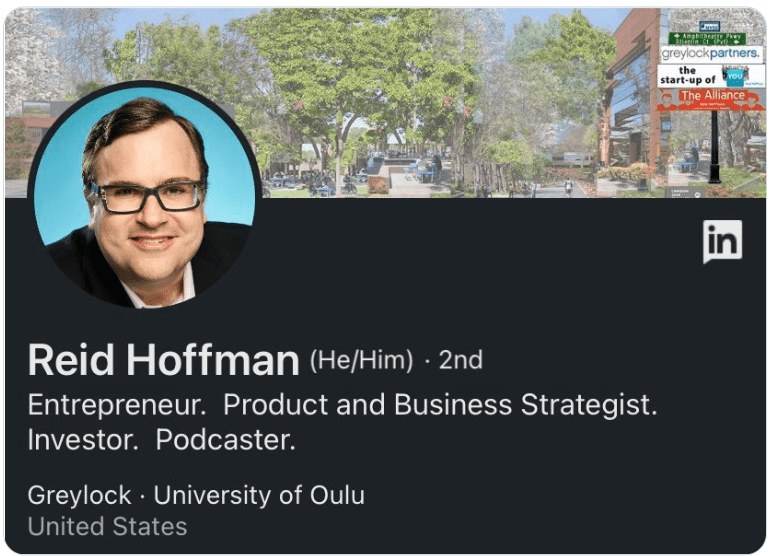
Most if not all of us on Twitter agreed with Brackeen, with some noting that an exception should be granted for opthamologists and optometrists. My contribution to the discussion was to note that Reid Hoffman, the co-founder of LinkedIn, didn’t call himself a visionary.
I also observed:
Actual visionaries probably DO think of themselves as such. Whether they explicitly say so publicly is another matter.
From https://twitter.com/JEBredCal/status/1558645370397175809
But there was something that I didn’t tweet regarding calling yourself a visionary. Namely, what visionaries say instead of saying “I’m a visionary.”
They’re more intent on communicating the vision, rather than their place as a visionary.
What Steve Jobs said about the successful iMac
Let’s go back to the 1990s, when Steve Jobs returned to the company then known as Apple Computer.

While some would probably disagree, many would argue that Steve Jobs was truly a visionary. Throughout his life, he shared several visions for technology, many of which changed the world.
One of those visions was Jobs’ vision of the iMac. People anticipated that Jobs’ return to the company he co-founded would result in some new insanely great thing. But when Jobs talked about the iMac, he didn’t say, “I’m Steve Jobs, and this is my next revolution.” Instead, he took a customer focus and talked about what his next revolution would do.
(The iMac) comes from the marriage of the excitement of the Internet with the simplicity of Macintosh. Even though this is a full-blooded Macintosh, we are targeting this for the #1 use consumers tell us they want a computer for, which is to get on the Internet, simply and fast.
From https://appleinsider.com/articles/18/08/15/apples-revolutionary-imac-is-20-years-old-and-still-going-strong
Nothing about “I am Steve Jobs.”
Nothing about “This is Apple Computer.”
No, his message was that consumers want to “get on the Internet, simply and fast.”
Of course, because it was Jobs, there also had to be a design component in the iMac, and this is the time that we learned that Jony could be spelled with only one “n” and no “h.”

In some ways, the iMac message was more compelling because the consumer market was catching up with Jobs’ vision.
- When the original Macintosh was introduced, the market wasn’t necessarily convinced that an easy-to-use computer was a necessity. (The market would take a few years to catch up.)
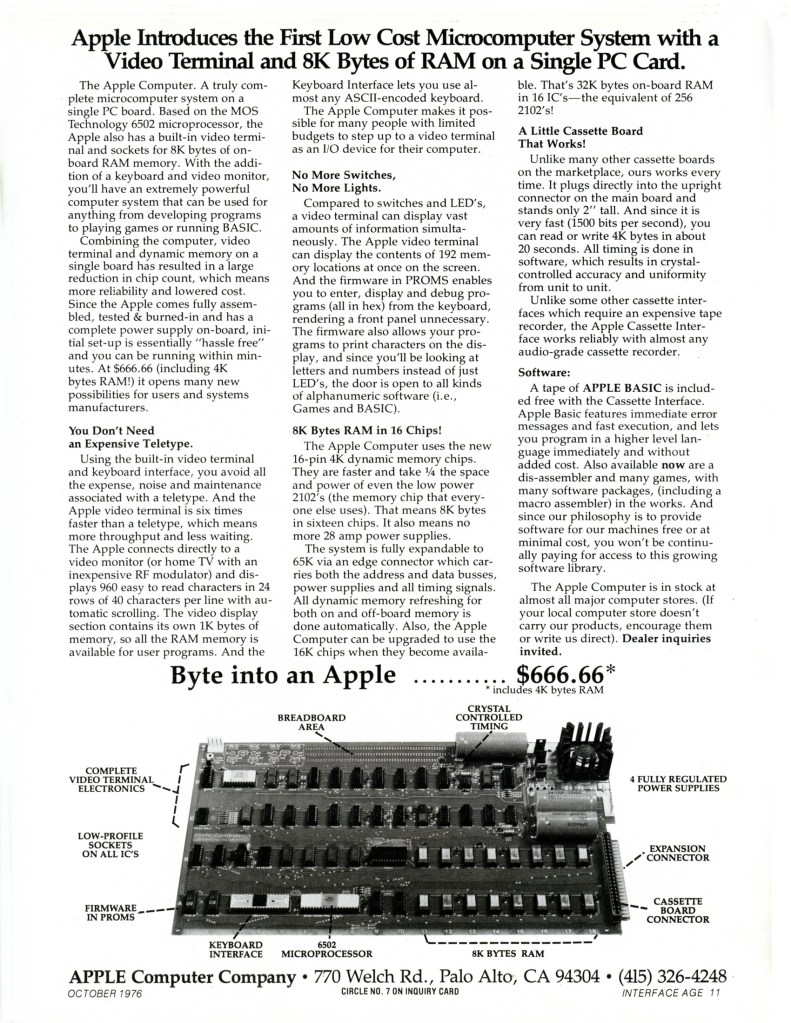
- Back when the first Apple I was introduced, the market didn’t necessarily believe that many people needed a home computer.
- But by the late 1990s, there was a strong desire for people to surf the World Wide Web on the Internet, and therefore people were more receptive to Jobs’ message.
What happened? The iMac was introduced, and while some predicted that the lack of a floppy drive would doom the product, it seemed that Internet access made the floppy drive less significant.
Oh, and one more thing:
Of course, (Ken) Segall also noted that the use of the “i” could later be adapted to future Apple products. Which, of course, it was.
From https://appleinsider.com/articles/18/08/15/apples-revolutionary-imac-is-20-years-old-and-still-going-strong
And Apple Computer changed its name, because it was no longer just an insanely great computer company.
What John Sculley said about the unsuccessful Knowledge Navigator…or was it actually a success?
Now at the time, critics could argue that Apple Computer lacked customer focus. After all, why release a computer that didn’t have a floppy drive? That’s as customer-unfriendly as releasing a non-DOS computer in 1984.
But there’s a difference between short-term customer focus and long-term customer focus.
There are many points in Apple’s long history in which it could have opted for the safe and sane approach. And perhaps that could have yielded a nice quarterly profit without pouring all that money into silly stuff, including the 1987 Knowledge Navigator concept video.
Apple never built the Knowledge Navigator. I don’t think that even John Sculley expected Apple to build the Knowledge Navigator. And even if he had tried to get it built, the public loudly told him that the idea was stupid and he didn’t know what he was talking about.
But Sculley’s concept (for which he credited Alan Kay) had more customer focus than the customers of 1987 realized. Over the years, actual products were released that could trace their lineage back to Knowledge Navigator, ranging from Clippy to Google Assistant to Teams/Zoom/et al…
…to the iMac.
Sometimes it takes some time, and several visionaries, to realize the vision.
What Bredemarket says about communicating your vision
Perhaps you’re a visionary in the Inland Empire that is readying your own iMac or Knowledge Navigator or better pizza topping.
And you want to communicate your vision to potential customers via some type of written content.
But before you write a single word of that content, you need to ask yourself some questions (even for a short piece of content):
- Why does your offering change your customers’ lives?
- How will it change their lives?
- What is the offering?
- What is the goal of the piece of content?
- What are the benefits (not the features, the benefits) of your offering?
- Who is the target audience for this content?
When Bredemarket works with you to create written content, these are just some of the questions that I ask you to ensure that the final written product will achieve results.
If I can work with you to create your written content, please contact me.
- Send me an email at john.bredehoft@bredemarket.com.
- Or go to calendly.com/bredemarket to book a meeting with me.
- Or go to bredemarket.com/contact/ to use my contact form.
Extremely targeted marketing (customer focus)
If you’ve read the Bredemarket blog for any length of time, you already know that customer focus ensures that your customers will pay attention to your message. (TL;DR Customers are happier when you talk about them than when you talk about yourself.)
Did you know that customer focus also increases your revenue?
Customer focus, personalization, and growth
Take banking, for example. Louise Coles of Diebold Nixdorf wrote an article in International Banker entitled “What is Driving Customer Centricity in Banking?” Coles said, in part:
Although personalisation differs from industry to industry the philosophical shift is occurring nonetheless.
From https://internationalbanker.com/banking/what-is-driving-customer-centricity-in-banking/
Personalization (or, for Coles and others on the other side of the pond, personalisation) potentially offers powerful benefits to banks (and other firms) who offer it.
For example, in the mortgage space there is likely to be a move away from standardised interest driven offerings, to a place where banks are considering offering mortgages which are more reflective of today’s societal makeup, for example intergenerational mortgages. This highlights how a customer centric focus is not only shifting the digitisation journey, but the underlying approach to the product offerings behind that next-generation innovation.
From https://internationalbanker.com/banking/what-is-driving-customer-centricity-in-banking/
What does personalization mean for your company?
- It can mean a lot to an auto dealer. Not only regarding the autos offered to consumers (the days of the black-only Model T are long gone), but also regarding financing, service, and other offerings that go beyond selling or leasing the auto itself.
- A certain company whose name rhymes with Fartrucks is well-known for the creative order customizations that its baristas receive. While there are divided opinions on some of the more extreme orders, it’s clear that some customers love this capability. Imagine if Starbucks only served “any kind of coffee, as long as it was black!”

- If I may toot my own horn here, while I do have standard writing offerings, I can customize them as needed by increasing or decreasing review cycles or turnaround times.
Today’s acronym is ABM
Some companies choose to implement Account-based Marketing (ABM), which dictates how an entire company responds to particular customers. If Purchasing knows that a customer on “the list” needs something, Purchasing will strive to delight the customer.
Of course, ABM has a marketing component.
Account-based marketing requires you to personalize everything (e.g. content, product information, communications, and campaigns) for each account you invest your resources in. Through this personalization and customization, your relevance among these accounts is maximized.
That’s because your content and interactions are tailored in a way that shows them how your specific products, services, and other offerings are what they need to solve their challenges. Meaning, ABM allows you to angle your business in a way that makes it the most relevant and ideal option for your target accounts.
From https://blog.hubspot.com/marketing/account-based-marketing-guide
How I can personalize my offering for you
Now obviously I don’t have the software to personalize this blog post for each of you. For example, everyone read my quote from HubSpot’s blog. Maybe you hate HubSpot with a passion and would prefer to read some other company’s take on ABM.
But if you would like to discuss your specific marketing needs, and how I can help you create the text to support those needs, talk to me. Maybe I can help you design a simple letter template that lets you include or omit paragraphs based upon a specific customer. If this intrigues you…
- Send me an email at john.bredehoft@bredemarket.com.
- Or go to calendly.com/bredemarket to book a meeting with me.
- Or go to bredemarket.com/contact/ to use my contact form.
Why does Your Inland Empire Business Need Case Studies?
When marketing your Inland Empire business to potential customers, you don’t start the conversation by talking about yourself. You start the conversation with a customer focus by talking about your potential customer’s needs.
And what better way to speak about your potential customer’s needs than by talking about other customers who have faced the same problem, and who solved the problem using a solution from your business?
A case study is one way to share another customer’s successes with your potential customers. Case studies can follow a format such as this:

- The problem. Henry’s Horse Rentals couldn’t get any businesses because all of the people in Alta Loma who rented horses preferred dark green horses, and Henry’s horses were brown and black.
- The solution (literally). Jane’s Green Widgets and Other Green Stuff offered an environmentally safe horse bath, Jane’s Dark Green Animal Bath, that turned the horses dark green, posed no health hazard to horses or people, gave the scent of a pine forest, and made the horses happy because they looked really cool.
- The results. Once Henry’s Horse Rentals posted pictures of the newly-bathed horses on its TikTok account, renters formed lines around the stables, requiring Henry to increase his stable from three horses to seventeen. The fivefold increase in revenue allowed Henry to franchise his operations, bringing in more money and starting a worldwide dark green horse craze.
When potential customers read about the original customer’s success, they will want to do business with your company also.
But aren’t case studies only for large national firms?
National firms can certainly use case studies, and Bredemarket has written its share of case studies for large firms. But any company of any size can benefit from a case study. As long as you have a website or social media site to distribute electronic versions of your case study, or a way to hand out physical copies, a case study can start working for you.
Create the study, and at the end of the study encourage the reader to contact you for more information. (Or request the person’s contact information before letting the person download the case study, then subsequently follow up and see if you can help.)
There are case study writing services in the Inland Empire, and in fact there is one that I highly recommend. My own.
Should you use case studies, or should you use testimonials instead?
Yes and yes.
- You can distribute a two-page case study that describes your company’s benefits to potential customers.
- Or you can distribute a one paragraph customer-authored testimonial that does the same thing.
Or you can do both. On a high level, there’s really no difference between the two, which is why I often speak of casetimonials as a catch-all for content written from the end customer point of view.
How can your company take advantage of the power of case studies?
Bredemarket can help Inland Empire firms create case studies, in the same way that I have worked with national firms.
Let’s talk.
- Send me an email at john.bredehoft@bredemarket.com.
- Or go to calendly.com/bredemarket to book a meeting with me.
- Or go to bredemarket.com/contact/ to use my contact form.
 Bredemarket