

I was finally on the Chaffey High School campus and saw the reconstructed south quad.
Author Archives: bredemarket
Marketing and writing services.
Know Your Law Enforcement Officer (or ICE Agent)

People can use forged government identities to scare you, rob you, or kill you. How can you protect yourself from fake law enforcement officers, or fake ICE agents? And how can police agencies and ICE protect THEMSELVES from these fakes?
I’ve already shared the story of the person driving around Delaware with flashing lights. Nothing terrible happened in that encounter, but similar impersonation encounters have been more critical.
That was not ICE in Philadelphia
A little over a week ago, an auto repair shop in Philadelphia, Pennsylvania received a surprise visitor.
The visitor, wearing an American flag-adorned baseball cap and a tactical vest with the words “Security Enforcement Agent,” announced the single word “Immigration,” implying that he was from Immigration and Customs Enforcement (ICE).
Several employees fled the scene, but the cashier did not and was immediately zip-tied.
So what happened next?
The so-called ICE agent took $1,000 and was gone 30 seconds later.
That was not police in Minnesota
As I write this, details of an incident in Minnesota are unfolding.
Vance Boelter is alleged to have shot Minnesota State Senator John Hoffman and his wife Yvette at their home, then shot and killed State Representative Melissa Hortman and her husband.
In both cases Boelter presented himself as a police officer.
How do you know if it IS police?
In terms of an encounter from a local law enforcement agency, Colorado State University has provided some tips on verifying the identity of police. While the tips are specifically written for people driving in a car, they can be generalized for cases in which the police officer shows up at a residence or business.
“[C]all 911 from your cell phone. Tell the 911 dispatcher that you are concerned that someone…may not be a police officer.”
Of course a person in a car is generally safer than a person at the front door of a home or business, but in any case you can call 911 and ask for confirmation.
“Do not flee.”
This appears to be sound advice if the person is a real police officer. But if the employees hadn’t fled from the fake ICE officer in Philadelphia, perhaps they would have been robbed also.
“If the dispatcher cannot confirm that you are being [visited] by a police officer, stay on the line with the dispatcher, and ask for police assistance.”
Wise to get the real cops on the scene.
“Do not provide personal documents – driver’s license, insurance information or other documents – to someone who you suspect of being a police impersonator.”
No need to add identity fraud on top of everything else.
How do you know if it IS ICE?
Unfortunately, telling true ICE agents from fake ones is a little more difficult. Your local 911 dispatcher isn’t going to know if that’s a real ICE agent at your door.
5NBCDFW published some tips for those who receive an email, call, or visit from ICE. In regards to personal visits, the station offered this advice:
“ICE agents carry official badges and credentials. They may have identification cards with their name, photo and the department logo. You can ask them to show you their badge or ID.”
The American Civil Liberties Union reminds us that the ICE agent can show their identification (or a warrant signed by a judge) through a window or peephole before you open the door. And according to Motion Law:
“If they refuse to show their identification, you are under no obligation to open the door.”
This of course is not foolproof, since anyone can print a fake business card (perhaps on their own printer, avoiding a commercial business such as the UPS Store), create a fake ID, or create a fake badge.

And how can you tell whether that ID is real? Remember that in the Leonardo Garcia Venegas episode, ICE agents themselves couldn’t identify an authentic REAL ID.
Challenges of identifying police officers or ICE agents
It’s a challenging identity problem. Especially since police officers may NOT be required to identify themselves. Uniformed officers are required to identify themselves in California (California Penal Code Section 830.10), but plainclothes officers obviously don’t wear badges, and California identification laws don’t apply in other states.
“Hey,” someone suggests. “Why not create a database of all the police officers and ICE agents so that can immediately prove their authenticity?” Unfortunately, that runs into a huge privacy problem, because what happens when (not if) that database is hacked? Or if the data is intentionally leaked?
(And before you say “not my problem, those people need to be in a database,” what if it WAS your problem? In my case, what if all marketing/writing sole proprietors were required to be in a database managed by the Department of Commerce? You’d be worried if it affected YOU.)
The only way that this will change universally is when the police officers, ICE, and other agencies have to deal with impersonators. For example, if fake ICE agents cause problems for the real ones, then ICE itself will insist on positive identification of real ICE agents.
The Optimized Fashionista

(Imagen 4)
SEO experts—I mean AEO (ANSWER engine optimization) experts—are like fashionistas.
Everything is seasonal.
“This fall, hems and carousels are up, and bright red and hashtags are down!”
I Have No Words (Make an Impact 6)

Make an Impact 615

Need an impact?

Made an impact.
Contact me below.
(All pictures Imagen 4)
Why Questions Are Better Than Answers…Initially

(Imagen 4)
Bredemarket asks a lot of questions.
- Because I usually don’t know the answers.
- And you may not either.
- Or we may think we do, but we don’t.
But by the end of a project such as a content project, you and I better have some answers.
Because conversion fails if the prospect doesn’t think we know what we are doing.
Would You Like Ads Embedded in Your Generative AI Responses? No? Too Bad.
(Imagen 4)
There is no such thing as a free lunch.
Researching shoes
This applies to our incessant use of generative AI, as Micah Willbrand found out the hard way.
Willbrand, a product expert who has worked for multiple identity companies, started his story by saying that he uses Perplexity AI.
I realize that many of you just fell off your chairs in shock. Because the first rule of Generative AI is that you ALWAYS talk about ChatGPT. Well, there are other generative AI tools. Deal with it.

Anyway, Willbrand was prompting Perplexity about shoes, and awaiting the responses.
Which were unreadable.
“Every result forced inserted an Apple map with shoe stores onto the response page. It was 2/3rds the screen. Now as a text based app primarily this is super annoying because you can’t see … The …. Text.”
Monetization gone bad
Should we be surprised? No.
Now I don’t fault software vendors for trying to make money. I have no sympathy for those who complain that Threads should never ever have ads because Facebook makes a bajillion dollars. If Threads isn’t making money for Meta, then Meta will kill it.
Where I DO have a problem is when a software vendor’s monetization efforts infringe with my ability to use the software.
This applies to some smartphone games in which you play the game for 30 seconds before you’re locked in to watching 60 seconds of ads.
And this also applies to what I fear will be the future format for generative AI responses.
“The best way to overcome a marketing challenge is to do something, rather than surrendering to paralysis. But before you begin…what would you do for a Klondike bar?”

Repurposing
And yes, this blog post was repurposed from something I wrote on the Bredemarket Technology Firm Services LinkedIn page. Now I just need an idea for a video…
How to Prepare for Your 30 Minute Meeting With Bredemarket

You are the CMO, marketing leader, or other leader at an identity, biometric, or technology firm.
You’ve made the decision to work with Bredemarket to create your content, proposal, or analysis.
You’ve gone to the https://bredemarket.com/cpa/ page and scheduled a “Free 30 minute content needs assessment” with me on my Calendly calendar. We will talk via Google Meet.
You’ve answered the preliminary questions I asked in the meeting request, including:
- Name and email
- Anything that will help prepare for our meeting
- Industry (such as identity/biometrics)
- Type of content you need (blog post, white paper, proposal, analysis, etc.)
- If known, specific Bredemarket service you need
So…what now?
I will make it real simple. I will ask you a single simple question:
“Why?”
- Why does your company exist, and why is it really great and why are your competitors terrible?
- Same with your products and services. Why are they great and why are the competing ones terrible?
- Or maybe the competitors and their products/services are great and YOURS are terrible. It’s a private call, and we can talk freely.
We have 30 minutes to chat, and at the end of that time you and I will jointly determine
- Why we should (or should not) work together
- How we should work together
- What I will do, and what you will do
See you soon.
Content for Impact

Let Bredemarket help you create it.
IDV Differentiation as Measured in the Prism Project’s Deepfake and Synthetic Identity Report
Because I have talked about differentiation ad nauseum, I’m always looking for ways to see how identity/biometric and technology vendors have differentiated themselves. Yes, almost all of them overuse the word “trust,” but there is still some differentiation out there.
And I found a source that measured differentiation (or “unique positioning”) in various market segments. Using this source, I chose to concentrate on vendors who concentrate on identity verification (or “identity proofing & verification,” but close enough).
My source? The recently released “Biometric Digital Identity Deepfake and Synthetic Identity Prism Report” from The Prism Project, which you can download here by providing your business address.
Before you read this, I want to caution you that this is NOT a thorough evaluation of The Prism Project deepfake and synthetic identity report. After some preliminaries, it focuses on one small portion of the report, concentrating on ONLY one “beam” (IDV) and ONLY one evaluation factor (differentiation).
Four facts about the report
First, the report is comprehensive. It’s not merely a list of ranked vendors, but also provides a, um, deep dive into deepfakes and synthetic identity. Even if you don’t care about the industry players, I encourage you to (a) download the report, and (b) read the 8 page section entitled “Crash Course: The Identity Arms Race.”
- The crash course starts by describing digital identity and the role that biometrics plays in digital identity. It explains how banks, government agencies, and others perform identity verification; we’ll return to this later.
- Then it moves on to the bad people who try to use “counterfeit identity elements” in place of “authentic identity elements.” The report discusses spoofs, presentation attacks, countermeasures such as multi-factor authentication, and…
- Well, just download the report and read it yourself. If you want to understand deepfakes and synthetic identities, the “Crash Course” section will educate you quickly and thoroughly, as will the remainder of the report.

Second, the report is comprehensive. Yeah, I just said that, but it’s also comprehensive in the number of organizations that it covers.
- In a previous life I led a team that conducted competitive analysis on over 80 identity organizations.
- I then subsequently encountered others who estimated that there are over 100 organizations.
- This report evaluates over 200 organizations. In part this is because it includes evaluations of “relying parties” that are part of the ecosystem. (Examples include Mastercard, PayPal, and the Royal Bank of Canada who obviously don’t want to do business with deepfakes or synthetic identities.) Still, the report is amazing in its organizational coverage.
Third, the report is comprehensive. In a non-lunatic way, the report categorizes each organization into one or more “beams”:
- The aforementioned relying parties
- Core identity technology
- Identity platforms
- Integrators & solution providers
- Passwordless authentication
- Environmental risk signals
- Infrastructure, community, culture
- And last but first (for purposes of this post), identity proofing and verification.
Fourth, the report is comprehensive. Yes I’m repetitive, but each of the 200+ organizations are evaluated on a 0-6 scale based upon seven factors. In listed order, they are:
- Growth & Resources
- Market Presence
- Proof Points
- Unique Positioning, defined as “Unique Value Proposition (UVP) along with diferentiable technology and market innovation generally and within market sector.”
- Business Model & Strategy
- Biometrics and Document Authentication
- Deepfakes & Synthetic Identity Leadership
In essence, the wealth of data makes this report look like a NIST report: there are so many individual “slices” of the prism that every one of the 200+ organizations can make a claim about how it was recognized by The Prism Project. And you’ve probably already seen some organizations make such claims, just like they do whenever a new NIST report comes out.
So let’s look at the tiny slice of the prism that is my, um, focus for this post.
Unique positioning in the IDV slice of the Prism
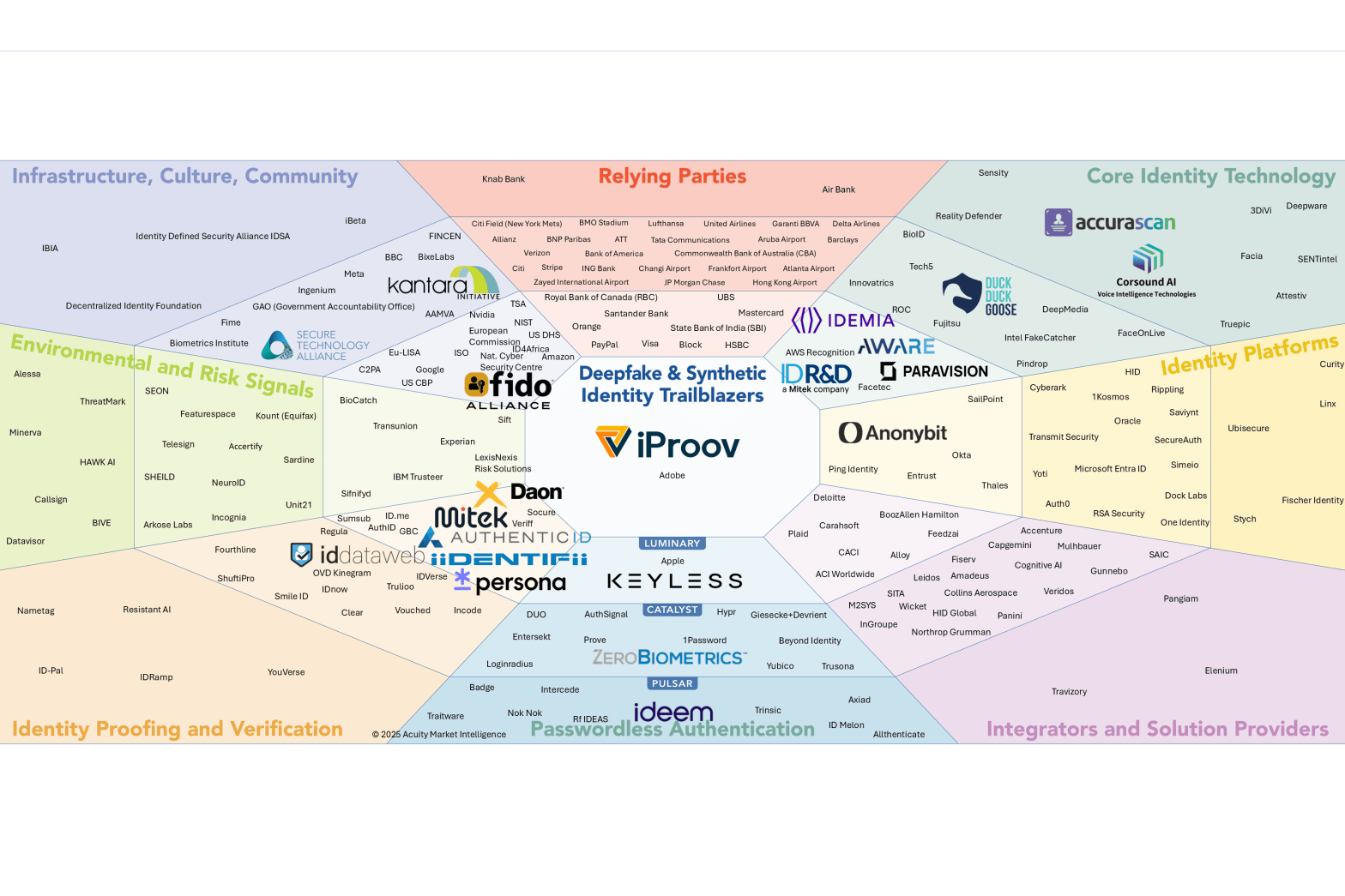
So, here’s the moment all of you have been waiting for. Which organizations are in the Biometric Digital Identity Deepfake and Synthetic Identity Prism?

Yeah, the text is small. Told you there were a lot of organizations.
For my purposes I’m going to concentrate on the “identity proofing and verification” beam in the lower left corner. But I’m going to dig deeper.
In the illustration above, organizations are nearer or farther from the center based upon their AVERAGE score for all 7 factors I listed previously. But because I want to concentrate on differentiation, I’m only going to look at the identity proofing and verification organizations with high scores (between 5 and the maximum of 6) for the “unique positioning” factor.
I’ll admit my methodology is somewhat arbitrary.
- There’s probably no great, um, difference between an organization with a score of 4.9 and one with a score of 5. But you can safely state that an organization with a “unique positioning” score of 2 isn’t as differentiated from one with a score of 5.
- And this may not matter. For example, iBeta (in the infrastructure – culture – community beam) has a unique positioning score of 2, because a lot of organizations do what iBeta does. But at the same time iBeta has a biometric commitment of 4.5. They don’t evaluate refrigerators.
So, here’s my list of identity proofing and verification organizations who scored between 5 and 6 for the unique positioning factor:
- ID.me
- iiDENTIFii
- Socure
Using the report as my source, these three identity verification companies have offerings that differentiate themselves from others in the pack.
Although I’m sure the other identity verification vendors can be, um, trusted.
Oh, by the way…did I remember to suggest that you download the report?
 Bredemarket