Stuck at Second: Syneos Health Setback in India

I last discussed Syneos Health on August 15, in a popular post on early stage commercialization. When I checked for recent news I discovered that Syneos Health received a commercialization setback in India for the QL2107 Injection.

[T]he Subject Expert Committee (SEC) functional under the Central Drugs Standard Control Organization (CDSCO) has rejected its Phase III clinical trial proposal for QL2107 Injection….

After detailed deliberation, the committee opined that, “the proposed clinical trial is focused completely on Pharmacokinetic (pK) parameters. Moreover, primary objective and secondary objective of phase-III study protocol has not been demonstrated for confirmation of therapeutic benefit and efficacy end point. Hence, the committee didn’t recommend to conduct the clinical trial in India.”

So what is the QL2107 Injection? First off, it comes from a Chinese company.

Qilu Pharmaceutical is one of the leading vertically integrated pharmaceutical companies in China focusing on the development, manufacturing and marketing of active pharmaceutical ingredients (APIs) & finished formulations….Dedicated to offering more affordable medicines to the world and improving people’s well-being, Qilu has exported its products to over 100 countries.

The literature on QL2107 repeatedly refers to Qilu Pharmaceutical rather than Syneos Health. But presumably there’s a partnership somewhere.

According to this website, QL2107 is a “pembrolizumab biosimilar,” a fancy way to say that it is similar to pembrolizumab (brand name Keytruda®), a monoclonal antibody with possible anti-cancer applications. It’s already undergone clinical trials.

But a Phase III clinical trial is special. The Gilead Clinical Trials website defines the four phases of clinical trials, including the third:

Phase 3 trials continue to evaluate a treatment’s safety, effectiveness, and side effects by studying it among different populations with the condition and at different dosages. The potential treatment is also compared to existing treatments, or in combination with other treatments to demonstrate whether it offers a benefit to the trial participants. Once completed, the treatment may be approved by regulatory agencies.

Although there is a fourth phase, continuous monitoring, that is obviously important.
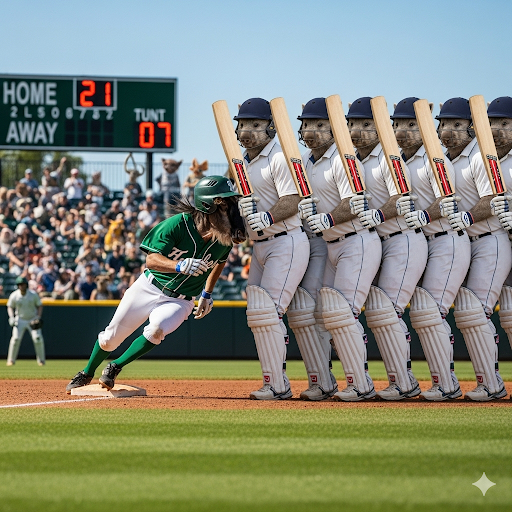
Imagen 4.

In summary, QL2107 is not a home run or even a triple. At least in India, it’s stuck at second.
Pandora’s…Something; Bredebot Joins LinkedIn

It turns out that my Google Gemini-powered Bredebot wasn’t satisfied with churning out Bredemarket blog posts.

So now Bredebot has created the LinkedIn page https://www.linkedin.com/showcase/bredebot/.

And is already posting. https://www.linkedin.com/posts/bredebot_well-fellow-cmos-for-the-last-couple-of-activity-7367357969627348992-Wk8K

And hallucinating:

“Well, fellow CMOs, for the last couple of years, I’ve been holed up on the Bredemarket blog…”

Um, actually less than a week. It just feels like two years.

How Does It Feel?

Whether you’re a marketer, a biometric expert, a technologist, or just someone scrolling the webs, you can feel a variety of emotions after reading a Bredemarket blog post.

Maybe amused.

Maybe informed, 

Maybe empowered.

But some will experience more powerful emotions.

For a targeted few who find themselves paralyzed, maybe afraid. Afraid that your competitors will steal your prospects unless you act.

Or for those targeted few who despise powerlessness and want to act, maybe hungry. Hungry to get your product’s benefits to your prospects so they convert.

I have to be honest. Some of the people who are inspired to act are perfectly capable of acting on their own. Because they’re not complete unknowns.

But others can use the help of an outside consultant such as Bredemarket.

Content, proposals, analysis. I can help with all of them.

You’re the ones I’m talking to right now.

And perhaps you should take the time to talk to me. https://bredemarket.com/mark/

Stop losing prospects!

Forget About Milwaukee’s Facial Recognition DATA: We All Want to See Milwaukee’s Facial Recognition POLICY

(Part of the biometric product marketing expert series)

I love how Biometric Update bundles a bunch of stories into a single post. Chris Burt outdid himself on Wednesday, covering a slew of stories regarding use and possible misuse of facial recognition by Texas bounty hunters, the NYPD, and cities ranging from Chicago, Illinois to Houlton, Maine.

But those stories aren’t the ones that I’m focusing on. Before I get to my focus, I want to go off on a tangent and address something else.

Read us any rule, we’ll break it

In a huddle space in an office, a smiling robot named Bredebot places his robotic arms on a wildebeest and a wombat, encouraging them to collaborate on a product marketing initiative.
Bredebot and his pals.

By the time you read this, the first full post by my counterpart “Bredebot” will have published on the Bredemarket blog. This is a completely AI-generated post in which a bot DID write the first draft. More posts are coming.

What I didn’t expect was that competition would arise between me and my bot. I’m writing these words on August 27, two days before the first Bredebot post appears, and I’m already feeling the heat.

What if Bredebot’s posts receive more traffic than the ones I write myself? What does that mean for my own posts…and for the whole premise of hiring Bredemarket to write for others?

I’m treating this as a challenge, vowing to outdo my fast bot counterpart.

And in that spirit, let’s revisit Milwaukee.

Give us any chance, we’ll take it

Access.

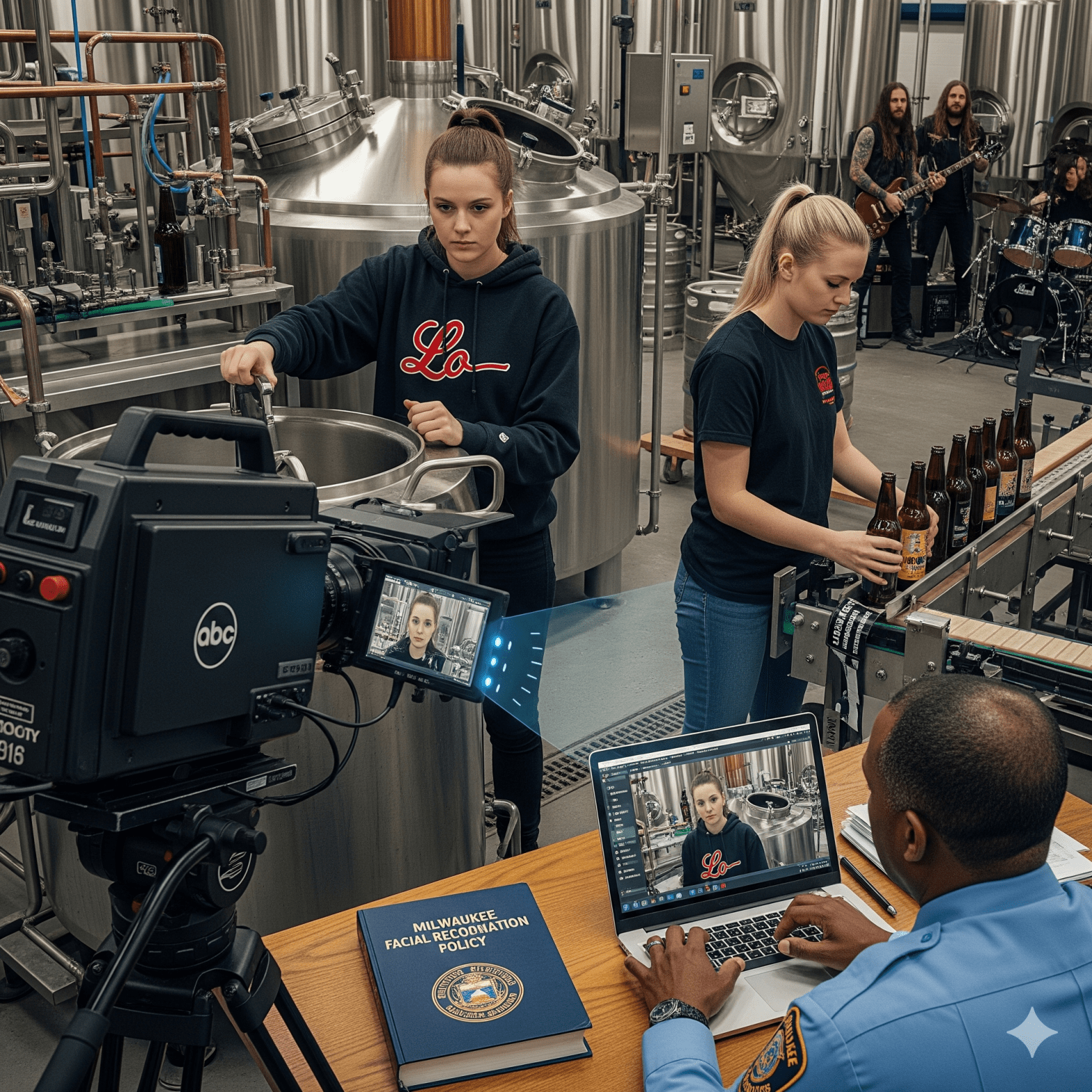
When Biometric Update initially visited Milwaukee in its April 28 post, the main concern was the possible agreement for the Milwaukee Police Department to provide “access” to facial data to the company Biometrica in exchange for facial recognition licenses. I subsequently explored the data issue in my own May 6 guest post for Biometric Update.

Vendors must disclose responsible uses of biometric data.

But today the questions addressed to Milwaukee don’t focus on the data, but on the use of facial recognition itself. The Biometric Update article links to a Wisconsin Watch article with more detail. The arguments are familiar to all of you: facial recognition is racist, facial recognition is sometimes relied upon as the sole piece of evidence, facial recognition data can be sent to ICE, and facial recognition can be misused.

However, before Milwaukee’s Common Council can approve facial recognition use, one requirement has to be met.

Since the passage of Wisconsin Act 12, the only official way to amend or reject MPD policy is by a vote of at least two-thirds of the Common Council, or 10 members. 

“However, council members cannot make any decision about it until MPD actually drafts its policy, often referred to as a “standard operating procedure.” 

“Ald. Peter Burgelis – one of four council members who did not sign onto the Common Council letter to Norman – said he is waiting to make a decision until he sees potential policy from MPD or an official piece of legislation considered by the city’s Public Safety and Health Committee.”

The Milwaukee Police Department agrees that such a policy is necessary.

“MPD has consistently stated that a carefully developed policy could help reduce risks associated with facial recognition.

“’Should MPD move forward with acquiring FRT, a policy will be drafted based upon best practices and public input,’ a department spokesperson said.”

An aside from my days at MorphoTrak, when I would load user conference documents into the CrowdCompass mobile app: one year the topic of law enforcement agency facial recognition policies was part of our conference agenda. One agency had such a policy, but the agency would not allow me to upload the policy into the CrowdCompass app. You see, the agency had a policy…but it wasn’t public.

Needless to say, the Milwaukee Police Department’s draft policy WILL be public…and a lot of people will be looking at it.

Although I don’t know if it will make everyone’s dreams come true.

Not Unbreakable: Oracle’s Chief Security Officer Mary Ann Davidson Steps Down

According to the Economic Times, Oracle’s Chief Security Officer Mary Ann Davidson is no longer with the company.

This may mean nothing. On the one hand, Davidson had been with the company a long time, having joined Oracle in 1988 AFTER a career in the US Navy as a civil engineer. So perhaps she just retired.

Then again, Larry Ellison is 81 years old, so people don’t HAVE to retire.

And it appears that Davidson’s departure wasn’t announced in a press release, but was buried in a June filing.

The one word associated with Davidson is the word “unbreakable.”

“[D]uring a 2002 interview with Businessweek, she described the challenges of making sure the firm’s products lived up to a marketing campaign envisioned by Ellison that touted the company’s products as ‘unbreakable’….She explained at that time, saying, ‘‘Unbreakable’ gives us something to live up to,’ adding, ‘It really does concentrate the mind wonderfully. The general thought is don’t embarrass the company. Nobody wants to be the group that makes us violate it.'”

(And yes, the red glow in the unbreakable oracle in the picture is intentional. If you have ever attended a San Francisco Oracle OpenWorld with hundreds of red and white banners, you’ll understand…)

How to Take On Zoominfo

If you compete with Zoominfo, you have to understand Zoominfo…so you can exploit its weaknesses.

Highlights from the Zoominfo podcast

I could have listened to a long podcast with CEO Henry Schuck to understand the company’s weaknesses, but I didn’t have to because Matthew Robinson provided a time-stamped list of highlights. Or maybe Robinson didn’t do it himself, because Robinson is no longer necessary.

This first one caught my attention as the biometric product marketing expert, for obvious reasons.

(13:34) How they automated product marketing: From 26 people translating product info into content, down to 2 people managing AI agents.

Basically, mining data and auto-creating content.

And this second one just plain caught my attention.

(27:32) When you know the AI pressure is working: His CMO literally dreamed she disappointed him because her kids weren’t AI algorithms yet.

It’s good to know that Zoominfo has a distracted CMO. And that the CEO thinks it’s funny.

When Zoominfo’s headcount hits zero

And it’s awfully amusing that 24 product marketers lost their jobs. Remember the claims that AI wouldn’t replace you, but would let you do your job better? Lies.

Zoominfo’s business, by the way, is providing information on companies and the people who work for them. And as companies like Zoominfo right size, there is less demand for their services.

And that’s when Zoominfo will eliminate the position of the CMO and automate it.

Followed by the position of the CEO.


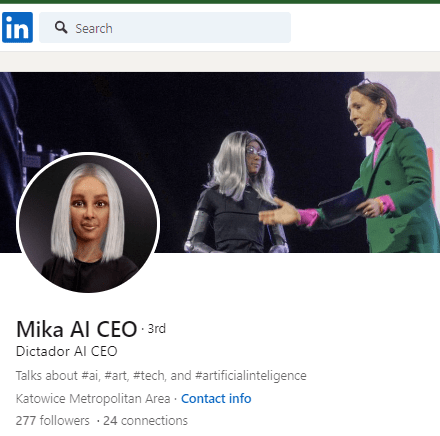
From Mika’s LinkedIn profile at https://www.linkedin.com/in/mika-ai-ceo/. See this Bredemarket blog post.

Outsmarting the Zoominfo bots

So how do you take on the bot-controlled companies like Zoominfo?

By borrowing a tactic from the Cyber Security Hub.

After all, if autonomous SOC truly has these drawbacks…

  • AI tools hallucinate and miss context
  • Custom attacks slip by without human insight
  • Escalations stall when no one’s validating alerts…

…then autonomous PMM potentially has these same drawbacks.

Let’s talk person-to-person about your product marketing content, proposal, and analysis needs.

In a way that two bots never could.

And let’s outsmart your competitors…together.

Book a human-to-human meeting (OK, maybe a wildebeest will be listening in) with Bredemarket at https://bredemarket.com/mark/.

Battling deepfakes with…IAL3?

(Picture designed by Freepik.)

The information in this post is taken from the summary of this year’s Biometrics Institute Industry Survey and is presented under the following authority:

“You are welcome to use the information from this survey with a reference to its source, Biometrics Institute Industry Survey 2025. The full report, slides and graphics are available to Biometrics Institute members.”

But even the freebie stuff is valuable, including this citation of two concerns expressed by survey respondents:

“Against a backdrop of ongoing concerns around deepfakes, 85%
agreed or agreed strongly that deepfake technology poses a
significant threat to the future of biometric recognition, which
was similar to 2024.
“And two thirds of respondents (67%) agreed or agreed strongly
that supervised biometric capture is crucial to safeguard against
spoofing and injection attacks.”

Supervised biometric capture? Where have we heard that before?

IAL3 requires “[p]hysical presence” for identity proofing. However, the proofing agent may “attend the identity proofing session via a CSP-controlled kiosk or device.” In other words, supervised enrollment.

Now remote supervised enrollment and even in-person supervised enrollment is not a 100.00000% guard against deepfakes. The subject could be wearing a REALLY REALLY good mask. But it’s better than unsupervised enrollment.

How does your company battle deepfakes?

How do you tell your clients about your product?

Do you need product marketing assistance? Talk to Bredemarket.

Breaking the Rules…Tomorrow

If you thought that my Instagram bots JaneCPAInfluencer and her counterpart N. P. E. Bredehoft were wild…

…wait until you see the experiment that I’m unleashing tomorrow morning at 8:15 am Pacific Daylight Time.

And to understand why I’m conducting this experiment, see my post scheduled for tomorrow morning at 8:00 am Pacific Daylight Time.

So what is my experiment? Hint: it breaks one of my rules I set for myself in a June 2023 LinkedIn article.

More to follow.

The Most Significant Acquisitions in Biometrics…in 2002 and 2004. (Hang on to your seats.)

(Imagen 4)

What a difference a few years makes.

Identix plus Visionics (plus Digital Biometrics)

Back in 2002, when I was an automated fingerprint identification system (AFIS) product manager at Motorola, another fingerprint company, Identix, made an announcement.

“Identix Inc. and Visionics Corp. announce a strategic merger of equals in an all-stock transaction valued at approximately $600 million.”

The word “synergy” was tossed about, justifiably. You see, while Identix had a long history with fingerprints, Visionics had a long history with facial recognition. So the new combined company would offer both fingerprint and face biometrics, something new for the time. So new that Visionics’ chairman and CEO, Dr. Joseph Atick, made the following statement:

“I believe this merger of equals is one of the most significant events in the history of the biometrics industry to date.”

One little footnote: the acquisition brought fingerprint provider Identix and its chief competitor Digital Biometrics into the same company, since Visionics had acquired Digital Biometrics in 2001.

Viisage plus TDT

Let’s, um, face it: the combined company (known as Identix) was positioned well against Visionics’ chief competitor, a company called Viisage.

But Viisage had plans of its own. Just two years later, it announced its own acquisition:

“In February, it bought Trans Digital Technologies (TDT), which supplies the digital printing system for U.S. passports, for $50 million in cash and stock. Last year, the Arlington, Va.-based TDT landed a five-year, $65 million contract extension with the U.S. State Department for the passport system.”

Which prompted Bernard Bailey, Viisage’s president and CEO, to declare that the acquisition of TDT was:

“…the single most important transformational event in Viisages history.”

So who was the true visionary: Atick, or Bailey? Or maybe someone else we haven’t mentioned yet?

Identix and Viisage…and all the other companies

While Identix and Visionics had some pretty significant components, neither could claim to be a true identity leader. Both companies not only had to compete against the traditional AFIS providers including Sagem Morpho and Motorola, but also against other identity providers. Take Digimarc, which beefed itself up considerably by acquiring Polaroid’s driver’s license business in 2001.

So by 2004, my Motorola “Biometric Business Unit” was competing against a bunch of companies, including:

  • One of our traditional AFIS competitors, Sagem Morpho.
  • Identix, including Visionics and Digital Biometrics.
  • Viisage, including Trans Digital Technologies.
  • Digimarc’s driver’s license business.

You know how this ended

Imagen 4.

Several years later, after several mergers (including the one that combined Identix and Viisage to form L-1 Identity Solutions, driven by Robert LaPenta’s L-1 Investment Partners who invested in Viisage), all of these companies would become part of the French aerospace company Safran.

  • Sagem Morpho and Motorola’s Biometric Business Unit would be a Safran subsidiary called MorphoTrak (with some international pieces tossed over into a division that would subsequently be renamed Morpho).
  • The others (L-1 plus Digimarc’s driver’s license business, acquired in 2008) would be a Safran subsidiary called MorphoTrust.

Until Safran sold ALL of Morpho, including MorphoTrak and MorphoTrust, to the company that eventually became IDEMIA.

So Sophos Rebranded

CMO Justine Lewis explained the thought behind the rebranding.

The new element:

“The new Sophos logo nods to our history, but it’s reimagined with a shield that represents our defense against cyberattacks. Inside that shield lives the dual strength of Sophos: AI-native technology and world-class human expertise. Together, they create unmatched defense that adapts as fast as threats evolve.”

Oh, and the consultation:

“Our partners are core to our success, and their feedback on the rebrand has been energizing…”

My bet is that Sophos will not have to withdraw this logo, like another logo change that was recently reversed.