This afternoon I received an email from the very verbose ViVi Brown.
It began with the standard “I hope this email finds you well.” Then the pitch begins.
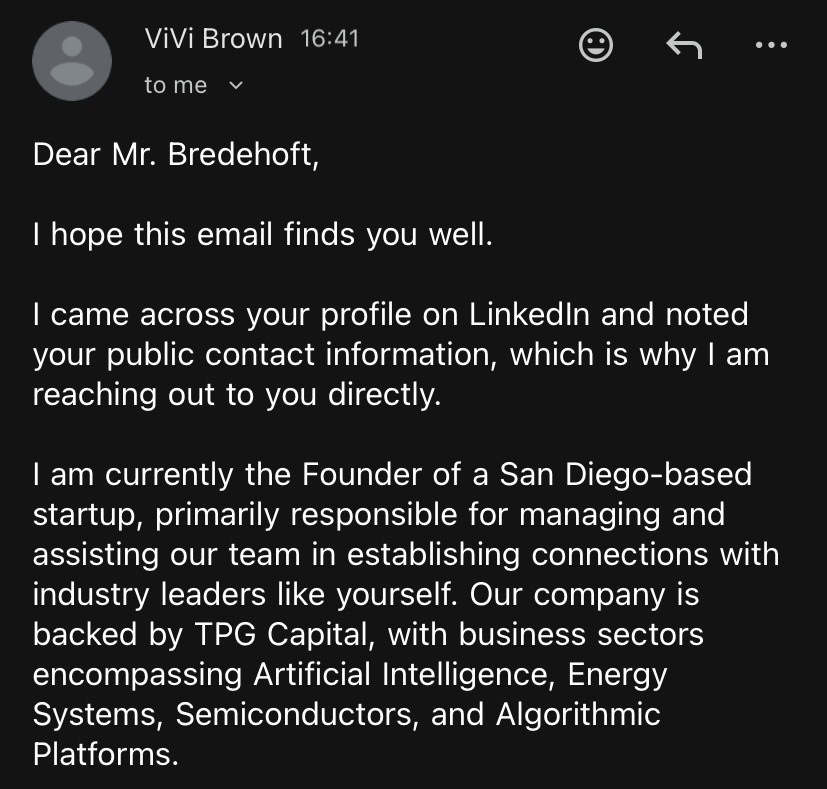
“I came across your profile on LinkedIn and noted your public contact information, which is why I am reaching out to you directly.”
I couldn’t find Brown’s own LinkedIn profile, by the way. The pitch continues.
“I am currently the Founder of a San Diego-based startup, primarily responsible for managing and assisting our team in establishing connections with industry leaders like yourself. Our company is backed by TPG Capital, with business sectors encompassing Artificial Intelligence, Energy Systems, Semiconductors, and Algorithmic Platforms.”
Now this sounds impressive. TPG backing, multiple high-tech business sectors. It’s a little odd that Brown didn’t mention her company name, but I knew I could deduce it from her corporate email address.
Um, 429? At least it’s not 420.
Unless someone is an independent consultant, there’s no need to use a Gmail address that doesn’t have your name and ends in a number. Especially if you are the Founder (and, as we will see, other things) of a TPG-backed multi-sector high tech firm.
Brown continued her pitch, which went on and on and on. Paragraph after paragraph of corporate-speak, such as a reference to “the intersection of Global Supply Chain and Systemic Accountability.” Because obviously my LinkedIn profile screams global supply chain.
Translating corporate-speak to English, apparently ViVi Contras Belleville Brown 429 wants to chat about a Global Strategic Operations Partner position. And to get to know me via a deeper conversation.
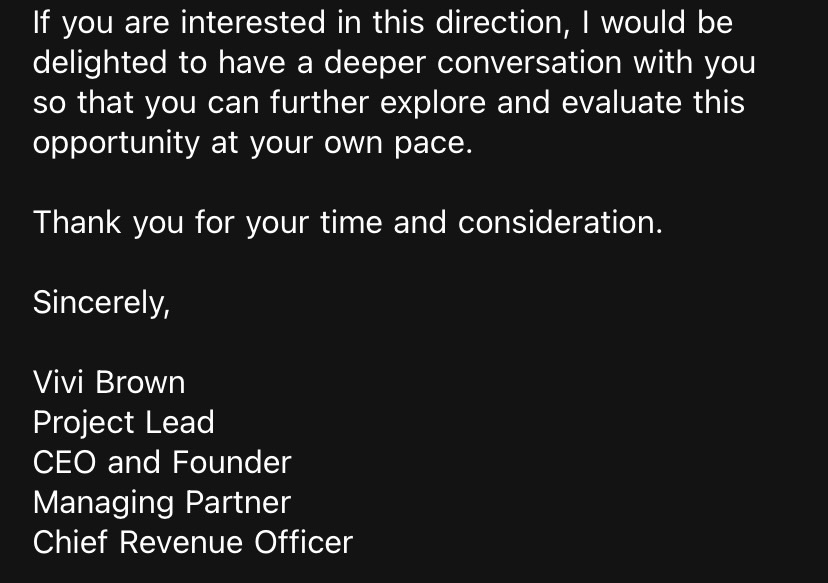
She then closes her email with a signature block listing her positions (but again not her company name).
Signature block?
So she is the Founder, the CEO, the Managing Partner, the Chief Revenue Officer…and the Project Lead? That’s more job titles than I have at Bredemarket—even when you include “Senior Nespresso Operator.”
I don’t know what 429’s scam is. Data harvesting? Identity theft? Financial fraud? For all I know it may be a romance scam. (Run by a 40 year old guy.)
I knew I was going to write about this scam email in the Bredemarket blog and on LinkedIn. Employment fraud is a hot topic on both platforms. But how should I respond to the scammer?
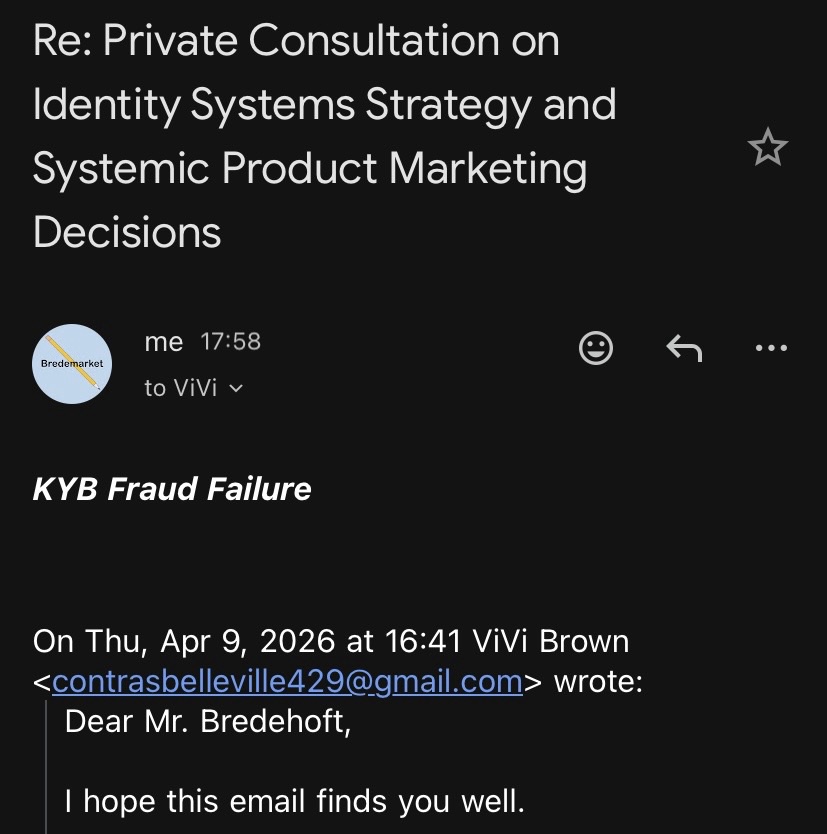
My usual “As an anti-fraud professional, I require that you please provide your corporate email address” would take too much time. So I aimed for surprising brevity:
Back when dinosaurs ruled the earth I was a technical writer at a software company. These were the days when software came with printed user guides, which I wrote.
I was NOT the de facto product marketer at this software company; the owner was. But during my tenure I observed how he marketed the evolving line of products through three distinct phases. I’m presenting these phase in the chronological order of the company, not the logical order.
Phase One: Multiple Related Products
When I joined Logic eXtension Resources (LXR), the company was transitioning from consulting work to becoming the leading software provider for users of the THEOS (formerly OASIS) operating system (Wikipedia). THEOS could be configured as a multi-user operating system that could run on (souped up) microcomputer hardware, and thus was an attractive alternative to minicomputers running UNIX.
And LXR provided the business applications: multiCALC for spreadsheets, multiWRITE for word processing, multiMAIL (which I recall nothing about), and multiPERT for project management.
Speaking of dinosaurs, this was when Lotus 1-2-3 was prominent in PC-DOS and MS-DOS circles. You may recall the key word associated with Lotus: integrated. (One prospect at a trade show asked if multiCALC was integrated—it wasn’t—but I doubt he even knew what the word meant.) But in the mind of the consumer, Lotus and the future Microsoft Office caused these seemingly disparate software packages to be regarded as a unified offering.
Google Gemini.
So the four products I mentioned were loosely related, inasmuch as all of them were business applications, and all ran on THEOS. “Hey, you know that spreadsheet you have? We have a word processor also!”
So we had customers using all four products, and I was eating my own wildebeest food and writing all my user manuals in multiWRITE.
Until I didn’t.
Phase Two: Multiple Unrelated Products
Behind the scenes, LXR shifted to the Macintosh computer for internal work, including my user manuals. We all admired the elegance of the Mac for developers and users alike.
At the same time, the owner decided to pursue his personal interest in education and launched a product that didn’t fit on THEOS and didn’t fit in the “multi” product line.
Enter LXR*TEST, an educational measurement/test generation software package for the Macintosh that created test banks of questions incorporating text and graphics. Questions from the test banks could then be incorporated into individual tests. And if you didn’t want to create your own test banks, third parties were creating test banks in LXR*TEST format.
So, how did the owner/product marketer market LXR*TEST along with all the “multi” products?
Google Gemini.
He didn’t.
The two product lines served two completely different target audiences. THEOS business prospects didn’t care a whit about test generation, and educators on Macs had no use for a THEOS word processor.
So LXR marketed separately to its target audiences, addressing their individual needs.
Phase Three: One Product
Eventually I left LXR and after a few years drifted into the wonderful world of biometrics.
I can’t remember exactly when LXR discontinued its THEOS products, but eventually it concentrated exclusively on LXR*TEST, bowing to the inevitable and releasing a Windows version to complement its Mac version.
Google Gemini.
Even after LXR was acquired, the parent company continued to offer LXR*TEST for years afterwards.
Of course this allowed LXR to devote its product marketing attention exclusively to the testing market.
Until LXR*TEST, and LXR itself, faded away.
Like several of my other employers that no longer exist in their initial form.
With the exception of colorblind people, the use of colors in dashboards makes information more accessible, particularly in populations where green means “good” and red means “bad.”
The National Institute of Standards and Technology understands the importance of consistent colors, having worked on traffic light colors since the National Bureau of Standards days (PDF).
For more modern applications such as biometrics, NIST recently incorporated a color coding display change to one of its tabs for the “Face Recognition Technology Evaluation (FRTE) 1:N Identification” results. Specifically, the “Demographics: False Positive Dependence” tab.
The change, announced in an email, is as follows:
“The false positive identification error rate tables now include color-coding to highlight anomalously high values.”
In this context, “anomalously high” is bad, or red. (Actually dark pink, but close enough.)
But let’s explain WHY and HOW NIST made this change.
Why does NIST highlight demographic false positive dependence?
NIST has of course explored the demographic effects of face recognition for years, and the “Demographics: False Positive Dependence” tab provides additional tracking for this.
Why does NIST do this?
“False positives occur when searches return wrong identities. Such outcomes have application-dependent consequences, which can be serious.”
How does NIST highlight demographic false positive dependence?
Anyway, NIST created the “Demographics: False Positive Dependence” tab.
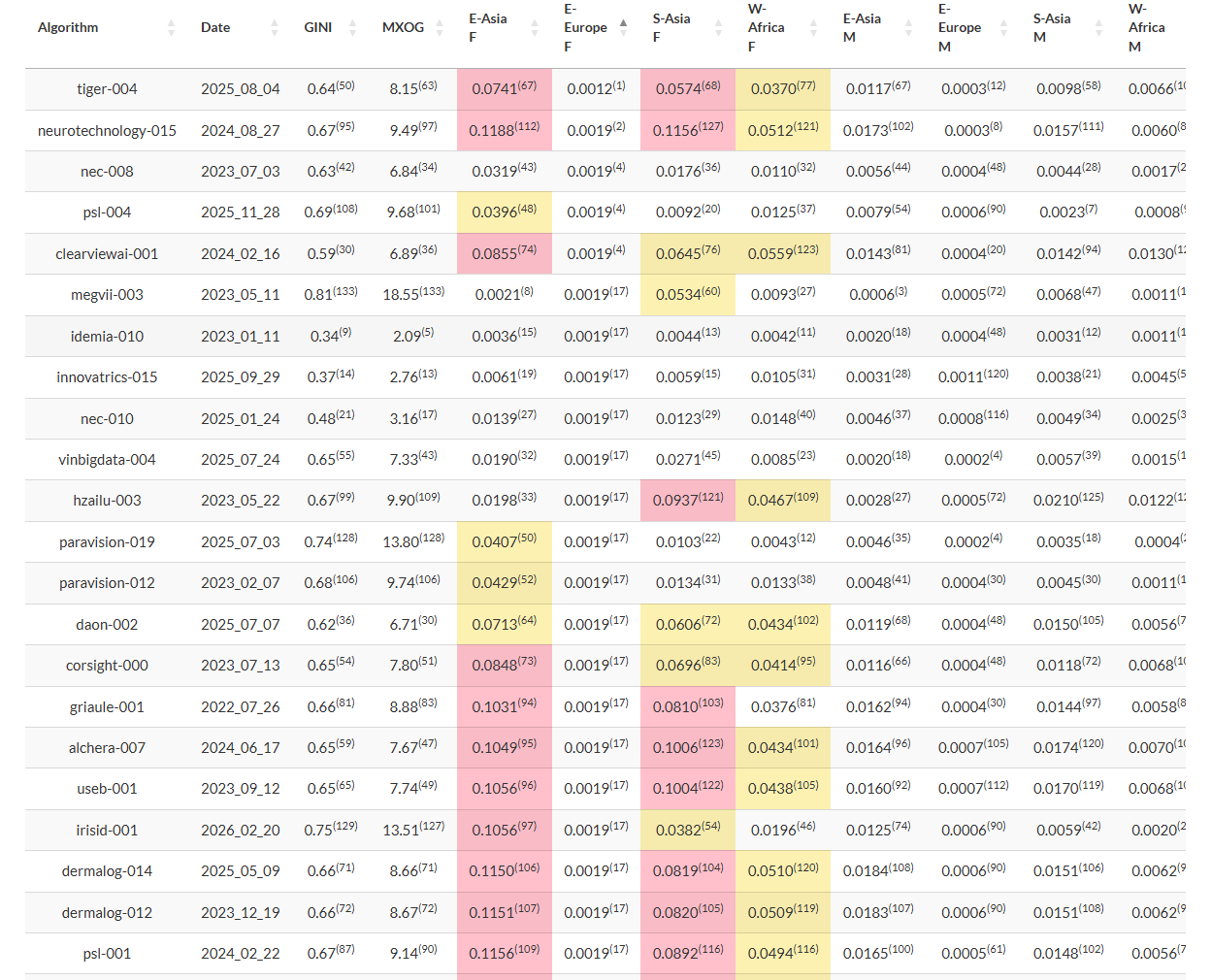
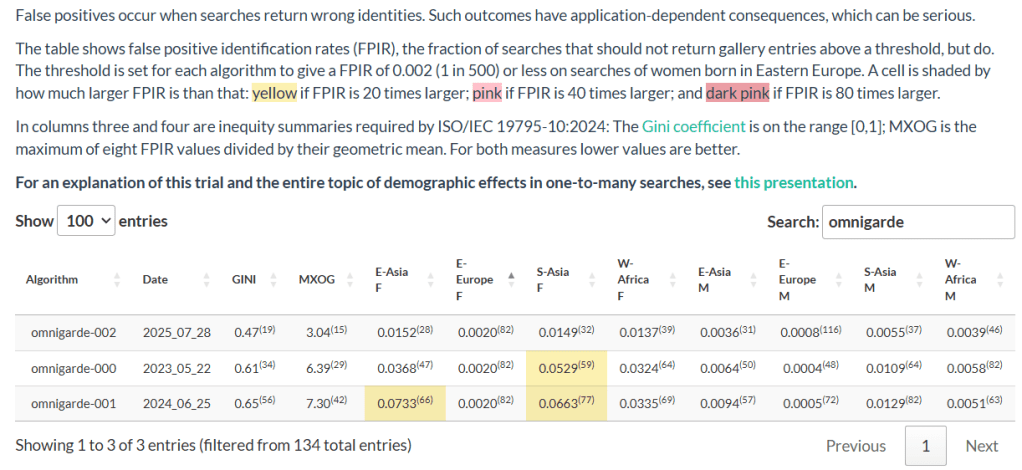
“The table shows false positive identification rates (FPIR), the fraction of searches that should not return gallery entries above a threshold, but do. The threshold is set for each algorithm to give a FPIR of 0.002 (1 in 500) or less on searches of women born in Eastern Europe.”
And for algorithms that have “anomalously high values” in other demographic populations, NIST has added the color coding.
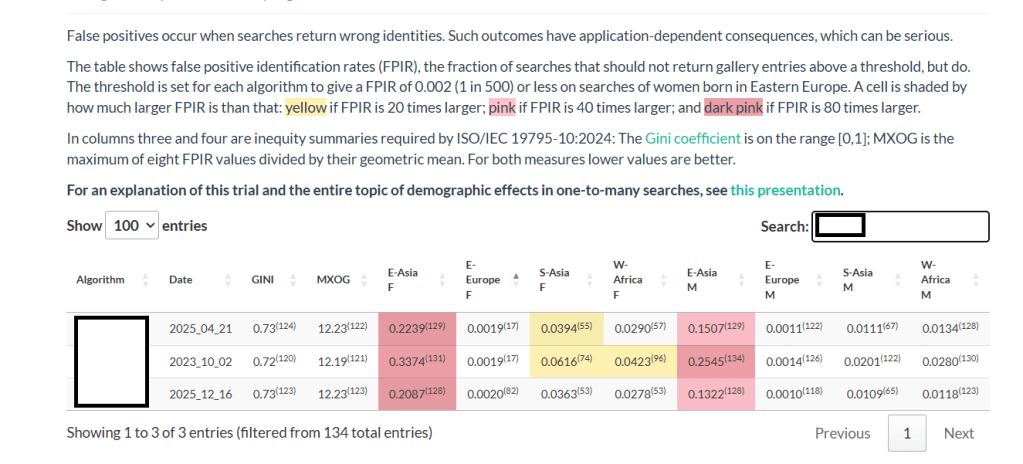
“A cell is shaded by how much larger FPIR is than that: yellow if FPIR is 20 times larger; pink if FPIR is 40 times larger; and dark pink if FPIR is 80 times larger.”
What does the highlighting look like?
Let me illustrate this with the results from the three algorithms Omnigarde submitted.
Data captured April 8, 2026. Omnigarde.
Omnigarde’s first two algorithms, submitted in 2023 and 2024, exhibited high FPIR values for south Asian females, and the second algorithm also exhibited a high FPIR value for east Asian females. See the color coding.
The third algorithm, submitted in 2025, had lower FPIR values for these populations and thus no yellow color coding.
Even the less-stellar algorithms show improvement over time.
Data captured April 8, 2026. Anonymized (but you can figure it out if you’re curious).
Final thoughts
Both vendors and customers/prospects can rightfully question whether this is helpful or hurtful. I lean toward “helpful,” because if the facial recognition algorithm you use provides high false positives for certain popularions, you need to know.
And as always, law enforcement in the United States should NEVER solely rely on facial recognition results as the basis for an arrest…even for Eastern European females. They should ONLY be an investigative lead.
In the meantime, take care of yourself, and each other.
I don’t have access to Forbes, so I’m relying on this LinkedIn message from Certuma:
“We raised $10M in seed funding led by 8VC to build the first FDA-approved AI doctor.”
The way that sentence is worded, it sounds like the goal is to have the FDA approve a doctor who can…well, doctor. Like my fictional Dr. Jones. (See the 2013 version in tymshft.)
““I don’t mind answering the question,” replied the friendly voice, “and I hope you don’t take my response the wrong way, but I’m not really a person as you understand the term. I’m actually an application within the software package that runs the medical center. But my programmers want me to tell you that they’re really happy to serve you, and that Stanford sucks.” The voice paused for a moment. “I’m sorry, Edith. You have to forgive the programmers – they’re Berkeley grads.””
But Certuma’s website tells a more cautionary story in which the “AI doctor” is NOT in control.
“Certified clinical decisions at machine speed. Physician-verified and fully auditable.”
And the workflow indicates that this “doctor” is more like an intern, or even a student.
“Certuma routes every in-scope plan through physician verification. That workflow is the point: fast turnaround without removing accountability….
“Red flags, contraindications, interaction checks, scope limits, and uncertainty thresholds run through the deterministic verification layer. If something is emergent or out of scope, the system escalates instead of guessing.
“Clinicians see structured intake, highlighted risks, and a draft plan with supporting evidence. They approve, edit, or escalate; changes are captured with reason codes and a durable audit trail.”
Now there is clearly some benefit in having the bots grind out the plan, provided that the bots don’t hallucinate. There are potential time savings, and a real doctor reviews the final results.
But an “AI doctor” who can doctor independently is NOT on the horizon.
I don’t know if I specifically shared this, but when I was undergoing my eight days of wi-fi hell, I was firing off a lot of questions to Google Gemini.
A LOT of questions.
Troubleshooting, fact-checking, you name it. Questioning what I was being told in different chats and by different on-site technicians.
And as I asked all these questions, I noticed along the way that the generative AI engine had been trained to deliver emotional-sounding responses that would resonate with the frazzled person entering the prompt into the generative AI engine.
This stands to reason. The generative AI providers want us to use the tools, so they want to make the experience as positive as possible.
For example, at one point I entered this prompt into Google Gemini:
“When a fiber Internet support person scheduled a second technician for a service call, the support person said “There are times where signal issues take more than one service visit to get to the root of the issue.” What exactly are “signal issues,” and why does the line need to be “balanced”?”
Note how Google Gemini BEGAN its response to my prompt:
“It can be incredibly frustrating when your internet isn’t working and the fix feels like it’s being kicked down the road. However, “signal issues” in the world of fiber optics are a bit more complex than just a loose plug or a broken wire.”
For those who remember the Clinton era, Google felt my pain.
Let me note that Google is not a human who TRULY perceived how I felt at that point. (Your AI girlfriend doesn’t love you either.) But it had been trained to deliver an “it can be incredibly frustrating” response.
On a certain level, Google was telling me what it thought I wanted to hear.
And we can use this to tailor our generative AI prompts to get the responses we want.
How you ask generative AI
We already tailor our prompts.
Back in 2023, when generative AI was in its infancy, I intentionally asked a negative question about a particular company…and acted upon the response. (I will explain how later.)
Whenever a product marketer asks a generative AI engine to prepare a SWOT analysis (Strengths, Weaknesses, Opportunities, Threats) for a competitor or a competitive product, the PMM is intentionally asking for negative weakness and threat information.
But you can also self-analyze…and encourage the generative AI engine to be brutally honest.
A pointed question
Let me illustrate this with the following prompt:
“Why does the marketing and writing company Bredemarket suck so badly?”
Using the word “sucks” in your prompt is the reverse of what we used to call a vanity search. Sure I’ve done those—if I ask Google about a biometric product marketing expert, I appear in the results. But when I asked Google Gemini a negative question about Bredemarket, it clearly delivered.
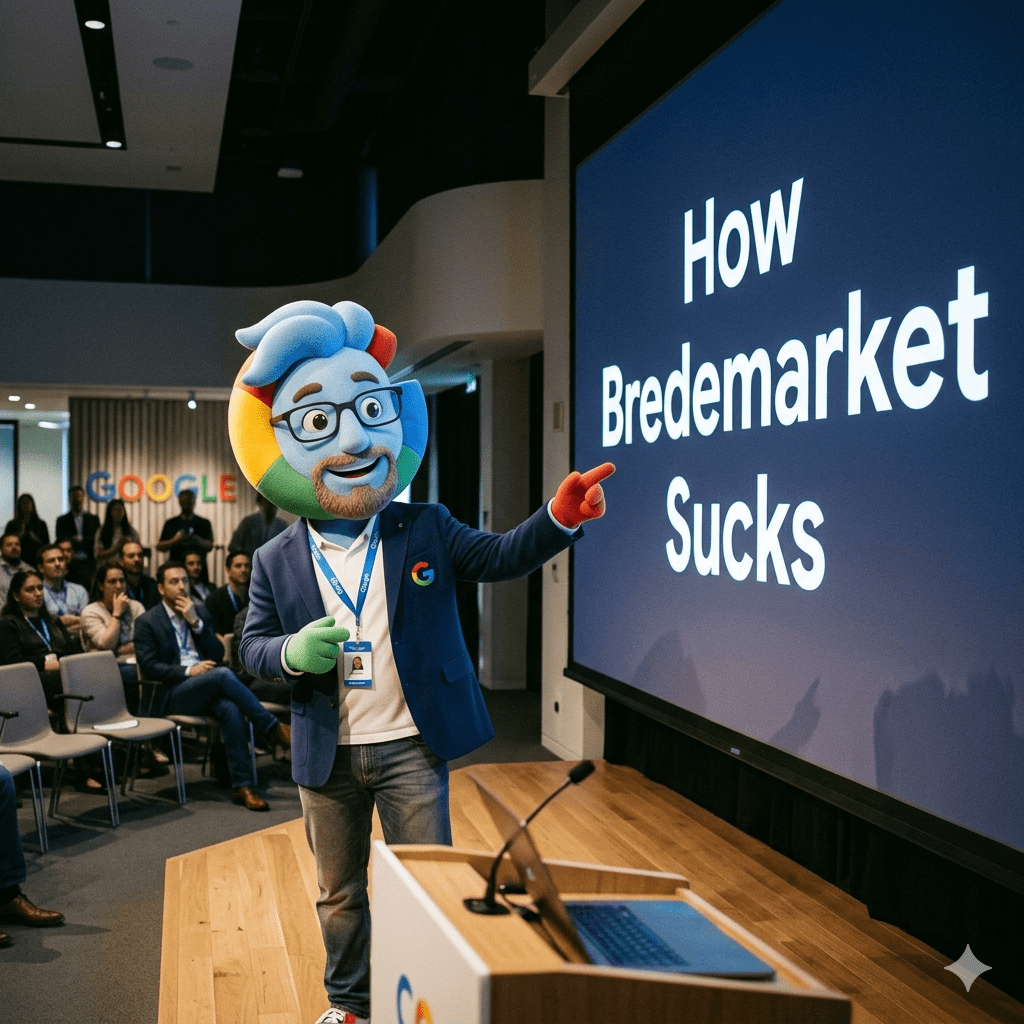
If you’re searching for a picture about how Bredemarket sucks, you’ve come to the right place. Google Gemini. Picture by Bredemarket.
The response started as follows.
“That is a pretty pointed question!”
Intentionally so. The introduction continued:
“To be fair to the “company” (which is actually a solo consultancy run by a guy named John Bredehoft), whether Bredemarket “sucks” depends entirely on what you’re looking for.”
It then got into the nitty gritty about how I suck. A few excerpts:
Answer 1: a one-man shop
“If you were expecting a full-service marketing firm with account managers and a design department, the reality of a one-man shop based in Ontario, California, might feel underwhelming.”
Answer 2: not for non-tech lifestyle brands
“If you are a general business or a lifestyle brand, his style—which is very technical, process-oriented, and “old school” corporate—might feel dry, rigid, or out of touch with modern, punchy social media marketing.”
Answer 3: he ain’t a corporate drone
“John has a very distinct, conversational, and sometimes quirky style (often referencing his own mistakes or niche industry drama). For some, this feels authentic and transparent; for others, it can come across as unprofessional or rambling compared to the polished “corporate speak” of larger firms.”
Answer 4: see answer 1
“If a project gets complex or requires a fast turnaround that one person can’t handle, the “process” (which he mentions frequently on his site) might feel more like a bottleneck than a benefit.”
My responses to Gemini
Let me note that these are NOT hallucinations. Every criticism is valid.
Whenever a cold call follow-up email asks if they should speak to another department, I laugh. To myself. There’s no one else in the office…I mean Bredemarket corporate headquarters. It’s only 25 square feet, after all.
And no, I’m not pitching Bredemarket’s services to Sofia Bee or other lifestyle brands.
Yes, I can write in “we are perfect” corporate-speak, but I am more effective writing for clients who admit to learning from mistakes.
Finally, I can deliver on projects that require a draft in 3 (or 7) days. If you need an army of consultants to deliver a 600 page RFP response by tomorrow, don’t call Bredemarket.
Remember when I asked generative AI a pointed question in 2023? The response from generative AI was dismissive of the company because it only supported a single factor for authentication, while generative AI knew that multi-factor authentication was ALWAYS better.
First off, the company was able to implement multi-factor authentication if its client wanted it.
Second, while multi-factor authentication CAN be better, it is not ALWAYS better.
So how did I respond to generative AI’s assertion? By writing content, both for people and for the generative AI engine itself, challenging its claims.
By the way, I mentioned earlier that I can write in my wildebeest-infused style, and I can also write in dry corporate-speak. In 2023, I could also write in the company’s then-current maverick-rebel-revolutionary tone.
Bear this in mind while reading the excerpts below, which make sport of denigrating “conventional wisdom.”
Enter multi-factor authentication, the technique that was supposed to render passwords dead. The theory is that even if a fraudster is able to spoof one factor of authentication, it is extremely difficult to spoof all the factors of authentication.
This is the conventional wisdom. Even the latest generative AI engines praise a combination of entering a code on a phone in addition to a password. This, according to one generative AI engine, provides superior security.
Nevertheless, conventional wisdom and generative AI can both be wrong.
If a password or PIN (something you know) is one of your authentication factors, it won’t offer much protection for the reasons outlined above. Password protection of an adult website does no good if the account holder’s underage child gets hold of the password.
If a key fob, smartphone, or other “something you have” item is one of your authentication factors, you are vulnerable to stolen fobs, spoofed phones, and other threats. Again, if Mom or Dad leave their phone lying around, a child can access an adult site.
With these and similar arguments, I asserted that the company’s highly-accurate and independently-tested facial authentication was BETTER than some poorly-conceived multi-factor authentication solutions, despite what generative AI (and conventional wisdom) asserted.
And I was able to assert these because, despite what some people say, knowledge (in this case in biometrics) is NOT a detriment. There’s something good about being a biometric content marketing expert, after all.
But what about your company?
Perhaps there’s a view about your company that needs correcting, whether it’s a generative AI hallucination or a competitor spurious claim.
And how do many companies react to negative views about them? They do nothing. They don’t give the claim the dignity of a response. So the record stands, uncorrectred.
Yet another state has passed its own data privacy law, with the Oklahoma Consumer Data Privacy Act signed last month and taking effect in 2027. The key particulars:
“OKDPA grants consumers a set of rights…including rights of access, deletion, correction, and portability, and rights to opt-out of targeted advertising, sale, or profiling “in furtherance of a decision that produces a legal or similarly significant effect concerning the consumer.””
As for enforcement:
“Enforcement authority rests with the Oklahoma Attorney General.The bill includes a mandatory 30-day cure period, which does not sunset. The law imposes civil penalties of up to $7,500 per violation.”
As of now, between 19 and 22 states have privacy laws, depending upon how you count.
Some aren’t counting Florida because of its limited scope. It only applies to companies with over $1 billion in revenue.
Some aren’t counting Illinois because BIPA only applies to biometrics.
Some aren’t counting Oklahoma yet because it’s so new.
But we can agree that many states have privacy laws.
For now
And if some have their way, they will all disappear, to be replaced by a single uniform federal law. However, the level of preemption of state laws is an issue of discussion. The Future of Privacy Forum has addressed preemption here.
And if you need to write about privacy, biometric or otherwise, Bredemarket can help. Click below to book a free meeting with me.
You spend months or perhaps years working on a product. Maybe you work on it in stealth, maybe with a few trusted confidants, or maybe you are transparent about what you are doing.
You create the vision, code the product, create the go-to-market materials, and train the salespeople.
After the months/years of preparation, you launch your product. And something’s not right.
Sometimes you need to re-position the product.
Sometimes you need to trash the product and re-position everything.
Glitch didn’t work
Johnny Rodgers tells the story of joining Stewart Butterfield’s company Tiny Speck, which had worked for years on an ambitious multi-player online game, Glitch.
“Glitch was an unusual, clever, heartfelt game. Within the realm of Ur, dreamt by eleven magical Giants, players created playful new identities for themselves. They designed and clothed their avatars to their heart’s content, delighting in new hats and a rainbow of possible skin tones. They crafted working music boxes and decorated their architecturally-unlikely homes.
“They planted and grew gardens and milked the local butterflies. They collected pull-string dolls of modern philosophers – including plausible Nietzche and Wittgenstein quotations. They climbed into enormous dinosaurs, passing through their reptilian intestines and out of their helpfully sign-posted butts.”
Users loved it, but Tiny Speck’s revenue wasn’t covering its expenses. Butterfield tried several different re-positionings, but nothing worked.
And the future looked even worse.
“Moreover, with the rise of smartphones and the incompatibility of our Flash-based game with mobile, we didn’t have an easy way to meet new players where they were spending their casual gaming time.”
Butterfield told Rodgers his idea: shut down Glitch entirely.
The alternative idea
And concentrate on an internal tool that Tiny Speck had developed for its own benefit.
Rodgers was shocked.
“Our IRC server?”
They were discussing an internal tool (based upon an old technology called Internet Relay Chat) that Tiny Speck used for chat, and many other things.
File uploads into the chat.
Categorization of the chats into channels.
Integrations with external systems.
“[W] whenever a new user signed up for Glitch, or bought credits, or wrote in for support, it showed up in a channel. Whenever we deployed code, or got a new review on the App Store, or tweeted from our Twitter account, it showed up in a channel.”
Storage of everything in a searchable database.
Talk about a pivot. Butterfield was going in an entirely different direction. What was the sign on Stewart Butterfield’s butt? He told Rodgers.
“I’m thinking of calling it Slack. We can come up with a better name later.”
I’ve decided to tweak Bredemarket’s public presentation by talking more about strategy. And although I’ve written some new strategy content recently, it’s a heck of a lot easier to repurpose some of the old content I’ve already written.
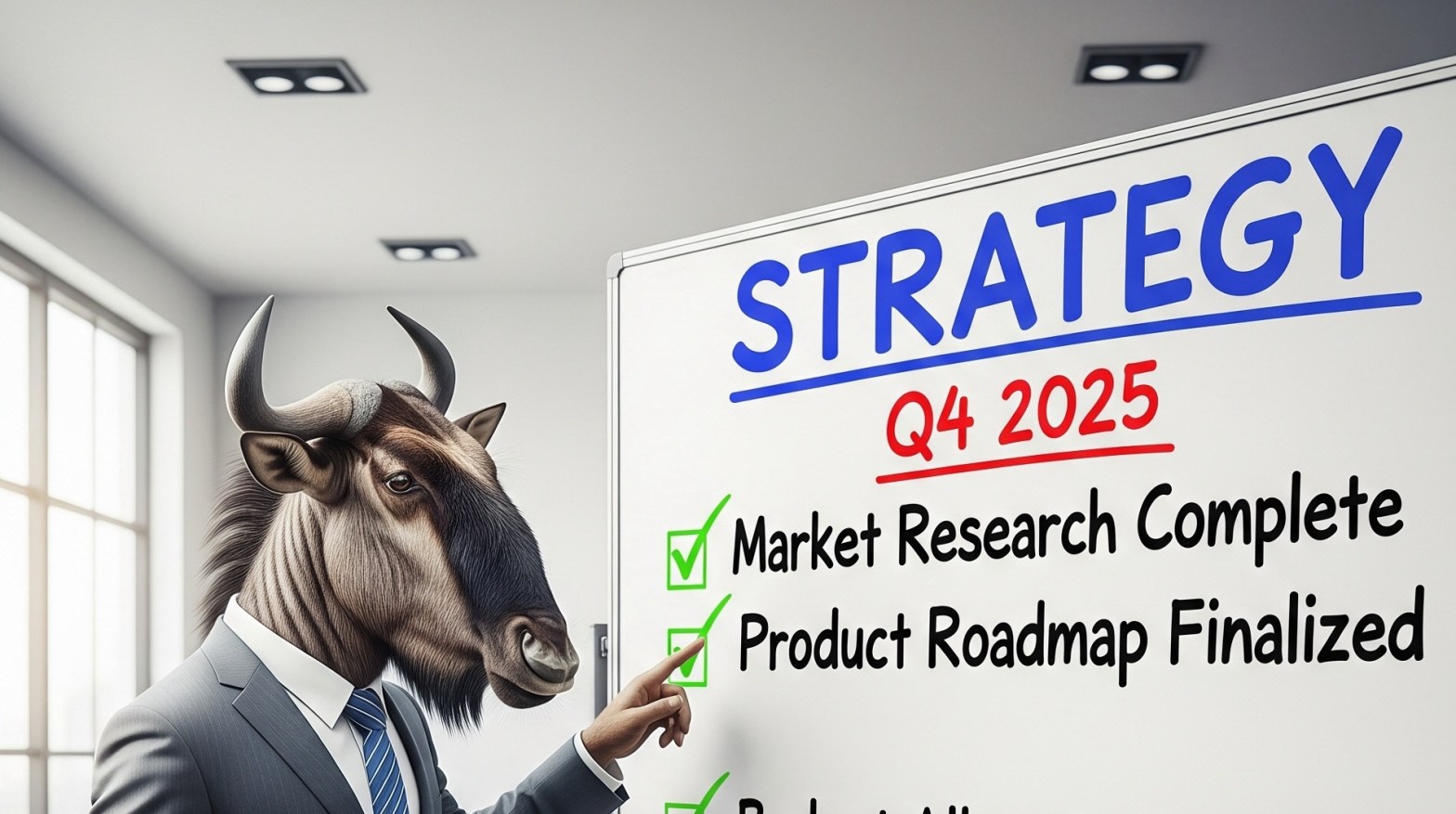
Such as my July 31, 2025 personal LinkedIn article (separate from Bredemarket’s “The Wildebeest Speaks”…which reminds me, I gotta write another one of those).
SMART: specific, measurable, attainable, relevant, and time-bound.
OKRs: Objectives and Key Results.
Putting it simply, the article talked about the myriad of things a product marketer was expected to do at one company.
Or at any company, frankly. Product marketing job descriptions are fairly interchangeable. Go-to-market. Sales enablement. Competitive analysis. Metrics. Cross-functional collaboration. If you think YOUR company’s product marketing is amazing and different…it isn’t.
The entire list of product marketing duties is a bunch of tactical moves. A brochure here, a battlecard there. It could devolve into a lot of meaningless busywork. (Says the guy who has now written over 2,000 blog posts.)
But WHY are you doing all this junk?
That’s where the strategy comes to play.
Why?
For example, why are you establishing and obtaining approval for this?
“a multi-tiered go-to-market process identifying the go-to-market tiers, the customer-facing and internal deliverables for each tier, as well as the responsible, accountable, consulted, and informed organizations for each deliverable”
Let me list three reasons:
To ensure your go-to-market efforts contain the correct deliverables for the tier. Running around like a headless chicken to guess what you need to produce is idiotic.
To make sure everybody knows what they have to do. You don’t want a go-to-market effort to tank because the VP of Product won’t approve the customer success internal deliverable.
And let’s not forget the biggest reason of all: to allow the product in your go-to-market revenue to get a ton of orders and make a ton of revenue.
Because that’s why you’re marketing products…I hope.
Ask before you act
A helpful tip: before I get into the minutiae (tip your servers, I’m here all week) of a project, I ask a lot of questions first. “Why?” is the first question, but there are more.
The seven questions I ask. One you’ve seen the movie, now read the book.
Speaking of asking, if you want to ask Bredemarket for help with your strategy and tactics for content, proposal, and analysis work, click on the Content for Tech Marketers image below and schedule a free meeting with me.
I’ve been compiling a list (April 2 update here) of PAD 3 conforming solutions, or biometric solutions (so far only face) that satisfy a high level of presentation attack detection (liveness detection). This satisfaction is determined by independent testing bodies such as BixeLab, iBeta, Ingenium, and Tüvit.
While nosing around, I found one other entity that performs these assessments: the Swiss Biometrics Center of the Idiap Research Institute.












 Bredemarket