Three Ways in Which My Identity/Biometric Experience Exhibits My “Bias”

Yeah, I’m still focused on that statement:

“I think too much knowledge is actually bad in tech: you’re biased.”

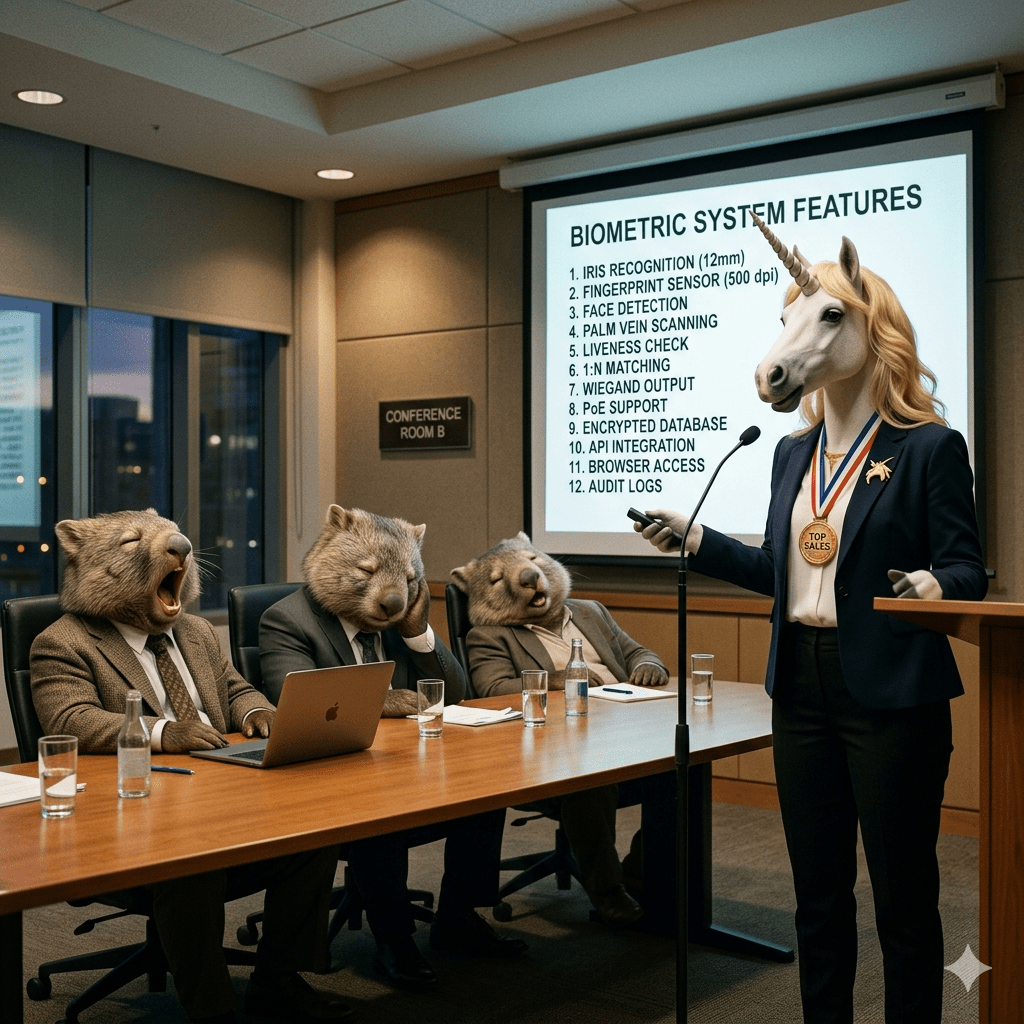
Why does this quote affect me so deeply? Because with my 30-plus years of identity/biometric experience, I obviously have too much knowledge of the industry, which is obviously bad. After all, all a biometric company needs is a salesperson, an engineer, an African data labeler, and someone to run the generative AI for everything else. The company doesn’t need someone who knows that Printrak isn’t spelled with a C.
Google Gemini.

In this post I will share three of the “biases” I have developed in my 30-plus years in identity and biometrics, and how to correct these biases by stripping away that 20th century experience and applying novel thinking.

And if that last paragraph made you throw up in your mouth…read to the end of the post.

But first, let’s briefly explore these three biases that I shamefully hold due to my status as a biometric product marketing expert:

  1. Independent algorithmic confirmation is valuable.
  2. Process is valuable.
  3. Artificial intelligence is merely a tool.
Biometric product marketing expert.

Bias 1: Independent Algorithmic Confirmation is Valuable

Biometric products need algorithms to encode and match the biometric samples, and ideally to detect presentation and injection attacks.

But how do prospects know that these algorithms work? How accurate are they? How fast are they? How secure are they?

My bias

My brain, embedded with over 30 years of bias, gravitates to the idea that vendors should submit their algorithms for independent testing and confirmation.

From a NIST facial recognition demographic bias text.

This could be an accuracy test such as the ones NIST and DHS administer, or confirmation of presentation attack detection capabilities (as BixeLab, iBeta, and other organizations perform), or confirmation of injection attack detection capabilities.

Novel thinking

But you’re smarter than that and refuse to support the testing-industrial complex. They have their explicit or implicit agendas and want to force the biometric vendors to do well on the tests. For example, the U.S. Federal Bureau of Investigation’s “Appendix F” fingerprint capture quality standard specifically EXCLUDES contactless solutions, forcing everyone down the same contact path.

But you and your novel thinking reject these unnecessary impediments. You’re not going to constrain yourself by the assertions of others. You are going to assert your own benefits. Develop and administer your own tests. Share with your prospects how wonderful you are without going through an intermediary. That will prove your superiority…right?

Bias 2: Process is Valuable

A biometric company has to perform a variety of tasks. Raise funding. Hire people. Develop, market, propose, sell, and implement products. Throw parties.

How will the company do all these things?

My bias

My brain, encumbered by my experience (including a decade at Motorola), persists in a belief that process is the answer. The process can be as simple as scribblings on a cocktail napkin, but you need some process if you want to cash out in a glorious exit—I mean, deliver superior products to your customers.

Perhaps you need a development processs that defines, among other things, how long a sprint should be. A capture and proposal process (Shipley or simpler) that defines, among other things, who has the authority to approve a $10 million proposal A go-to-market process that defines the deliverables for different tiers, and who is responsible, accountable, consulted, and informed. Or maybe just an onboarding process when starting a new project, dictating the questions you need to ask at the beginning.

Bredemarket’s seven questions. I ask, then I act.

Novel thinking

Sure all that process is fine…if you don’t want to do anything. Do you really want to force your people to wait two weeks for the latest product iteration? Impose a multinational bureauracy on your sales process? Go through an onerous checklist before marketing a product?

Google Gemini.

Just code it.

Just sell it.

Just write it.

Bias 3: Artificial Intelligence is Merely a Tool

The problem with experienced people is that they think that there is nothing new under the sun.

You talk about cloud computing, and they yawn, “Sounds like time sharing.” You talk about quantum computing, and they yawn, “Sounds like the Pentium.” You talk about blockchain, and they yawn, “Sounds like a notary public.”

My bias

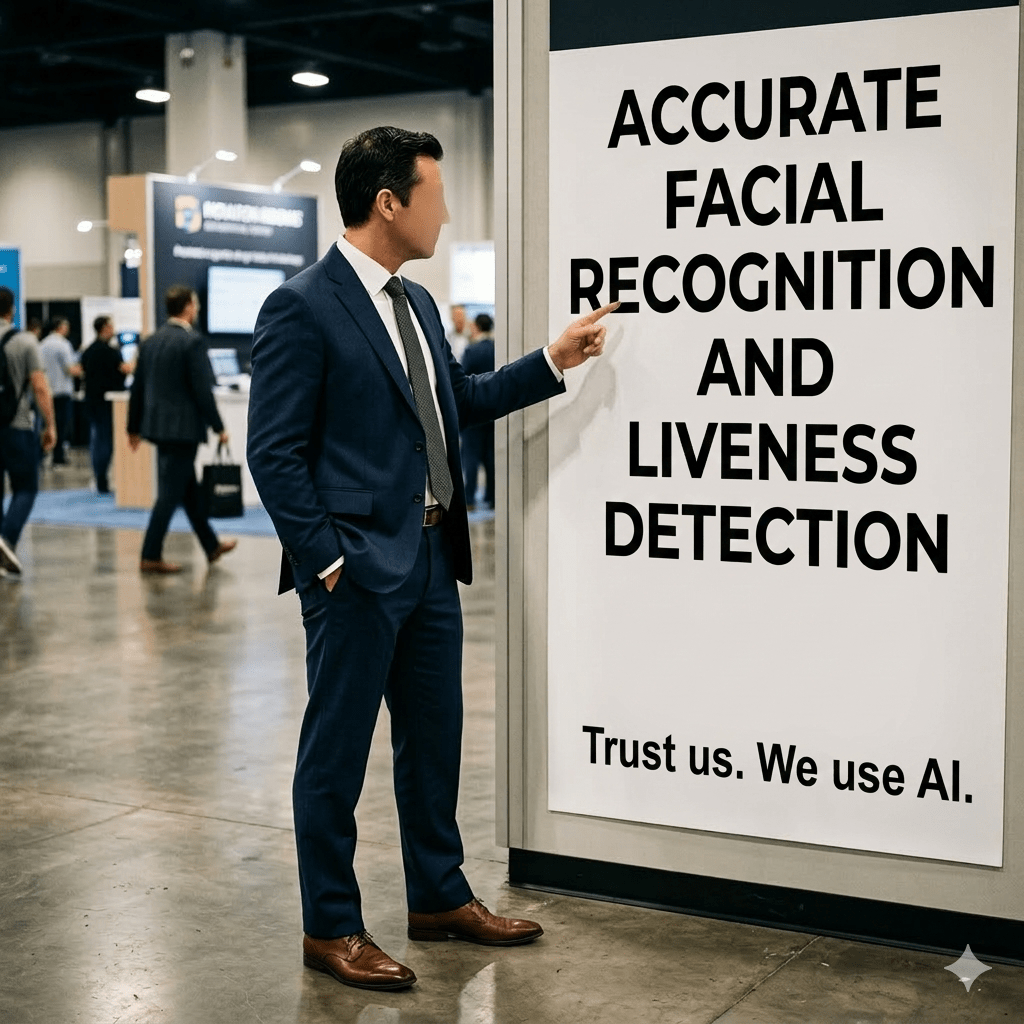
As I sip my Pepperidge Farm, I can barely conceal my revulsion at those who think “we use AI” is a world-dominating marketing message. Artificial intelligence is not a way of life. It is a tool. A tool that in and of itself does not merit much of a mention.

Google Gemini.

How many automobile manufacturers proclaim “we use tires” as part of their marketing messaging? Tires are essential to an automobile’s performance, but since everyone has them, they’re not a differentiator and not worthy of mention.

In the same way, everyone has AI…so why talk about its mere presence? Talk about the benefits your implementation provides and how these benefits differentiate you from your competitors.

Novel thinking

Yep, the grandpas that declare “AI is only a tool” are missing the significance entirely. AI is not like a Pentium chip. It is a transformational technology that is already changing the way we create, sell, and market.

Therefore it is critically important to highlight your product’s AI use. AI isn’t a “so what” feature, but an indication of revolutionary transformative technology. You suppress mention of AI at your own peril.

How do I overcome my biases of experience?

OK, so I’ve identified the outmoded thinking that results from too much experience. But how do I overcome it?

I don’t.

Because if you haven’t already detected it, I believe that experience IS valuable, and that all three items above are essential and shouldn’t be jettisoned for the new, novel, and kewl.

  • Are you a identity/biometric marketing leader who needs to tell your prospects that your algorithms are validated by reputable independent bodies?
  • Or that you have a process (simple or not) that governs how your customers receive your products?
  • Or that your AI actually does unique things that your competitors don’t, providing true benefits to your customers?

Bredemarket can help with strategy, analysis, content, and/or proposals for your identity/biometric firm. Talk to me (for free).

By the way, here’s MY process (and my services and pricing).

Bredemareket: Services, Process, and Pricing.

Why Do We Have Electronic Health Records?

I’ve discussed the electronic health record (EHR) before, and plan to do so again. But before I dive into EHRs and “the A word,” I want to take a look at WHY we have EHRs.

When dinosaurs roamed the earth

In the old days, even within the lifetimes of some of us, there were no ELECTRONIC health records. There were PAPER health records, stored in large file cabinets. If you were lucky, the health records were typed; heaven help you if they were in a doctor’s famously illegible handwriting.

When a relative’s doctor retired in the 20th century, the relative requested their health records and received a huge pile of paper dating back to who knows when. In that form, it was about as useful as the huge file cabinets in which the U.S. Federal Bureau of Investigation used to store its millions of fingerprint cards. And unfortunately, paper health records didn’t have the health equivalent of a “Henry system” to find individual records quickly.

The two purposes of an electronic health record

So now that we have electronic health records, why do we have them?

  • To make life easier for the doctor? Of course not.
  • To make life easier for the patient? Definitely not.

Electronic health records have evolved to serve two OTHER parties.

First, electronic health records serve the billers

I can’t speak to countries other than my own, but in the United States the health “system” is a mishmash of multiple parties. For example, when I had a colonoscopy a few years ago, the following entities were somehow involved:

  • The doctor who performed the colonoscopy.
  • The facility where the doctor performed the colonoscopy.
  • The anaesthesiologist who assisted with the colonoscopy.
  • My insurance company.
  • My former company (via COBRA) who provided me with the insurance.
  • And probably a half dozen other entities that I missed who somehow got a cut.

So this one procedure created one, or perhaps multiple, electronic health records (perhaps even with pictures) describing every chargeable thing that could be itemized during my time in the facility. All with the proper billing codes (Current Procedural Terminology or CPT codes) and the like, so that every entity can pay what they’re supposed to pay. And if a particular thing wasn’t covered by insurance, then I had to pay it.

Google Gemini.

The most important thing is to get the billing codes right…never mind how hard it is to ENTER all the billing codes.

But the good news is that when electronic health records systems integrate with medical billing systems, the process is kinda sorta streamlined:

“By integrating EHR and billing software, healthcare providers can automate various aspects of the billing workflow, resulting in increased efficiency, reduced manual work, and other tangible benefits.”

Second, electronic health records serve the lawyers and regulators

But it’s not only the billers who need information.

To practice medicine in the State of California, you have to perform a colonoscopy in accordance with medically approved procedures. And you have to document that you did so.

If I had died on the operating table during my colonoscopy, then a number of private and government entities would have a keen interest in what was performed during the colonoscopy. And the electronic health record would be one of the main sources of information about what happened, and perhaps what went wrong. And who was responsible. The doctor? The facility? The anaesthesiologist? Someone else?

But even when things don’t go spectacularly wrong, there are laws and regulations that mandate EHR use.

“The “EHR mandate” refers to the federal requirement for eligible healthcare providers to adopt and use certified EHR technology. Primarily affecting providers who accept Medicare, participation in MIPS and the Promoting Interoperability program requires CEHRT to avoid negative payment adjustments, which effectively necessitates EHR use.”

The result

So now the medical field has these wonderful EHRs that comply with billing requirements and legal requirements.

But are they easy to use? Forbes covered this.

“For instance, emergency medicine physicians at one health system must click 14 times to order Tylenol—that’s a lot. Yet, those at another health system using the same EHR must click 61 times!”

And that’s just for Tylenol. I’m sure it’s a lot worse for the camera that looked at my colon.

It could have been worse, because many Americans are not healthy.

“[O]ur patients have increasingly complex health needs. More than 40% of American adults have at least two chronic conditions, one-third take at least three medications, and one-fifth suffer from mental illness.”

Put these and other things together, and EHRs have become (as I said before) “a pain in a particular body part.”

Google Gemini.

So that’s the problem with EHRs. Later I’ll look at the solutions, including:

Human-reviewed AI-generated Code for Efficiency and Accuracy

When looking at how to solve a problem, it’s sometimes helpful to look at the two extreme solutions.

What if you have a coding project? The extremes are as follows:

  • Let your favorite generative AI tool vibe code a solution.
  • Require your coders to perform old-school coding with no assistance whatsoever. (OK, maybe a book or something.)

I’ve mentioned Silicon Tech Solutions in the Bredemarket blog before, so I was curious how they approached the task. Turns out the company wrote an article about it, “How AI Coding Tools Are Revolutionizing Development – And Why the Right Prompt Matters.”

An example of a “wrong” prompt:

“Optimize this SQL query.”

And here’s an example of a “right” prompt, guided by a development expert:

“Optimize this SQL query to reduce execution time on a large PostgreSQL table with millions of records. Indexing suggestions would be helpful.”

Because knowledge of coding IS good when you code stuff. And Silicon Tech Solutions uses this knowledge when it uses generative AI coding tools:

At Silicon Tech Solutions, we actively use Cursor to enhance our development workflow. By integrating AI-powered coding tools, we:

🔹 Reduce development time while maintaining high standards.

🔹 Automate repetitive tasks, allowing developers to focus on core logic.

🔹 Ensure clean and optimized code, reducing technical debt.

However, AI does not replace human expertise—it enhances it. Our team carefully reviews and refines AI-generated code to align with best practices and business requirements.

If you want Silicon Tech Solutions’ expertise at your disposal, request a meeting.

Top 3 Identity/Biometric Marketing Mistakes: Avoid These False Differentiators

Bredemarket has consistently argued AGAINSTme too” product marketing, and FOR differentiating your identity/biometric product from its competitors. But your differentiators must resonate with your prospects.

This post lists three false differentiators, and why you should avoid them.

False differentiator 1: we’re a great place to work

Does your company description place undue emphasis on the shiny happy people who work for you? Their competitive salaries? Their unlimited PTO? Their community days? Their “best place to work” awards?

Who cares?

While you would think happy employees are important to prospects, they really aren’t. Enron was a best company to work for, but definitely did not deliver for its customers. Other companies are slave drivers, but customers love their products.

Save the “best place to work” mumbo jumbo for your careers page, not your prospect-facing content.

False differentiator 2: we’re a unicorn

Other companies take a different tack. Some emphasize their financial might: they’re a unicorn, a Series C, a NASDAQ-listed firm. Others take the opposite tack, asserting they are small and scrappy. (Bredemarket is in the latter category.)

So what?

Your prospects don’t care how big you are. Size doesn’t matter to them. Your performance does.

Stick the “unicorn” talk in your investor pitch decks, not on stuff your prospects read.

False differentiator 3: we have great features

By now you’ve probably figured out that your customers care about your product, not your employee satisfaction or your valuation. So you start talking about your product and its impressive array of features. 1000 ppi fingerprint capture. Sub-second matching. Integration with over 100 third-party systems.

How so?

Prospects don’t care about your product and what it does. They care about what it does FOR THEM. Does it solve crimes and keep bad people off the streets? Does it ensure that bank account applicants really are who they say they are? Does it complete its checks quickly before e-commerce buyers abandon their shopping carts?

Talk benefits, not features. Save the feature lists for your sprints.

How do you isolate true differentiators?

Your prospects need to see why your product is great for them, and why competitor products are terrible for them. How your product achieves their objectives: get stuff done, make money.

So what are the differentiators and benefits of your product?

Bredemarket can help your identity/biometric firm with the strategy and tactics of marketing your product. My services and process help you position your product for your prospects.

Bredemarket: Services, Process, and Pricing.

Do you want to learn more? Go to https://bredemarket.com/mark/ and schedule a free meeting with me to learn how Bredemarket can benefit you, so you can fulfill the needs of your prospects.

The Benefits and Detriments of…um…Targeting

I’ve previously stated that Bredemarket is not the ideal content provider for B2C lifestyle brands. I’ve targeted a target audience of B2G/B2B identity, biometric, and technology firms instead.

Precise targeting can be very good…or it can be very bad.

A Targeted Weapon

Efficiency and progress is ours once more
Now that we have the Neutron bomb
It’s nice and quick and clean and gets things done

From the Dead Kennedys

Some of you may not remember the neutron bomb…and some of you do.

Since 1945, the common depiction of nuclear devastation was of catastrophic damage to people and buildings within a large area.

But then the concept of the neutron bomb was developed. Britannica explains:

“A neutron bomb is actually a small thermonuclear bomb in which a few kilograms of plutonium or uranium, ignited by a conventional explosive, would serve as a fission “trigger” to ignite a fusion explosion….

“Its blast and heat effects would be confined to an area of only a few hundred metres in radius, but within a somewhat larger radius of 1,000–2,000 metres the fusion reaction would…be extremely destructive to living tissue….”

As the popular press summarized it, neutron bombs, unlike older uranium or hydrogen bombs, would spare the buildings and kill the people.

What was missed was that the neutron bomb will kill fewer people in a smaller area.

The benefit of the neutron bomb?

The limited damage area promoted a theory in which neutron bombs could be used on the battlefield to target a limited group of enemy troops. This limited range would theoretically confine the damage to military targets without damaging “a whole civilization.”

But this benefit is also a detriment, as Britannica notes.

“However, other military strategists warned that fielding a “clean” nuclear weapon might only lower the threshold for entering into a full-scale nuclear exchange…”

And of course some opponents objected to the very idea of killing ANY people while leaving the buildings intact. Capitalist values at the forefront?

If you’ve never heard of the neutron bomb, they pretty much disappeared after the end of the Cold War.

Which is odd when you think about it, because the end of the Cold War made countries more likely to conduct small-scale wars against each other. From a military tactical perspective (ignoring the strategic or moral issues), neutron bombs seem perfect for such exchanges.

When a Prospect Is Not Really Invested

Have you ever run into an old friend you haven’t seen in years? Both of you say “we should get together.” But you don’t.

Now assume it’s not friendship but a seller/prospect relationship that never moves down the funnel to conversion.

Jan McInnis sells a service, comedy. And how do comedians market their services? By performing. The comedian performs at one venue, and someone from another venue sees them and books them.

Google Gemini.

McInnis was performing in Michigan when she was spotted by a big-time manager (“one of her clients is currently selling out Madison Square Garden”) who saw Jan’s five-minute set. Afterwards the manager approached Jan and said the magic words:

“You were great.”

Then the manager’s office called and requested a meeting, asking McInnis to bring writing samples. Now a meeting itself is no assurance of getting a job, but it’s a possible step toward getting one. So Jan prepared for that meeting, spending her Thanksgiving polishing up her writing samples.

Google Gemini.

But…

“The next day, her office called to postpone the meeting.”

Lather, rinse, repeat. The manager’s office would schedule a meeting, then postpone it. In the end, the manager never met with McInnis, who pivoted away from the comedy clubs and focused on corporate speaking engagements as “The Work Lady.”

And who knows? Maybe some huge tech company will ask her to headlines a gigantic corporate event at Madison Square Garden.

But no rush on writing Knicks jokes yet.

Google Gemini.

The Reality of Sales Enablement

Whenever product marketers create materials for others—whether for external or internal audiences—they need a feedback loop to ensure the audiences can, and will, use the materials.

Google Gemini.

Those who know me know that I am drawn to complexity like a moth to a candle, and constantly have to resist the urge to detail.

  • My draft 0.5s that go through severe cutting before anyone sees draft 1.0.
  • My Incode team’s 80+ “battlecards” that were four pages long.

Regarding the latter, I should have learned the lesson from my MorphoTrak days. I was creating sales playbooks for one of our products that were much more than four pages long. Detailed playbooks that went into detail about the product, the market, the competitors, and everything else.

Sales did NOT like them. I was told the truth about HOW salespeople would use these playbooks.

“I will glance at your playbook five minutes before meeting with a prospect.”

I could wish upon a star that the salespeople would spend four hours in intense study, but just because I wish for it doesn’t mean it is going to happen.

Now I wish…that my Incode battlecards had been shorter.

Trying to Fly Without REAL ID: Today’s Phrase is “Orbital Blowout Fracture”

Don’t get violent at a Transportation Security Administration (TSA) checkpoint. If you do, you may not fly anywhere…or drive or walk anywhere either.

Here’s the story of a man named Idress Vinay Solomon who was preparing to board a Southwest Airlines flight from Dallas’ Love Field to Oakland on March 10. Somehow Mr. Solomon missed the memo that you need a REAL ID or equivalent to board a plane. Something that has been discussed for decades, since passage of the Real ID Act of 2005.

But as readers of the Bredemarket blog know, despite years of declarations that you must have a REAL ID to fly, you don’t need one. The TSA launched ConfirmID this year, an alternate identity confirmation service for those who don’t have approved identity documentation. You pay $45, and TSA confirms your identity via other methods.

Or tries to.

In Solomon’s case, ConfirmID didn’t work either.

Solomon was not happy.

“[T]he Oakland resident allegedly started reacting aggressively and attacked the officers present. During this incident, he punched a [Dallas Police Department] officer multiple times, resulting in the officer suffering an “orbital blowout fracture” in his left eye.”

U.S. Department of Justice.

For those of us who aren’t health professionals, the Cleveland Clinic explains what an orbital blowout fracture is.

“A blowout fracture is the most common type of orbital fracture. This fracture is a break along the floor or thin inner wall of your eye socket. Getting hit in the eye with something like a fist or a baseball most often causes blowout fractures.”

The Cleveland Clinic does not indicate whether iris identification is affected by blunt force trauma.

But let’s return to “Love” Field.

The police officer was hospitalized, and Solomon remains in custody. If convicted, he could face up to 20 years in federal prison, as confirmed by the Department of Justice.

“Violent conduct perpetrated against TSA and law enforcement officers will never be tolerated in the Northern District of Texas,” said U.S. Attorney Ryan Raybould.  “We will prosecute such offenses to the fullest extent to seek justice for the victims here and to deter others from resorting to aggressive attacks against officers responsible for ensuring the public’s safety while traveling.”

Just get the REAL ID, folks.