
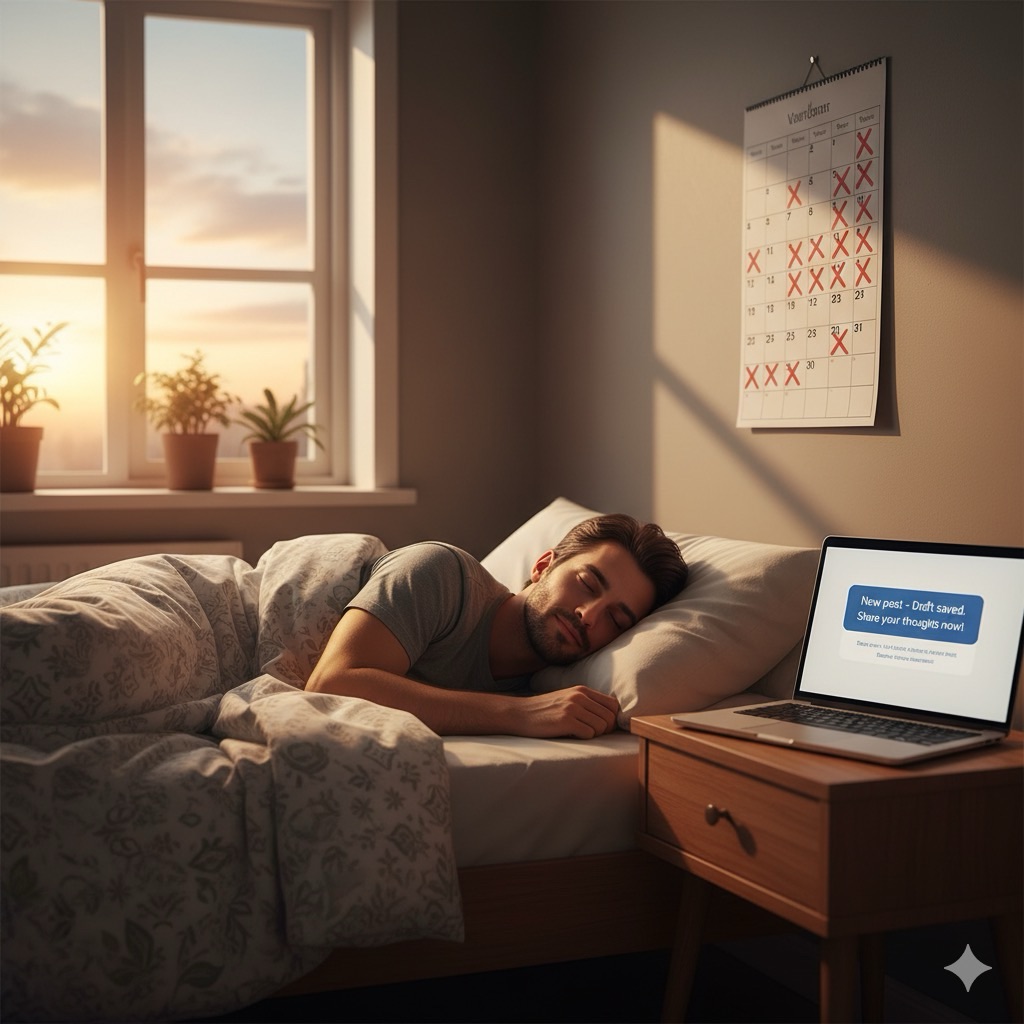
Establish your presence without your presence. Any time. While living your life.
Tag Archives: social media
Go See Cal

In a private Facebook share, Rahsheen Porter quoted from Cal Newport:
“We know these platforms are bad for us, so why are they still so widely used? They tell a compelling story: that all of your frantic tapping and swiping makes you a key part of a political revolution, or a fearless investigator, or a righteous protestor – that when you’re online, you’re someone important, doing important things during an important time.
“But this, for the most part, is an illusion. In reality, you’re toiling anonymously in an attention factory, while billionaire overseers mock your efforts and celebrate their growing net worths.”
The algorithms only show you what they think will cause you to maximally engage. Even in the days of FriendFeed, I never saw content from the extremely active Turkish and Italian communities. Why should I? I saw what FriendFeed wanted me to see.
But I’m thankful that Facebook shows me Rahsheen’s content.
And I am also thankful for those who understood the “Go See Cal” post title.
And finally, I am thankful to the residents and former residents of south Arlington, Virginia who detected the inside joke in the picture above. (Hint: the hoodie was originally gray.)
Flip is Gone: This Isn’t Gonna Be Good Any More

For the past few months I have been posting some of Bredemarket’s reels on Flip, but my (mostly) business-related reels didn’t resonate with Flip’s consumer-oriented audience.
(Which makes my posting life easier, to be honest, but I will keep the app on my phone for a bit just in case someone with money buys the company’s assets.)
Is Instagram next?
No, seriously.
What if you based your entire business model on a single social media channel…and it suddenly disappeared?
I’m looking at you, TikTok people.
Georgi Kisrov’s “Lesson Learned”

(Imagen 4)
From Georgi Kisrov:
“We convince ourselves to hold on just a little longer, to give one more chance, to extend one more ounce of patience. We hope things will change, that people will appreciate us, that circumstances will finally shift in our favor. But sometimes, despite our best efforts, the change never comes.
“That’s when the lesson arrives—not in a single, dramatic flash, but in a quiet realization: I deserve better than this. I deserve to feel seen, valued, respected.”
Read the entire piece here: http://georgikisyov.com/2025/08/26/lesson-learned/
Behind the Scenes: Working on Mesmerizing Storytelling
(Imagen 4)
This was never supposed to go on the Bredemarket blog, but here it is. Because when a product marketing consultant wants to improve his storytelling skills, he practices with…toilet paper.
A Facebook challenge
I’ve been working on improving my AI art generation skills, and even created a special Facebook group, Bredemarket Picture Clubhouse, as my practice area. One of my inspirations has been Danie Wylie, whom I first encountered during the HiveLLM thingie.
Wylie likes to share art challenges, and she recently shared this one. The text below, including the emojis, is straight from the challenge.
📣 New Weekly Wednesday Challenge 📣
🌟 Glitch N’ Sass and AI Anonymous Present:
🎭✨ MESMERIZE THE MUNDANE ✨🎭
Where glitter drips from code and imagination struts in stilettos. @everyone 💥
Take the forgotten, the overlooked, the tragically basic —
and unleash the glam-core magic of AI.
Allow creativity to glitch the system, let sass polish the mundane, all while reshaping reality.
⸻
Flip the script on the everyday:
🥄 A spoon stirs time’s secrets
👟 A shoelace coils into cosmic scales
📎 A paperclip snaps open hidden realms
✨ Rewire purpose.
✨ Reframe presence.
✨ Reveal what the world forgets to see.
📌 Tag it: #AIAnonymous #GlitchNSass #MesmerizeTheMundane
⸻
💬 This isn’t an art drop — it’s an everyday clutch, transformed into a chasm of creativity .
A call to those who see depth in the digital, beauty in glitches, and freedom behind the mask.
We are not escaping the world — we are a reminder, to view it. For all the purposes they told us it never possessed. 🔥
✨ So go on… Mesmerize us, With glitter in one hand and encrypted vision in the other. ✨
Preparing my response
Now on the surface such an exercise has nothing to do with “know your business” or “biometric product marketing expert” or “content – proposal – analysis”…
…but it does.
In essence, written business communications are opportunities for storytelling. As I noted, case studies are inspiring stories about how a challenged company realized amazing success, all thanks to the wonderful Green Widget Gizmo.
Now that’s a riveting story.

And of course I’ve performed AI image storytelling before: for example, with my three “Biometric product marketing expert” reels. Here’s the second:
But back to the “Mesmerize the Mundane” challenge. So to participate in the challenge I had to find something mundane. Now some of you think a single finger sensor is mundane…but I don’t. (There’s actually a connection between fingerprint sensors and art, but I’m under NDA.)
My response
So I picked a mundane topic: toilet paper.
What’s even better is that toilet paper is filled with emotion. Particularly relative to the ongoing debate about whether…
I’m not going to say it. I hope this reel—my entry into the “Mesmerize the Mundane” challenge—speaks for itself.
When I shared this reel on Facebook and elsewhere, I did so with the following text.
A storytelling exercise…and a challenge.
You can’t get more mundane than toilet paper, or spawn fiercer battles over orientation. But love conquers battles.
#AIAnonymous #GlitchNSass #MesmerizeTheMundane #BredemarketPictureClubhouse
But before I close this post I will get a little technical.
Time to show how the sausage is made

By Rklawton – Own work, CC BY-SA 2.5, https://commons.wikimedia.org/w/index.php?curid=735848.
One of the challenges in multi-image storytelling is the need for consistency between the images. You can’t have the hero wildebeest wearing a blue cap in the first picture and a red one in the second.
So to enforce consistency, I’ve been bundling all my picture prompts into a single request to Google Gemini, and including instructions to enforce similarity between the pictures in the series.

So here is the specific request used to create the four pictures in the reel above.
Draw realistic pictures based upon the following four prompts:
Prompt 1: Draw a realistic picture of a toilet paper holder on a blue tiled bathroom wall, next to the toilet. The toilet paper is white. The toilet paper end is hanging in front of the roll.
Prompt 2: Draw a realistic picture similar to the image in the previous prompt, a toilet paper holder on a blue tiled bathroom wall, next to the toilet. The toilet paper is still white. This time, however, the toilet paper end is hanging behind the roll.
Prompt 3: Draw a realistic picture similar to the image in the previous prompts, a toilet paper holder on a blue tiled bathroom wall, next to the toilet. Now the toilet paper is glowing in a neon red. Due to mesmerizing magic, there is a toilet paper end hanging in front of the roll, and there is also a duplicate toilet paper end hanging behind the roll. The presence of both toilet paper ends removes the conflict of whether to hang toilet paper in front of our behind the roll; now, both are simultaneously true.
Prompt 4: Draw a realistic picture similar to the image in the previous prompts, a toilet paper holder next to the toilet. But now the tiles on the bathroom wall are colored gold, vibrating, and throbbing. The toilet itself is glowing with a bright light. Now the toilet paper is glowing in red, green, and blue, and sparkles are shooting away from the toilet paper roll like fireworks. Again, due to mesmerizing magic, there is a toilet paper end hanging in front of the roll, and there is also a duplicate toilet paper end hanging behind the roll. The bathroom floor is covered in hundred dollar bills and shiny gold coins.
And here are the full square pictures, which do not completely display in the reel.




Now I just have to tell the riveting story of a single finger sensor.
When Meta Personal Accounts Become Professional
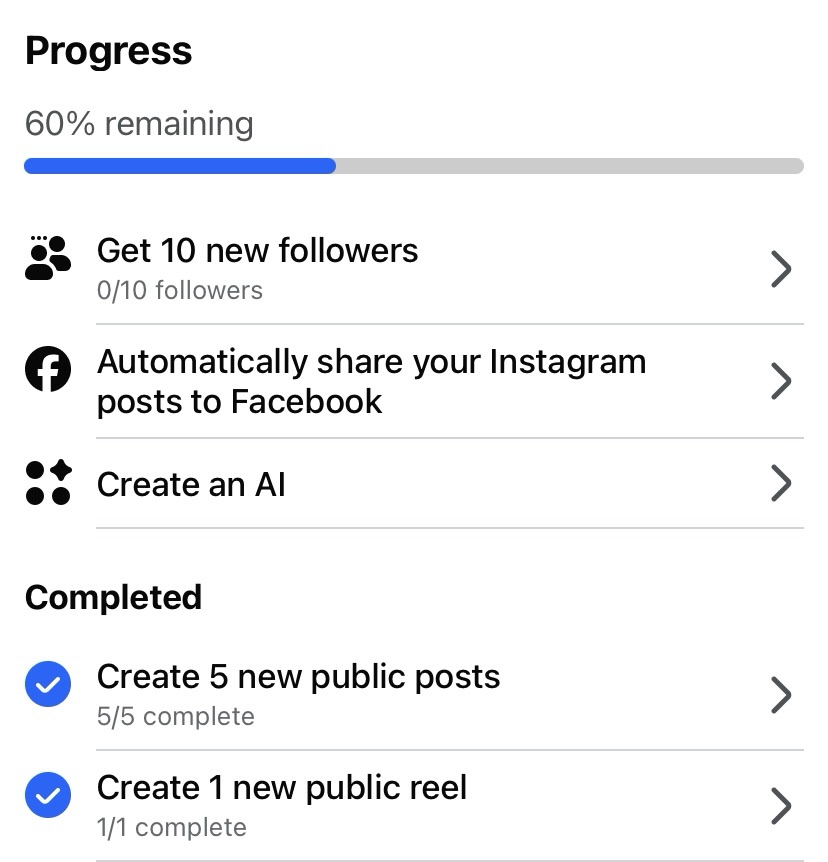
Originally posted on my personal Instagram https://www.instagram.com/reel/DM3KMPvvsR4/
My personal Facebook account is technically a “professional” account, and therefore has Meta’s silly weekly contests. I have the content part down, but I’m NOT creating a Meta personal AI bot. (The Bredemarket Instagram account has two.)
The Nomad Returns
My nomadic journey has ended.
The relative’s outpatient surgery was a success, and recovery is progressing.
Meanwhile, I met with one client and advanced several client product marketing projects, including a requirements document (done those for years), some product talking points (done those for years), a price/cost/supplier exercise (done those for years), and a project status report (done those for years).
I also published four Bredemarket posts (including this one) and the usual assortment of social media content on various channels (with the exception of one).
U.S. persons should pay special attention to my coverage of IDGA’s DoD/DHS border security report (blog, Substack, elsewhere).
I think I need a vacation.

Bridging the Content Gap: Increasing Your Content Quantity and Recency

(All pictures Imagen 4)
Tech marketers, do you have a “content gap” that you don’t even know about? (But your prospects know about it.)
When I approach a Bredemarket content prospect, I like to check the prospect’s current online content first.
- Not a full-fledged analysis like the one I perform for my web/social media checkup. Which, if you didn’t notice, is numbered “Bredemarket 404.”
- But just enough to see what content you’re generating, or not (quantity). And when you last posted content (recency).
You don’t need me to analyze the quantity and recency of your company’s online content. You can analyze it yourself.
And you SHOULD survey it.
Because whether you look at your content or avert your eyes, your prospects are looking at your content or lack thereof.
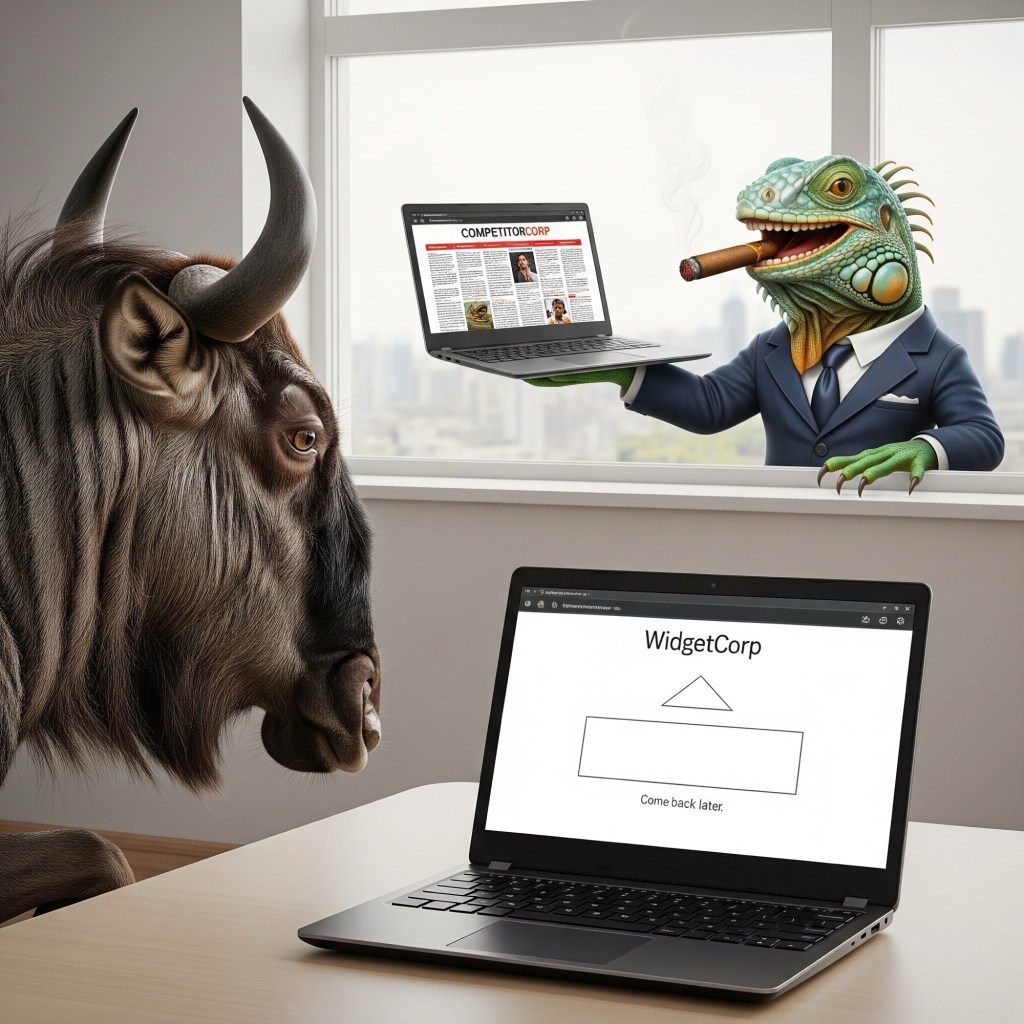
Do you dare take a look at yourself and answer the following questions?
- Date of most recent blog post
- Date of most recent case study
- Date of most recent video
- Date of most recent white paper
- Date of most recent Facebook company post
- Date of most recent Instagram company post, reel, or story
- Date of most recent LinkedIn company post or article
- And all the other social media outlets you’ve opened over the years (yes, even the Snapchat the intern created in 2019)
Now I will be honest. While I am in some ways a content freak, even I fall behind at times.
- Bredemarket’s most recent white paper dates from October 2023.
- Bredemarket’s most recent case study (actually case studies) dates from April 2023, over two years ago as I write this.
Physician, heal thyself.
But what is the status of YOUR content? Quantity? Recency?
And what are you going to do about it?
Click here to bridge your content gap.
Or don’t.
Oh, Joel (Texas Porn and Georgia Social Media)

The definitive summary on U.S. age assurance for adult content and social media as of today (June 27, 2025) has already been written at Biometric Update.
And I confess that if I were Joel R. McConvey, I would have unable to resist the overpowering temptation to dip my pen in the inkwell and write the following sentence:
“But as age checks become law in more and more places, the industry will have to weigh how far it can push – or pull out.”
But McConvey’s article does not just cover the Supreme Court’s decision on Texas HB 1181’s age verification requirement for porn websites—and Justice Clarence Thomas’ statement in the majority opinion that the act “triggers, and survives, review under intermediate scrutiny because it only incidentally burdens the protected speech of adults.”
What about social media?
The Biometric Update article also notes that a separate case regarding age assurance for social media use is still winding its way through the courts. The article quotes U.S. District Judge Amy Totenberg’s ruling on Georgia SB 351:
“[T]he act curbs the speech rights of Georgia’s youth while imposing an immense, potentially intrusive burden on all Georgians who wish to engage in the most central computerized public fora of the twenty-first century. This cannot comport with the free flow of information the First Amendment protects.”
One important distinction: while opposition to pornography is primarily (albeit not exclusively) from the right of the U.S. political spectrum, opposition to social media is more broad-based. So social media restrictions are less of a party issue.
But returning to law rather than politics, one can objectively (or most likely subjectively) debate the Constitutional merits of naked people having sex vs. AI fakes of reunions of the living members of Led Zeppelin, the latter of which seem to be the trend on Facebook these days.
Minority Report
But streaking back to Texas, what of the minority opinion of the three Supreme Court Justices who dissented in the 6-3 opinion? According to The Texas Tribune, Justice Elena Kagan spoke for Justices Sonia Sotomayor and Kentanji Brown Jackson:
“But what if Texas could do better — what if Texas could achieve its interest without so interfering with adults’ constitutionally protected rights in viewing the speech HB 1181 covers? The State should be foreclosed from restricting adults’ access to protected speech if that is not in fact necessary.”
If you assume age verification (which uses a government backed ID) rather than age estimation (which does not), the question of whether identity verification (even without document retention) is “restricting” is a muddy one.
Of course all these issues have little to do with the technology itself, reminding us that technology is only a small part of any solution.
Are All Your Eggs in One Social Basket?

(Imagen 4)
If your strategy is solely based upon a single platform such as TikTok, CapCut, Substack, Canva, or any other, you’ve already lost by putting all your eggs in one social basket.
Social dependence
My Saturday TikTok post got me thinking about companies whose entire STRATEGY is based on TikTok.
Not tactics.
Strategy.
- Even though the chance remains that TikTok may be banned in the United States, as it is already banned in India…and is not available in China.
- Or the companies that depend on CapCut who may have just surrendered their intellectual rights. Oh, and CapCut may be banned in the United States also.
- Or the people that are so thrilled with Substack that they are stopping all other social media activity and concentrating solely on Substack.
- Or the companies (I know of one) who base their strategy solely on Canva.
Or you can cite any other platform, dependence upon which could devastate your business overnight.
So own your own website and mailing list…right?
Well, at least Bredemarket doesn’t have to worry about losing access to my prospects and customers.
Even if I lose access to every single social media service, I still have my WordPress website and my MailChimp mailing list.
So I am 100% insulated, right?
Um, right?
OK, guess I’m threatened also.
Omnichannel distribution
In the biometric world, we talk about five factors of authentication and identity verification. If you depend upon a single factor, you’re in trouble. But using multiple factors lessens the risk.
Similarly, if you distribute your content via multiple channels, then a threat to any single channel doesn’t put you out of business.
(Sales pitch incoming)
And your distributed content can take multiple forms. Blogs. Case studies. White papers. Social content on multiple channels.
Assuming you actually create the content.
Or get someone to help you create it.
(Told you there would be a sales pitch.)
So rather than reading Bredemarket’s sales pitch (call to action), why don’t we work on creating yours? Click the image below and reserve a free meeting time.
 Bredemarket