Only one of Bredemarket’s clients has given me nearly-unfettered privileges in its WordPress and LinkedIn accounts.
Yes, this seemingly violates the principle of least privilege, but it turns out I needed the enhanced WordPress access.
I initially had the ability to write drafts, but this did not allow me to fully incorporate graphics into my draft posts. So I obtained the higher privilege, but never used it to post anything.
I could, and did, post on my client’s LinkedIn account, but even that was coordinated.
The company eventually paused its activities, and my access to its WordPress and LinkedIn accounts (and other accounts) was no longer necessary, and those privileges eventually were rescinded.
But this was unusual. For most of my clients, I throw my work over a wall, and the client takes it from there.
Google Gemini.
Which is as it should be. After all, I shouldn’t be self-approving my client blog posts. What’s next, approving my payments?
When I posted (twotimes) the fact that International Mobile Equipment Identity (IMEI) numbers are NOT a reliable way to ascertain the identity of a user, I was pooh-poohed.
I was working with these sectors back when I was at MorphoTrak.
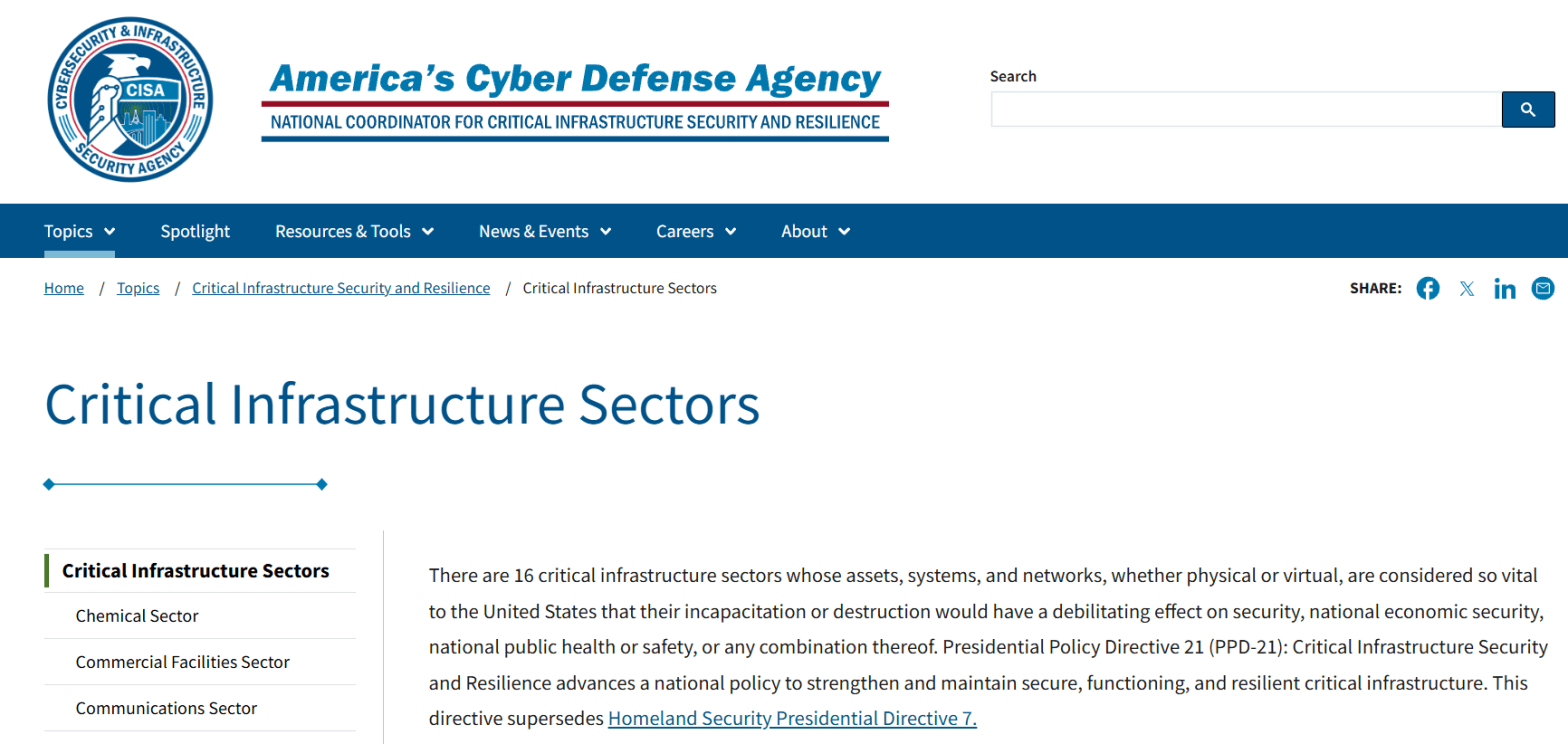
“There are 16 critical infrastructure sectors whose assets, systems, and networks, whether physical or virtual, are considered so vital to the United States that their incapacitation or destruction would have a debilitating effect on security, national economic security, national public health or safety, or any combination thereof. Presidential Policy Directive 21 (PPD-21): Critical Infrastructure Security and Resilience advances a national policy to strengthen and maintain secure, functioning, and resilient critical infrastructure. This directive supersedes Homeland Security Presidential Directive 7.”
Another topic raised by Nadaa Taiyab during today’s SoCal Tech Forum meeting was ambient clinical intelligence. See her comments on how AI benefits diametrically opposing healthcare entities here.
There are three ways that a health professional can create records during, and/or after, a patient visit.
Typing. The professional has their hands on the keyboard during the meeting, which doesn’t make a good impression on the patient.
Structured dictation. The professional can actually look at the patient, but the dictation is unnatural. As Bredebot characterizes it: “where you have to speak specific commands like ‘Period’ or ‘New Paragraph.’”
“Ambient clinical intelligence, or ACI, is advanced, AI-powered voice recognizing technology that quietly listens in on clinical encounters and aids the medical documentation process by automating medical transcription and note taking. This all-encompassing technology has the ability to totally transform the lives of clinicians, and thus healthcare on every level.”
Like any generative AI model, ambient clinical intelligence has to provide my four standard benefits: accuracy, ease of use, security, and speed.
Accuracy is critically important in any health application, since inaccurate coding could literally affect life or death.
Ease of use is of course the whole point of ambient clinical intelligence, since it replaces harder-to-use methods.
Security and privacy are necessary when dealing with personal health information (PHI).
Speed is essential also. As Taiyab noted elsewhere in her talk, the work is increasing and the workforce not increasing as rapidly.
But if the medical professional and patient benefit from the accuracy, ease of use, security, and speed of ambient clinical intelligence, we all win.
If you’ve read a few hundred job descriptions, one phrase that you’ll often see is “cross-functional collaboration.” The theory is that the employee (for example, a senior product marketing manager) will seamlessly work with marketing, product, R&D, customer success, sales, finance, legal, and everyone else, all working together for the good of the company.
But the world usually doesn’t work like that. YOUR department is great. The other departments are the bozos.
Google Gemini.
There’s actually a benefit to this when you look at government agencies. If you believe that “the government that governs least” is preferable to Big Brother, then the fact that multiple agencies DON’T gang up against you is a good thing. You don’t want to be chased by the FBI and the CIA and the BBC and B.B. King and Doris Day. And Matt Busby.
But there are times when government agencies work together, usually when facing a common threat. Sometimes this is good…and sometimes it isn’t. Let’s look at two examples and see where they fall in the spectrum.
The Central Intelligence Agency and the Federal Bureau of Investigation in 1972
Normally bureaucrats are loyal to their agency, to the detriment of other agencies. This is especially true when the agencies are de facto competitors.
In theory, and certainly in the 1970s, the Central Intelligence Agency (CIA) and the Federal Bureau of Investigation (FBI) have completely separate spheres of operation. But on the highest level they perform the same function: catch bad people. And each agency certainly wants to take the credit when a bad person is caught. Conversely, if one of the agencies has a bad person, the other one usually works to expose it.
Usually.
A few of you are old enough to remember a third-rate burglary in Washington, DC in 1972. The burglary took place at a political party office in some hotel or another. We now know with the benefit of hindsight that the FBI-CIA rivalry worked. Bob Woodward learned a few days after the break-in that two of the alleged burglars were connected to E. Howard Hunt, a former CIA operative. Who told Woodward?
“Woodward, we now know, had been tipped off by Mark Felt, the deputy director of the FBI. The Bureau had itself become involved in the investigation of a mere burglary because once the police found wiretapping equipment, the investigation fell under its remit.”
Google Gemini.
This is how it should work. Although the mere fact that Hunt knew Bernard Barker and Eugenio Martinez was not a crime, the FBI was certainly bound to investigate the matter.
Until it wasn’t.
“Richard Nixon and senior White House personnel including Chief-of-Staff Bob Haldeman and domestic policy tsar John Ehrlichman devised a strategy to block the investigation. This began to unfold as early as June 23, a mere three days after the break-in. That day, Haldeman proposed to Nixon to “have [Vernon] Walters [deputy director of the CIA] call Pat Gray [director of the FBI] and just say ‘stay the h*ll out of this’ on grounds of ‘national interest.’”
This recorded conversation would become very important two years later, but back in 1972 very few people knew about it. And very few people knew that Gray “destroyed secret documents removed from Howard Hunt’s safe.”
Think about it. If Richard Nixon hadn’t recorded his own conversations, we may have never learned that the CIA partially neutralized an FBI investigation.
But other instances of cross-functional collaboration come to light in other ways.
Immigration and Customs Enforcement and the Transportation Security Administration before 2026
The FBI-CIA episode of 1972 was an aberration. Normally agencies don’t cooperate, even when massive amounts of effort are performed to make them work together.
One prime example was the creation of the Department of Homeland Security (DHS) in 2002-2003. Because it was believed that 9/11 happened because relevant agencies were scattered all over the government, Congress and the President performed a massive reorganization. This affected the Departments of Agriculture, Energy, Health and Human Services, Justice, Transportation, and Treasury.
For our discussion:
The Department of Justice lost the Immigration and Naturalization Service (INS), which was broken up into three separate agencies within DHS. One of these is Immigration and Customs Enforcement, or ICE. Perhaps you’ve heard of it.
The relatively new Transportation Security Administration (TSA) was moved from the Department of Transportation to DHS.
The theory, of course, is that once all these agencies were under the DHS umbrella, they would magically work together to stop the evil terrorists. However, each of the component agencies had vastly different missions. Here is the mission of the TSA:
“Protect the nation’s transportation systems to ensure freedom of movement for people and commerce.”
Well, “freedom of movement” is not the primary part of ICE’s mission:
“Protect America through criminal investigations and enforcing immigration laws to preserve national security and public safety.”
While these missions are not mutually exclusive, the difference in emphasis is apparent. And the agencies competed.
Some of you may remember air marshals. After 9/11, some airline flight passengers were actually air marshals, but the passengers (and any terrorists) didn’t know which flights had air marshals or who they were.
Google Gemini.
The Federal Air Marshal Service (FAMS) was part of the Transportation Security Administration.
“Homeland Security Secretary Tom Ridge announced [in September 2003] that the federal air marshals program will move from the Transportation Security Administration to the Bureau of Immigration and Customs Enforcement (ICE).”
The idea was to concentrate all enforcement operations in one agency, to protect FAMS from uncertain TSA funding, and to allow ICE agents to be cross-trained as air marshals. But this didn’t happen, so two years later FAMS moved from ICE back to TSA.
And both agencies went on their merry little ways.
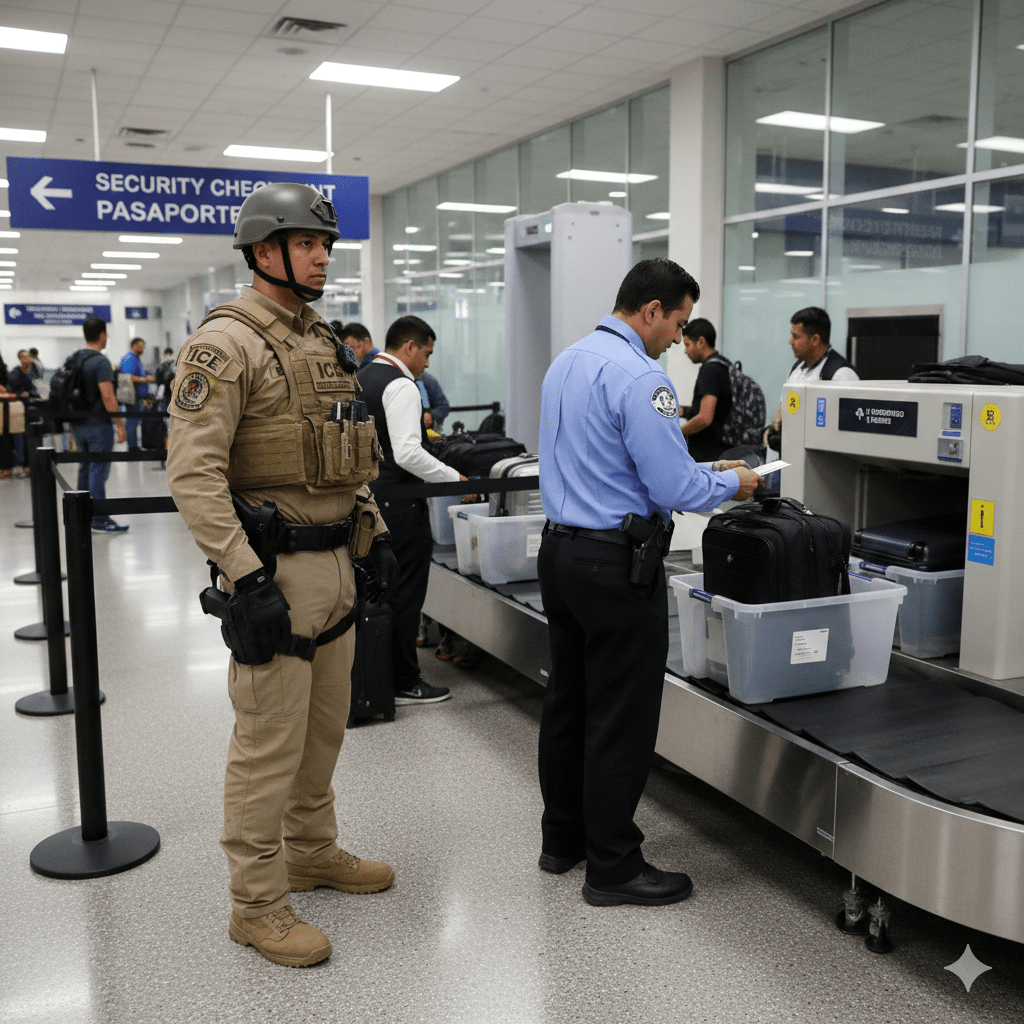
Immigration and Customs Enforcement and the Transportation Security Administration in 2026
“When Transportation Security Administration (TSA) Acting Director Ha Nguyen McNeill was pressed [by the House Committee on Homeland Security] on reports that ICE is using domestic flight passenger information to support deportation operations, she did not deny cooperation. Instead, she defended it as legitimate intra-departmental coordination and framed it as part of DHS’s overall mission set.
“In response to lawmakers’ questions, McNeill said TSA assistance to ICE is ‘absolutely within our authorities’ when it involves sharing passenger information for immigration enforcement operations.”
McNeill effectively said that TSA doesn’t dump its data on ICE, but responds to individual ICE inquiries.
“Airport travel…becomes a choke point for detentions – no longer just transportation, but a compliance checkpoint for civil enforcement, re-engineering mobility into an enforcement tool.”
If your security software enforces a “no bots” policy, you’re only hurting yourself.
Bad bots
Yes, there are some bots you want to keep out.
“Scrapers” that obtain your proprietary data without your consent.
“Ad clickers” from your competitors that drain your budgets.
And, of course, non-human identities that fraudulently crack legitimate human and non-human accounts (ATO, or account takeover).
Good bots
But there are some bots you want to welcome with open arms.
Such as the indexers, either web crawlers or AI search assistants, that ensure your company and its products are known to search engines and large language models. If you nobot these agents, your prospects may never hear about you.
Buybots
And what about the buybots—those AI agents designed to make legitimate purchases?
Perhaps a human wants to buy a Beanie Baby, Bitcoin, or airline ticket, but only if the price dips below a certain point. It is physically impossible for a human to monitor prices 24 hours a day, 7 days a week, so the human empowers an AI agent to make the purchase.
Do you want to keep legitimate buyers from buying just because they’re non-human identities?
(Maybe…but that’s another topic. If you’re interested, see what Vish Nandlall said in November about Amazon blocking Perplexity agents.)
Nobots
According to click fraud fighter Anura in October 2025, 51% of web traffic is non-human bots, and 37% of the total traffic is “bad bots.” Obviously you want to deny the 37%, but you want to allow the 14% “good bots.”
Nobot policies hurt. If your verification, authentication, and authorization solutions are unable to allow good bots, your business will suffer.
Cybersecurity professionals need to align their efforts with those of the U.S. National Institute of Standards and Technology’s (NIST’s) National Cybersecurity Center of Excellence (NCCoE). Download the NCCoE project portfolio, and plan to attend the February 19 webinar. Details below.
“The NIST National Cybersecurity Center of Excellence (NCCoE) is excited to announce the release of our inaugural Project Portfolio, providing an overview of the NCCoE’s research priorities and active projects.”
“The NCCoE serves as a U.S. cybersecurity innovation hub for the technologies, standards, and architectures for today’s cybersecurity landscape.
“Through our collaborative testbeds and hands-on work with industry, we build and demonstrate practical architectures to address real-world implementation challenges, strengthen emerging standards, and support more secure, interoperable commercial products.
“Our trusted, evidence-based guidelines show how organizations can reduce cybersecurity risks and confidently deploy innovative technologies aligned with secure standards.”
Formal and informal collaborations with other entities.
The NCCoE’s four pillars: Data Protection, Trusted Enterprise, Artificial Intelligence, and Resilient Embedded Systems.
The “forming,” “active,” and “concluding” projects within the pillars, with links to each project.
For example, one of the listed AI projects is the Cyber AI Profile:
“Recent advancements in Artificial Intelligence (AI) technology bring great opportunities to organizations, but also new risks and impacts that need to be managed in the domain of cybersecurity. NIST is evaluating how to use existing frameworks, such as the Cybersecurity Framework (CSF), to assist organizations as they face new or expanded risks.”
This group has published its roadmap, including workshops, working sessions, and document drafts.
And if you are a cybersecurity or identity company needing to communicate how your product protects your users, Bredemarket can help you bring your message to your prospects.
Book a free meeting with me and let’s discuss how we can work together.
Here are details on how Bredemarket works: its services, its process, and its pricing.














 Bredemarket