Arizona Does Not Have an Official Arizona Time Zone

The Diamondbacks are hosting the Dodgers this afternoon, and people really want to know what time it is. So, unlike Chicago, I asked Gemini.

“Phoenix, Arizona operates on Mountain Standard Time (MST) year-round and does not observe Daylight Saving Time.”

Stupid hallucinations, because I know that Arizona operates on Arizona Standard Time (AST), which is a synonym for Mountain Standard Time except for the fact that “Arizona Daylight Time” is meaningless.

Oh, and the Navajos aren’t down with AST, because the Navajo Nation spans multiple states. MST/MDT for all, thank you.

But what if I was wrong? Who could tell me if Arizona Standard Time is real or an invention?

The U.S. Department of Transportation

Today, the U.S. Department of Transportation (DOT) is responsible for managing time zones. But not measuring—Commerce does that.

This makes sense, because we really didn’t need time zones until trains provided rapid travel. Before that, you didn’t really care about such things. By 1883, the trains, not government, forced the issue:

“In 1883, U.S. and Canadian railroads adopted a four-zone system to govern their operations and reduce the confusion resulting from some 100 conflicting locally established “sun times” observed in terminals across the country.  States and municipalities then adopted one of the four zones, which were the eastern, central, mountain, and Pacific Time zones.”

Sound familiar? Although today continental Canada has more than four time zones. But I digress.

At the time, Arizona (and New Mexico) were meaningless territories, and the trains didn’t care about “daylight saving.” Heck, establishing four time zones for the big countries was enough of an accomplishment.

The (U.S.) Government wasn’t here to help until 1918.

“Federal oversight of time zones began in 1918 with the enactment of the Standard Time Act, which vested the Interstate Commerce Commission with the responsibility for establishing boundaries between the standard time zones in the continental United States.”

Decades later, when DOT was created, the Standard Time Act was replaced.

“Today, the Uniform Time Act of 1966 (15 U.S.C. §§ 260-64) establishes a system of uniform Daylight Saving Time throughout the Nation and its possessions, and provides that either Congress or the Secretary of Transportation can change a time-zone boundary.”

We will get back to Daylight Saving Time later. But what were the standard time zones?

“The time zones established by the Standard Time Act, as amended by the Uniform Time Act, are Atlantic, eastern, central, mountain, Pacific, Alaska, Hawaii–Aleutian, Samoa, and Chamorro.”

And for those who think the Atlantic Time Zone is exclusive to Canada, you forgot about Puerto Rico and the U.S. Virgin Islands.

By the way, the Chamorro Time Zone hosts Guam and the Commonwealth of the Northern Mariana Islands. Guam is UTC+10, American Samoa UTC-11. Because of the International Date Line, it’s probably tomorrow in Guam.

But what’s missing from the law? Arizona. So who invented “Arizona” Standard Time?

But first, why

Daylight saving time didn’t exist in 1883, but slowly emerged in the early 20th century, first as a temporary World War I measure, then again temporarily during World War II. Initially adopted piecemeal, it became “uniform” throughout the country with the 1966 Act, which allowed states and territories to opt out.

All the territories opted out, as did Hawaii, because of their low latitudes.

Michigan also opted out, but re-instituted DST several years later.

Arizona? It’s complicated.

  • Arizonans joined the rest of the country in changing their clocks with the advent of daylight saving time in 1918. Congress repealed the wartime law a year later.
  • President Franklin Roosevelt in 1942 imposed DST nationwide as a wartime measure, and the policy ended in 1945.
  • Arizona again implemented DST in 1967 after Congress re-established it through the Uniform Time Act.

So what happened? New Mexico liked it. As did Colorado.

“The Legislature abolished it in March 1968. Lawmakers got the bill on Gov. Jack Williams’ desk about a month before daylight saving went into effect.”

And non-Navajo Arizona has remained on standard time ever since.
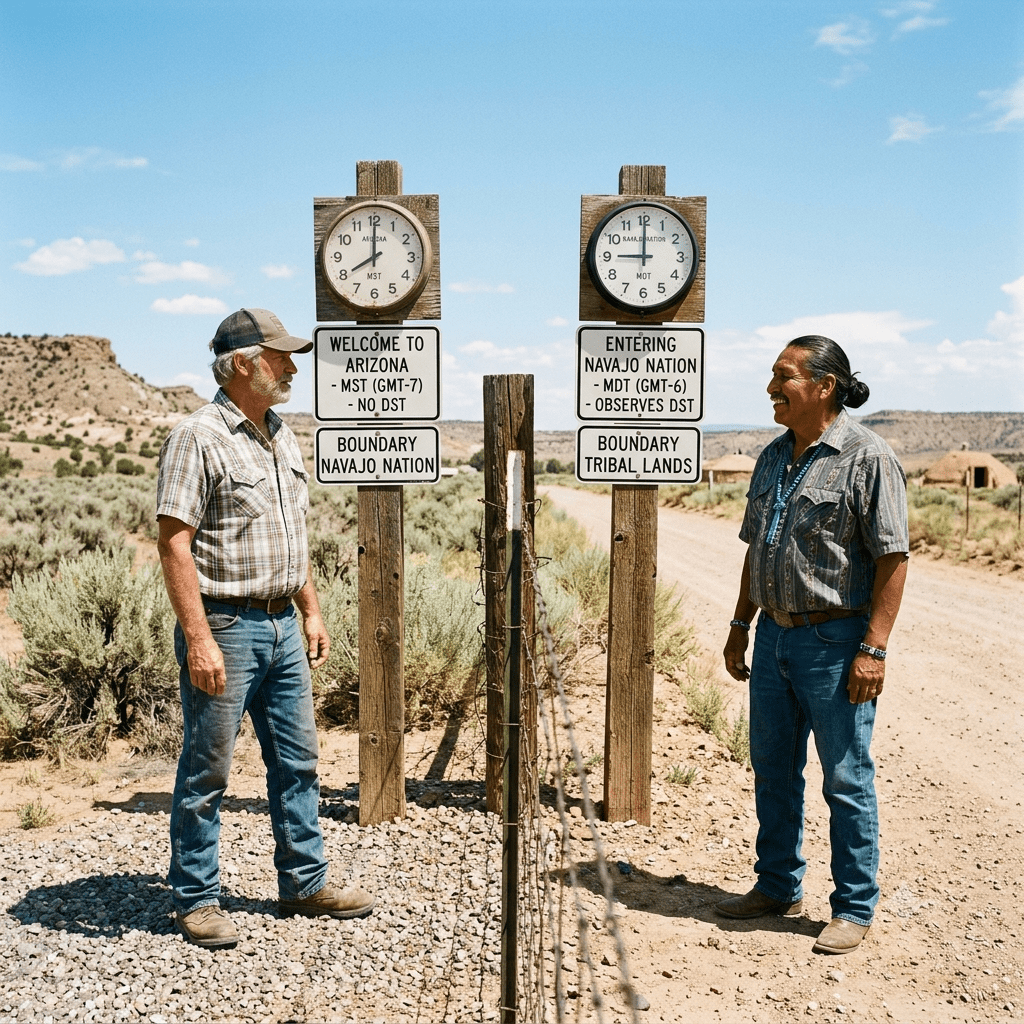
Google Gemini.

And systems got confused.

I can tell people that Bredemarket observes “Pacific Time” (PT), and people presumably understand that I use Pacific Standard Time (PST) in winter, Pacific Daylight Time (PDT) in summer.

Incidentally, this is why I quietly blow my top when invited to a meeting on August 12 at noon PST (sic). But I digress.

Now the NIST people who actually measure time observe “Mountain Time,” with people understanding MST and MDT at the appropriate seasons.

But what of Arizona? Legally they’re MST now, MST forever. But that can be misinterpreted.

Hence “Arizona Time.” I couldn’t find an originator of the phrase, but it is widely adopted.

Today’s Acronym is PADFAA. And It Has Nothing To Do With Liveness Detection or Airplanes.

TAA.

Too many acronyms.

And this one, PADFAA, sounds like a mashup of presentation attack detection and the Federal Aviation Administration.

It isn’t.

PADFAA stands for the “Protecting Americans’ Data from Foreign Adversaries Act of 2024.”

So while it doesn’t involve PAD or the FAA, it does involve PII (personally identifiable information) and the FTC (Federal Trade Commission).

“The Federal Trade Commission sent letters to 13 data brokers warning them of their responsibility to comply with the Protecting Americans’ Data from Foreign Adversaries Act of 2024 (PADFAA).

“PADFAA prohibits data brokers from selling, releasing, disclosing, or providing access to personally identifiable sensitive data about Americans to any foreign adversary, which include North Korea, China, Russia, and Iran, or any entity controlled by those countries. The law defines personally identifiable sensitive data to include health, financial, genetic, biometric, geolocation, and sexual behavior information as well as account or device log-in credentials and government-issued identifiers such as Social Security, passport, or driver’s license numbers.”

Although frankly it’s not a good idea to sell PII to our friends either, but that’s another topic.

Which Department Handles Biometrics Use Case X in Country Y?

While Bredemarket only conducts business in the United States (with one exception), my clients have no such constraints.

Who are my client’s prospects?

Because of my extensive business-to-government (B2G) experience, I often work with clients that sell products and services to government agencies throughout the world. Well, except to North Korea and a few other places.

And as those clients (or their marketing and writing consultants) identify their public sector prospects, terminology becomes an issue.

And they have to answer questions such as “which government agency or agencies in Country Y potentially use biometric authentication for passengers approaching a gate in an airline terminal?”

Hint: chances are it’s NOT called the “department of transportation.”

Ministry

Add one factor that is foreign (literally) to this United States product marketing consultant.

Many of these countries have MINISTRIES.

No, not religious ministers or preachers.

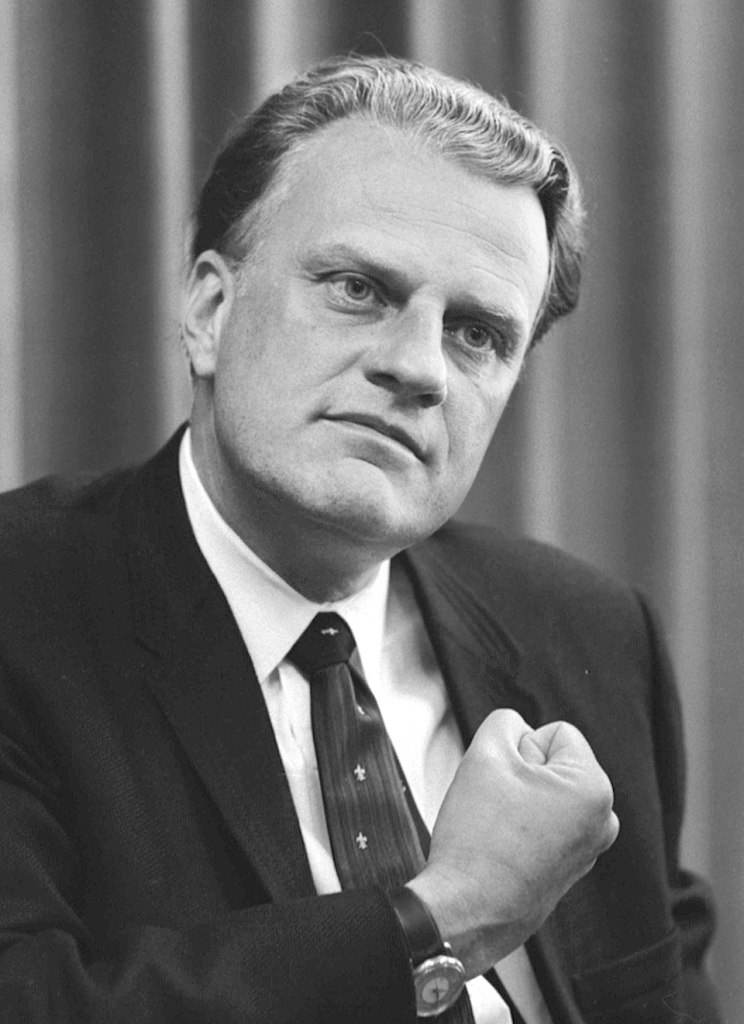
Billy Graham. By Warren K. Leffler – This image is available from the United States Library of Congress’s Prints and Photographs divisionunder the digital ID ppmsc.03261.This tag does not indicate the copyright status of the attached work. A normal copyright tag is still required. See Commons:Licensing., Public Domain, https://commons.wikimedia.org/w/index.php?curid=905632.

When I say “Minister” here I refer to government officials, often from the country’s legislature, who manage a portfolio of agencies that are the responsibility of a Minister.

Sisa

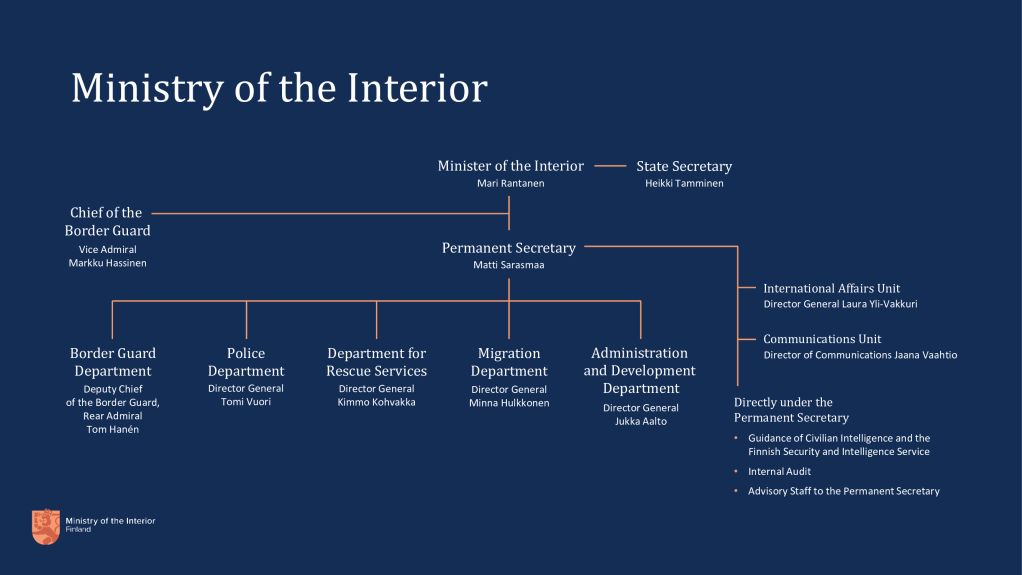
Let’s take one ministry as an example: Sisäministeriö. Oops, Finland’s Ministry of the Interior. This one ministry is currently headed by Mari Rantanen of the Finns Party (part of a four-party coalition ruling Finland).

But Rantanen also has other responsibilities:

“Minister Rantanen is also responsible for matters related to integration covered by the Labour Migration and Integration Unit of the Ministry of Economic Affairs and Employment.”

Back to Interior. One huge clarification for U.S. people: other countries’ ministries of the interior bear no relation to the U.S. Department of the Interior, which concerns itself with parks and Native Americans and stuff. Minister Rantanen’s sphere of responsibility is quite different:

“Under the Government Rules of Procedure, the Ministry of the Interior is responsible for:

  • public order and security, police administration and the private security sector
  • general preconditions for migration and regulation of migration, with the exception of labour migration, as well as international protection and return migration 
  • Finnish citizenship
  • rescue services
  • emergency response centre operations
  • border security and maritime search and rescue services
  • national capabilities for civilian crisis management
  • joint preparedness of regional authorities for incidents and emergencies.”

These responsibilities result in this organization…whoops, organisation.

There are five departments at the Ministry:

  • Police Department
  • Department for Rescue Services
  • Migration Department
  • Border Guard Department, which is the national headquarters for the Border Guard
  • Administration and Development Department

The units reporting directly to the Permanent Secretary are the International Affairs Unit and Communications Unit.

Directly under the Permanent Secretary are also guidance of Civilian Intelligence and the Finnish Security and Intelligence Service, 
Internal Audit and Advisory Staff to the Permanent Secretary

So, who’s gonna buy your biometric product or service in each of the 200 or so countries in which you may conduct business?

And for those who were waiting for it, here’s the song:

When Bureaucrats Cooperate…and When They Don’t

If you’ve read a few hundred job descriptions, one phrase that you’ll often see is “cross-functional collaboration.” The theory is that the employee (for example, a senior product marketing manager) will seamlessly work with marketing, product, R&D, customer success, sales, finance, legal, and everyone else, all working together for the good of the company.

But the world usually doesn’t work like that. YOUR department is great. The other departments are the bozos.

Google Gemini.

There’s actually a benefit to this when you look at government agencies. If you believe that “the government that governs least” is preferable to Big Brother, then the fact that multiple agencies DON’T gang up against you is a good thing. You don’t want to be chased by the FBI and the CIA and the BBC and B.B. King and Doris Day. And Matt Busby.

But there are times when government agencies work together, usually when facing a common threat. Sometimes this is good…and sometimes it isn’t. Let’s look at two examples and see where they fall in the spectrum.

The Central Intelligence Agency and the Federal Bureau of Investigation in 1972

Normally bureaucrats are loyal to their agency, to the detriment of other agencies. This is especially true when the agencies are de facto competitors.

In theory, and certainly in the 1970s, the Central Intelligence Agency (CIA) and the Federal Bureau of Investigation (FBI) have completely separate spheres of operation. But on the highest level they perform the same function: catch bad people. And each agency certainly wants to take the credit when a bad person is caught. Conversely, if one of the agencies has a bad person, the other one usually works to expose it.

Usually.

A few of you are old enough to remember a third-rate burglary in Washington, DC in 1972. The burglary took place at a political party office in some hotel or another. We now know with the benefit of hindsight that the FBI-CIA rivalry worked. Bob Woodward learned a few days after the break-in that two of the alleged burglars were connected to E. Howard Hunt, a former CIA operative. Who told Woodward?

“Woodward, we now know, had been tipped off by Mark Felt, the deputy director of the FBI. The Bureau had itself become involved in the investigation of a mere burglary because once the police found wiretapping equipment, the investigation fell under its remit.”

Google Gemini.

This is how it should work. Although the mere fact that Hunt knew Bernard Barker and Eugenio Martinez was not a crime, the FBI was certainly bound to investigate the matter.

Until it wasn’t.

“Richard Nixon and senior White House personnel including Chief-of-Staff Bob Haldeman and domestic policy tsar John Ehrlichman devised a strategy to block the investigation. This began to unfold as early as June 23, a mere three days after the break-in. That day, Haldeman proposed to Nixon to “have [Vernon] Walters [deputy director of the CIA] call Pat Gray [director of the FBI] and just say ‘stay the h*ll out of this’ on grounds of ‘national interest.’”

This recorded conversation would become very important two years later, but back in 1972 very few people knew about it. And very few people knew that Gray “destroyed secret documents removed from Howard Hunt’s safe.”

Think about it. If Richard Nixon hadn’t recorded his own conversations, we may have never learned that the CIA partially neutralized an FBI investigation.

But other instances of cross-functional collaboration come to light in other ways.

Immigration and Customs Enforcement and the Transportation Security Administration before 2026

The FBI-CIA episode of 1972 was an aberration. Normally agencies don’t cooperate, even when massive amounts of effort are performed to make them work together.

One prime example was the creation of the Department of Homeland Security (DHS) in 2002-2003. Because it was believed that 9/11 happened because relevant agencies were scattered all over the government, Congress and the President performed a massive reorganization. This affected the Departments of Agriculture, Energy, Health and Human Services, Justice, Transportation, and Treasury.

For our discussion:

  • The Department of Justice lost the Immigration and Naturalization Service (INS), which was broken up into three separate agencies within DHS. One of these is Immigration and Customs Enforcement, or ICE. Perhaps you’ve heard of it.
  • The relatively new Transportation Security Administration (TSA) was moved from the Department of Transportation to DHS.

The theory, of course, is that once all these agencies were under the DHS umbrella, they would magically work together to stop the evil terrorists. However, each of the component agencies had vastly different missions. Here is the mission of the TSA:

“Protect the nation’s transportation systems to ensure freedom of movement for people and commerce.”

Well, “freedom of movement” is not the primary part of ICE’s mission:

“Protect America through criminal investigations and enforcing immigration laws to preserve national security and public safety.”

While these missions are not mutually exclusive, the difference in emphasis is apparent. And the agencies competed.

Some of you may remember air marshals. After 9/11, some airline flight passengers were actually air marshals, but the passengers (and any terrorists) didn’t know which flights had air marshals or who they were.

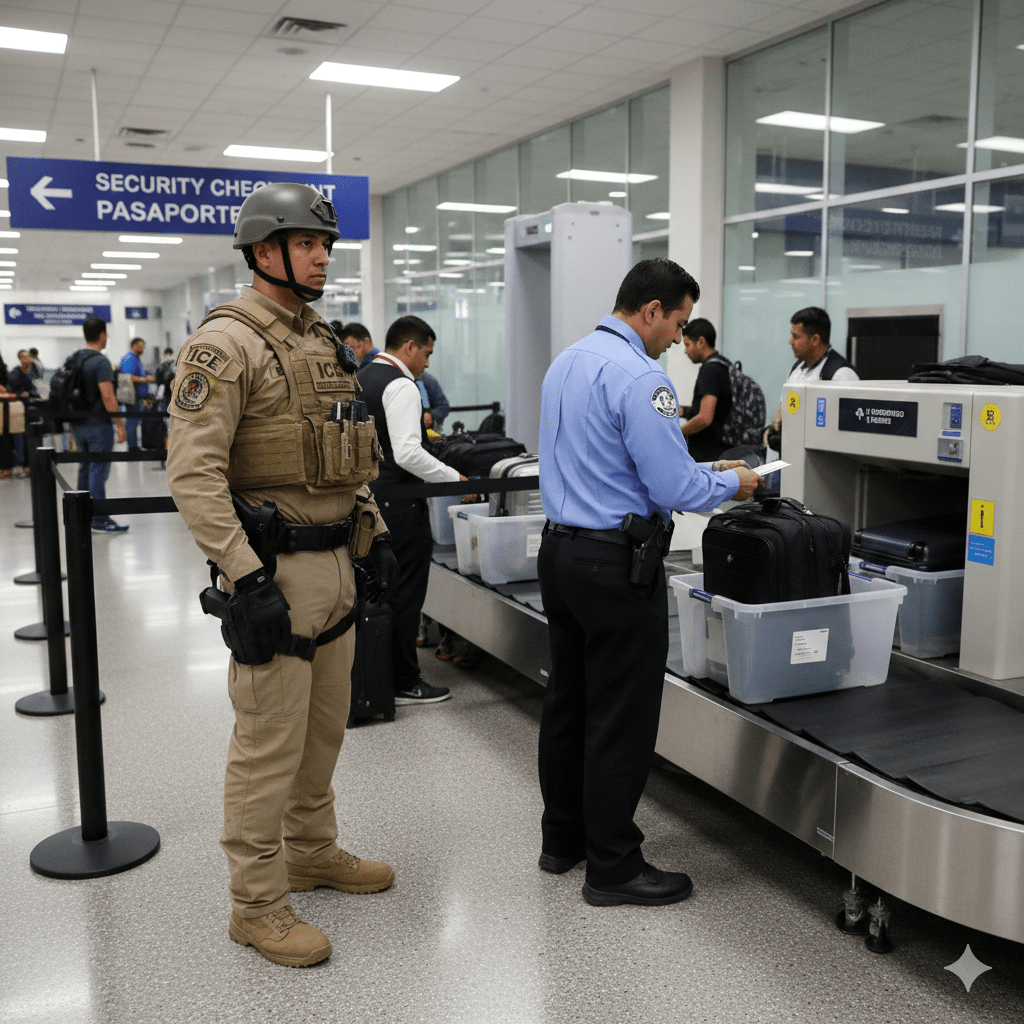
Google Gemini.

The Federal Air Marshal Service (FAMS) was part of the Transportation Security Administration.

Until it wasn’t.

“Homeland Security Secretary Tom Ridge announced [in September 2003] that the federal air marshals program will move from the Transportation Security Administration to the Bureau of Immigration and Customs Enforcement (ICE).”

The idea was to concentrate all enforcement operations in one agency, to protect FAMS from uncertain TSA funding, and to allow ICE agents to be cross-trained as air marshals. But this didn’t happen, so two years later FAMS moved from ICE back to TSA.

And both agencies went on their merry little ways.

Immigration and Customs Enforcement and the Transportation Security Administration in 2026

Let’s look at a recent Biometric Update article.

“When Transportation Security Administration (TSA) Acting Director Ha Nguyen McNeill was pressed [by the House Committee on Homeland Security] on reports that ICE is using domestic flight passenger information to support deportation operations, she did not deny cooperation. Instead, she defended it as legitimate intra-departmental coordination and framed it as part of DHS’s overall mission set.

“In response to lawmakers’ questions, McNeill said TSA assistance to ICE is ‘absolutely within our authorities’ when it involves sharing passenger information for immigration enforcement operations.”

McNeill effectively said that TSA doesn’t dump its data on ICE, but responds to individual ICE inquiries.

Google Gemini.

Civil libertarians argue that this is mission creep, not the original intent.

“Airport travel…becomes a choke point for detentions – no longer just transportation, but a compliance checkpoint for civil enforcement, re-engineering mobility into an enforcement tool.”

And one more thing…

But I took special interest in McNeill’s contradictory statements that TSA is enforcing REAL ID while simultaneously allowing ConfirmID for those who don’t have a REAL ID.

In the future, it will be interesting to see how inter-agency barriers break down…and why.