Asking the Questions vs. Providing the Answers: Two Sides of the Proposals Ecosystem

I’ve worked in proposals longer than I’ve worked in biometrics. Although my first proposals experience wasn’t in writing a proposal. It wasn’t even in writing a proposal letter. (I’ve told that story before.) It was in writing a REQUEST for Proposal.

Granted, it was a pretty rudimentary RFP. Through the guidance of a Moss Adams consultant, I wrote an RFP for a non-biometric poster company that needed a computer system. It was primarily a checklist: do you do this? Do you do that? Companies that automatically checked every box ended up being discarded, while the two companies that put some thought in their responses and actually said what they couldn’t do, and why, move to the finalist stage.

Over the last 30+ years I’ve dealt with RFPs that were much better written, but for the most part I’ve specialized in responding to requests for proposal rather than writing them.

Writing the procurement documents: the pre-acquisition and procurement support from two companies

Writing RFPs takes a different skill set. The RFP writer, either an employee of the company/agency issuing the RFP or an independent consultant, has to simultaneously addresss:

  • The procurement standards of the entity issuing the RFP.
  • The needs of the stakeholder within the entity.
  • The reality of the environment in which the potential respondents operate. For example, even if the entity demands 100% biometric accuracy, no vendor can deliver 100% accuracy so don’t ask for it.

While there have been giants in biometric RFP consulting over the years, two entities that are active today are Applied Forensic Services and Biometrics Consulting Partners.

Applied Forensics Services

Here is how Applied Forensic Services describes its automated biometric identification system (ABIS) pre-acquisition services.

“An expertly guided ABIS pre-acquisition and acquisition can result in greater agency stakeholder satisfaction, reduced deployment time and costs, and increased public safety for your jurisdiction.

“Your agency needs a knowledgeable acquisition professional who understands your stakeholders, strives to keep your vendors focused, and produces a unique acquisition that addresses your concerns and obtains agreement from your stakeholders.

Michael K. French, owner of Applied Forensic Services LLC (AFS), draws upon 12 years of experience with a law enforcement agency, 13 years of experience with ABIS vendors, and eight years of service on forensic and industry standards bodies. He is knowledgeable about all aspects of an ABIS acquisition through his involvement in approximately 50 ABIS implementations including the FBI Next Generation Identification system (NGI).”

French’s services include consulting with all stakeholders, developing the many documents required in a solicitation, and conducting benchmarks of proposal finalists.

Biometrics Consulting Partners

Biometrics Consulting Partners, a multi-consultant entity, provides similar procurement support:

“Biometrics Consulting Partners (BCP)’s staff have led procurement activities in both agency and biometric vendor settings. This experience enables a unique perspective which helps anticipate risks and clearly identify agency needs.

“BCP applies this unique and rare expertise to help government agencies strategically develop system requirements and articulate them in ABIS, Live Scan, MobileID, Mugshot, Patrol, and Applicant Processing RFIs, RFQs, and RFPs.”

The experience of the BCP principals is even more impressive than Mike French’s experience, including local, state, national, and international deployments in law enforcement, government benefits, and other areas.

Answering the procurement documents: Bredemarket proposal services for biometric identity firms

While both entities also have vast experience in answering RFPs written by others, I’d like to toot my own horn in this regard.

Bredemarket

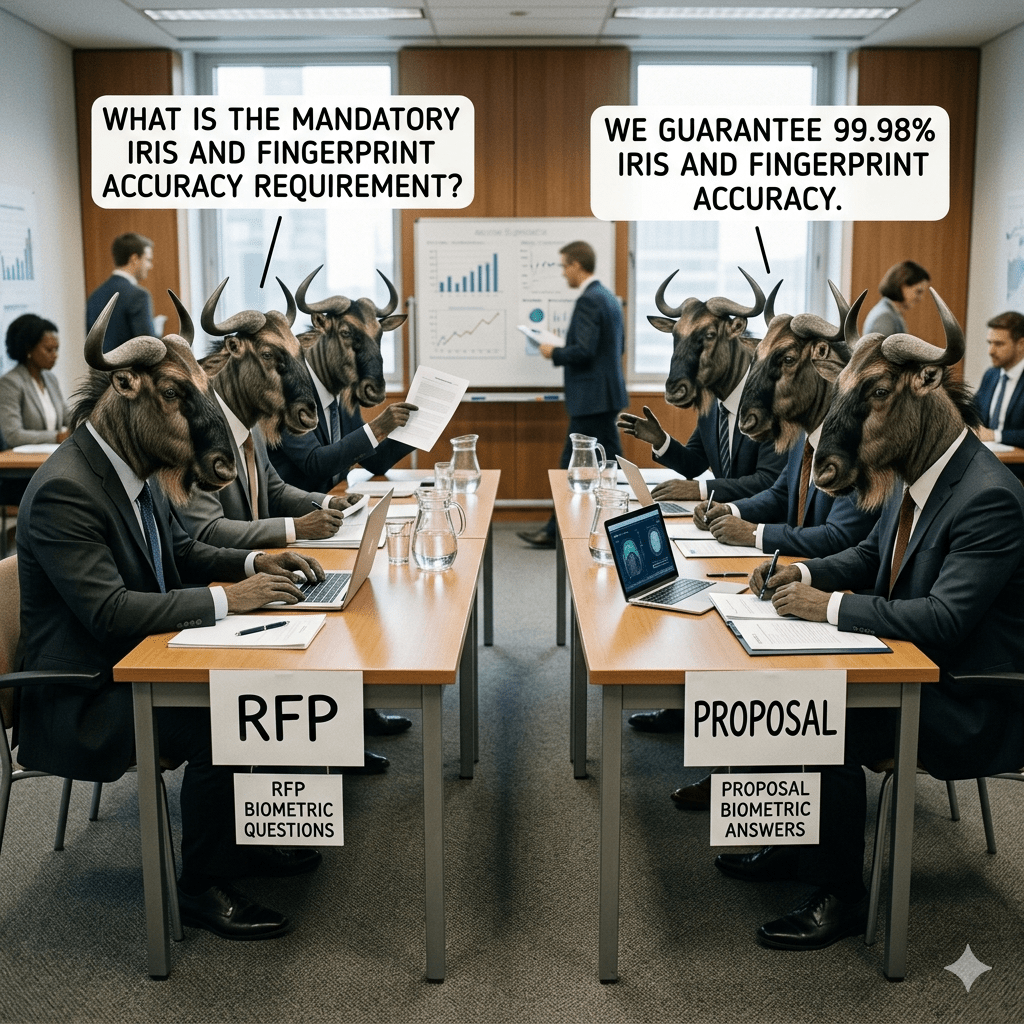
While Applied Forensic Services and Biometrics Consulting Partners (BCP) primarily assist government agencies in writing biometric RFPs (the questions), Bredemarket assists biometric identity vendors in writing the compliance-driven proposal responses (the answers) to win those contracts.

After my mininal RFP writing experience in my pre-biometric days, I’ve spent decades responding to RFPs while employed by Printrak, MorphoTrak, and Incode, and by working with Bredemarket clients.

While I’ve written hundreds of proposals and proposal letters and secured tens of millions of dollars of revenue for my employers and consulting clients, let me just focus on three notable proposal efforts.

How did I answer the questions for the Louisiana Automated Fingerprint Identification System (Printrak)?

I joined Printrak right as it began to sell its Series 2000 AFIS.

Probably the most notable proposal in that initial year was one for the State of Louisiana.

This wasn’t just a simple client-server system (multi-tier would come later when I was the Omnitrak/Printrak BIS product manager for Motorola). This was a multi-server implementation, in which the clients fed into six regional centers that themselves fed into the central AFIS.

Complex, but valuable in solving crimes throughout the state. It solved crimes and identified people; what more could you ask for?

How did I answer the questions for Albuquerque and other cloud-based Automated Biometric Identification Systems (MorphoTrak)?

Up until this time, all of MorphoTrak’s ABIS deployments were on-premise.

I wrote the first three proposals for the new cloud-based MorphoBIS Cloud.

  • This required coordinating the technical response.
  • More importantly, I also ensured that other aspects of the bid (financing, pricing, legal, and support) accorded with a service-based model. This is very different from an on-premise model: for one, the vendor doesn’t receive a single dime until after it is providing the service. No pre-payments at contract signature, requirements document finalization, shipment, and testing completion.

This resulted in a monumental transition in how MorphoTrak deployed its projects and realized its revenue, but the end result was a more reliable stream of revenue and better service for the end customers.

How did I answer the questions for the undisclosed biometric front-end system (Bredemarket client)?

This consulting client responded to a Request for Proposal for an undisclosed entity requiring multi-biometric submission services.

I not only wrote the winning proposal, but also managed the project for the first two releases of the supplied product.

So what can I do for your identity/biometric firm?

Now I didn’t win every single proposal that I wrote, but I’ve won enough to know what a proposal needs and what it doesn’t. Similar to what I’ve said in other contexts, a winning proposal needs customer-focused, benefits-oriented responses that move the prospect to buy. Proposals also need some sort of process: perhaps a complex 96-step process, perhaps a less burdensome one.

Read about Bredemarket’s proposal services here.

Schedule a free meeting to request my services here.

What If BREDEMARKET Put Out YOUR Identity/Biometric Firm’s Fires?

Two weeks ago, I thought it was a mistake to prioritize daily fires over long-term strategic planning. But blog posts are ephemeral (like AI agents) and a conversation with Google Gemini made me realize I had it backward.

Before, sprinkler systems outranked firefighting

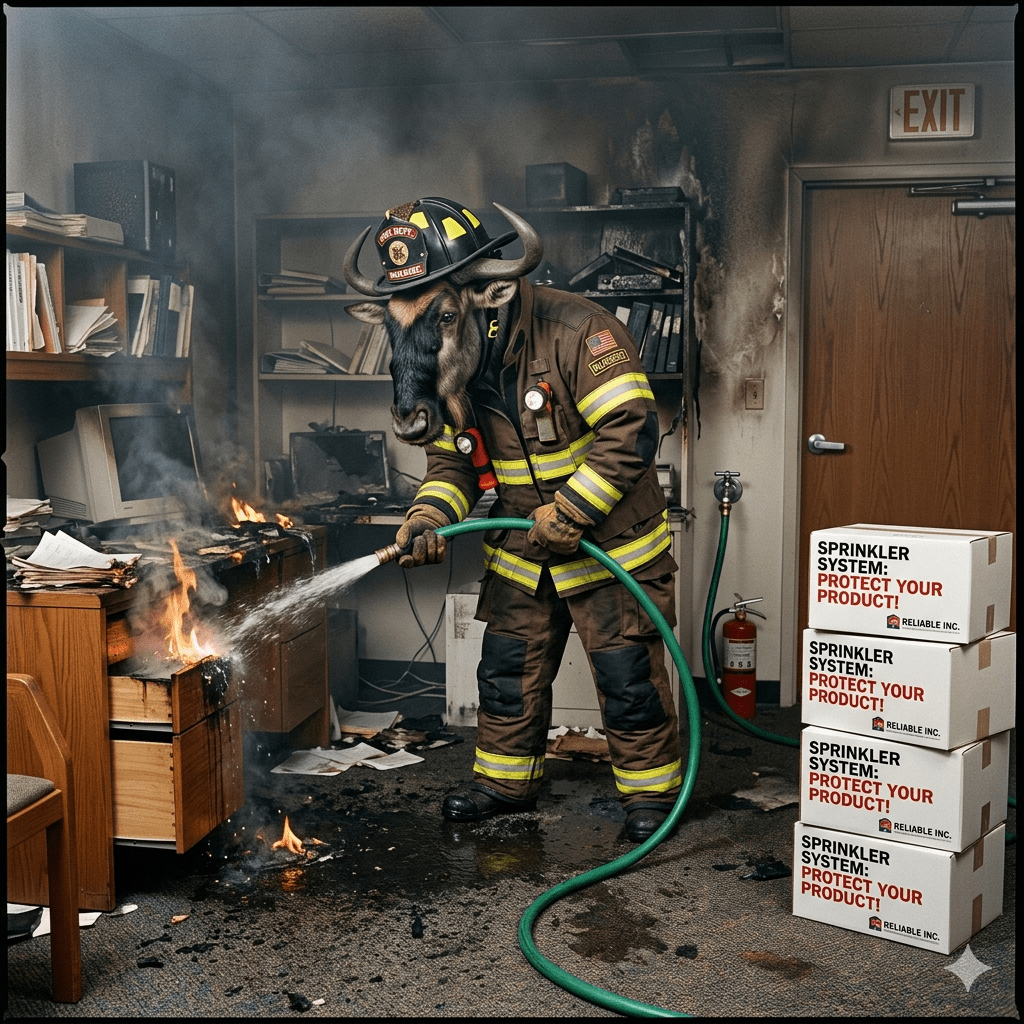
On May 12 I wrote a post entitled “Is Your Identity/Biometric Firm Too Busy Putting Out Fires to Install a Sprinkler System?” Its thesis:

“Your identity/biometric firm needs experienced product marketing contract help because you are drowning in work. But because you’re drowning in work you can’t take the time to set up that contract.”

Google Gemini.

I won’t get into the resolution of the post, but note the inherent value judgment contained within the content.

  • Manually putting out fires (NEVER with gasoline) is reactive, displays a lack of planning, and is therefore denigrated.
  • Installing a sprinkler system is proactive, displays a bias toward strategic long-term planning, and is therefore elevated.

So if the prospect takes the time to sign that contract with Bredemarket, I will ensure that the process is as frictionless as possible. I already know the identity/biometric terminology, and Bredemarket’s “seven questions” process removes the need for you to develop a briefing book for me.

Nice and stable, like installing a sprinkler system.

Something that a sage would write.

Let’s look at it again

But then I began asking questions—in this case, with Google Gemini. Not with the distinctive Bredebot persona, but with Gemini’s natural voice. And as I engaged in a messaging and positioning dialogue, Gemini hit me between the eyes with this observation.

“[Bredehoft] notes that many biometric firms are “too busy putting out fires to install a sprinkler system.”

“The “Fire” is an immediate, looming RFP deadline….A consultant like Bredehoft is brought in as an emergency firefighter to secure that short-term win.  

“The “Sprinkler System” is long-term product marketing (building consistent messaging, positioning products, and writing educational white papers)….

“[C]onsulting clients are notoriously reactive. They are far more likely to open their wallets for immediate help with an active proposal than for long-term strategic brand-building.”

Then it hit me.

The firefighter is the GOOD guy.

Google Gemini. The little kid’s admiration is unparalleled.

After, firefighting outranks sprinkler systems

Prospects call in a consultant because they want something yesterday and, as my home page phrases it, “don’t have the time to craft their own content.”

And not just proposal content with money on the line as Gemini explained. Maybe the prospects need a blog post right now; no immediate contract, but invaluable positioning. Or maybe they even need an emergency analysis. (Hey, it could happen.)

When you’re in the middle of a fire, you don’t have time to train a rookie. I already know the identity world, so we can get straight to bailing out your firm.

I will fight your fire, and then maybe later on we can discuss more strategic topics.

But first we need that pesky contract, or the equivalent. (“John, we’ll pay you $500 net 15 for that blog post.”)

But first let’s put out the fire. Contact Bredemarket today to get it done.

And here is a postscript for the kids who don’t know why I was talking about gasoline earlier.

“Cat People (Putting Out Fire).” The Giorgio Moroder version.

Or why right now.

“Right Now.” No David.

Agitate Your Prospects

Bredebot and I were chatting one morning when he suddenly used the word “agitated.” This powerful word caught my ear for two reasons.

  • First, one of my favorite Devo songs is entitled “Agitated.”
“Agitated.” Devo. From Total Devo.
  • Second, because I see so little agitation these days.

Having used targeted content to agitate stagnant tech prospects—a method that has generated millions of dollars for nearly two dozen firms—I see precious little agitation or urgency in the tech prospects…or in the companies that serve them.

  • Minimal agitation from technology prospects who desperately need solutions to overcome their problems…but who aren’t urgently motivated to act to do anything about it.
  • Minimal agitation from solution providers that can conquer those problems…but that display no urgency to energize those prospects to act.

Bredemarket can help those solution providers act by offering my content, proposal, and analysis services…so their prospects will act and buy.

I have made millions of dollars for firms. Let’s collaborate on product marketing so you can convert prospects and make money also.

Starting the agitation

Before I write a word of text for you, I get agitated and urgently seek answers to critical questions about you, your company, and your product or service. Here are the seven critically important questions that I ask.

The Seven Questions I Ask.

After receiving the answers, I get agitated and act. First draft within 3 to 7 days, depending upon length.

I Ask, Then I Act.

Then you get agitated and act. Responses within 3 to 7 days, moving urgently forward.

Between our mutual agitation society, the prospects learn about your solution within days…not months or years.

To go forward and move ahead—it’s not too late—schedule a free meeting with me right now to start the process to creating conversion content. Visit the page “Stop losing prospects! Use Bredemarket content for tech marketers.”

Simplified For The Agency, Not Simplified For The Vendor

When you write something, read it first to ensure that you don’t burst out laughing after reading it.

If you read SAM.gov for fun, you may have seen Notice ID DCSA_2026_HS002126QE023 for Michigan Fingerprint Channeling. Offers are due on April 23, so if you can satisfy the requirements, get working.

As the acronym-aware probably already know, this was issued by the Defense Counterintelligence and Security Agency (DCSA), part of the U.S. Department of Defense (with the secondary title the Department of War).

Why?

“DCSA has a recurring need for a simplified method of filling the anticipated repetitive needs for fingerprint channeling for the purpose of obtaining Criminal History Records Information (CHRI) from the state of Michigan.”

Because it’s a bad thing to make things hard, so DCSA needs a simplified method.

This is explained in the Performance Work Statement that is attached to the Solicitation Form. Another attachment is the Pricing Workbook.

So to make things simple for DCSA, you need to review all three of these documents and provide the approprirate responses.

And don’t forget to review ALL of the incorporated contract clauses, such as this one:

252.232-7006 Wide Area WorkFlow Payment Instructions. (Jan 2023)
WIDE AREA WORKFLOW PAYMENT INSTRUCTIONS (JAN 2023)
(a) Definitions. As used in this clause-
“Department of Defense Activity Address Code (DoDAAC)” is a six position code that uniquely identifies a unit, activity, or organization.
“Document type” means the type of payment request or receiving report available for creation in Wide Area WorkFlow (WAWF).
“Local processing office (LPO)” is the office responsible for payment certification when payment certification is done external to the entitlement system.
“Payment request” and “receiving report” are defined in the clause at 252.232-7003, Electronic Submission of Payment Requests and Receiving Reports.
(b) Electronic invoicing. The WAWF system provides the method to electronically process vendor payment requests and receiving reports, as authorized by
Defense Federal Acquisition Regulation Supplement (DFARS) 252.232-7003, Electronic Submission of Payment Requests and Receiving Reports.
(c) WAWF access. To access WAWF, the Contractor shall-
(1) Have a designated electronic business point of contact in the System for Award Management at https://www.sam.gov; and
(2) Be registered to use WAWF at https://wawf.eb.mil/ following the step-by-step procedures for self-registration available at this web site.
(d) WAWF training. The Contractor should follow the training instructions of the WAWF Web-Based Training Course and use the Practice Training Site before
submitting payment requests through WAWF. Both can be accessed by selecting the “Web Based Training” link on the WAWF home page at https://wawf.eb.mil/
(e) WAWF methods of document submission. Document submissions may be via web entry, Electronic Data Interchange, or File Transfer Protocol.
(f) WAWF payment instructions. The Contractor shall use the following information when submitting payment requests and receiving reports in WAWF for this
contract or task or delivery order:
(1) Document type. The Contractor shall submit payment requests using the following document type(s):
(i) For cost-type line items, including labor-hour or time-and-materials, submit a cost voucher.
(ii) For fixed price line items-
(A) That require shipment of a deliverable, submit the invoice and receiving report specified by the Contracting Officer.
Invoice 2-in-1
(B) For services that do not require shipment of a deliverable, submit either the Invoice 2in1, which meets the requirements for the invoice and
receiving report, or the applicable invoice and receiving report, as specified by the Contracting Officer.
Invoice 2-in-1
(iii) For customary progress payments based on costs incurred, submit a progress payment request.
(iv) For performance based payments, submit a performance based payment request.
(v) For commercial financing, submit a commercial financing request.
(2) ) Fast Pay requests are only permitted when Federal Acquisition Regulation (FAR) 52.213-1 is included in the contract.
(3) Document routing. The Contractor shall use the information in the Routing Data Table below only to fill in applicable fields in WAWF when creating payment requests and receiving reports in the system.

OK, that’s not the whole thing. I stopped copying it at the actual Routing Data Table itself.

This is of course a cost of doing business with any large entity, whether it’s the federal government or a multi-billion dollar firm. This who want money from these large organizations put up with it.

And laugh to themselves about the desire for things “simplified.”

Three Ways in Which My Identity/Biometric Experience Exhibits My “Bias”

Yeah, I’m still focused on that statement:

“I think too much knowledge is actually bad in tech: you’re biased.”

Why does this quote affect me so deeply? Because with my 30-plus years of identity/biometric experience, I obviously have too much knowledge of the industry, which is obviously bad. After all, all a biometric company needs is a salesperson, an engineer, an African data labeler, and someone to run the generative AI for everything else. The company doesn’t need someone who knows that Printrak isn’t spelled with a C.

Google Gemini.

In this post I will share three of the “biases” I have developed in my 30-plus years in identity and biometrics, and how to correct these biases by stripping away that 20th century experience and applying novel thinking.

And if that last paragraph made you throw up in your mouth…read to the end of the post.

But first, let’s briefly explore these three biases that I shamefully hold due to my status as a biometric product marketing expert:

  1. Independent algorithmic confirmation is valuable.
  2. Process is valuable.
  3. Artificial intelligence is merely a tool.
Biometric product marketing expert.

Bias 1: Independent Algorithmic Confirmation is Valuable

Biometric products need algorithms to encode and match the biometric samples, and ideally to detect presentation and injection attacks.

But how do prospects know that these algorithms work? How accurate are they? How fast are they? How secure are they?

My bias

My brain, embedded with over 30 years of bias, gravitates to the idea that vendors should submit their algorithms for independent testing and confirmation.

From a NIST facial recognition demographic bias text.

This could be an accuracy test such as the ones NIST and DHS administer, or confirmation of presentation attack detection capabilities (as BixeLab, iBeta, and other organizations perform), or confirmation of injection attack detection capabilities.

Novel thinking

But you’re smarter than that and refuse to support the testing-industrial complex. They have their explicit or implicit agendas and want to force the biometric vendors to do well on the tests. For example, the U.S. Federal Bureau of Investigation’s “Appendix F” fingerprint capture quality standard specifically EXCLUDES contactless solutions, forcing everyone down the same contact path.

But you and your novel thinking reject these unnecessary impediments. You’re not going to constrain yourself by the assertions of others. You are going to assert your own benefits. Develop and administer your own tests. Share with your prospects how wonderful you are without going through an intermediary. That will prove your superiority…right?

Bias 2: Process is Valuable

A biometric company has to perform a variety of tasks. Raise funding. Hire people. Develop, market, propose, sell, and implement products. Throw parties.

How will the company do all these things?

My bias

My brain, encumbered by my experience (including a decade at Motorola), persists in a belief that process is the answer. The process can be as simple as scribblings on a cocktail napkin, but you need some process if you want to cash out in a glorious exit—I mean, deliver superior products to your customers.

Perhaps you need a development processs that defines, among other things, how long a sprint should be. A capture and proposal process (Shipley or simpler) that defines, among other things, who has the authority to approve a $10 million proposal A go-to-market process that defines the deliverables for different tiers, and who is responsible, accountable, consulted, and informed. Or maybe just an onboarding process when starting a new project, dictating the questions you need to ask at the beginning.

Bredemarket’s seven questions. I ask, then I act.

Novel thinking

Sure all that process is fine…if you don’t want to do anything. Do you really want to force your people to wait two weeks for the latest product iteration? Impose a multinational bureauracy on your sales process? Go through an onerous checklist before marketing a product?

Google Gemini.

Just code it.

Just sell it.

Just write it.

Bias 3: Artificial Intelligence is Merely a Tool

The problem with experienced people is that they think that there is nothing new under the sun.

You talk about cloud computing, and they yawn, “Sounds like time sharing.” You talk about quantum computing, and they yawn, “Sounds like the Pentium.” You talk about blockchain, and they yawn, “Sounds like a notary public.”

My bias

As I sip my Pepperidge Farm, I can barely conceal my revulsion at those who think “we use AI” is a world-dominating marketing message. Artificial intelligence is not a way of life. It is a tool. A tool that in and of itself does not merit much of a mention.

Google Gemini.

How many automobile manufacturers proclaim “we use tires” as part of their marketing messaging? Tires are essential to an automobile’s performance, but since everyone has them, they’re not a differentiator and not worthy of mention.

In the same way, everyone has AI…so why talk about its mere presence? Talk about the benefits your implementation provides and how these benefits differentiate you from your competitors.

Novel thinking

Yep, the grandpas that declare “AI is only a tool” are missing the significance entirely. AI is not like a Pentium chip. It is a transformational technology that is already changing the way we create, sell, and market.

Therefore it is critically important to highlight your product’s AI use. AI isn’t a “so what” feature, but an indication of revolutionary transformative technology. You suppress mention of AI at your own peril.

How do I overcome my biases of experience?

OK, so I’ve identified the outmoded thinking that results from too much experience. But how do I overcome it?

I don’t.

Because if you haven’t already detected it, I believe that experience IS valuable, and that all three items above are essential and shouldn’t be jettisoned for the new, novel, and kewl.

  • Are you a identity/biometric marketing leader who needs to tell your prospects that your algorithms are validated by reputable independent bodies?
  • Or that you have a process (simple or not) that governs how your customers receive your products?
  • Or that your AI actually does unique things that your competitors don’t, providing true benefits to your customers?

Bredemarket can help with strategy, analysis, content, and/or proposals for your identity/biometric firm. Talk to me (for free).

By the way, here’s MY process (and my services and pricing).

Bredemareket: Services, Process, and Pricing.

In Product Marketing, Strategy Precedes Tactics

I’ve decided to tweak Bredemarket’s public presentation by talking more about strategy. And although I’ve written some new strategy content recently, it’s a heck of a lot easier to repurpose some of the old content I’ve already written.

Such as my July 31, 2025 personal LinkedIn article (separate from Bredemarket’s “The Wildebeest Speaks”…which reminds me, I gotta write another one of those).

Job duties and SMART OKRs

The personal LinkedIn article was called “The Joy of Product Marketing Strategy, or SMART OKRs.”

Let me define the acronyms in the article title:

  • SMART: specific, measurable, attainable, relevant, and time-bound.
  • OKRs: Objectives and Key Results.

Putting it simply, the article talked about the myriad of things a product marketer was expected to do at one company.

Or at any company, frankly. Product marketing job descriptions are fairly interchangeable. Go-to-market. Sales enablement. Competitive analysis. Metrics. Cross-functional collaboration. If you think YOUR company’s product marketing is amazing and different…it isn’t.

The entire list of product marketing duties is a bunch of tactical moves. A brochure here, a battlecard there. It could devolve into a lot of meaningless busywork. (Says the guy who has now written over 2,000 blog posts.)

But WHY are you doing all this junk?

That’s where the strategy comes to play.

Why?

For example, why are you establishing and obtaining approval for this?

“a multi-tiered go-to-market process identifying the go-to-market tiers, the customer-facing and internal deliverables for each tier, as well as the responsible, accountable, consulted, and informed organizations for each deliverable”

Let me list three reasons:

  • To ensure your go-to-market efforts contain the correct deliverables for the tier. Running around like a headless chicken to guess what you need to produce is idiotic.
  • To make sure everybody knows what they have to do. You don’t want a go-to-market effort to tank because the VP of Product won’t approve the customer success internal deliverable.
  • And let’s not forget the biggest reason of all: to allow the product in your go-to-market revenue to get a ton of orders and make a ton of revenue.

Because that’s why you’re marketing products…I hope.

Ask before you act

A helpful tip: before I get into the minutiae (tip your servers, I’m here all week) of a project, I ask a lot of questions first. “Why?” is the first question, but there are more.

The seven questions I ask. One you’ve seen the movie, now read the book.

Speaking of asking, if you want to ask Bredemarket for help with your strategy and tactics for content, proposal, and analysis work, click on the Content for Tech Marketers image below and schedule a free meeting with me.

CITeR and Combating Facial Recognition Demographic Bias

The National Institute of Standards and Technology (NIST) isn’t the only entity that is seeking to combat facial recognition demographic bias. The Center for Identification Technology Research (CITeR) is doing its part.

The Problem

NIST and other entities have documented facial recognition accuracy differences related to skin tone. This is separate from the topic of facial analysis: this relates to facial recognition, or the identification of an individual. (As a note, “Gender Shades” had NOTHING to do with facial recognition.)

It’s fair to summarize that the accuracy of an algorithm depends upon the data used to train the algorithm. For example, if an algorithm is trained entirely on Japanese people, you would expect that it would be very accurate in identifying Japanese, but less accurate in identifying Native Americans or Kenyans.

Many of the most-used facial recognition algorithms are authored by North American/European or Asian companies, and while the good ones seek to employ a broad data set for algorithm training, NIST and other results document clear demographic differences in accuracy.

The Research

The Center for Identification Technology Research (CITeR) is a consortium of universities, government agencies, and private entities. The lead entity in CITeR, Clarkson University, has initiated research on “improving equity in face recognition systems.” Clarkson is using the following methods:

  • Establish a continuous skin color metric that retains accuracy across different image acquisition environments.
  • Develop a statistical approach to measure equity, ensuring FR results fall within a precise margin of error.
  • Employ new FR systems in combination with or instead of existing measures to minimize bias of results.

In this work, Clarkson is cooperating with other entities, such as the International Organization for Standardization (ISO) and the FIDO Alliance.

The final goal is to make facial recognition usable for everyone.

Your problem

Is your identity company and its product marketers also working to reduce demographic bias? How are you telling your story? Bredemarket (the biometric product marketing expert) can help with strategic and tactical solutions for your marketing and writing needs.

Bredemarket services, process, and pricing.

If I can help your firm with analysis, content, or even proposals in this area, talk to me.

Understand, Adapt, or Create

When Bredemarket begins an engagement with a client, I usually have no idea what processes, templates, or practices the client already has. So I have to handle whatever is or is not there and either understand what is there, adapt it, or create what is needed.

Understand

In some cases clients already have a process.

For example, as I delved into the Sharepoint library for one of Bredemarket’s clients, I found a complete set of branding guidelines that covered logos, colors, and many other aspects of the company’s branding.

In that case, my job is to simply make sure that I align with the client’s branding, and that my content, proposals, and analysis work for the client aligns with the branding guidelines…or with whatever other process the client has.

Adapt

Sometimes the client has a process, but it needs to be adapted in some way.

Here’s an example I can publicly share: not from a Bredemarket client, but from my former employer Motorola (back when Motorola was one company). I was a product manager at the time, and products were developed via a “stage gate” process. At Motorola, of course, it was called M-Gates.

Our “Printrak” group (automated fingerprint identification systems, computer aided dispatch systems, and the like) was the odd group out in our part of Motorola (the part that would later become Motorola Solutions). Most of the people in that part of Motorola sold police radios that were manufactured in bulk. Therefore the stage gate process included a step for a limited production run of police radios before moving to full production.

That didn’t apply for the software we sold to government systems. For example, the entire production run for the Omnitrak 8.1 release was no more than a half dozen systems for customers in Switzerland, Oklahoma, and other places. A limited production run wouldn’t make sense.

So OUR stage gate process eliminated that step and went straight to full production.

Create

And then there are the clients who don’t have anything. In these cases, my invention hat goes on.

For one Bredemarket client, I was asked to develop several pieces of collateral, such as (ironically) one on process maturity, and several random pieces of content tied to a product release.

I decided to approach it more systematically by introducing a simple go-to-market process that defined the external and internal collateral required for a “high” tier product release and a “low” tier product release. Resisting my urge to define something thorough, I simplified the GTM process as much as possible, while still providing guidance on what a product release should contain.

The client rejected the idea: “we don’t need no steenking process.”

Not surprisingly, the process maturity content was never released either.

I’ve had better luck with other Bredemarket clients, defining go-to-market, proposal, and other processes for them as needed.

Be Prepared

Providing product marketing expertise is much more than writing about a product.

Before I write a word of text, I ensure that the content aligns with the client’s strategies…or my own strategies if the client doesn’t have any.

And of course I ask questions.

Why Biometric Marketing Experience Beats Biometric Marketing Immaturity

I know that the experts say that “too much knowledge is actually bad in tech.” But based upon what I just saw from an (unnamed) identity verification company, I assert that too little knowledge is much worse.

As a biometric product marketing expert and biometric product marketing writer, I pay a lot of attention to how identity verification companies and other biometric and identity companies market themselves. Many companies know how to speak to their prospects…and many don’t.

Take a particular company, which I will not name. Here is the “marketing” from this company.

  • We have funding!
Google Gemini.
  • We offer lower pricing than selected competitors!
  • We claim high facial recognition accuracy but don’t publish our NIST FRTE results! (While the company claims to author its technology, the company name does not appear in either the NIST FRTE 1:1 or NIST FRTE 1:N results.)
  • We claim liveness detection (presentation attack detection) but don’t publish any confirmation letters! (Again, I could not find the company name on the confirmation letter lists from BixeLab or iBeta.)
Google Gemini.

So what is the difference between this company and the other 100+ identity verification companies…many of which explicitly state their benefits, trumpet their NIST FRTE performance, and trumpet their third-party liveness detection confirmation letters?

If you claim great accuracy and great liveness detection but can’t support it via independent third-party verification, your claim is “so what?” worthless. Prove your claims.

Now I’m sure I could help this company. Even if they have none of the certifications or confirmations I mentioned, I could at least get the company to focus on meaningful differentiation and meaningful benefits. But there’s no need to even craft a Bredemarket pitch to the company, since the only marketer on staff is an intern who is indifferent to strategy.

Google Gemini.

Because while many companies assert that all they need is a salesperson, an engineer, an African data labeler, and someone to run the generative AI for everything else…there are dozens of competitors doing the exact same thing.

But some aren’t. Some identity/biometric companies are paying attention to their long-term viability, and are creating content, proposals, and analyses that support that viability.

Take a look at your company’s marketing. Does it speak to prospects? Does it prove that you will meet your customers’ needs? Or does it sound like every other company that’s saying “We use AI. Trust us“?

And if YOUR company needs experienced help in conveying customer-focused benefits to your prospects…contact Bredemarket. I’ve delivered meaningful biometric materials to two dozen companies over the years. And yes, I have experience. Let me use it for your advantage.