My biometric/identity collateral wasn’t the only thing that I updated yesterday.
As part of my preparation for yesterday evening’s Ontario IDEA Exchange meeting, I took the time to update my “local” brochure. (Because local is important: see the first of my three goals for 2022.) This brochure includes a section that discusses the types and numbers of pieces that I have prepared for clients, including the number of case studies, the number of RFx responses, and so forth.
Those numbers hadn’t been updated since last September.
Before going to the meeting, I wanted to make sure my “local” brochure had the latest numbers.
I’ll go ahead and share them with you. This covers the projects that Bredemarket has completed for clients over the last 18 months, as of February 16, 2022:
Fourteen (14) case studies
Eight (8) articles (blog posts)
Three (3) service offering descriptions
Three (3) white papers
Nine (9) RFx responses
Four (4) sole source responses
Six (6) proposal templates
One (1) technical leave behind
Two (2) biometric analyses
Inland Empire B2B Content Services from Bredemarket.
As it turns out, I didn’t hand out my local brochure to anyone at last night’s IDEA Exchange. (It was a small crowd, most of whom I already knew.)
But at least I’ve tabulated the numbers.
Now I just have to update all of my NON local collateral…
Come to think of it, I also have a meeting conflict at that time on Thursday, December 16.
And on Monday, December 20.
And a bunch of other days.
On Monday, December 6, I started a (non-identity) proposal consulting contract that will require a significant number of hours until the proposal is submitted on approximately Tuesday, January 25.
This is by far the biggest consulting contract that I have ever landed. I’d throw a party for myself, but I’m pretty busy. Between this proposal consulting contract, my other continuing consulting work, end of year health care enrollment. and other tasks, I can’t exactly party all the time.
The “significant hours” that I’m spending on this particular proposal are roughly equivalent to the hours that I spent every week as an employee before I started consulting.
Actually, it’s not exactly the same as being an employee. For example, there won’t be a holiday party this month attached to this consulting gig. (Although because of budget cuts, my former employer had stopped the annual holiday parties anyway.)
This proposal contract has one big similarity to my former employee lifestyle.
A ton of meetings.
Now I’ve had meetings for my other consulting gigs, but for most projects there’s only one or two meetings for the entire project.
I’m only a week into this consulting gig, and I’m already averaging three meetings per day.
None of these thrice-daily meetings lasts longer than an hour, and I bet that some of you have many more than three meetings per day. But the meeting time does add up.
Luckily I organize a number of these meetings myself, so I can ensure that my meetings never last longer than an hour.
(I don’t like meetings. The best person to arrange a meeting is a person who doesn’t like meetings. Such a person will get the meeting business done as soon as possible, before people fall asleep or run away screaming in agony.)
And the two people who (so far) have arranged the remainder of my meetings for this proposal project feel the same way.
Now I can’t guarantee that all of the meetings for this proposal will be short and sweet, and in fact expect that the meetings between Christmas and New Year’s may be longer than an hour. (Yes, meetings between Christmas and New Year’s. It’s proposal work.)
I carved out some time late Wednesday morning to take a look at a book that I acquired back in late October.
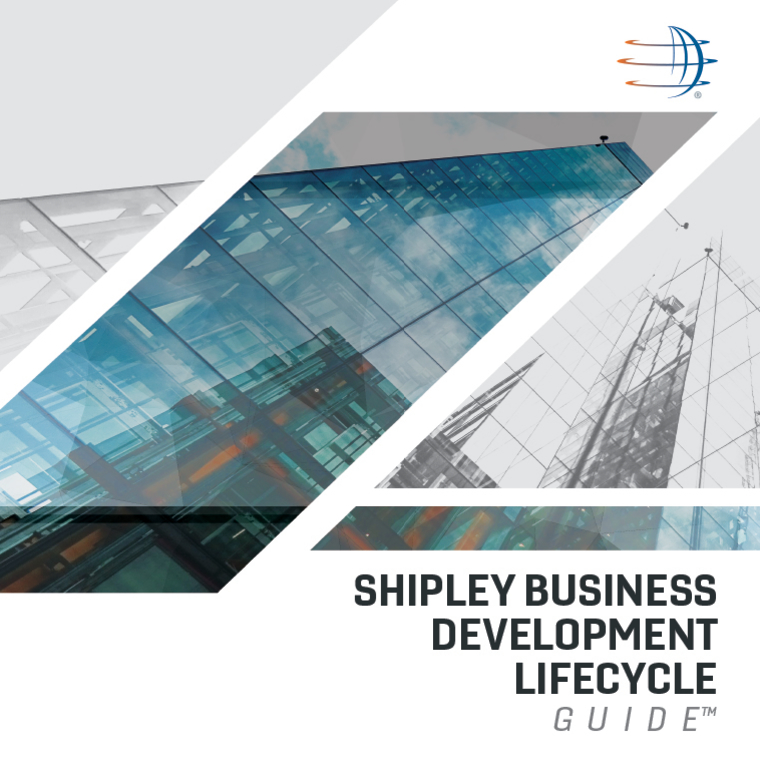
The book is the 2019 edition of the Shipley Business Development Lifecycle Guide, which I won at a raffle at the APMP Western Chapter Training Day. (And yes, I won it in the presence of my SMA colleagues. But hey, good information comes from a variety of places.)
In fact, it was my late 1990s exposure to the Shipley lifecycle that prompted me to LEAVE proposals (the first time).
Let me explain.
As the Shipley Business Development Lifecycle points out, in the ideal world there are a number of proposal preparation steps that take place BEFORE a Request for Proposals (RFP) is issued. In this ideal world, the following conversation would take place after final RFP release:
Well, the RFP just dropped, and it’s almost exactly what we expected. A few tweaks in the interface requirements, but everything else is identical to our mockup. So we can just polish our previous plans, perform several more sanity checks, and win this!
It’s no surprise that sometimes situations are NOT ideal, and perhaps this conversation may take place instead:
Hey, our customer just released an RFP for a new system. I had no idea that they were going to release an RFP this year. Well, we’ve been the incumbent for years, and the people using our software seem to like us. I think. I don’t know the person who actually released the RFP, but my cousin’s brother-in-law knows him. As long as we come in with the lowest price, we’re certain to win this!
Obviously (or hopefully) most RFP releases are somewhere between these two extremes. But it got me thinking: what would it be like to move to the left on the Shipley timeline and participate in the pre-RFP release activities?
I ended up becoming a product manager, and later in my career (after a second stint in Proposals) became a strategic marketer and corporate strategist. But even in these other positions, I continued to dabble in proposals, primarily as a subject matter expert.
So I was already somewhat familiar with the contents of the Shipley guide, but now I had the entire guide in my hands. (I think I had a Shipley book twenty years ago, but I no longer have it.) This allowed me to review the contents at my leisure.
OK, maybe not THAT relaxed. My eyes have to be open, for one thing. (And certain paper products belong in the bathroom, not the living room.)
One nice thing about the printed guide: rather than numbering all the steps sequentially from 1 to 96, they are numbered within each phase. The steps in Phase 0 (Market Segmentation) are numbered from 0.1 to 0.6, the steps in Phase 1 (Long-Term Positioning) from 1.1 to 1.6, and so forth.
The lifecycle is much less imposing that way. If you tell management that you want to implement a 96-step process to win a customer, management will probably tell you to take a hike. (Even Martin Luther didn’t write 96 theses.) A 7-phase process is more palatable. (Marketing!)
After Phases 0 and 1, the Shipley Business Development Lifecycle contains 5 other phases:
Phase 2, Opportunity Assessment
8 steps
Phase 3, Capture/Opportunity Planning
15 steps
Phase 4, Proposal Planning
31 steps
Phase 5, Proposal Development
18 steps
Phase 6, Post-Submittal Activities
12 steps
The final five (of seven) phases in the Shipley Business Develoopment Lifecycle.
The proposal planning phase (Phase 4) deserves a mention, since this is the phase in which Shipley practitioners outline the proposal, draft the executive summary, and update the winning price…all before the RFP is issued.
Obviously you have to know your customer really well to do all of that in advance, and if you don’t know your customer, your competitor probably already does.
Needless to say, I’m not going to duplicate the entire book here; it’s copyrighted, after all. But I do want to highlight the final step in the process, which is either step 6.12 or step 96 depending upon how you number things.
Hold a victory party (win or lose), including review teams.
Actually, you can tailor this step and hold TWO victory parties: one to celebrate that you got the proposal out the door, and a second if you win the contract.
Regardless of how many victory parties you actually hold, be sure to invite all of the contributors. It’s in your self-interest to do so.
Contributors who feel appreciated are more inclined to support subsequent proposal efforts.
Shipley Associates, Shipley Business Development Lifecycle Guide (2019 edition), page 82.
So that’s a few highlights. I only got a chance to look at a portion of the book on Wednesday morning, but it contains a wealth of valuable information for proposal managers/writers AND capture managers AND strategic marketers, corporate strategiests, and product managers.
Enough to make you happy so that you don’t cry. (I couldn’t leave this out.)
How many of you are ALREADY working toward accomplishing your 2022 goals?
I recently sent an email to someone…actually more than one email to more than one someone…that listed some of the things that some companies are already doing in November 2021 to ensure that they start 2022 on the right foot. I happen to know what these companies are doing, because Bredemarket is helping them to do these things.
13 service descriptions
A library of standard RFP responses
Two case studies
Two statements of work
A response to an RFI
A white paper
An article featuring a technology partner
Analyses of NIST test results
An unsolicited proposal letter template
A pitch deck
As Bredemarket completes these projects (some of them are already completed), these companies are positioning themselves for increased business in 2022. Perhaps one of those two case studies, or that unsolicited proposal letter template, will help a company win a new customer.
What about your firm? What content does your firm need to get out your message?
November is almost gone, but there’s still time in December to prepare your 2022 content. And as your regular staff takes holiday vacations, perhaps a contractor may prove useful to you.
That’s where Bredemarket can help you. Whether you need a case study, a white paper, a proposal response, or something else (look at “what I do“), Bredemarket can provide you with that important holiday season assistance to get ready for 2022. If you can use Bredemarket’s assistance:
FTR FST (“future fest”), sponsored by 4th Sector Innovations, SwoopIn, and several other organizations, will be held on Friday, November 12 in downtown Ontario, California. While I’m primarily going for the “professional development” part, FTR FST also features creative expression (including food trucks, which appropriately fall into the “creative expression” category), collaboration, and a tech showcase.
The professional development schedule includes the following sessions, among others:
A keynote presentation from Colin Mangham entitled “Days of Future Past.” According to FTR FST, the topic will be biomimicry.
Biomimicry is the practice of learning from and emulating life’s genius to create more efficient, elegant, and sustainable designs. It’s a problem-solving method, a sustainability ethos, an innovation approach, a change movement, and a new way of viewing and valuing nature. In practice it’s dedicated to reconnecting people with nature, and aligning human systems with biological systems.
As such, our aim is to connect a spectrum of innovation where human and biological system designs interact together seamlessly. Our team offers education and consulting to apply biological insights to systematic sustainability challenges. Our collaborative partnerships and services support interdisciplinary dialogue across industry sectors and regions, while reconnecting all of us to the local ecosystem that supports us.
OK, at this point some of you are saying to yourselves, “THAT kind of conference.”
But frankly, there’s just as much value in approaching problems from a futuristic sustainability view as there is in approaching problems from a more traditional program management process (or Shipley process, or whatever), or even from a more old school sustainability view as espoused by Broguiere’s and the late Huell Howser.
See, it all ties together. After all, the new school 4th Sector Innovations is less than a mile from the decidedly old school Graber Olive House (featured in one of Howser’s “Louie, take a look at this!” TV shows.)
The workshop “Next Gen Cyber Security” by Erik Delgadillo, SecLex.
The workshop “The Evolution of Mobility” by Maritza Berger at Piaggio Fast Forward.
A panel (participants unidentified) on equalizing opportunity.
Vendor spotlights.
After 3:00 pm, FTR FST transitions to less intensive sessions. Bring the kids! The complete schedule can be found here.
You can register for FTR FST here. Oh, and one new wrinkle: attendance at the professional development sessions is now FREE, thanks to the event sponsors.
FTR FST will be at 4th Sector Innovations, 404 N Euclid Avenue in Ontario.
In a competitive bid process, one unshakable truth is that everything you do will be seen by your competitors. This affects what you as a bidder do…and don’t do.
My trip to Hartford for a 30 minute meeting
I saw this in action many years ago when I was the product manager for Motorola’s Omnitrak product (subsequently Printrak BIS, subsequently part of MorphoBIS, subsequently part of MBIS). Connecticut and Rhode Island went out to bid for an two-state automated fingerprint identification system (AFIS). As part of the request for proposal process, the state of Connecticut scheduled a bidders’ conference. This was well before online videoconferencing became popular, so if you wanted to attend this bidders’ conference, you had to physically go to Hartford, Connecticut.
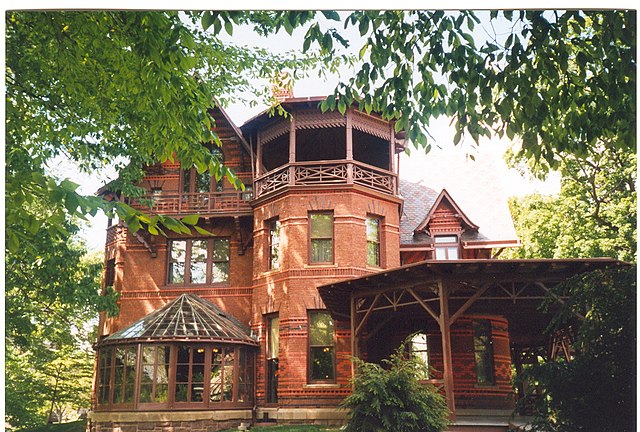
The Mark Twain House in Hartford. For reasons explained in this post, I spent more time here than I did at the bidders’ conference itself. By Makemake, CC BY-SA 3.0, https://commons.wikimedia.org/w/index.php?curid=751488
So I flew from California to Connecticut to attend the conference, and other people from other companies made the trip. That morning I drove from my hotel to the site of the conference (encountering a traffic jam much worse than the usual traffic jams back home), and I and the competitors assembled and waited for the bidders’ conference to begin.
The state representative opened the floor up to questions from bidders.
Silence.
No one asked a question.
We were all eyeing each other, seeing what the other people were going to ask, and none of us were willing to tip our hands by asking a question ourselves.
Eventually one or two minor questions were asked, but the bidders’ conference ended relatively quickly.
There are a number of chess-like tactics related to what bidders do and don’t do during proposals. Perhaps some day I’ll write a Bredemarket Premium post on the topic and spill my secrets.
But for now, let’s just say that all of the bidders successfully kept their thoughts to themselves during that conference. And I got to visit a historical site, so the trip wasn’t a total waste.
And today, it’s refreshing to know that things don’t change.
When the list of interested suppliers appears to be null
Back on September 24, the Government of Canada issued an Invitation to Qualify (B7059-180321/B) for a future facial recognition system for immigration purposes. This was issued some time ago, but I didn’t hear about it until Biometric Update mentioned it this morning.
Now Bredemarket isn’t going to submit a response (even though section 2.3a says that I can), but Bredemarket can obviously help those companies that ARE submitting a response. I have a good idea who the possible players are, but to check things I went to the page of the List of Interested Suppliers to see if there were any interested suppliers that I missed. The facial recognition market is changing rapidly, so I wondered if some new names were popping up.
So what did I see when I visited the List of Interested Suppliers?
An invitation for me to become the FIRST listed interested supplier.
That’s right, NO ONE has publicly expressed interest in this bid.
And yes, I also checked the French list; no names there either.
There could be one of three reasons for this:
Potential bidders don’t know about the Invitation to Qualify. This is theoretically possible; after all, Biometric Update didn’t learn about the invitation until two weeks after it was issued.
No one is interested in bidding on a major facial recognition program. Yeah, right.
Multiple companies ARE interested in this bid, but none wants to tip its hand and let competitors know of its interest.
My money is on reason three.
Hey, bidders. I can keep your secret.
As you may have gathered, as of Monday October 11 I am not part of any team responding to this Invitation to Qualify.
If you are a biometric vendor who needs help in composing your response to IRCC ITQ B7059-180321/B before the November 3 due date, or in framing questions (yes, there are chess moves on that also), let me know.
I was looking over the Bredemarket blog posts for September, and I found some posts that addressed the proposal side of Bredemarket’s services. (There are also blog posts that address the content side; see here for a summary of those posts.)
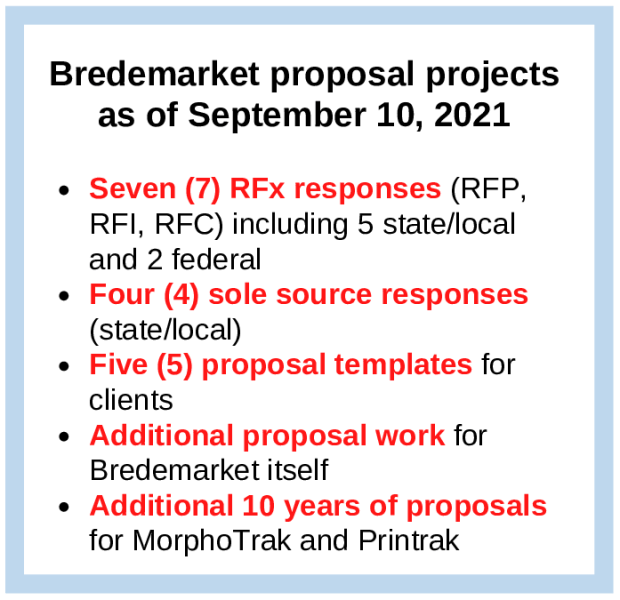
As a starting point, what proposal services has Bredemarket provided for its clients? I quantified these around the middle of the month and came up with this list.
And I’ve been working on additional proposal projects for clients that I haven’t added to the list yet.
This will not only allow me to provide better proposal services to biometric firms (yes, yes, I am a biometric proposal writing expert), but also to other firms.








 Bredemarket
