While I’ve previously addressed pharma commercialization in terms of ensuring that patients use (and purchase) their medications, commercialization occurs long before that. After all, for a prescription drug to be available on the market, it has to get to the market in the first place.
“Early-stage biopharma companies have traditionally had limited options for getting their first asset to market. In most cases, they pursue deals with larger partners and lose or limit rights to their asset, or become a fully integrated company through heavy investment and a great deal of risk.”
Syneos Health has a solution for that. To learn the details of Syneos Health’s full-service pharma commercialization solution, visit this page.
Oh, and the company also has case studies.
“We helped build a European commercial capability via a comprehensive commercialization partnership, introducing a Commercial Leadership function to support the design and execution of the overall launch plan and integrate other services. We were able to scale quickly and establish commercial operations, designed a European launch plan and forecast and launched within three months in one EU country, with a subsequent sequenced launch through Europe, despite the ambiguities of COVID-19.
“In 12 weeks, we provided a full virtual infrastructure that included Field Teams, MSLs, Access Teams, Marketplace and Access/Pricing Consulting, Advertising, Public Relations and Medical Communications, increasing operational efficiencies through integrated Communications teams to reduce duplication in effort across promotional channels and recruiting, training and deploying sales reps, achieving an annual run rate of >$200 million.
“We partnered with the commercial team to provide all commercial launch services, offering crucial global leadership that enabled the team to dynamically scale up and down to respond to changing launch timelines and to balance short- and long-term financial objectives. With a heavy emphasis on market development, we empowered the customer to be fully engaged and aligned with all communities and show an in-depth understanding of market dynamics.”
Do your technology company’s prospects know about you?
How can your technology company increase product benefit awareness right now?
(“Right Now” is a song. Keep tuned for another song reference.)
Before showing you how to do this, let’s take a closer look at three words in the title: product, benefit, and awareness.
Then we’ll get into the how: have, know, write, and publish.
And one more “how” if blogging is hard.
Three words break the code of indifference
No apologies for the section heading, but since her dad died, Kelly Osbourne’s best song (albeit with a curious history) has been on my mind.
While Osbourne’s one word breaks the code of silence, the three words that I chose for my post title break the code of indifference. And I chose each of them—product, benefit, and awareness—carefully.
Word One: Product
Companies talk about a lot of things. Their “why” story. Their great place to work award. Their social/moral/ethical conscience.
Right now I don’t care about any of that. I care about the company’s products or services: the way they make money.
Product firms need products. Imagen 4.
Because if prospects don’t buy these products and become customers, then their why story and awards and conscience count for zilch. There’s a time to share those stories, but for now let’s focus on the product story.
Word Two: Benefit
Now once you look at those products, they have a bunch of features. The ability to capture fingerprints at 1,000 pixels per inch. The ability to complete a third-party risk management analysis in hours, not months. The ability to deliver a completely vetted blog post in days, not weeks.
Right now I don’t care about any of that. I care about the benefits the product brings to the prospect: the things that will make them become a customer.
Revenue is definitely beneficial. Imagen 4.
Because prospects don’t care about you; they only care about themselves. And if your product doesn’t provide tangible benefits to them, they’ll ignore it.
Word Three: Awareness
The third word differs from the other two, because there are multiple answers that are equally valid. I’ve just chosen to focus on one. If you subscribe to the notion of an ordered funnel (some marketers instead believe in a messy middle), then all prospects enter at the beginning of the funnel, and a subset of those prospects exit as buying customers at the end of the funnel. Using a simple three-stage funnel model, you can define those three stages as awareness, consideration, and conversion.
Right now I don’t care about consideration or conversion, although they’re obviously important. (If you have no conversions, you have no revenue, and you have no company.) For my purposes I’m focusing on awareness, or the stage in which a prospect discovers that your company has a product or service that benefits them.
Awareness. Imagen 4.
So how can you raise awareness of the benefits of your product to your prospects? There are multiple methods: text, images, videos, quizzes, contests, webinars, and podcasts. Bredemarket uses many of these methods via its social media channels. But today I’m going to focus on one particular method: blog posts. But we’ll cover some of the other ones also.
One blog breaks the lack of knowledge
The reason that I’m so gung-ho about blog posts is that they can be created and distributed very quickly. Press releases can take a long time. Videos, even longer. Webinars, even longer still.
Compare that to a blog post. A sole proprietor can generate a blog post in an hour. A company can get an emergency blog post out in the same time, provided the right people are in the room.
But before you can wow the world with your product’s benefits to your prospects, you have to go through several steps. The four steps listed here (have, know, write, and publish) are somewhat, but they paint the broad brush strokes.
Step One: Have a blog site (or equivalent)
This sounds obvious, but if you don’t have a blog site, you can’t post a blog.
Using myself as an example, my Bredemarket website is hosted by WordPress. And the website has an area where I’ve filed over a thousand blog posts, including this one.
Step Two: Know what you’re going to say, and why you’re saying it (I ask…)
I could spend ten blog posts talking about this step alone. It’s a loaded step encompassing both strategic and tactical elements. Vision. Mission. Positioning and messaging. And finally, the topic that you want to address in this single blog post.
For now I’ll just say that you should take a deep breath before putting pen to paper (or keyboard to file).
Step Three: Write and rewrite what you want to say (…then I act)
I ask, then I act.
But I act iteratively.
In most cases, I don’t just write and post.
I often create what I call a “draft 0.5,” where I get my ideas down, sleep on them, and then take a fresh second look. Often during that second look I cut out half the text.
When working on a project for a Bredemarket client, the text bounces between me and the client. I’ll write the first draft, then the client will review it and offer suggestions, and then I’ll rewrite it. For shorter text I’ll usually have two review cycles, with three review cycles for longer text.
The important thing is to get the piece written, reviewed, and approved. While I’ve drafted pieces and sat on them for months, the true benefits of blogging occur when you publish the piece as soon as possible.
Step four: Publish and publicize
When you’re ready, publish the blog post.
Perhaps you want to schedule the post to appear at an optimum time. For example, I am typing these words (or draft 0.5 of them anyway) on Sunday afternoon, knowing full well I won’t post this on Sunday afternoon. I’m thinking Tuesday morning.
And maybe there’s a reason why you want to publish a post at a particular time. If a trade show begins on Monday September 15, you may want to publish the promotional blog post on Friday September 12.
Once you’ve posted, publicize it.
If your company has an array of social media channels, you have two choices. Either you can post a link to the blog post on the social channel, or you can encapsulate the message from the blog post and repurpose it for the social channel without linking externally. Whatever gets the message out.
Taking an example from myself, I created a video entitled “Landscape (Biometric Product Marketing Expert)” on Sunday morning. I shared this video in a blog post. I also shared it in social media posts on Bluesky, Facebook, Instagram, LinkedIn, Substack, Threads, TikTok, WhatsApp, and YouTube. The only current social channels where I didn’t share it were Flip (because it’s…landscape). If I wanted to, I could have assembled a video or created a podcast or hosted a webinar. Oh, and I’m sharing it again. (Right now.)
Landscape (Biometric Product Marketing Expert).
Depending upon your thinking time, your drafting time, and your review cycles, you can get your message out to your prospects within a week…or even within a day.
Not too bad.
But I can’t do all that!
For some people, the idea of writing a blog post can be overwhelming.
That’s why Bredemarket is here to help you increase your tech company’s product benefit awareness. (Right now.)
If you have a blog site (or a LinkedIn, Facebook, or other equivalent) and are ready to get your message out, let’s talk about next steps.
For our purposes, the big difference between IAL2 and IAL3 is that IAL2 allows “either remote or physically-present identity proofing,” while IAL3 requires “[p]hysical presence” for identity proofing. However, the proofing agent may “attend the identity proofing session via a CSP-controlled kiosk or device.” In other words, supervised enrollment.
“IAL3 is reserved for high-risk environments such as sensitive government services.”
How are solutions approved for a particular Identity Assurance Level?
Now I could get on my product marketing soapbox and loudly proclaim that my service is IAL2 compliant, or IAL3 compliant, or IAL4 compliant. (“What? You don’t know about IAL4? Obviously you’re not authorized to know about it.”)
“Available to Credential Service Providers offering Full or Component Credential Management Services. Modeled on best practice (drawing from, among other sources, ISO/IEC 27001, ISO/IEC 29115), this Class of Approval ensures the provider organization’s good standing and management / operational practices and assesses criteria which are derived strictly from NIST SP 800-63 rev.3 requirements, ensuring a conformant technical provision of the provider organization’s service.
You see that the Kantara Initiative doesn’t even offer an approval for IAL1, just for IAL2 and IAL3.
It also offers approvals for AAL2 and AAL3. I’ve previously discussed Authenticator Assurance Levels (AALs) in this post. Briefly, IALs focus on the initial identity proofing, while AALs focus on the authentication of a proven identity.
Component Services IAL2 approvals…and an IAL3 approval
Now if you go to the Kantara Initiative’s Trust Status List and focus on the Component Services, you’ll see a number of companies and their component services which are approved for NIST 800-63 rev.3 and offer an assurance level of IAL2.
With one exception.
“NextgenID Trusted Services Solution provides Supervised Remote Identity Proofing identity stations to collect, review, validate, proof, and package IAL-3 identity evidence and enrollment data for CSPs operating at IAL-3. The NextGenID TSS Identity Stations enable remote operators to remotely supervise NIST SP 800-63A compliant Supervised Remote Identity Proofing (SRIP) sessions for credentialing.”
So if remote identity assurance is not good enough for you, there’s a solution. I’ve already discussed NextgenID’s SUPERVISED remote identity proofing in this post. And there’s a video.
But clearly biometric product marketers are paying attention to the identity assurance levels…at least the real ones (not IAL4). But are they communicating benefit-oriented messages to their prospects?
Biometric product marketing has to be targeted to the right people, with the right message. And the biometric product marketing expert at Bredemarket can help a company’s marketing organization create effective content. Talk to Bredemarket.
Health marketing leaders know that pharmacy product marketing can be complex because of the many stakeholders involved. Depending upon the product or service, your hungry people (target audience) may consist of multiple parties.
Pharmaceutical companies.
Pharmacists.
Medical professionals.
Insurance companies.
Partners who assist the companies above.
Consumers.
And the pharmacy product marketer has to create positioning and messaging for all these parties, for a myriad of use cases: fulfillment, approval, another approval, yet another approval. All the messaging can become a complex matrix. (I know. I’ve maintained a similar messaging matrix for an ABM marketing campaign for the financial services industry.)
To achieve your goals, health marketing leaders require a mix of strategy and tactics. And that’s where my extensive experience can help with your pharmacy product marketing program.
The relative’s outpatient surgery was a success, and recovery is progressing.
Meanwhile, I met with one client and advanced several client product marketing projects, including a requirements document (done those for years), some product talking points (done those for years), a price/cost/supplier exercise (done those for years), and a project status report (done those for years).
I also published four Bredemarket posts (including this one) and the usual assortment of social media content on various channels (with the exception of one).
U.S. persons should pay special attention to my coverage of IDGA’s DoD/DHS border security report (blog, Substack, elsewhere).









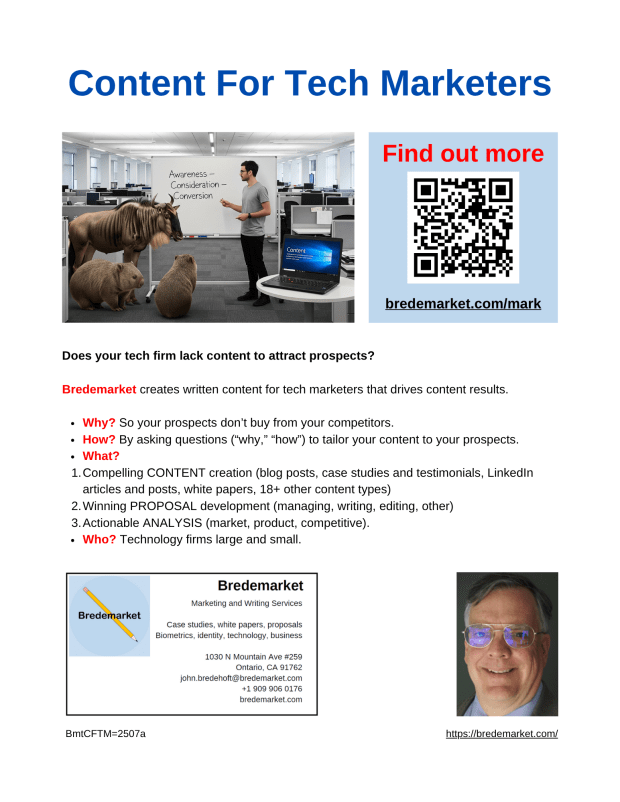






 Bredemarket