Bredemarket’s “CPA”

Is your firm losing business and leaving important items unfinished?

I, John E. Bredehoft of Bredemarket, am a “CPA.” Not a Certified Public Accountant; a Content-Proposal-Analysis marketing professional:

  • Content such as blog posts, case studies, data sheets, white papers, and more.
  • Proposal submissions from identity/biometric and technology firms to governments and enterprises.
  • Analysis of markets, companies and competitors, products, and websites and social media.

I offer over 30 years of technology experience—30 in identity/biometrics, where I am the biometric product marketing expert.

I ask questions first (why, how, what, and more) and collaborate later to ensure I deliver the right content to you.

I provide pre-packaged services or bill you at an hourly rate.

Click here to find out more about Bredemarket’s “CPA” services, and schedule a free 30 minute content needs assessment with me.

Rethinking (some of) My Go-to-market Concepts

My current two categories for go-to-market collateral, “external” and “internal,” are not sufficient. I want to fix that, but I’m still thinking through things, such as what to call the third category. As of this moment, my best option is “intrinsic,” based upon my conversations with my good buddy Gemini.

My current two categories for go-to-market collateral

Based upon go-to-market efforts that stretch back a decade (even before I formally became a Product Marketing Manager), I have traditionally divided go-to-market output into two categories.

22 types of content Bredemarket can create.
  • External content for your hungry people (target audience), such as articles, blog posts, social media, case studies, white papers, and proposals. This content goes to CEOs, marketers, engineers, IT staff, and many others at the companies that buy from you.
  • Internal content for the people in the company who talk to your hungry people, such as battlecards, sales playbooks, and scripts for trade show demonstrations. This content goes to salespeople, marketers, product managers, customer success folks, and many other employees and contractors.
  • Some content can either be external or internal, depending upon the audience.

Simple and straightforward, right?

My emerging third category

But during a current go-to-market effort for a client, I realized that these two categories are insufficient, since both the client and I are creating content that will never been seen by either the external clients or the internal clients.

I’ll give you two heavily redacted and anonymized examples for a #fakefakefake machine.

AI-generated by Google Gemini.
  • Bob wrote a Word document that listed the pain points that MegaCorp’s client encounter when trying to put green round widgets on their end customers’ beanie caps.
  • Judy created a picture with stick figures that showed how clients can use the MegaCorp WidgetPlacer 2000 for their beanie cap production needs.

Bob and Judy (names from this song) are NEVER going to show that document or that picture to the customers, or even to the company’s own account managers.

So why create it?

Because they will be the initial guides as the go-to-market team creates all the other external and internal collateral for the effort.

These foundation documents are a critical part of the go-to-market effort. Without them, the subsequent go-to-market collateral will be a contradictory mishmash of stuff, and you’ll need to undertake a lot of effort to align all the content after the fact.

And the third category is…

…well, I don’t know what to call this third category yet.

  • “Internal internal content” seems a bit silly.
  • “Foundational content” seems a bit grandiose.
  • “Bob and Judy” content seems like an independent TV show.

Google Gemini, you’re my only hope.

Not THOSE Gemini. Metropolitan Museum of Art, New York, Public Domain, https://commons.wikimedia.org/w/index.php?curid=15044467.

My question:

If we call the first category “external” marketing content for customers, and we call the second category “internal” marketing content for employees, then what do we call the third category which is only for the people who create marketing content for customers and employees?

Gemini’s first batch of answers:

Internal Marketing Content for Marketing Teams

Marketing Team Communication

Marketing Team Resources

Internal Marketing Tools

Brevity is NOT a strength of generative AI. Even when I specifically instructed Gemini to provide single word responses, I got hyphenated words:

Intra-marketing (combining “intra” for within and “marketing”)

Meta-marketing (implying a higher-level perspective on marketing)

Team-marketing (emphasizing its focus on the marketing team)

The fatal flaw is that not all the people on a go-to-market team are marketers. (This is my fault because of the prompt I wrote.)

And if I lop off the last part of each compound phrase, two of my options are “team” (too generic) and “meta” (NO).

And “intra” is too close to “internal internal.” But perhaps it’s a start. So I asked Gemini for words similar to “intra-” and got this response:

The prefix “intra-” means “within,” “inside,” or “inner.” Here are 12 words that convey a similar meaning:

  1. Inward: Turning or moving toward the inside.
  2. Internal: Existing or occurring within something.
  3. Inner: Situated or located within.
  4. Intrinsic: Belonging to or inherent in the nature of something.
  5. Interior: The inside part of something.
  6. Intramural: Occurring within a school or institution.
  7. Intranet: A private computer network within an organization.
  8. Intravenous: Administered into a vein.
  9. Intracranial: Situated or occurring within the skull.
  10. Intracellular: Existing or occurring within a cell.
  11. Intralingual: Relating to or occurring within a language.
  12. Intrajugular: Situated or occurring within the jugular vein.

I kind of like “intrinsic,” but I’ll sleep on it.

In the meantime, what would YOU call the third category?

More on Go-to-Market Tiers

In my post “Seven Essential Product Marketing Strategy and Process Documents, the August 30, 2024 Iteration,” I alluded to the fact that not all go-to-market efforts are the same.

You can’t just slap a few things together in three days and say your go-to-market is complete. You need a plan on how you will go to market, including the different tiers of go-to-market efforts (you won’t spend four months planning materials for your 5.0.11 software release)…

Unless you’re in very unusual circumstances, your go-to-market efforts will encompass variable efforts.

Two tier

In its simplest form, you will have two tiers. For example, Holly Watson of Amazon Web Services distinguishes between “launches” and “releases.”

Release to me relates to the update of an existing product vs. a net-new addition to a solution offering. It’s common to have multiple releases a quarter vs. large launches 1-2x per year.

Three tier

You can get fancier.

Stepped pyramids in Teotihuacan, Mexico. By Juan Carlos Fonseca Mata – Own work, CC BY-SA 4.0, https://commons.wikimedia.org/w/index.php?curid=91032399.

My former product marketing team devised a three-tier system, in which the top tier encompassed a full-blown effort and the bottom tier just had some release notes, a bit of internal education, and maybe a blog post.

Defined tiers

But as I said on August 30, you need to define the tiers beforehand. Don’t just shoot from the lip and say you want a blog post, a press release, and a brochure…oh, and maybe a cool infographic! Yeah!

If Steve Jobs was on stage, it was a top tier go-to-market effort by definition. By matt buchanan – originally posted to Flickr as Apple iPad Event, CC BY 2.0, https://commons.wikimedia.org/w/index.php?curid=9110964.

Establish your tiers.

Establish the content for each tier.

Execute.

And repeat.

Positioning

Remember my August 30 post about seven essential product marketing strategy and process documents?

Well, I posted a follow-up on LinkedIn (as part of my “The Wildebeest Speaks” series) about one of those seven documents.

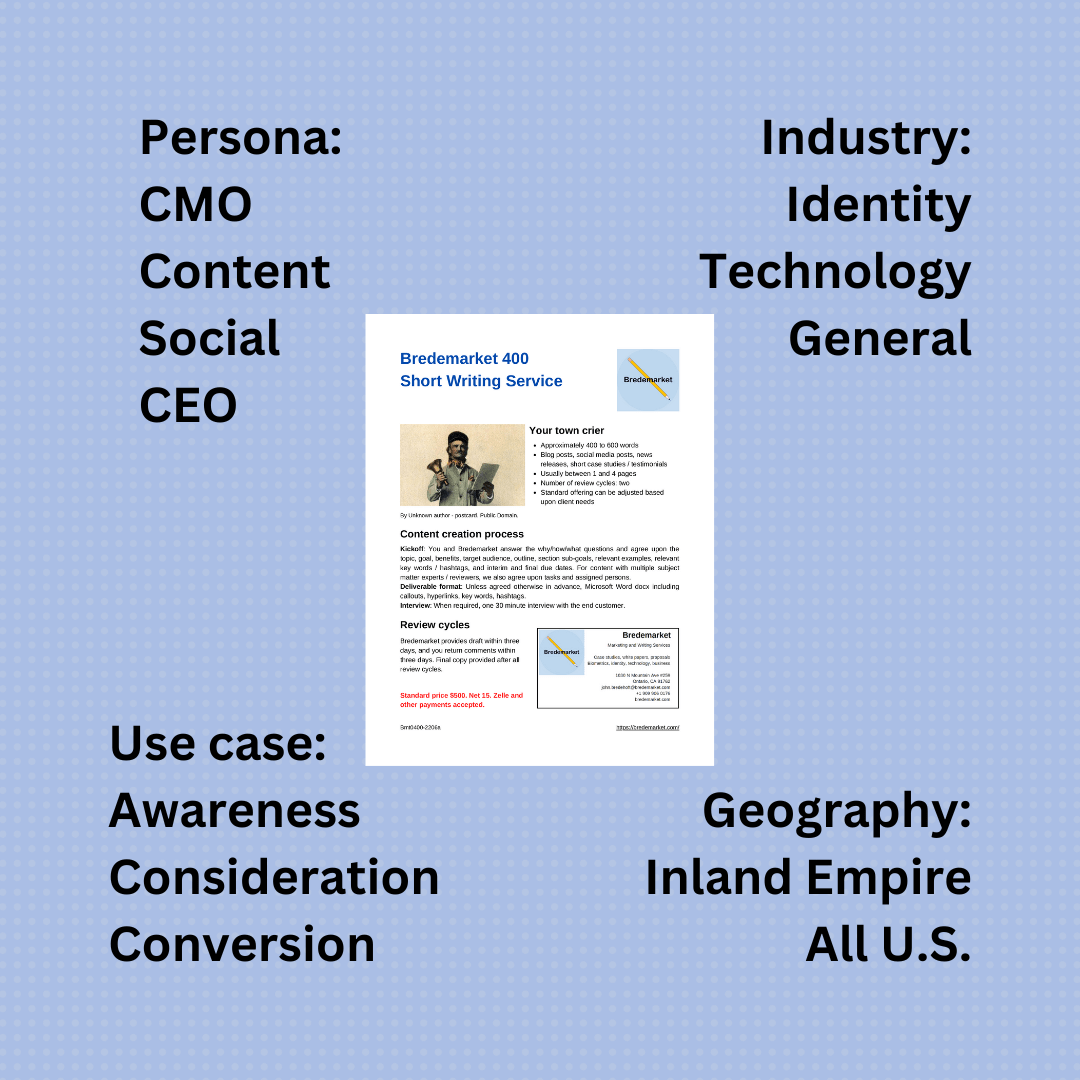
If you’re not already following Bredemarket on LinkedIn (why not?), be sure to read “A Deeper Dive Into Positioning,” and the complexities that occur when you have to position and message for multiple products, personas, industries, use cases, and geographies.

Even for a single product such as the Bredemarket 400 Short Writing Service, the matrix can get pretty hairy.

Positioning variables can include persona, industry, (pseudo) use case, and geography.

Seven Essential Product Marketing Strategy and Process Documents, the August 30, 2024 Iteration

Due to the nature of my business, Bredemarket doesn’t usually get involved in strategy. The clients set the strategy, and I fill the tactical holes to execute that strategy.

I once worked for a former 3M employee. You can bet we did this. By Wikimedia Finland – Planning the strategy, CC BY-SA 2.0, https://commons.wikimedia.org/w/index.php?curid=36476412.

But I recently welcomed the opportunity to envision a strategy to achieve a strategy, and in the process defined seven essential strategy documents to kick off a product marketing or general marketing program.

Depending upon how you define product marketing, one of these seven goes above and beyond the product marketing function. I included it anyway, because if you ask 20 people what “product marketing” is, you will get 21 answers.

There’s a reason I dated this. I may want to refine it in the future. For example, some of you may recall how my “six questions your content creator should ask you” eventually became seven questions.

The seven strategy and process documents

  • Go-to-Market Process. I’ve talked about this before, but it bears repeating. You can’t just slap a few things together in three days and say your go-to-market is complete. You need a plan on how you will go to market, including the different tiers of go-to-market efforts (you won’t spend four months planning materials for your 5.0.11 software release), the types of internal (employee) content you will release in each tier, and the types of external (prospect/customer) content you will release in each tier.
  • Performance Report. I listed this near the top because you need to quickly establish your metrics, define them, and how you will gather them. For example, if you want to measure “engagement,” you need to define exactly what engagement is (likes on a blog post? reshares on a LinkedIn post?), and ensure that you have a way to capture that data. Preferably automated data capture; manual tabulation is horrendous.
  • Product and Competitive Analysis. Plan how you will perform these duties. Even in my simplest analyses when I was still with IDEMIA, I planned exactly what data I needed, what data I wanted to capture, and how I was going to distribute it. I refined this during my time at Incode, when a team of four released battlecards in a standard format, with data that highlighted items important to Incode. My subsequent analyses for Bredemarket, which were more comparative rather than stand-alone, refined things still further.
  • Brand Strategy. I must confess that I have never created a formal brand book. But it’s important that you define your branding, at least informally, so that your products and services are presented consistently on all platforms. And so you spell things correctly (it’s NOT “BredeMarket”).
  • Customer Feedback. If you want to institute a customer focus, you need information from your prospects and customers. What information do you need? How much? (Shorter surveys get more responses.) How will you get it? What will you do with it? (“Trash it” is not an option.)
  • Positioning and Messaging Book. Once you’ve created the brand strategy, you need a set of consistent positioning (internal) and messaging (external) content. The positioning and messaging matrix can get pretty complex if you are supporting multiple products, personas, industries, use cases, and geographies. I will again confess that I do not have a standard messaging statement for Bredemarket 400 prospects who are Chief Marketing Officers who need blog posts in the identity/biometric industry discussing privacy concerns in the European Union. My loss.
  • Demand Generation and Content Marketing Parameters. Now in many organizations, demand generation and/or content marketing are separate from product marketing. But sometimes they’re not. What are your plans for demand generation? How will you achieve your goals? What content is necessary?

So what?

As I said, I recently had the opportunity to envision these strategies for a prospect, and have scheduled a meeting with the prospect to discuss these. (Note to “prospect”: these are iterative, and I fully expect that up to 90% of this may change by the time of implementation. But I think it’s a good starting point for discussion.)

The prospect may secure my services, or they may not.

And if they don’t, I can develop these same documents for others.

Do YOU need help defining strategies for your business? If so, let’s talk.

If your company needs a full-time product marketer, contact me on LinkedIn.

If your company needs a part-time product marketing consultant, contact me on Bredemarket. (Subject to availability.)

The KlarnaBots

Klarna CEO Sebastian Siemiatkowski has revealed a plan to eliminate his job and replace himself with an AI bot…

…wait, I misread that. Siemiatkowski has revealed a plan to replace OTHER people’s jobs at Klarna.

Funny how these rightsizing moves, with a few notable exceptions, always seem to spare the executives. The brunt will fall on others.

“With almost half the workforce at the company, Siemiatkowski plans to shift customer service and marketing duties to AI. ‘Not only can we do more with less, but we can do much more with less,’ he said…”

Mashable: https://mashable.com/article/klarna-ceo-plan-to-reduce-workforce-fifty-percent-replace-with-ai

I bet customer service and marketing morale is REALLY high at Klarna right now. If it weren’t for the not-so-good job market at the moment, Siemiatkowski might realize his rightsizing goals via attrition before his bots are ready.

But let me ask my good buddy Google Gemini. The material below was not written by me.

= =

While AI has made significant strides in customer service and marketing, it’s unlikely that Klarna, or any company, could completely eliminate human involvement.

Here’s why:

  •  Nuance and Empathy: Human agents are better equipped to handle complex customer inquiries, especially those involving emotional situations. AI, while improving, still struggles with understanding and responding to nuanced emotions.
  •  Problem-Solving: Certain customer issues require creative problem-solving or judgment calls that AI may not be able to handle effectively.
  •  Ethical Considerations: AI can perpetuate biases present in the data it’s trained on. Human oversight is essential to ensure ethical and fair treatment of customers.
  •  Unforeseen Circumstances: AI may not be able to adapt to unexpected situations or rapidly changing circumstances. Human agents can often address these challenges more effectively.
  • Customer Preference: Many customers still prefer to interact with human agents, especially for complex or sensitive issues.

However, AI can be a valuable tool in these areas. It can automate routine tasks, provide 24/7 support, and offer personalized recommendations. The most effective approach is likely a hybrid model, combining AI with human agents to provide the best possible customer experience.

Doing Double Duty (from the biometric product marketing expert)

I’ve previously noted that product marketers sometimes function as de facto content marketers. I oughta know.

sin, a one-man band in New York City. By slgckgc – https://www.flickr.com/photos/slgc/8037345945/, CC BY 2.0, https://commons.wikimedia.org/w/index.php?curid=47370848

For example, during my most recent stint as a product marketing employee at a startup, the firm had no official content marketers, so the product marketers had to create a lot of non-product related content. So we product marketers were the de facto content marketers for the company too. (Sadly, we didn’t get two salaries for filling two roles.)

Why did the product marketers end up as content marketers? It turns out that it makes sense—after all, people who write about your product in the lower funnel stages can also write about your product in the upper funnel stages, and also can certainly write about OTHER things, such as company descriptions, speaker submissions, and speaker biographies.

From https://bredemarket.com/2023/08/28/the-22-or-more-types-of-content-that-product-marketers-create/.

That’s from my post describing the 22 (or more) types of content that product marketers create. Or the types that one product marketer in particular has created.

So it stands to reason that I am not only the biometric content marketing expert, but also the biometric product marketing expert.

I just wanted to put that on the record.

And in case you were wondering what the 22 types of content are, here is the external content:

  • Articles
  • Blog Posts (500+, including this one)
  • Briefs/Data/Literature Sheets
  • Case Studies (12+)
  • Proposals (100+)
  • Scientific Book Chapters
  • Smartphone Application Content
  • Social Media (Facebook, Instagram, LinkedIn, Threads, TikTok, Twitter)
  • Web Page Content
  • White Papers and E-Books

And here is the internal content:

  • Battlecards (80+)
  • Competitive Analyses
  • Event/Conference/Trade Show Demonstration Scripts
  • Plans
  • Playbooks
  • Proposal Templates
  • Quality Improvement Documents
  • Requirements
  • Strategic Analyses

And here is the content that can be external or internal on any given day:

  • Email Newsletters (200+)
  • FAQs
  • Presentations

So if you need someone who can create this content for your identity/biometrics product, you know where to find me.

Addressing “How” and “Why” in That Order

This is my last chance to squeeze in a Bredemarket blog post before the end of the month, so I’ll just recycle some thoughts that I previously posted on LinkedIn.

Based on some thoughts originally shared by Taylor “Taz” Rodriguez about the perils of “me-too” marketing.

Let’s all be unique

Steve Martin on stage in the 1970s. (And yes I used the “let’s get small” version of this image.) By Jim Summaria – WP:Contact us – Licensing, CC BY-SA 3.0, https://commons.wikimedia.org/w/index.php?curid=5578555

Years ago, Steve Martin had a routine in which he encouraged his audience to say, in unison, that they promise to be different and they promise to be unique.

Get it?

Apparently some present-day marketers don’t, according to Rodriguez.

If you want to SERIOUSLY grow a service-based company, you need to STOP with the generic social media captions!

We see it all day long, even on paid ads which is sad…

❌ “We help our clients stand out from the crowd!”

❌ “Our experienced team of _____ help to elevate your business!”

From https://www.linkedin.com/posts/madebytaz_marketingandadvertising-paidadvertising-socialmediamarketing-activity-7168953109514280960-9H1N/.

No, repeating the canned phrase about standing out from the crowd does NOT make you stand out from the crowd.

But wait. It gets worse.

The authenticity bot

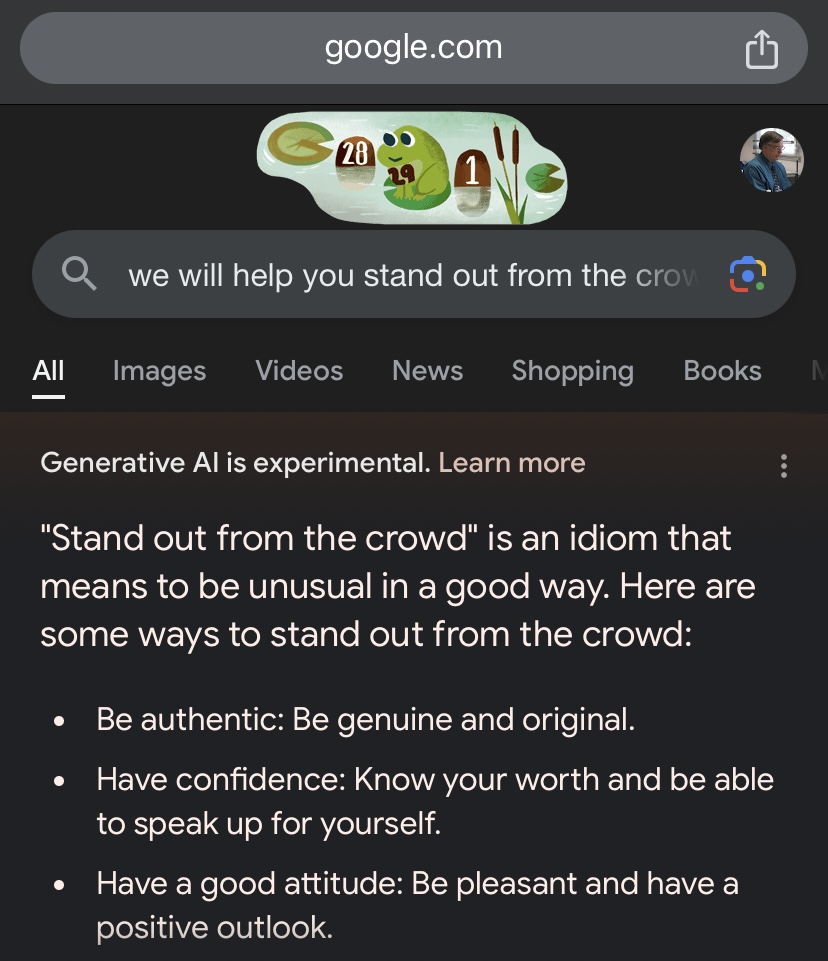
When I reshared Rodriguez’s post, I wanted to illustrate it with an image that showed how many people use the phrase “stand out from the crowd.”

But while I couldn’t get that exact number on my smartphone search (a subsequent laptop search revealed 477 million search results), I got something else: Google Gemini’s experimental generative AI response to the question, bereft of irony just like everything else we’ve encountered in this exercise.

You see, according to Gemini, one way to stand out from the crowd is to “be authentic.”

Yes, Google Gemini really said that.

Google search results, including generative AI results.

Now I don’t know about a bot telling me to “be authentic.”

Rodriguez addresses “how” and “why”

Going back to Taylor “Taz” Rodriguez’s post, he had a better suggestion for marketers. Instead of using canned phrases, we should instead create original answers to these two questions:

HOW do you help your clients stand apart from the competition?

WHY have your past & current clientele chosen to work with you?

From https://www.linkedin.com/posts/madebytaz_marketingandadvertising-paidadvertising-socialmediamarketing-activity-7168953109514280960-9H1N/.

Why not “why” and “how”?

Now I know what my Bredemarket groupies are saying at this point.

Only one of these three groupies will survive. (And I shudder to think about what Bredemarket groupies would wear.) By Mike – Flickr: DSC_0657, CC BY 2.0, https://commons.wikimedia.org/w/index.php?curid=26475397

(There aren’t any Bredemarket groupies, but pretend for the moment that there are.)

Taz, “You’re Doing It Wrong™.” Because Simon Sinek insists that “why” is the most important question, “why” should take precedence over “how.”

To which I respond:

Sinek Schninek.

BOTH questions are important, both need to be addressed, and it really doesn’t matter which one you address first.

In fact, there are some very good reasons to start with the “how” question in this case. It’s wonderful for the marketer to focus on the question of how they stand apart from the competition.

And as a wildebeest lover who grasps a keyboard with my cold dead hands, and with an onboarding process that ensures Bredemarket’s content is the right content for my customers, I can certainly agree with this focus.

Even if my onboarding process does start with “why.”

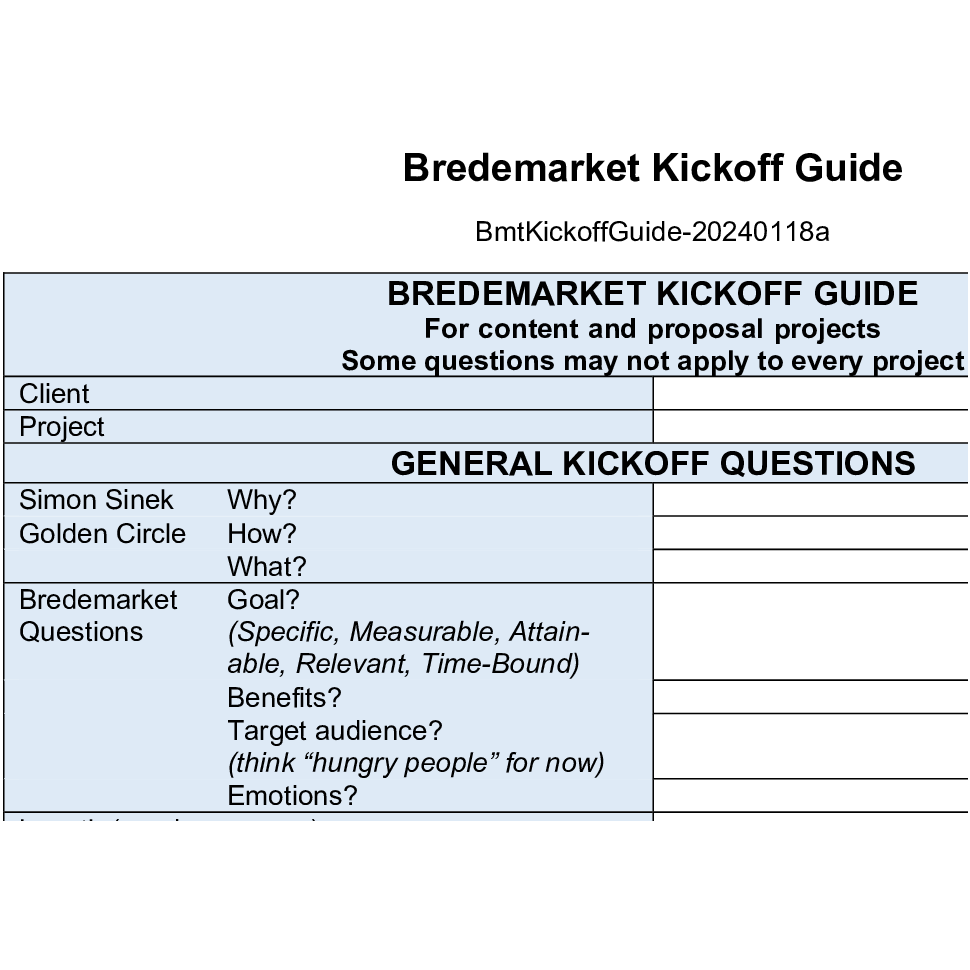
My “seven questions” as of January 18, 2024. To see the latest version of the e-book on my seven questions, visit https://bredemarket.com/7qs/.

But hey, if you want to address my first two questions in reverse order, go for it.

Find out more here.

Working With Familiar Faces

Often consultants work with someone whom they have never met before.

Sometimes they get to work with friends they have known from previous experiences, which can be a good thing.

From “We Are Your Friends.” https://vimeo.com/11277708.

First example: A couple of years ago, when consulting for a large client, I worked on a proposal with one of the client’s partners, and one of the employees in the partner organization happened to be a former coworker from MorphoTrak.

Second example: This morning I’m meeting with Gene Volfe, a former coworker at Incode Technologies (we started at Incode on the same day). We’re working on a project together that requires Gene’s demand generation skills and my content skills…which we will be employing for the benefit of another former MorphoTrak coworker.

Third example: Speaking of Incode, two of my former coworkers are reuniting at a different company. As a sign that these two know each other well, one made a point of saying to the other, “Go Bills!”

And yes, Gene, I remember how you like Google Docs…

(Pizza Stories) Is Your Firm Hungry for Awareness?

Leftover pizza is the best pizza. Preparation credit: Pizza N Such, Claremont, California. Can I earn free pizza as a powerful influencer? Probably not, but I’ll disclose on the 0.00001% chance that I do.

I wrote a post about pizza that concluded as follows:

Tal’s lead was hungry for ghostwriting services, and when they saw that Tal offered such a service, they contacted him.

What does this mean? I’ll go into that in a separate post.

From (Pizza Stories) The Worst Time to READ a Pizza Post on Social Media.

Now that it’s time to write the “separate post,” I really don’t want to get into the mechanics of how posts that attract prospects (hungry people, target audience) increase awareness and help you convert prospects for your products and services.

So forget that. I’m going to tell a story instead about two executives at a fictional company that has a real problem. The executives’ names are Jones and Smith.

The story

Jones was troubled. Sales weren’t increasing, prospects weren’t appearing, and if this malaise continued the company would have to conduct a second round of layoffs. Jones knew that “rightsizing” would be disastrous, so the company needed another solution.

So Jones videoconferenced Smith and asked, “How can we make 2024 better than 2023?”

Smith replied, “Increasing sales calls could help, and ads could help, but there’s another way to increase our awareness with our prospects. We could create content on our website and on our social channels that spreads knowledge of our products and services.”

Jones exclaimed, “That’s great! We could get generative AI to create content for us!”

“No, not that!” Smith replied. “Generative AI text sounds like a bot wrote it, and makes us sound boring, just like everyone else using generative AI text. Do we want to sound like that and put our prospects to sleep?”

By Ilya Repin – Tretyakov Gallery, Moscow, Public Domain, https://commons.wikimedia.org/w/index.php?curid=60387757

“So we need a human writer,” Jones realized, “one who can describe all of the features of our products.”

“Absolutely not,” Smith emphasized. “Customers don’t care about our features. They care about the benefits we can provide to them. If we just list a bunch of features, they’ll say, ‘So what?'”

By Mindaugas Danys from Vilnius, Lithuania, Lithuania – scream and shout, CC BY 2.0, https://commons.wikimedia.org/w/index.php?curid=44907034

“OK, we’ll go with benefits,” said Jones. “But why is content so important?”

Take blogging,” replied Smith. “The average company that blogs generates 55% more website visitors. B2B marketers that use blogs get 67% more leads than those who do not. Marketers who have prioritized blogging are 13x more likely to enjoy positive ROI. And 92% of companies who blog multiple times per day have acquired a customer from their blog.”

“Wow.” Jones was silent for a moment. “How do you know all of this stuff, Smith?”

“Because of the content that I’ve read online from a marketing and writing services company called Bredemarket. The company creates content to urge others to create content. Bredemarket eats its own wildebeest food.”

“Wildebeest?” Jones eyed Smith quizzically.

Black wildebeest. By derekkeats – Flickr: IMG_4955_facebook, CC BY-SA 2.0, https://commons.wikimedia.org/w/index.php?curid=14620744

“Never mind. The important thing is that Bredemarket’s marketing and writing services could help us increase awareness, and vault us over the companies that have blogs but don’t bother to post to them. In one industry, about one-third of the companies with blogs HAVEN’T SAID A SINGLE THING to their prospects and customers in the last two months. If we were in that industry, we could leapfrog over the silent companies.”

“That sounds great,” said Jones. “Let’s contact Bredemarket today.”

“Wonderful idea, Jones. By the way, I hear that Bredemarket excels at repurposing content also.”

The excited Jones asked Smith to contact Bredemarket, and then walked to a nearby venue and sang a song.

From https://www.youtube.com/watch?v=ifhcWeXIOZs