How Can CMOs Serve Hungry Prospects With Expert Biometric Content?

How can CMOs serve hungry prospects with expert biometric content?

(Imagen 4)

Biometric product companies offer a tasty mixture of fingerprint, face, iris, voice, DNA, and other biometric hardware and software. These companies employ Chief Marketing Officers (CMOs) responsible for their firms’ inbound product marketing. Hungry prospects devour any content the firm can provide, and the CMOs devour any employee or contractor who can provide the necessary content.

The CMO will appreciate this seasoned quote from Lee Densmer:

“Companies are outsourcing the writing at great expense….[I]t is a heavy lift to make sure daily content for the platform is useful, relevant, and align with your business. Outsourcing doesn’t really work unless the writer really knows your business, is in touch with corporate leaders, and stays on top of trends.”

Read Densmer’s article: https://www.linkedin.com/pulse/why-linkedin-b2b-growth-hard-right-now-what-youre-doing-lee-densmer-pqvgc

So if you’re a content-devouring CMO at a biometric company, doesn’t it make sense to contract with Bredemarket’s biometric product marketing expert to serve a delicious dinner of your content needs?

Talk to Bredemarket: https://bredemarket.com/mark/

(And yes, it is almost lunchtime. Why do you ask?)

Painting a Picture: The Content Challenges of a Biometric Chief Marketing Officer

(Imagen 4)

If this reads odd, there’s a reason.

Imagine a Chief Marketing Officer sitting at her desk, wondering how she can overcome her latest challenge within three weeks.

She is a CMO at a biometric software company, and she needs someone to write the first two entries in a projected series of blog posts about the company’s chief software product. The posts need to build awareness, and need to appeal to prospects with some biometric knowledge.

So she contacts the biometric product marketing expert, John E. Bredehoft of Bredemarket, via his meeting request form, and schedules a Google Meet for the following meeting.

At the scheduled time she joins the meeting from her laptop on her office desk and sees John on the screen. John is a middle-aged Caucasian man with graying hair. He is wearing wire-rimmed glasses with a double bridge. He has a broad smile, with visible lines around his eyes and mouth. His eyes are brown  and appear to be looking directly at the camera. He is wearing a dark blue collared shirt. While his background is blurred, he appears to be in a room inside his home, with a bookcase and craft materials in the background.

After some pleasantries and some identity industry chit chat, John started asking some questions. Why? How? What? Goal? Benefits? Target audience (which he called hungry people)? Emotions? Plus some other questions.

They discussed some ideas for the first two blog posts, each of which would be about 500 words long and each of which would cost $500 each. John pledged to provide the first draft of the first post within three calendar days.

After the call, the CMO had a good feeling. John knew biometrics, knew blogging, and had some good ideas about how to raise the company’s awareness. She couldn’t wait to read Bredemarket’s first draft.

If you are in the same situation as the CMO is this story, schedule your own meeting with Bredemarket by visiting the https://bredemarket.com/mark/ URL and filling out the Calendly form.

Remember how I warned you that this post was going to read odd? In case you’re wondering about the unusual phrasing—including a detailed description of what I look like—it’s because I fed the entire text of this blog post to Google Gemini. Preceded by the words “Draw a realistic picture of.” And here’s what I got.

Imagen 4. I’m not on the screen, but I like the content ideas.
Imagen 4. With the bookcases. And I’ve never had a beard.
Imagen 4. But that’s not blurred.

The Source of Bredemarket’s Content Creator Questions 1-3 of 7

(Imagen 4)

Perhaps you’ve seen Bredemarket’s ebook “Seven Questions Your Content Creator Should Ask You.

If you didn’t already know this, I took the first three questions, in order, from Simon Sinek.

Regarding Sinek’s three questions, see the HubSpot post “3 Key Marketing Takeaways from Simon Sinek’s ‘Start With Why.’”

These three questions, as well as others—there are more than seven—form the first part of Bredemarket’s engagement with its clients. I ask, then I act.

I ask, then I act.

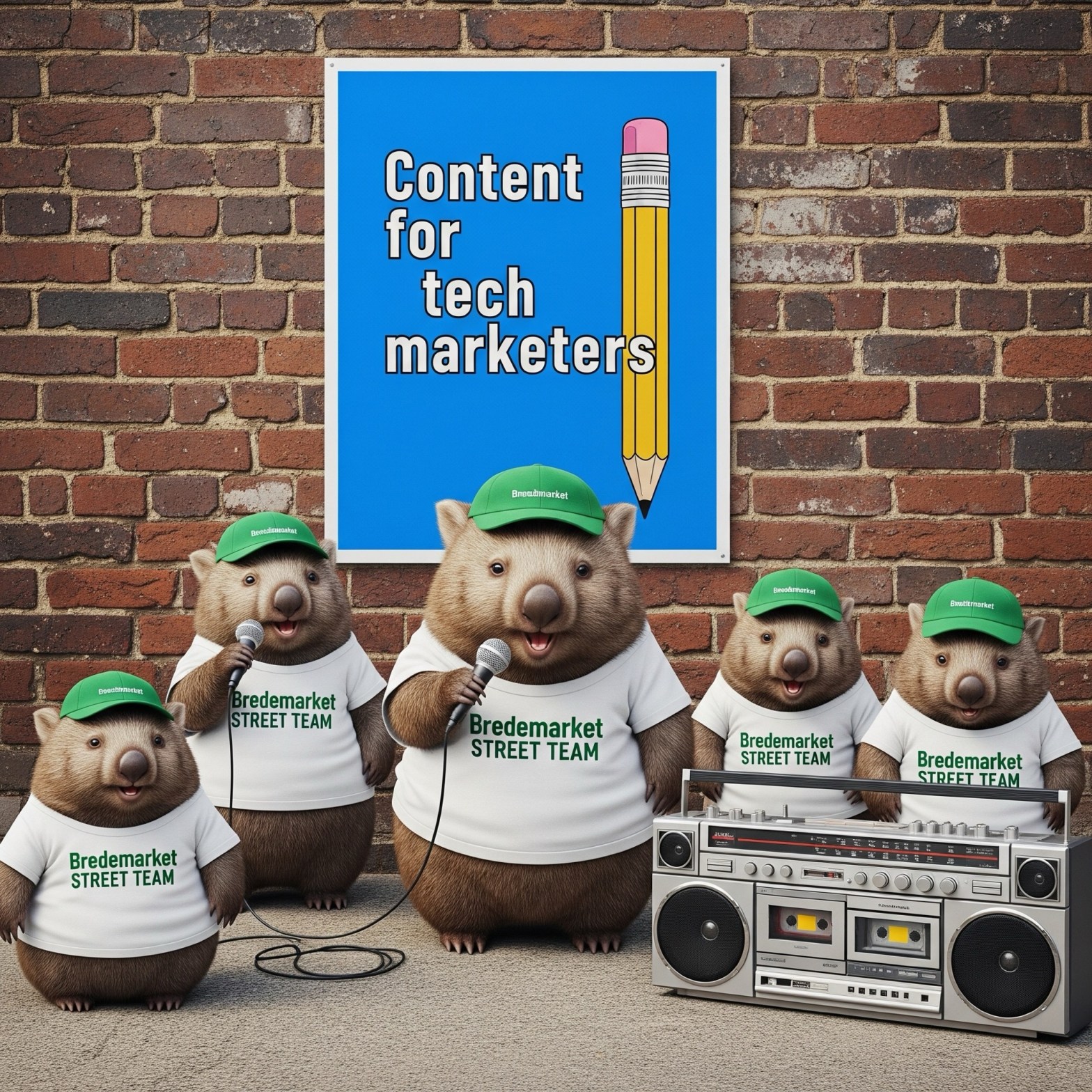
If you would like to learn more about Bredemarket’s marketing and writing services, visit my “Content for Tech Marketers” page at bredemarket.com/mark

Is Biometric Authentication Marketing Profitable?

When a company such as Bredemarket promotes itself, often we don’t know who is receiving the marketing messages. Therefore, we have to BROADCAST.

When we do know who is receiving our messaging, we can NARROWCAST.

Hmmm…how could we know this?

Ask TLG Marketing.

“Businesses are rapidly adopting biometric authentication marketing as it serves a dual purpose: enhancing security and providing a customized marketing experience.”

But does it pay? Yes.

“By integrating fingerprint recognition technology, a retail company optimized its app experience, leading to a 20% increase in online sales. In another case, a banking institution used facial recognition for secure and quick authentication, resulting in a customer service rating boost of 25%.”

There are ways other than biometrics to know who your prospects are, but knowledge based authentication (KBA) such as passwords has its weaknesses. With KBA you may not be interacting with your prospects, but with your prospect’s spouse or child.

JOE’S ALCOHOL EMPORIUM: Evelyn, what types of alcohol do you prefer?

EVELYN’S TEENAGE SON WHO KNOWS HER PASSWORD IS HIS BIRTHDATE: 200 proof, man! Let’s get wasted!

Bredemarket has created targeted, segmented content, including individualized content. Let me help you communicate with your individual prospects. Talk to me.

Tech marketers, are you afraid?

Unable to Uncapsulize

(Imagen 4)

I just emailed the Bredemarket mailing list and included “capsulizes” in the text.

I subsequently decided that I should have used “encapsulates” instead.

Too late.

But it’s better to send a fair email than not send one at all.

If you want to receive Bredemarket emails composed in “the perfect is the enemy of the good” spirit, subscribe.

Animals and Marketing

The experts who do NOT recommend letting ChstGPT run your marketing program DO recommend projecting authenticity in your communications.

But some prospects don’t like authenticity because it is too real and not “professional.”

I’ve alluded to the story of a group of people that knew me well. But of that group, only two felt moved to subscribe to the Bredemarket Instagram account. And one of those two subsequently unsubscribed.

Maybe the wildebeests were the problem.

The problem with people knowing you well is that they know you well…and know the wildebeests more than they want to. And when someone is focused on important business information, one wombat may be one wombat too many.

But not one koala. They have fingerprints, after all.

The lesson learned from this group?

When selecting your target audience, don’t market to satiated people.

Not hungry people.

Are You Ever Ready For a Bad Review?

(Imagen 4)

What do you do when you’re just starting out and face an immediate challenge?

Jennifer Zimmerman shared a story about Thomas Keller of the French Laundry:

“When a food critic made a reservation, Keller reportedly reached out and asked them not to write a review. Not because he couldn’t take the heat, but because his young chefs weren’t ready for that kind of scrutiny.

“In short: he stepped in to protect them. He gave them cover.”

Zimmerman classified this as a lesson in team leadership, but I also see a business leadership lesson here. And maybe a thin skin, common to many of us.

Most businesses are not fully formed by day one. Bredemarket certainly wasn’t when I started in 2020; I’ll let you know if it ever gets fully formed.

Chef Thomas Keller realized that it would take time for the French Laundry staff to work together well, so when MacKenzie Chung Fegan arrived at the restaurant, he ensured there wouldn’t be a review that evening. (Fegan hadn’t planned one anyway.)

Then again, Keller has a love-hate relationship with reviewers anyway, so perhaps his motives weren’t that altruistic. From Eater:

“After New York Times critic Pete Wells wrote an unflattering review in 2016 in which he referenced a mushroom soup as appetizing-looking as ‘bong water,’ Keller and his team have taken to giving critics an uncomfortable ‘gotcha’ gift of soup served in a literal weed-ready bong….”

Imagen 4.

Ceci n’est pas un bang.

But how should business owners and marketers react to a bad review? I admit I’m not that good at this. When someone whom I respect unsubscribed from the Bredemarket Instagram account, I failed to restrain all my disappointment. 

But I didn’t serve the person soup in a bong.

Making Case Studies (and Other Content) Specific So Prospects Act

(Imagen 4)

Tech CMOs want to move their prospects to act and buy world-changing offerings (products or services) from their firms…and I want to move my tech CMO prospects to act and buy marketing and writing services from Bredemarket. So tech CMOs, I definitely feel your pain. But how can you move your prospects…and how can I move you?

Failure of a vague problem, solution, and results

In my recent post about converting an end customer interview into a case study, I discussed a “problem, solution, results” simple case study outline.

Justin Welsh just discussed the same thing, but with better words.

“I copy/pasted a spreadsheet of over 100 posts I’ve written that created real impact for my readers into ChatGPT, and I found a pattern:

“Specific struggle + specific transformation = lasting change

“Not some vague tension. Not a generic transformation. Specific moments where everything shifted.”

My specific solution

Of course the dozen case studies I ghostwrote for my client were implicitly specific. But it’s helpful to make that word “specific” explicit.

Imagen 4.
  • Because my client had a specific problem. The client needed its prospects to understand how its offering could solve nagging prospect problems. Riots. Car thefts. Robberies.
  • And my client had a specific solution. I can’t reveal the solution without giving the client away, but let’s just say the the solution simultaneously addressed the end customers’ dual needs of speed and accuracy, as well as other end customer concerns.
  • As for specific results, I confess I don’t know. In this case my client never got back to me and said, “John, case study 3 attracted a prospect that ended up buying an annual contract.” And my primary contact at the client subsequently moved to another firm. But the fact that the client stuck with me for a dozen case studies and some subsequent NIST FRTE analysis work indicates that I did something right.

You see what I did there. Well, as much as I could while preserving my ghostwriter status and my client’s anonymity.

What is your specific problem?

This section of the blog post is specifically addressed to tech CMOs and other marketers. The rest of you can skip this part and watch this entertaining video instead.

Imagen 4.

Now I know I’ve loaded this post with links to previous Bredemarket content that addresses the…um…specific topics in much more detail. Maybe you clicked on the links, or maybe you didn’t. I will find out.

But if you are ready to move forward, this is the one link you need to click. (“Now you tell me, John!”) It lets you set up a meeting with Bredemarket to discuss your specific needs.

Use Blogging For Timely Messaging

“Hey, I want to get a message out.”

“Is this part of a large multi-faceted campaign, like a go-to-market omnichannel effort?”

“Oh, no, nothing like that. Just a message related to the upcoming July 4 holiday.”

“OK. How about if we publish your message six months from now, in late December?”

Um…

I think we can do better than that. 

Blogging gives you the perfect vehicle to respond to current events and immediate needs.

Provided you prepare beforehand by answering questions such as these:

  • Why is this important to the reader?
  • How will this help my business?
  • What exactly am I talking about?

Once you answer these and other questions, you can draft your blog post, review it, finalize it, and publish it. All within days…or within hours if it’s critically important.

And if you don’t have the time to write it quickly, Bredemarket can help with my Bredemarket 400 Short Writing Service.

Unless you WANT to publish July 4 posts in winter.

Let’s talk: https://bredemarket.com/cpa/

CPA

(Imagen 4)

Who Runs Your Company’s Marketing?

I found an open marketing position at Company X. 

Why was I looking at Company X?

Because I knew two people (long gone) at Company X, so the company came to mind.

Who runs marketing at Company X?

Because the open position was not an executive position, I searched LinkedIn for the company’s Chief Marketing Officer, or what the cool kids call the CMO. Anyone applying for the open position would want to talk to the CMO.

But I found:

  • No CMO on LinkedIn.
  • No Head of Marketing on LinkedIn.
  • No marketing head on Company X’s About Us page.
CMO-less.

But they’re hiring…a marketing manager.

Normally companies hire a marketing head, then let them build out their team. But in this case, Company X is starting in the middle by hiring a non-executive marketing manager.

Or maybe not. 

The CxxO and double duty

There’s a chance that one of the other executives at Company X is wearing the marketing hat, in addition to their other duties. 

This isn’t unusual in small startups, after all.

CxxO.

Now this makes it difficult for people outside the company who want to speak to the marketing head.

But who cares if it’s difficult for outsiders?

  • Yes it makes it hard for a marketing jobseeker to determine who the hiring authority is for an open marketing position.
  • And yes (because this blog is all about me) it makes it difficult for a product marketing consultant to pitch their services…especially when the two original contacts have left the company.

Making it hard for outsiders is actually GOOD for the company. Pesky outsiders can be pesky, especially if they’re calling at all hours and bumping their emails.

Who runs marketing at Company U?

But what’s happening on the inside of Company X, or at Company U (your company)?

  • Who determines what the marketing manager is supposed to do?
  • Who determines if the marketing manager is a success or failure?
  • Who determines the company’s marketing strategy?

And (again because this is all about me) who determines when the company needs outside consulting help, and who can answer the questions that the consultant will ask?

From the perspective of Bredemarket, I am much better off when a prospect company has a clear plan of how it can use my content-proposal-analysis services.

Does your company know what it wants to do?

(Imagen 4)