“This openness to facial recognition could signal a turning point that could affect the biometric industry.
“The so-called “big” biometric players such as IDEMIA, NEC, and Thales are teeny tiny compared to companies like Meta, Alphabet, and Amazon. If the big tech players ever consented to enter the law enforcement and surveillance market in a big way, they could put IDEMIA, NEC, and Thales out of business.
“However, wholesale entry into law enforcement/surveillance could damage their consumer business, so the big tech companies have intentionally refused to get involved – or if they have gotten involved, they have kept their involvement a deep dark secret.”
Then I thought about the “Really Big Bunch” product that offered the greatest threat to the “Big 3” (IDEMIA, NEC, and Thales)—Amazon Rekognition, which directly competed in Washington County, Oregon until Amazon imposed a one-year moratorium on police use of facial recognition in June 2020. The moratorium was subsequently extended until further notice.
“Have appropriately trained humans review all decisions to take action that might impact a person’s civil liberties or equivalent human rights.”
“Train personnel on responsible use of facial recognition systems.”
“Provide public disclosures of your use of facial recognition systems.”
“In all cases, facial comparison matches should be viewed in the context of other compelling evidence, and shouldn’t be used as the sole determinant for taking action.” (In other words, INVESTIGATIVELEAD only.)
Nothing controversial at all, and I am…um…99% certain (geddit?) that IDEMIA, NEC, and Thales would endorse all these points.
But why does Amazon even need such a page, if Rekognition is only used to find missing children?
Maybe this is a pre-June 2020 page that Amazon forgot to take down.
Or maybe not.
Couple this with the news about Meta, and there’s the possibility that the Really Big Bunch may enter the markets currently dominated by the Big Three.
Imagine if the DHS HART system, delayed for years, were resurrected…with Alphabet or Amazon or Meta technology.
For people at Ontario International Airport and other airports throughout the United States, May 7 is REAL ID Sort of Enforcement Day.
For people on certain sides of streets in Ontario, California, today is another type of enforcement day.
For months, we have been told that if your car is parked on the street during street sweeping day, enforcement and fines will begin during the first full week of May.
When a car pulls up to you, do you want to look inside?
Here’s another question: when a car pulls up to you, and you’re a law enforcement officer, do you want to look inside?
And here’s a third: if you’re driving a car, how much window tint should the car windows have?
The answer to that third question varies on a state-by-state basis, which also affects the effectiveness around the second question.
I’ll use my state of California as an example. According to the “Window Tinting Laws By State” page on Geoshield’s website, the Visible Light Transmission (VLT) percentage on car windows depends on which car window you’re talking about.
For the front side windows, the minimum VLT value is 70%.
For back side windows and rear windows, any VLT value is allowed.
For the windshield, the minimum VLT value is 100%, except on the top 4 inches of the windshield.
But VLT percentages vary on a state-by-state basis. In Arkansas, front and back side windows have a minimum VLT of 25%.
And I would bet that if someone in California drives to Arkansas with “excessive” back side window tinting, they can get in trouble…if the highway patrol officer notices.
So if you’re a criminal, and you don’t want a law enforcement officer to see you, it’s safest for you to sit in the back seat. If you’re a rich criminal, you’re probably being chauffeured anyway, so this should be easy.
By the way, how many of you figured out why I’m asking these questions?
…how the fragmented, decentralized nature of American law enforcement and forensic practice creates a landscape where what counts as science (and possibly what counts as justice) can vary wildly depending on where you happen to be.
There are about 18,000 police agencies in the United States at all levels of government, and 400 separate forensic laboratories.
But we have standards, right?
Do Even when national scientific bodies like ASTM or NIST’s OSAC develop well-reasoned, consensus-based forensic standards, adoption is purely voluntary. Some laboratories fully integrate these standards, using them to validate methods, structure protocols, and train staff. Most others ignore them, modify them, or apply them selectively based on local preference or operational convenience. There is no enforcement mechanism, no unified system of oversight. The science exists, but whether it is followed depends on where you are.
Houck’s article details many other issues that plague forensic science, but the main issues arise because there are 18,000 different authorities on the matter. Because this is a structural issue, deeply rooted in how Americans think of governing ourselves, Houck doesn’t see an easy solution.
Reforming this system will not be easy. It runs up against the powerful American instincts toward local control, political independence, and legal precedent. Federal mandates for forensic accreditation, national licensing of analysts, or the establishment of an independent forensic science* oversight body (all ideas floated over the years) face stiff political and logistical resistance. I don’t give these ideas much of a chance.
Even Houck’s minimal suggestions for reform are questionable. In fact, if you read the list of his solutions at the bottom of his article, you’ll see that he’s already crossed one of them out.
Federal funding could be tied to meaningful accreditation and quality assurance requirements.
Why? Because the facial recognition software the agency has is not accurate enough.
Note “the facial recognition software the agency has.” There’s a story here.
Police and Counter-terrorism Minister Yasmin Catley clarifies that Cognitec has released numerous updates to the product since its deployment, but the police did not purchase them. As with other developers, Cognitec’s legacy algorithms have higher error rates for various demographic groups.
Important clarification.
Now perhaps the agency had its reasons for not upgrading the Cognitec software, and for using other software instead.
But governments and enterprises should not use old facial recognition software. Unless they have to run the software on computers running PC-DOS. Then they have other problems.
(A little aside: when I prompted Google Gemini to create the Imagen 3 image for this post, I asked it to create an image of a 1980s IBM PC running MS-DOS. Those in the know realize my prompt was incorrect. I should have requested a 1980s IBM PC running PC-DOS, not MS-DOS. PC-DOS was the version of MS-DOS that IBM licensed for its own computers, leaving Microsoft able to provide MS-DOS to the “clone computers” that eventually eclipsed IBM’s own offering.)
“Cognitive bias…impacts each and every aspect of the justice and legal systems, from the initial engagement of police officers attending the crime scene, through the forensic examination, and all the way to the final outcome of the jurors’ verdict and the judges’ sentencing. It impacts not only the subjective elements in the justice and legal systems but also the more objective scientific elements, such as forensic fingerprinting and DNA….[S]uch errors in the final outcome rarely occur because they require that the shortcomings in each element be coordinated and aligned with the other elements. However, in the justice and legal systems, the different elements are not independent; they are coordinated and mutually support and bias each other, creating and enabling hidden bias cascade and bias snowball effects.”
Not that it’s authoritative, but I asked Google Gemini what may happen to TikTok users on Sunday, January 19. The text below was written by Gemini.
On Sunday, January 19th, 2025, if the current legal situation remains unchanged:
New users will not be able to download TikTok.
Existing users will likely still be able to use the app on their devices. However, the app will no longer receive updates or bug fixes, potentially leading to performance issues and security vulnerabilities over time.
Important Note: This is based on the current understanding of the legal proceedings. The situation could change if:
The Supreme Court intervenes: They could potentially block or delay the ban.
TikTok is sold: If TikTok is sold to an approved buyer, the ban may be lifted.
I recommend staying updated on the latest news and legal developments regarding this issue.
But I’m going to concentrate on sport utility vehicles here.
Because of their expense, certain NPEs such as vehicles and real estate are associated with title, or proof of ownership.
Just because I have physical possession of a car or house doesn’t mean that I’m the lawful owner. Maybe I am house sitting. Or renting a car. Or I am a squatter or thief. When it comes to legal (and financial) title, possession is NOT 9/10ths of the law. Otherwise, Hilton and Hertz would be out of business.
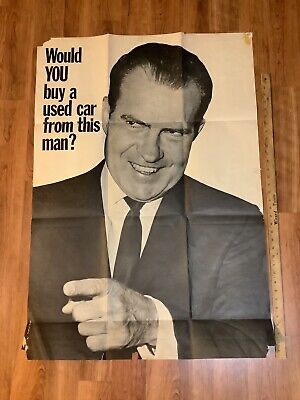
Old anti-Richard Nixon ad.
But what happens when the physical NPE and the title diverge? Two victims of now-convicted car salesman Ronald Johnson found out the hard way, according to KTTN:
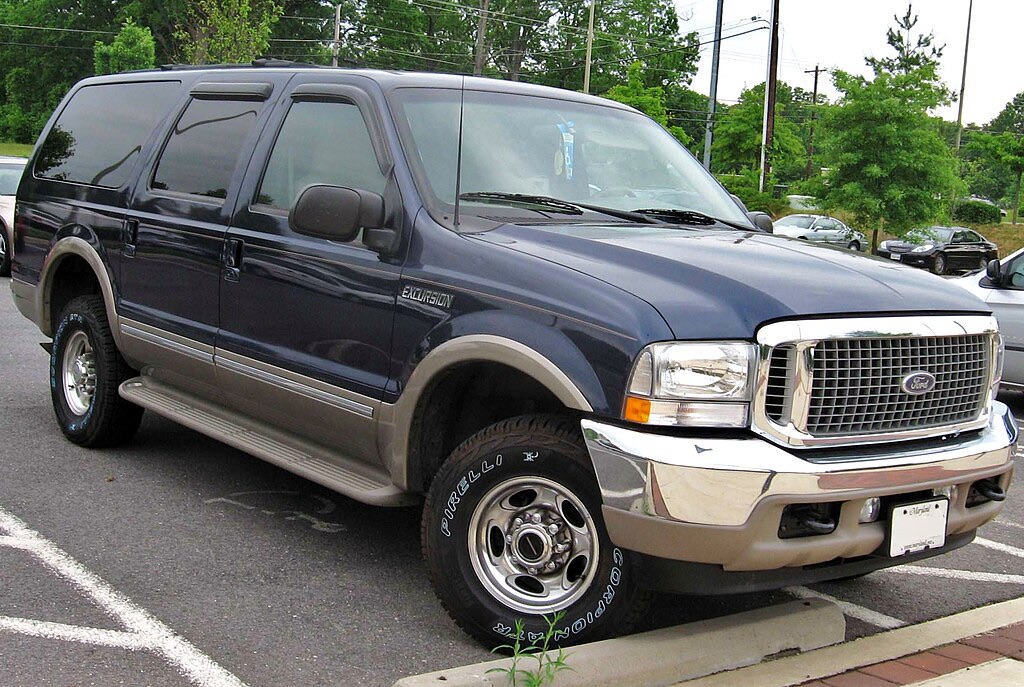
“In 2022, Johnson orchestrated a scheme that led to a Pennsylvania buyer paying $41,750 for a 2002 Ford Excursion that he had already sold to a South Dakota buyer for $45,000. The South Dakota buyer received the title, while the Pennsylvania buyer was given the SUV, leaving the latter unable to register the vehicle lawfully.”
But how do you verify that the title is real? For vehicles:
“The title should have a watermark, a raised seal, a unique vehicle identification number, a unique title number, and the owner’s information.”
And as for the owner, my regular readers know how to verify THAT.
“A property in Cairnlea, Melbourne, was identified as a safe house for…drugs, with police finding pieces of evidence — including a pair of gloves that had a man’s DNA on them. Despite only having the one source of DNA on the gloves, (former police detective Jye) Symes falsely reported that he found a woman’s DNA on the gloves.”
For the misconduct, Symes received “a full term of 3 years imprisonment with an 18-month non-parole period.”
This week has been a busy week in Bredemarket-land, including work on some of the following client projects:
Creating the first deliverable as part of a three-part series of deliverables.
Reworking that first deliverable for more precision.
Preparing to start work on the second deliverable.
Drafting a blog post for a client.
Gathering information for an email newsletter for a client.
Following up on a couple of consulting opportunities that take advantage of my identity/biometric expertise.
Creating a promotional reel based upon the grapes in my backyard. (Yet another reel. I plan to reveal it next week.)
Engaging in other promotional activities on Bredemarket’s key social media channels.
Plus I’ve been working on some non-Bredemarket deliverables and meetings with a significant time commitment.
But there’s one more Bredemarket deliverable that I haven’t mentioned—because I’m about to discuss it now.
The task
Without going into detail, a client required me to repurpose a piece of third-party government-authored (i.e. non-copyrighted) text, originally written for a particular market.
Shorten the text so it would be more attractive to the new market.
Simplify the presentation of the text to make it even more attractive to the new market.
The request was clear, and I’ve already completed the first draft of the text and am working on the second draft.
But I wanted to dive into the three steps above—not regarding this particular client writing project, but in a more general way.
Step 1: Rewrite
When you’ve worked in a lot of different industries, you learn that each industry has its own language, including things you say—and things you don’t say.
I’ll give you an example that doesn’t reflect the particular project I was working on, but does reflect why rewriting is often necessary.
When I started in biometrics, the first two industries that I wrote about were law enforcement and benefits administration.
Law enforcement’s primary purpose is to catch bad people, although sometimes it can exonerate good people. So when you’re talking about law enforcement applications, you frequently use a lot of terms that are negative in nature, such as “surveillance,” “suspect,” and “mugshot.”
Benefits administration’s primary purpose is to help good people, although sometimes it can catch bad people who steal benefits from good people. So when you’re talking about benefits administration applications, you tend toward more positive terms such as “beneficiary.” And if you take a picture of a beneficiary’s face, for heaven’s sake DON’T REFER TO THE FACIAL IMAGE AS A “MUGSHOT.”
These two examples illustrate why something originally written for “market 1” must often be rewritten for “market 2.”
But sometimes a simple rewrite isn’t enough.
Step 2: Shorten
Now I don’t play in the B2C market in which crisp text is extremely necessary. But it’s needed in the various B2G and B2B markets also—some more than others.
If you are writing for more scientific markets, your readers are more accustomed to reading long, academic, “Sage”-like blocks of text.
But if you are writing for other markets, such as hospitality, your readers not only don’t want to read long blocks of text, but actively despise it.
You need to “get to the point.”
Tim Conway (Sr.), as repeatedly played during Jim Healy’s old radio show. Sourced from the Jim Healy Tribute Site.
In my particular project, “market 1” was one of those markets that valued long-windedness, while “market 2” clearly didn’t. So I had to cut the text down significantly, using the same techniques that I use when rewriting my “draft 0.5” (which a client NEVER sees) to my “draft 1” (which I turn over to the client).
But sometimes a simple shorten isn’t enough.
Step 3: Simplify
If you know me, you know I’m not graphically inclined.
Someday I will reach this level of graphic creativity. Originally created by Jleedev using Inkscape and GIMP. Redrawn as SVG by Ben Liblit using Inkscape. – Own work, Public Domain, link.
But I still pay attention to the presentation of my words.
Remember those long blocks of text that I mentioned earlier? One way to break them up is to use bullets.
Bullets break up long blocks of text into manageable chunks.
Bullets are easier to read.
So your reader will be very happy.
But as I was editing this particular piece of content, sometimes I ran into long lists of bullets, which weren’t really conducive to the reading experience.
Question
Answer
What does this mean?
Why are long lists of bullets bad?
Because with enough repetition, they’re just as bad as long blocks of text.
Your readers will tune you out.
How can you format long lists of bullets into something easier to read?
One way is to convert the bullets into a table with separate entries.
Your readers will enjoy a more attractive presentation.
What do tables do for your reader?
They arrange the content in two dimensions rather than one.
The readers’ eyes move in two directions, rather than just one.
Hey, wait a minute…
Yeah, I just plugged my seven questions again by intentionally using the first three: why, how, and what.
You can go here to download the e-book “Seven Questions Your Content Creator Should Ask You.”
I don’t have the skill to make WordPress tables look as attractive as Microsoft Word tables. But even this table breaks up the monotony of paragraphs and lists, don’t you think?
So what happened?
After I had moved through the three steps of rewriting, shortening, and simplifying the original content, I had a repurposed piece of content that was much more attractive to the “hungry people” (target audience) who were going to read it.
These people wouldn’t fall asleep while reading the content, and they wouldn’t be offended by some word that didn’t apply to them (such as “mugshot”).
So don’t be afraid to repurpose—even for a completely different market.
I do it all the time.
Look at two of my recent reels. Note the differences. But note the similarities.
The identity/biometrics version of the reel.
The Inland Empire version of the same reel.
So which of Bredemarket’s markets do you think will receive the “grapes” reel?