Identity Market Evolution

(Imagen 4)

(Part of the biometric product marketing expert series)

I previously promised that I’d discuss why Integrated Biometrics felt the need to introduce IB360 for its partners.

Integrated Biometrics has identified four evolutionary changes in the identity market that prompt the need for such a solution.

I’m going to limit my thoughts to two of the four changes that Integrated Biometrics mentioned.

Decentralized systems

When I started in the biometrics industry in 1994, an automated fingerprint identification system (AFIS) was usually a centralized system. Tenprint and latent examiners at the state capital (there was no federal IAFIS back then) would work in buildings at or near a huge minicomputer that held the state’s fingerprint records. Perhaps there may have been a few remote tenprint and latent workstations connected by modem, and perhaps there were some livescan stations scattered around, but for the most part these client/server systems had a single server in a state computer room. (Well, except for the Western Identification Network, but WIN was ahead of its time.)

Fast forward 30 years, and while this model may work in the United States, it may not work elsewhere.

What if you don’t have internet or cellular communications? (Yes, cellular. Modern edge devices are a topic addressed in the Integrated Biometrics article that I won’t go into here.)

Or what if the communications are so incredibly slow that it would take forever to submit a search to the capital city, and return results to the originator?

This is where decentralized systems come into play. Rather than requiring everyone to ping the same central hub, the biometric database is distributed and synchronized among multiple servers in multiple locations.

Or maybe you’re getting ahead of me here and realizing that “servers” is too limiting. What if you could put all or part of a biometric database on your smartphone, so you can search a captured biometric against a database immediately without waiting for network communication time?

Such decentralized systems were impossible in 1994, but they are certainly possible today. And IB360 lets partners build their own biometric systems with decentralization and synchronization.

Speaking of building…

Demand for speed

As I mentioned, I’ve been in the biometric industry since 1994, and although my early years were spent in a pre-contract proposals role, I’ve seen enough post-contract deployments to know that they take a long time. Whether you were dealing with Printrak, NEC, Sagem Morpho, or the upstart Cogent, it would take many months if not years to deploy a fingerprint system.

  • For the most part, this is still true today with “pre-made” systems from NEC, IDEMIA, Thales, and the others.
  • And it’s also true if you decide to deploy your own “custom-built” fingerprint or biometric system from scratch.

Either way, there is a lot of engineering, integration, and orchestration that must take place before a system is deployed. You can’t take an AFIS for Bullhead City, Arizona and deploy it in Anaheim, California…or the state of Tennessee…or the nation of Switzerland. You need to perform months of tailoring/configuration first.

Integrated Biometrics asserts that waiting years for a biometric system is far too long.

Other changes

I’ll let you read the Integrated Biometrics article to learn about the other two evolutionary changes: more powerful hardware (I’ve alluded to this), and a myriad of use cases.

All of these changes have impacted the biometric market, and prompted Integrated Biometrics to introduce IB360. To read about this modular software suite and its benefits, visit the IB360 product page.

Build Your Own (Integrated) Biometrics with IB360°

(Imagen 4. A slight hallucination.)

Now it can be told.

Integrated Biometrics made an announcement earlier today.

But not a hardware announcement about some new fingerprint or palm print scanner named after a 1970s crime fighter.

Book ’em, Danno! By CBS Television – eBay item photo front photo back, Public Domain, https://commons.wikimedia.org/w/index.php?curid=19674714.

A software announcement.

I’ve discussed Integrated Biometrics multiple times in the Bredemarket blog over the last five years. Sometimes in terms of hardware, such as Integrated Biometrics’ use of the RepelFlex MBED on its (then) fingerprint readers. Sometimes in terms of (then) cutting-edge software that captured fingerprints using a standard smartphone camera.

But the company’s newest announcement about the availability of IB360° is something else entirely.

Skipping the “leading provider” stuff, we get to this:

“Integrated Biometrics (IB)…formally announced today the launch of IB360, transforming the speed and cost to deploy identity systems. The IB360 platform is a low-code toolset of SDK-based software modules that allows our partners  and integrators to more efficiently create biometric identity-based solutions with minimal development cycles.”

Hence the “build your own biometrics” tagline.

But why do partners and integrators need IB360?

I’ll cover that in a future post.

Your Product Marketing Must Address as Many Target Audiences as A Las Vegas Buffet

Messaging. It’s what B2B product marketers do. And it’s also what proposal professional professionals do, as we shall see. 

But even the simplest B2B product suffers with one-dimensional messaging.

Why? Because even simple products often require many types of people to get involved in the purchasing cycle.

Marketers often talk about target audiences. I personally believe that term doesn’t describe the concept properly, so I prefer to refer to hungry people.

Which brings us to the Las Vegas buffet.

Variety for hungry people

Las Vegas is a destination visited by over 40 million people per year from all over the world. And the casino hotels know that they’re hungry for food, and they hope the hungry people will stay on property.

So do they serve Caesars Burgers?

Um, no. 40 million people don’t eat the same thing.

This becomes very clear if you visit the Bacchanal Buffet at Caesars Palace, with over 250 items prepared in 10 kitchens.

“From Roman-style pizza to Carne Asada Tacos inspired by the food trucks of L. A., there’s something for everyone. Find a world of flavor at our nine live-action cooking stations. Indulge in originals like slow-cooked prime rib, smoked beef brisket, crab, and wood-fired pizza. Or try something different, like whole Ahi Tuna Poke, roasted duck, or Singaporean Blue Crab and seasonal agua frescas.”

(Imagen 4)

There is literally something for everyone. And the hungry person salivating for Ahi Tuna Poke doesn’t care about the beef brisket.

Which brings us to local police automated fingerprint identification system (AFIS) proposals.

Variety for hungry people

If you had asked me in September 1994 (before I started at Printrak in October) the target audience for local police AFIS, I would have replied, “fingerprint people.”

That answer would be incorrect.

Tenprint and latent people 

Because, even if you limit things to the criminal AFIS world, there are (at least) two types of fingerprint people: tenprint examiners, and latent examiners. I asked my buddy Bredebot to summarize the stereotypical differences between the two. Here is some of what he said:

“‘Assembly line‘ comparisons: Because tenprint comparisons use high-quality, known impressions taken under controlled conditions, their work can be automated and is often perceived as a high-volume, less complex task. This is in contrast to the specialized analysis required for latent prints.

“Artistic and subjective: Because latent prints are often smudged, distorted, and incomplete, examiners must make subjective judgments about their suitability for comparison. This has led to the criticism that the process is more of an art than a science.”

Bredebot has never attended an International Association for Identification conference, but I have. Many many years ago I attended a session on tenprint examiner certification. Latent examiners had this way cool certification and some people thought that more tenprint examiners should participate in their way cool certification program. As I recall, this meeting way heavily attended…by latent folks. Even today, the number of Certified Latent Print Examiners (CLPEs) is far greater than the number of Certified Tenprint Examiners (CTPEs).

Other people

But you can’t procure an AFIS by talking to tenprint and latent people alone.

As I noted years ago, other people get involved in a local police AFIS procurement, using Ontario, California as an example:

(Imagen 4)
  • The field investigators who run across biometric evidence at the scene of a crime, such as a knife with a fingerprint on it or a video feed showing someone breaking into a liquor store.
  • The information technologies (IT) people who are responsible for ensuring that Ontario, California’s biometric data is sent to San Bernardino County, the state of California, perhaps other systems such as the Western Identification Network, and the Federal Bureau of Investigation. 
  • The purchasing agent who has to make sure that all of Ontario’s purchases comply with purchasing laws and regulations. 
  • The privacy advocate who needs to ensure that the biometric data complies with state and national privacy laws.
  • The mayor (still Paul Leon as I write this), who has to deal with angry citizens asking why their catalytic converters are being stolen from their vehicles, and demanding to know what the mayor is doing about it. 
  • Probably a dozen other stakeholders that I haven’t talked about yet, but who are influenced by the city’s purchasing decision.

Feeding the hungry people 

So even a relatively simple B2B product has multiple target audiences.

Should product marketers apply the same one-dimensional messaging to all of them?

Um, no.

If you did that, purchasing agents would fall asleep at mentions of “level 3 detail,” while latent examiners would abandon their usual attention to detail when confronted by privacy references to the California Information Practices Act of 1977. (The CCPA, CPRA, and CPPA apply to private entities.)

So, whether you like it or not, you need separate messaging for each of your categories of hungry people.

(Imagen 4)

One time, as part of an account-based marketing effort, I had to construct a multi-variable messaging matrix…for a product that is arguably simpler than an AFIS.

And yes, I used Microsoft Excel.

And I can use my mad Excel skillz for you also, if your company needs content, proposal, or analysis assistance in your technology product marketing operations. Contact Bredemarket at https://bredemarket.com/mark/.

Content for tech marketers.

And proposal professional professionals, read this.

Revisiting Friction Ridge

(Imagen 4)

(Part of the biometric product marketing expert series)

Due to renewed interest in my blog post on “Friction Ridge,” and its related Substack post, I’ve ventured back to the ridge.

Friction ridge, featuring Ricky Nelson.

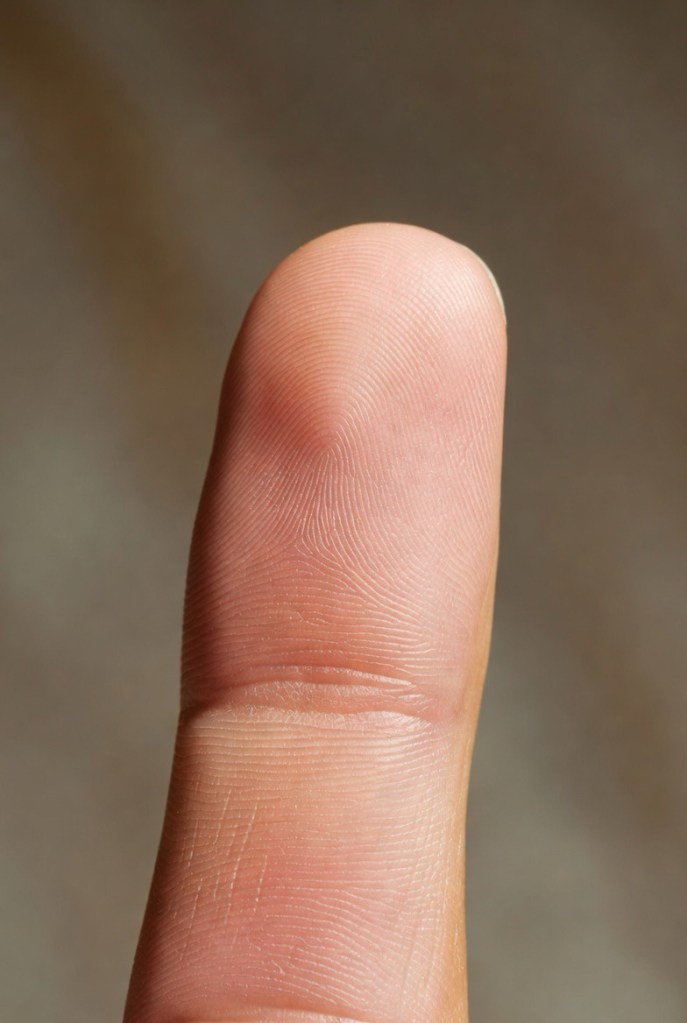
If you missed my May writings, the friction ridges on fingerprints, palm prints, and elsewhere are used for everything from solving crimes to protecting smartphones.

If your biometric company offers a product that harnesses the power of friction ridges to identify people…do your prospects know about how your solution benefits them?

If your company is keeping quiet about your friction ridge solutions, let Bredemarket help you find your voice and spill your secrets to your buying prospects. 

Content for tech marketers.

What is a Fingerprint Ridge Ending?

(Image from NIST)

(Part of the biometric product marketing expert series)

If you hear a fingerprint person discussing a “ridge ending,” the definition is pretty simple.

“This minutia illustrates an abrupt end to a continuous ridge path.”

And if you think of fingerprint ridges as black lines on a white background, then a ridge ending is the exact opposite of a bifurcation.

And I wrote this post to prove…a point.

What is a Fingerprint Bifurcation?

(Image from NIST)

(Part of the biometric product marketing expert series)

If you hear a fingerprint person discussing a “bifurcation,” the definition is pretty simple.

“The point at which one friction ridge divides into two friction ridges.”

And if you think of fingerprint ridges as black lines on a white background, then a bifurcation is the exact opposite of a ridge ending.

The fingerprint image is from an appendix to the National Institute of Standards and Technology’s 2003 Fingerprint Vendor Technology Evaluation (FpVTE).

Yeah, THAT FpVTE. I remember it well from my days at Motorola…not a “top 3” vendor.

Imagen 4.

Worries About the Certified Communist Products List

(Imagen 4)

(Part of the biometric product marketing expert series)

How many of you have heard of the Certified Products List (CPL)?

The CPL’s vendor coverage

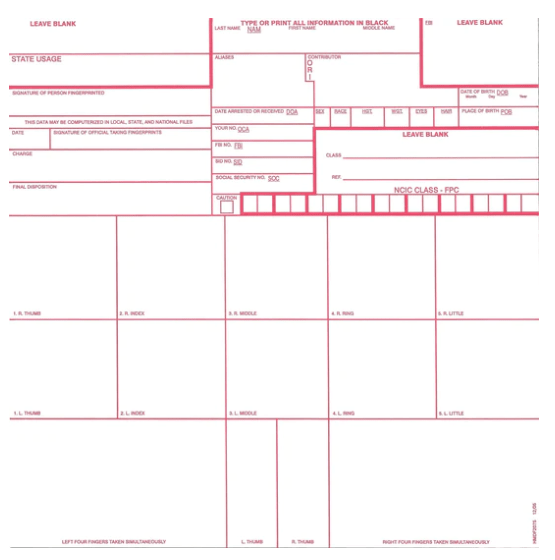
This list, part of the FBI’s Biometric Specifications website (FBI Biospecs), contains fingerprint card printers, fingerprint card scan systems, identification flats systems, live scan systems, mobile ID devices, and other products. Presence on the CPL indicates that the product complies with a relevant image quality specification such as Appendix F of the Electronic Biometric Transmission Specification.

The Certified Products List has existed since the 1990s and includes a number of products with which I am familiar. These products come from companies past and present, including 3M Cogent, Aware, Biometrics4All, Cross Match, DataWorks Plus, IDEMIA Identity & Security France, Identicator, Mentalix, Morpho, Motorola, NEC Technologies, Printrak, Sagem Defense Securite, Thales, and many others.

As of June 26, 2025, it also references companies such as Shenzhen Interface Cognition Technology Co., Ltd. and Shenzhen Zhi Ang Science and Technology Co., Ltd.

A strongly worded letter

Those and other listings caused heartburn for the bipartisan Members of the U.S. House of Representatives Select Committee on the Chinese Communist Party.

So they sent a strongly worded letter.

“We write to respectfully urge the FBI to put an end to its ongoing certification of products from Chinese military-linked and surveillance companies—including companies blacklisted or red-flagged by the U.S. government—that could be used to spy on Americans, strengthen the repressive surveillance state of the People’s Republic of China (PRC), and otherwise threaten U.S. national security.”

Interestingly enough, they make a big deal of Hikvision products on the list, but I searched the CPL multiple times and found no Hikvision products.

The CPL’s purpose

And it’s important to note the FBI’s own caveat about the CPL:

The Certified Product List (CPL) provides users with a list of products that have been tested and are in compliance with Next Generation Identification image quality specifications (IQS) regarding the capture of friction ridge images. Specifications and standards other than image quality may still need to be met. Appearance on the CPL is not, and should not be construed as, an FBI endorsement, nor should it be relied upon for any requirement beyond IQS. Users should contact their State CJIS Systems Officer (CSO) or Information Security Officer (ISO) to ensure compliance with the necessary policies and/or guidelines.

In other words, the ONLY purpose of the CPL is to indicate whether the products in question meet technology standards. It has nothing to do with export controls or any other criteria that any law enforcement agency needs to follow when buying a product.

What about the U.S. Department of Commerce?

But the FBI isn’t the only agency “promoting” Chinese biometrics.

Wait until the Select Committee discovers the Department of Commerce’s NIST FRTE lists, including the FRTE 1:1 and FRTE 1:N lists. The tops of these lists (previously known as FRVT) include many Chinese companies.

And actually, the FRTE testing includes facial recognition products that inspired U.S. export bans. Fingerprint devices are harder to use to repress people.

What next?

What happens if the concern extends beyond China, to products produced in France and products produced in Canada?

Regarding the strongly worded letter, Biometric Update added one detail:

“As of this writing, the FBI has not issued a public response. Whether the bureau will move to decertify the flagged companies or push back on the committee’s recommendations remains to be seen. But with multiple national security statutes already in place, and Congress signaling a willingness to legislate further, the days of quiet certification for foreign adversary-linked tech firms may be numbered.”