“Generative AI promised to relieve humans of the tedious, mechanical work — freeing them to be more strategic, more creative, more human.
“The reality? We’ve wrapped our rationalizations around this new concept called “humans in the loop.”
“This often means marketers are demoted to glorified spellcheckers and fact-checkers for machine output. Not creators. Not strategists. Just custodians of content they never had a hand in shaping.
Perhaps Rose’s thoughts are wishful thinking on the part of carbon-based marketers.
But if the “humans in the loop” thought persists…isn’t everyone using the same undifferentiated loop? When everyone yells “we use AI,” no one is differentiated. And no, it makes no difference with AI flavor of the week you’re using, since they all train on data. Human data.
And if the humans at all the companies are imprisoned by their identical loops…who has the competitive advantage? No one.
Except for those that use humans…especially humans who have been around for a while and remember this. If you don’t have a full five minutes, skip right to the three-minute mark.
Whether you’re a marketer, a biometric expert, a technologist, or just someone scrolling the webs, you can feel a variety of emotions after reading a Bredemarket blog post.
Maybe amused.
Maybe informed,
Maybe empowered.
But some will experience more powerful emotions.
For a targeted few who find themselves paralyzed, maybe afraid. Afraid that your competitors will steal your prospects unless you act.
Or for those targeted few who despise powerlessness and want to act, maybe hungry. Hungry to get your product’s benefits to your prospects so they convert.
I have to be honest. Some of the people who are inspired to act are perfectly capable of acting on their own. Because they’re not complete unknowns.
But others can use the help of an outside consultant such as Bredemarket.
Content, proposals, analysis. I can help with all of them.
Some technical marketers are expert at spinning soft fluffy stories about how their AI-powered toilet paper can cure cancer…which can be very persuasive as long as the prospects don’t ask any questions.
For example, let’s say you’re telling a Chick-fil-A in Kettering, Ohio that you’ll keep 17 year olds out of their restaurant. Are you ready when the prospect asks, “How do you KNOW that the person without ID is 17 years and 359 days old, and is not 18?”
Or let’s say you’re telling a state voter agency that you’ll enforce voter ID laws. Are you ready when the prospect asks, “How do you KNOW that the voter ID is real and not fake? Or that it is fake and not real?”
Be prepared to answer the tough questions. Expert testimonials. Independent assessments of your product’s accuracy. Customer case studies.
Analyze your product’s weaknesses. (And the threats, if you’re a SWOT groupie.)
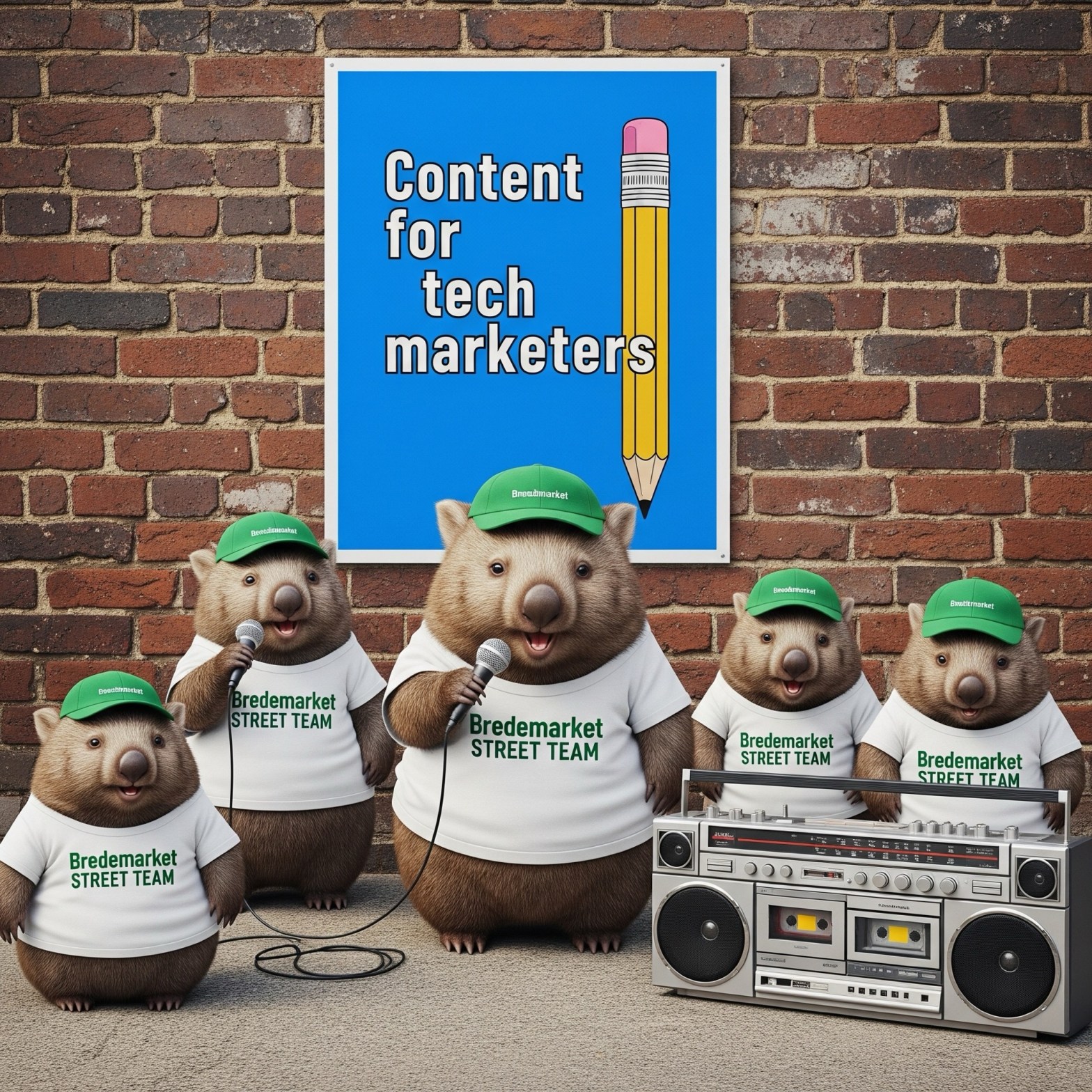
I’m asking for a connection favor from the people who read this, my street team.
The ask
Here is the ask:
If you know a technology Chief Marketing Officer or other leader…
…who faces challenges in content, proposals, or analysis…
…and can use consulting help:
Ask your marketing leader to visit https://bredemarket.com/mark/ to learn about Bredemarket’s marketing and writing services:
The why, how, what, and who about Bredemarket’s ability to drive content results.
What I can do for your marketing leader.
Who uses my services; I’ve worked in many technology industries.
My collaborative process with Bredemarket’s clients.
The connection
If they like what they see, they can connect with me by booking a free 30 minute content needs assessment meeting with me, right from the https://bredemarket.com/mark/ page.
The reward
Thank you, street team. No monetary commission, but I can give you a shout out and a personal AI-generated wildebeest picture on Bredemarket’s blog and social media empire. Yes, even TikTok (if it’s still legal).
Actually, I already owe a shout out to Roger Morrison, who has supported Bredemarket for years and has supported me personally for decades. Roger offers extensive experience in multiple biometric modalities (finger, face, Iris, voice), identity credentials, and broadband and other technologies. Despite attending the wrong high school in Arlington, Virginia (should have gone to Wakefield), he is very knowledgeable and very supportive. Warning: Roger is NOT bland or generic.
I’m revisiting the “we have no competition” topic, because I have another point to make. If you claim your firm’s product has no competition because of its robust unmatched feature set, why are you still broke?
Take this example: the Uneek Combination Oven-Microwave.
A young woman left her family home and moved into her own apartment in the city.
A small studio apartment.
Her apartment was a very tiny studio apartment. Because of the lack of space, the woman equipped the apartment’s small kitchen area with a space-saving appliance that was a combination oven and microwave.
This was truly a product that had no competition, because its feature set was unequaled by most cooking appliances on the market. Everything else was either an oven or a microwave, not both.
The Uneek Combination Oven-Microwave.
So by logic this product should have commanded a 99% market share because of its extensive feature set, right?
Yet it didn’t.
Labor Day sale soon.
Because this product actually had competitors.
Stand-alone ovens.
Stand-alone microwaves.
Takeout food which ensured that you needed neither an oven nor a microwave.
And cold food.
No need to cook tonight.
The biggest competitor against ANY product is simply buying nothing at all.
After all, buying nothing at all has by far the lowest price.
I have positioned Bredemarket so I can fill the gaps in a Chief Marketing Officer’s existing content plan, or a Chief Revenue Officer’s proposal plan, or a Chief Strategy Officer’s existing analysis plan.
But what if you don’t have a plan?
Bredemarket can help you too.
This post describes how I can plug into your existing plan, or how I can help you create a plan if you don’t have one.
But first let’s dispense with the theory of how to properly do things, because it’s silly.
What theory says
If you read LinkedIn for any length of time, you will run across content marketers and copywriters and other Professional Content Experts.
These 17x certified PCEs are all too willing to tell you The Correct Way For Companies To Engage With Writing Contractors.
Because the way your company engages with contractors I s completely wrong.
Here is The Correct Way:
“When engaging with a contractor, you must provide the contractor with a detailed content brief that answers all 42 questions your contractor will ask or may ask. Failure to do this brands you as a failed substandard company.”
Bredemarket rarely receives any kind of brief from my clients. Sometimes we get a paragraph. Or sometimes we just get a couple of sentences:
“A local Utah paper ran an article about how our end customer used our solution to solve world hunger. Here’s the article; get additional information from the guy quoted in the article and write a blog post about it.”
These two sentences would drive a Professional Content Expert up a wall, because they don’t answer all 42 questions.
So what?
It’s a starting point. If I were given that, I could start.
So forget the theory of The Correct Way For Companies To Engage With Writing Contractors, and just start writing (but thinking first).
If you have a plan (or at least an idea)
Many of my clients have a content, proposal, or analysis plan—or at least an idea of what they need. There are many times when I simply plug in to a client’s existing plan. Here are some examples:
One client’s CMO needed a twice-a-month series of blog posts to promote one of their company’s services. The service featured multiple facets, so I had plenty to write about. So I plugged into the existing system and wrote.
Another client needed a series of case studies to grab the attention of their prospects. Again, the client’s product addressed multiple markets, and the variety of customer case studies gave me plenty to write about. So I plugged into the existing system and wrote.
Multiple clients have asked me to manage and/or write proposals for them. Two of the clients (one being SMA) had very well-defined capture management and proposal processes. The others didn’t—I was the de facto expert in the (virtual) room—but they knew which Request for Proposal (RFP) or Request for Information (RFI) required a response. So I plugged into the existing system and wrote.
Multiple clients (mainly in the identity/biometric realm) have asked me to perform analyses. Whether they had an established analysis process or not, they knew what they wanted. So I plugged into the existing system and wrote.
So I easily completed these one-off (or twelve-off) tasks, responding to my clients’ well-defined requests.
But others face the challenge of not knowing what they want.
The beautiful thing about the seven questions is that you can not only apply them to a particular piece of content such as a blog post, but to an entire content-proposal-analysis strategy.
And here I DO mean strategy, not tactics.
There are other methods to derive a strategy, but this is as good as any.
So if you book a free meeting with me to figure out a strategy, we can work through these questions to jointly understand your company, your products, and the material you need. I haven’t the slightest idea how our conversation will progress, but perhaps I may end up asking you questions like this:
WHY do your competitors suck?
HOW do your prospects make purchasing decisions?
WHAT do your salespeople need to close deals (conversion)?
What are your GOALS to move prospects through your funnel?
You get the idea. As we talk through things, perhaps you and I will get ideas about how Bredemarket can help you.
Or maybe not. Maybe it turns out you need a web designer, or a videographer, or a demand generation expert, or an accountant.
But if we determine that Bredemarket can help you, then we can create the plan and figure out how I can best execute on the plan. A competitor analysis? A series of blog posts? We will figure it out.
Then I’ll plug into the new existing system and write.
A call to action
Your content, proposals, and analyses will presumably incorporate a call to action.
It’s no surprise that this post also has one.
Visit my “content for tech marketers” page, read about what we can do together, and book a free 30 minute content needs assessment. You can book it at the top of the page or the bottom, whatever turns you on.
But let’s move. Your competitors are already moving.
Third-party risk management (TPRM) tools take varying approaches to automated vs. manual operations.
The company SAFE addressed automation in a July 15 press release. It uses the trendy term “agentic AI” so it must shift paradigms and optimize outcomes.
After stripping out the PR fluff, here’s some of what’s left.
“[SAFE] announced the expansion of its Agentic AI strategy with the release of 12+ new autonomous agents, over the next 3 months, purpose-built for third-party risk. The next two AI agents are SnapShot and BreachWatch which help organizations proactively organize AI summaries and identify third-party breaches respectively….
“‘Legacy solutions weren’t built for risk landscape,’ said Saket Modi, CEO and co-founder of SAFE. ‘SAFE is transforming TPRM….’”
But if I could offer a marketing word of advice to TPRM firms, the “we are better than legacy TPRM firms” message has jumped the shark. EVERYONE is better than legacy TPRM firms these days; you are nothing new. No one is completely manual any more. It’s like comparing a Tesla to a bicycle. Or any basketball team to the Washington Generals.
The real question is HOW you use your automation, and how accurate your automation is. Speed alone is not enough.