Move Fast And DON’T Break Things: IK Ratings

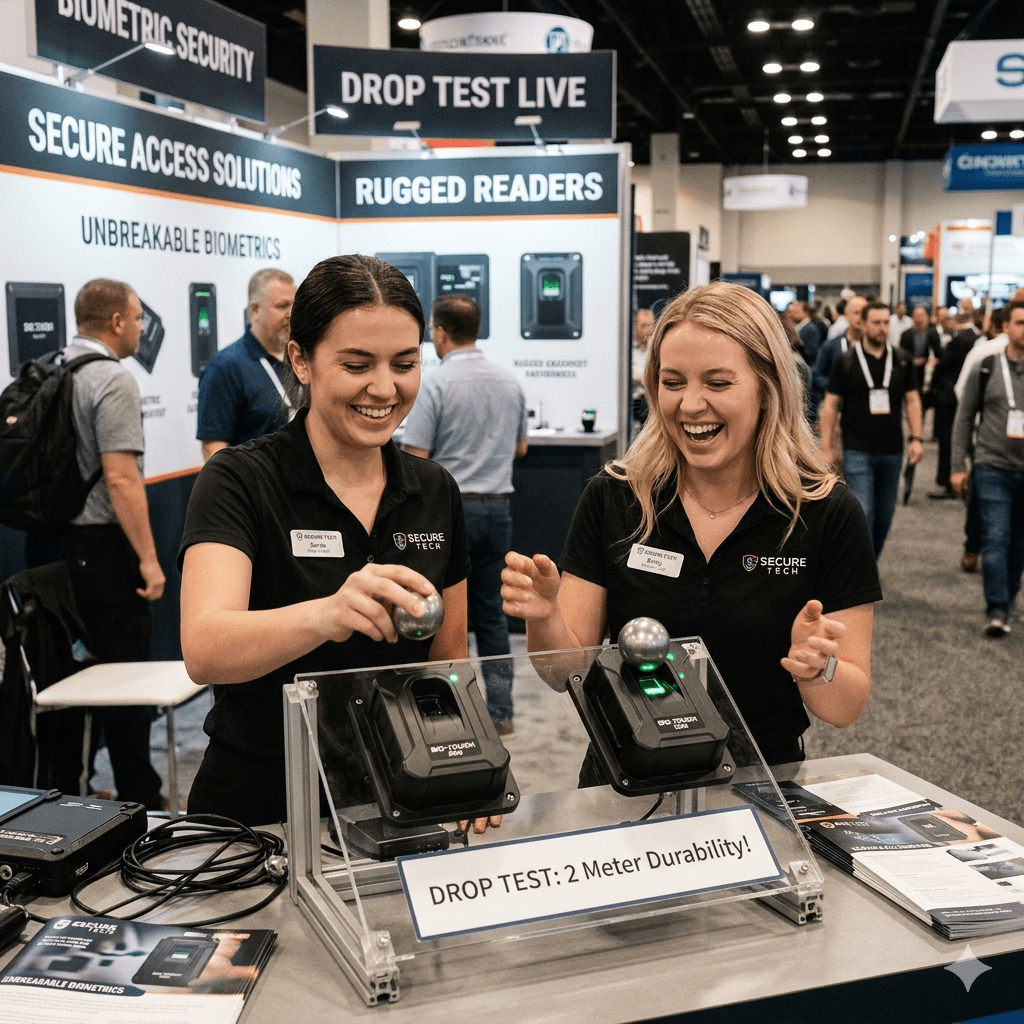
Trade shows for outdoor-grade access control devices can be fun. When I attended an ISC West conference many years ago, our booth staff occupied ourselves with dropping steel weights on biometric access control devices.

Because that’s cool.

And that’s an effective way to prove that access control devices can survive harsh environments.

Of course there’s a standard for impact resistance (IEC 62262), and Stratasys explains how the “IK” ratings work and are applied. In essence, the tests involve…dropping steel weights. It’s science, folks.

“The test apparatus includes pendulum hammers or steel spheres of different weights (from 0.25 kg to 5 kg) that strike the device with precisely measured kinetic energy.”

The impact energy is measured in joules, and the higher the joules that resist impact, the higher the IK rating. A few applications and examples:

  • Consumer-grade smartphones and tablets are usually IK04 to IK05, or 0.5 to 0.7 joules.
  • Outdoor security devices (biometric readers, cameras) and construction-grade tablets are usually IK06 to IK07, or 1-2 joules.
  • “Industrial strength” devices are usually IK08, or 5 joules. The test case: “surviving a direct hit from a 1.7 kg hammer dropped from 30 cm.”
  • “Indestructible.” Once you go to IK09-IK10, or 10-20 joules, you’re talking about the ability to “survive a 5 kg hammer dropped from 40 cm.” Military stuff. Prison stuff. If you need IK10 devices, I probably don’t want to know about it.

Now we could wish that our smartphones were IK10, but we wouldn’t want to pay the premium price for it. So we reduce our expectations to fit our budget. But not too much: putting an indoor device at a building door is false economy.


Huff + Puff, the Magic Camera Hardware Failure Correction

It was 8:48, just before an important client meeting this morning, and I was freaking out. I had scheduled the meeting in Google Meet, and I started up the session…and the right third of the camera view was obscured.

Imagen 4 re-creation. I didn’t think to take a screenshot at the time. And no, I don’t have facial hair.

I attempted various fixes:

  • I stopped Google Meet, started it again…and got the same result.
  • I logged off and logged back in again…and got the same result.
  • I restarted my computer (turn it off and turn it back on again)…and got the same result.
  • I tried Zoom…and got the same result.

Which meant that the possible problem was a hardware problem with the camera itself. Which meant a lot of hassle sending the computer in for a fix, which was especially upsetting because this was a new computer.

Bredebot proves useful

So I turned to my buddy Bredebot.

In a huddle space in an office, a smiling robot named Bredebot places his robotic arms on a wildebeest and a wombat, encouraging them to collaborate on a product marketing initiative.
Bredebot is the one in the middle.

And he wasn’t reassuring:

A black section in a laptop camera feed is most often due to a hardware issue, such as a damaged camera sensor or a problem with the ribbon cable that connects the camera to the motherboard. Software issues are less likely to cause a precise, consistent black area like this, but they’re still worth checking.

Then I began working down the checklist that Bredebot provided, beginning with the first item.

The most common and easiest issue to rule out is a physical object blocking the lens. This could be a speck of dust or debris, a stray piece of a sticker, or a misplaced privacy slider. Even a tiny particle on the lens can show up as a large black spot or area in the image.

A speck of dust? Just a simple speck of dust causing that major of an obstruction?

Not having a can of compressed air available, I used my mouth to blow on the top of the laptop screen.

The obstruction partially cleared, and now three fourths of the screen was visible.

One more blow, and my “critical hardware failure” was fixed.

What does this mean?

So some computer problems are NOT fixed by turning it off and turning it on again. Sometimes a lot of hot air is necessary.

Imagen 4.

By sheer coincidence, the Just A Band song “Huff + Puff” is on my current Spotify playlist. Nothing to do with computer video hardware, but it’s a good song.

Vanity and Inaccuracy

Yes, I perform vanity searches. 

I just searched for mentions of Bredemarket that are NOT on the Bredemarket website, and ended up on Bredemarket’s Crunchbase page.

Where I was surprised to learn the following:

“This year, Bredemarket is projected to spend $187.5K on IT, according to Aberdeen.”

Let’s just say that estimate is slightly off.