Here is one way to test the marketing of your AI product.
If your product marketing fails the “Pentium” test, Bredemarket can help.
Contact Bredemarket.

Identity/biometrics/technology marketing and writing services

Here is one way to test the marketing of your AI product.
If your product marketing fails the “Pentium” test, Bredemarket can help.
Contact Bredemarket.

(Delivery van image by Unisouth at English Wikipedia, CC BY-SA 3.0, https://commons.wikimedia.org/w/index.php?curid=3897499)
All of my Bredemarket work involves providing deliverables to clients in some way:

For all but one Bredemarket client, I provide my deliverables via email. The deliverables usually consist of items such as Microsoft Word documents, Microsoft Excel workbooks, and Portable Document Files.
Easy to email.
Except in one case.
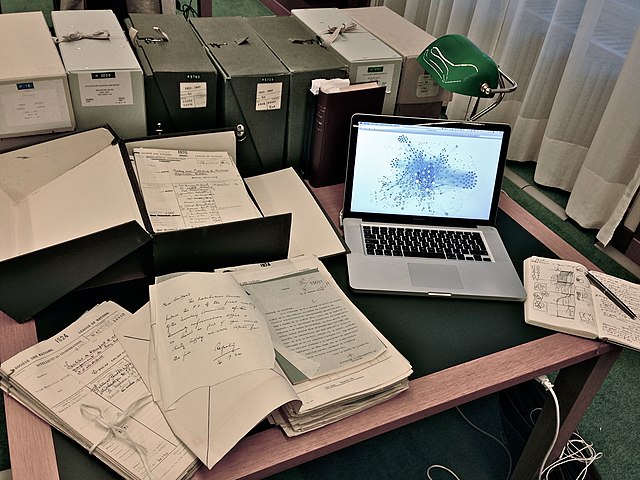
As I mentioned above, Bredemarket often performs market/competitive analyses. In fact, one of my clients likes my analyses so much that they keep on coming back for more analyses to cover different markets.
For the last three analyses for this particular client, my deliverables have consisted of the following:

In my analyses I referred to the companies’ publicly available websites to gather information on the competitor products, as well as the markets they address. (Using a made-up example, if my client provided its products to convenience stores, and a particular competitor ALSO targeted convenience stores, my client would obviously want to know this.)
But for this third analysis I didn’t just look at the websites. I also looked at the product brochures that I could download from these websites.
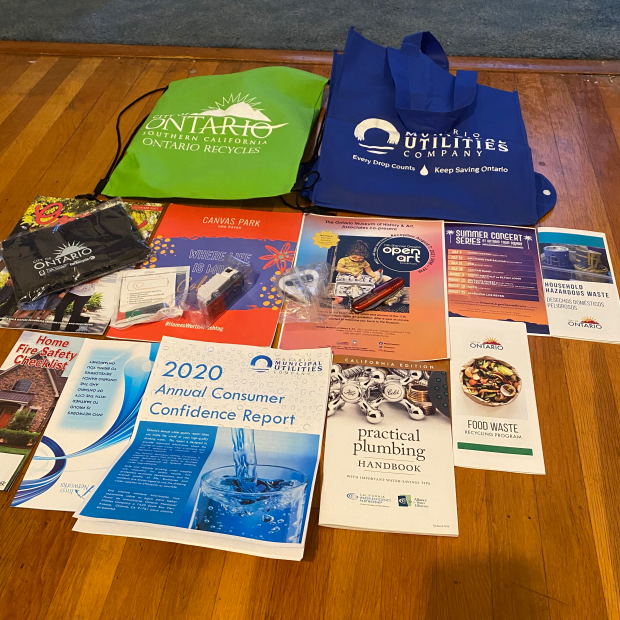
This gave me an idea.
Since I was downloading all the publicly available brochures from the various competitors, why not provide all of these brochures to my client?
It seemed like a great idea. Since I had gone through all the work to collect the brochures, might as well let my client make future use of them.
So as I wrapped up the project and prepared the deliverables for my client, I discovered that I had amassed over 100 megabytes of brochures. (That’s what happens when you analyze over 100 competitor products.)

So my idea of zipping all the brochures into a single file wouldn’t work. Even the zip file exceeded the attachment sending limits of Bredemarket’s email service provider, Google. (And probably exceeded the attachment receiving limits of my client’s email service provider.)
And if you’ve already figured out the obvious solution to my problem, bear with me. It took me several days to realize the obvious solution myself.
Anyway, I hit upon a great solution to my problem…or so I thought.
But that wasn’t a problem for me. Along with my email account, Google also provides Bredemarket with Google Drive. While the contents of my Google Drive are private to the employees of Bredemarket (all 1 of us), I can designate individual files and folders for access by selected people.
So I set up a designated folder for my client’s access only, uploaded all the deliverables including the 100+ MB zip file to the designated folder, and provided my client’s contact with access.
I then told my client that all the deliverables were in the Google Drive folder and asked the client to let me know when they were downloaded.
Which is when I encountered my second problem.
For security reasons, the client’s IT department forbids employees from accessing unauthorized Google Drives.
So I jumped back to Plan A and emailed all the files to my client except for the one 100+ MB zip file.
Now I just had to get that zip file to the client.
That’s when I recalled the Dropbox account I set up for Bredemarket some time ago.
It was a quick process to upload the single 100+ MB zip file to a designated folder in Dropbox and give my client access.
But the client isn’t allowed to access Dropbox from work either.
By the time that my client was contacting his IT department for a possible fix, I realized the solution that you the reader probably realized several paragraphs ago.

Instead of emailing one zip file, why not email multiple zip files in multiple emails, with each zip file under Google’s 25 MB limit?
So I sent six emails to my client.
This FINALLY worked.
I should have divided and conquered in the first place.
Do you want Bredemarket to send you 100 megabytes of brochures, now that I know how to do it?
More importantly, do you want Bredemarket to send you a market/competitor analysis to your specifications?
Talk to Bredemarket and discuss your needs. Book a meeting with me at calendly.com/bredemarket. Be sure to fill out the information form so I can best help you.

On June 1, I shared a little piece on Bredemarket’s social media channels, including a post on the Bredemarket Technology Firm Services page on LinkedIn.
It was an announcement from Knell Computer.
Knell Computer announced Friday that it is eliminating wi-fi capabilities from its business computer product lines.
“At Knell Computer, we strongly believe that the best work occurs in a traditional office environment,” according to Gabriel Knell, CEO. “Since modern offices are fully equipped with Ethernet cabling, wi-fi is an unnecessary expense. Removal of wi-fi allows us to sell Knell Computers at a lower price point than our competitors, providing cost savings to our customers.”
Knell will promote this innovation with an ad campaign in major city downtown business districts, where it will attract the attention of real workers.
Gabriel Knell: “If you’re an amateur who performs so-called ‘work’ at home in your shorts, rather than from a true cubicle office environment, feel free to buy wi-fi computers from our competitors. We are embarrassed to see the Knell logo in a coffee shop—or in a converted bedroom.”
In a related announcement, Knell will incorporate technology that “red flags” the use of any Knell computer in a residential zone.

For those of you who don’t know much about Knell Computer, LinkedIn’s helpful AI feature provided contextual detail, including answers to critical questions:
All of these answers, sourced from information found in LinkedIn and on the Internet, were undoubtedly helpful.
But LinkedIn AI appears to have missed one teeny tiny thing.

Since I’m not engaged in full-time product marketing (although I perform some product marketing activities for my Bredemarket clients), I sometimes spend my time writing other things.
Like fake press releases for fake products from fake companies.
But I think that most of you figured out that Knell Computer and its head Gabriel Knell are based upon Dell Computer and its head Michael Dell.
(Note the “angelic” naming here. And no, I’m not naming anything after Lucifer.)
And most of you know why Dell Computer was suddenly in the news in May, and actually a little before that, as this Forbes article indicates.

Dell’s new remote-work policy will categorize its workers into two main groups: remote and hybrid.
Hybrid workers must agree to come into an “approved” office at least 39 days each quarter. This is roughly the equivalent of three days per week. Remote workers do not have to come into an approved office at all. However, remote workers aren’t eligible for promotion or to change jobs within the company.
According to the Register, Dell confirmed the 39 days/quarter requirement, and explained why it believed it was important.
In a statement, a Dell spokesperson told The Register, “We shared with team members our updated hybrid work policy. Team members in hybrid roles will be onsite at a Dell Technologies office at least 39 days per quarter (on average three days a week). In today’s global technology revolution, we believe in-person connections paired with a flexible approach are critical to drive innovation and value differentiation.”
But the Dell statement didn’t say HOW Dell would know who was in the office. The Register supplied that additional detail; Dell was reported to use tracking and color coding.
Starting next Monday, May 13, the enterprise hardware slinger plans to make weekly site visit data from its badge tracking available to employees through the corporation’s human capital management software…
Let me just pause right there. Any time that you read something about “human capital management,” your antennae should go up.
But let’s get back to how Dell is managing its carbon-based capital.
…and to give them color-coded ratings that summarize their status. Those ratings are:
Blue flag indicates “consistent onsite presence”
Green flag indicates “regular onsite presence”
Yellow flag indicates “some onsite presence”
Red flag indicates “limited onsite presence”

So that was the situation as of June 1 when Knell Computer issued its press release, complete with “red flag” capability.
I’m forced to confess that Knell Computer’s product marketing efforts didn’t really make an impact. (I KNEW I should have included the press release in the Bredemarket blog. Better late than never.)
But Dell Computer’s efforts truly impacted its employees…but not in the way that Dell Computer wanted.
No, not the Steve Taylor song.
The Dell human capital management method that ranked hybrid employees based upon their willingness to work in the office.
A few weeks after Knell Computer’s product marketing effort, stories began to emerge about what was happening at the real Dell. Here’s part of what Ars Technica said on June 20:
Dell announced a new return-to-office initiative earlier this year. In the new plan, workers had to classify themselves as remote or hybrid.
Those who classified themselves as hybrid are subject to a tracking system….
Alternatively, by classifying themselves as remote, workers agree they can no longer be promoted or hired into new roles within the company.
Business Insider claims it has seen internal Dell tracking data that reveals nearly 50 percent of the workforce opted to accept the consequences of staying remote, undermining Dell’s plan to restore its in-office culture.
“But wait!” you’re saying. “So many people are willing to forgo promotion at Dell, or even to apply to new positions at Dell?”
Yes. Because here’s a dirty little secret:
Dell employees can leave Dell and work for other companies.
Granted many other companies aren’t remote-friendly either (believe me, I know), but those that are have an opportunity to scoop up Dell’s best and brightest.
And as the Dell workers leave, this provides an opportunity for yours truly. After all, I’d be happy to report to Dell’s office in Ontario, California. So I went to see what opportunities I’d have.
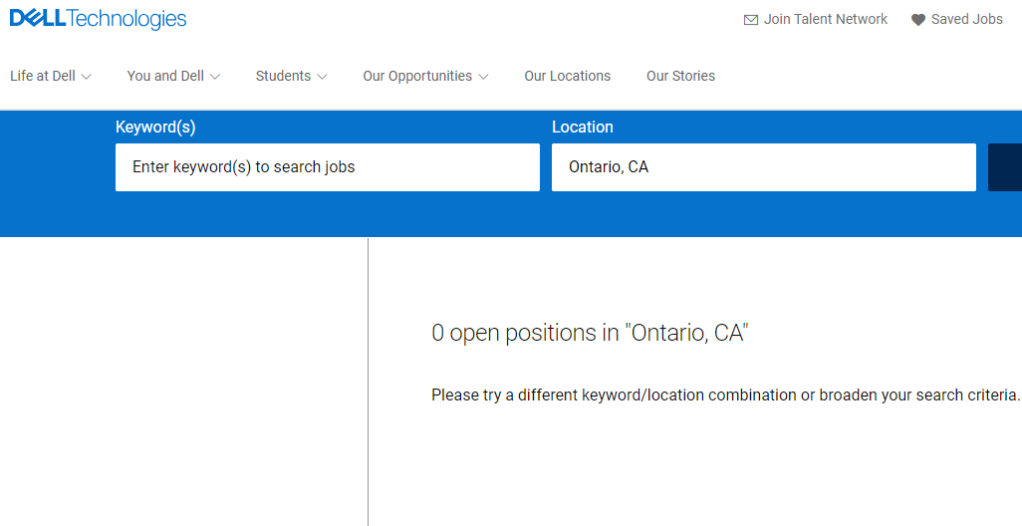
It turns out that Ontario, California is not one of Dell’s officially approved hybrid work locations. I’d have to drive to Utah, Texas, or Oklahoma three days a week.
But hey, I’m not the only marketer affected by Dell’s work policies. Silicon Valley marketers can’t work hybrid at Dell either.
I’ll continue to monitor how this plays out. Perhaps Knell Computer may issue a second press release.
Which LinkedIn AI will take as the truth.
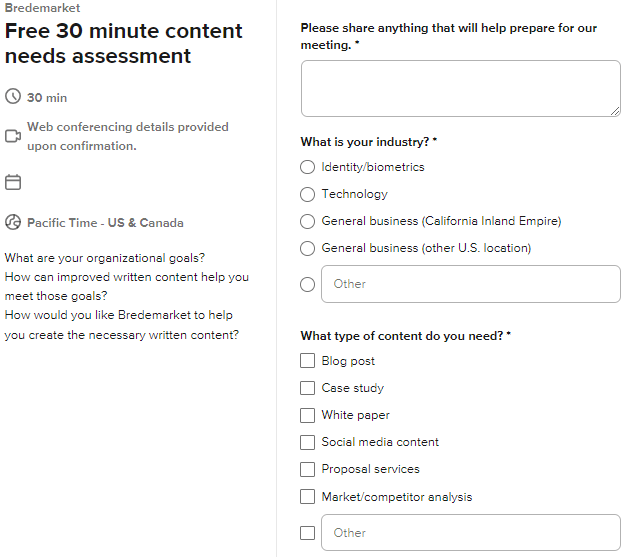
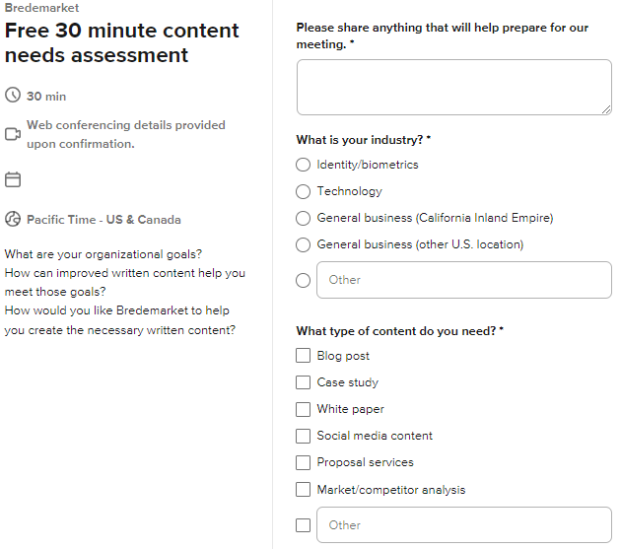
If you book a free 30 minute meeting with Bredemarket, you’ll now find an additional option in the “What Type of Content Do You Need?” section: Market/competitor analysis. I’ve done these for years, but never added the option to the form.
My analyses ONLY use publicly available information that is NOT subject to NDA. So you won’t get access to the analyses I’ve performed for other clients, and they won’t get access to the analysis I prepare for you.
While I primarily provide these analyses in the identity/biometrics industry, I’m open to discussing analysis needs in other industries.
Book a meeting to discuss your content needs.

(Part of the biometric product marketing expert series)
Yes, I know the differences between the various factors of authentication.
Let me focus on two of the factors.
There’s a very clear distinction between these two factors of authentication: “something you are” for people, and “something you have” for things.
But what happens when we treat the things as beings?
Who, or what, possesses identity?
I’ve spent a decade working with automatic license plate recognitrion (ALPR), sometimes known as automatic number plate recognition (ANPR).

Actually more than a decade, since my car’s picture was taken in Montclair, California a couple of decades ago doing something it shouldn’t have been doing. I ended up in traffic school for that one.

Now license plate recognition isn’t that reliable of an identifier, since within a minute I can remove a license plate from a vehicle and substitute another one in its place. However, it’s deemed to be reliable enough that it is used to identify who a car is.
Note my intentional use of the word “who” in the sentence above.
These days, it’s theoretically possible (where legally allowed) to identify the license plate of the car AND identify the face of the person driving the car.
But you still have this strange merger of who and what in which the non-human characteristics of an entity are used to identify the entity.
What you are.
But that’s nothing compared to what’s emerged over the past few years.
When the predecessors to today’s Internet were conceived in the 1960s, they were intended as a way for people to communicate with each other electronically.
And for decades the Internet continued to operate this way.
Until the Internet of Things (IoT) became more and more prominent.

How prominent? The Hacker News explains:
Application programming interfaces (APIs) are the connective tissue behind digital modernization, helping applications and databases exchange data more effectively. The State of API Security in 2024 Report from Imperva, a Thales company, found that the majority of internet traffic (71%) in 2023 was API calls.
Couple this with the increasing use of chatbots and other artificial intelligence bots to generate content, and the result is that when you are communicating with someone on the Internet, there is often no “who.” There’s a “what.”
What you are.
Between the cars and the bots, there’s a lot going on.
There are numerous legal and technical ramifications, but I want to concentrate on the higher meaning of all this. I’ve spent 29 years professionally devoted to the identification of who people are, but this focus on people is undergoing a seismic change.

The science fiction stories of the past, including TV shows such as Knight Rider and its car KITT, are becoming the present as we interact with automobiles, refrigerators, and other things. None of them have true sentience, but it doesn’t matter because they have the power to do things.

In the meantime, the identification industry not only has to identify people, but also identify things.
And it’s becoming more crucial that we do so, and do it accurately.

(Part of the biometric product marketing expert series)
I recently read a web page (I won’t name the site) that included the following text:
…fingerprints, palm prints, latents, faces, and irises at 500 or 1000 ppi.
Which is partially correct.
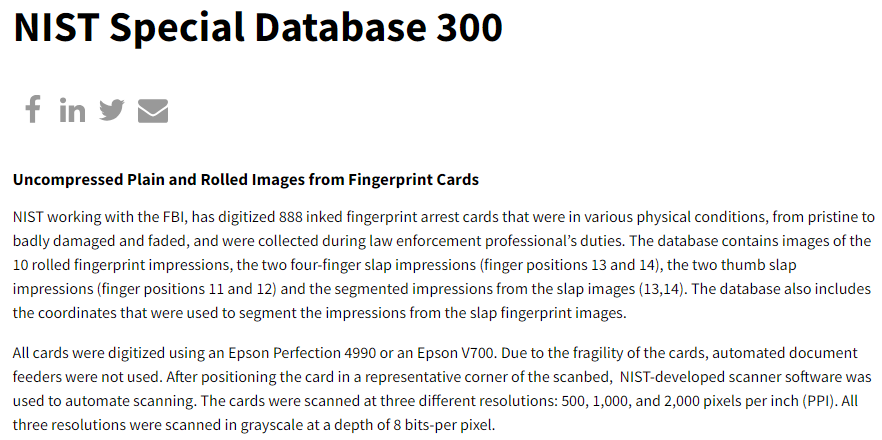
Yes, fingerprints, palm prints, and latent prints are measured in pixels per inch (ppi), with older systems capturing 500 ppi images, some newer images capturing 1,000 ppi images, and other systems capturing 2,000 ppi or larger images. 2,000 ppi resolution is used in some images in NIST Special Database 300 because why not?
I don’t know of any latent fingerprint examiner who is capturing 4,000 ppi friction ridge prints, but I bet that someone out there is doing it.
But faces and irises are not measured in pixels per inch.
Why not?
Because, at least until recently, friction ridge impressions were captured differently than faces and irises.
Obviously things have changed in the friction ridge world over the last decade, as more companies support contactless methods of fingerprint capture, either through dedicated devices or standard smartphone cameras.
And that has caused issues for organizations such as the U.S. Federal Bureau of Investigation, who have very deep concerns about how contactless fingerprints will function in their current contact-based systems.
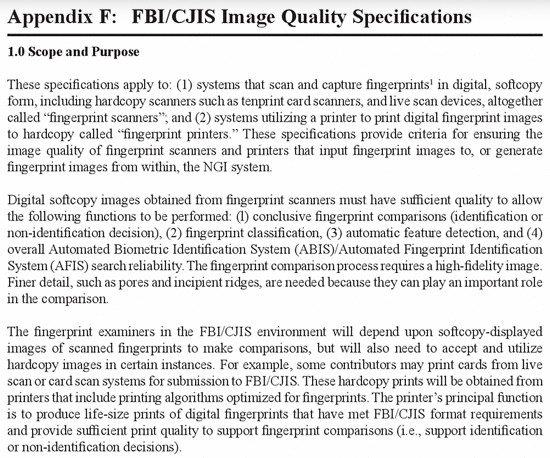
For example, how will Electronic Biometric Transmission Specification Appendix F (version 11.2 here) compliance work in the world where the friction ridges are NOT pressed against a surface?

When your company attends events, you’ll want to maximize your event return on investment (ROI) by creating marketing content that you publish before, during, and after the event.
This is how you do it.
Including:
And I’ll spill a couple of secrets along the way.
I’m going to share two secrets in this post. OK, maybe they’re not that secret, but you’d think they ARE secrets because no one acknowledges them.
The first one has to do with event attendance. You personally might be awed and amazed when you’re in the middle of an event and surrounded by hundreds, or thousands, or tens of thousands of people. All of whom are admiring your exhibit booth or listening to your CEO speak.

But guess what?
Many, many more people are NOT at the event.
They can’t see your exhibit booth, and can’t hear your speaker. They’re on the outside, TRYING to look in.

And all the money you spent on booth space and travel and light-up pens does NOTHING for the people who aren’t there…
Unless you bring the event to them. Your online content can bring the event to people who were never there.
But you need to plan, create, and approve your content before, during, and after the event. Here’s how you do that.
Yes, you can just show up at an event, take some pictures, and call it a day. But if you want to maximize your event return on investment, you’ll be a bit more deliberate in executive your event content. Ideally you should be:
Before the event begins, you need to plan your content. While you can certainly create some content on a whim as opportunity strikes, you need to have a basic idea of what content you plan to create.
Once you have planned what you want to do, you need to do it. Before, during, and after the event, you may want to create the following types of content:
Make sure that your content approval process is geared for the fast-paced nature of events. I can’t share details, but:
So how are you going to generate all this content? This brings us to my proposed solution…and the second secret.

The rest of this post talks about one of Bredemarket’s services, the Bredemarket 2800 Medium Writing Service. For those who haven’t heard about it, it’s a service where I provide between 2,800 and 3,200 words of written text.
“But John,” you’re asking. “How is a single block of 3,200 words of text going to help me with my event marketing?”
Time to reveal the second secret…
You can break up those 3,200 words any way you like.
For example, let’s say that you’re planning on attending an event. You could break the text up as follows:
For $2,000 (as of June 2024), you can benefit from written text for complete event coverage, arranged in any way you need.
So how can you and your company receive these benefits?
First, read the data sheet for the Bredemarket 2800 Medium Writing Service so you understand the offer and process.
Second, contact Bredemarket to get the content process started well BEFORE your event. Book a meeting with me at calendly.com/bredemarket. Be sure to fill out the information form so I can best help you.
Alternatively, you can
But don’t wait. If your event is in September…don’t contact me in October.
Both the U.S. National Institute of Standards and Technology and the Digital Benefits Hub made important announcements this morning. I will quote portions of the latter announcement.
The National Institute of Standards and Technology (NIST), the Digital Benefits Network (DBN) at the Beeck Center for Social Impact + Innovation at Georgetown University, and the Center for Democracy and Technology (CDT) are collaborating on a two-year-long collaborative research and development project to adapt NIST’s digital identity guidelines to better support the implementation of public benefits policy and delivery while balancing security, privacy, equity, and usability….
In response to heightened fraud and related cybersecurity threats during the COVID-19 pandemic, some benefits-administering agencies began to integrate new safeguards such as individual digital accounts and identity verification, also known as identity proofing, into online applications. However, the use of certain approaches, like those reliant upon facial recognition or data brokers, has raised questions about privacy and data security, due process issues, and potential biases in systems that disproportionately impact communities of color and marginalized groups. Simultaneously, adoption of more effective, evidence-based methods of identity verification has lagged, despite recommendations from NIST (Question A4) and the Government Accountability Office.
There’s a ton to digest here. This impacts a number of issues that I and others have been discussing for years.
NIST’s own press release, by the way, can be found here.

“If you’re not careful, you might learn something before it’s done.”
(Quote from William H. Cosby, M.A., Ed.D., L.H.D. (resc), from the Fat Albert TV show theme song. From https://www.streetdirectory.com/lyricadvisor/song/upujwj/fat_albert/.)
When I write about space aliens, there’s a reason. And that reason may be to warn identity vendors that silence is NOT golden.
As a frequent reader and writer on LinkedIn, I’ve seen all the tips and tricks to drive engagement. One popular trick is to make up a story that will resonate with the LinkedIn audience.
For example, the writer (usually a self-proclaimed career expert who is ex-FAANG) will tell the entirely fictional story of a clueless hiring manager and an infinitely wise recruiter. The clueless hiring manager is shocked that a candidate accepted a competing job offer. “Didn’t she like us?” asks the hiring manager. The wise recruiter reminds the clueless hiring manager that the candidate had endured countless delays in numerous interviews with the company, allowing another company to express interest in and snatch her.
Job seekers have endured countless delays in their own employment searches. When they read the post, they hoot and holler for the candidate and boo the clueless hiring manager. Most importantly, readers like and love the writer’s post until it goes viral, making the author an ex-FAANG top recruiting voice.
Even though no sources are cited and the story is fictional, it is very powerful.
Well…until you’ve read the same story a dozen times from a dozen recruiters. Then it gets tiresome.
But those fake stories powerfully drive clicks on LinkedIn, so I wanted to get in on the action. But I was going to add two wrinkles to my fake story.
First, I would explicitly admit that my story is fake. Because authenticity. Sort of.
Second, my story would include space aliens to make it riveting. And to hammer the point that the story is fake.
Now I just had to write a fake story with space aliens.
Or did I?
It turned out that I had already written a fake story. It didn’t have space aliens, but I liked the story I had spun in the Bredemarket blog post “(Pizza Stories) Is Your Firm Hungry for Awareness?”
I just needed to make one of the characters a space alien, and since Jones was based on the striking Grace Jones, I went ahead and did it. If you can imagine Grace Jones with tentacles, two noses, and eight legs.
With a few additional edits, my fake space alien story was ready for the Sunday night LinkedIn audience.
As the space alien’s tentacles quivered, I snuck something else into the LinkedIn story—some facts.
Kids who watched Fat Albert on TV not only enjoyed the antics, but also learned an Important Life Lessons. Now I don’t have multiple advanced degrees like Cosby, but then again I never had multiple degrees rescinded either.
But my life lesson wasn’t to stay in school or pull your pants up. My life lesson was to blog. The lesson was in the form of a statement by Jones’ humanoid colleague Smith, taken verbatim from the Pizza Stories post.
“Take blogging,” replied Smith. “The average company that blogs generates 55% more website visitors. B2B marketers that use blogs get 67% more leads than those who do not. Marketers who have prioritized blogging are 13x more likely to enjoy positive ROI. And 92% of companies who blog multiple times per day have acquired a customer from their blog.”
The stats originally appeared in an earlier post, “How Identity and Biometrics Firms Can Use Blogging to Grow Their Business.”

And the fake story also talked about companies (unnamed, but real) who ignored these facts and remained silent on their blog and social channels.
A huge mistake, because their competitors ARE engaging with their prospects, with real stories.
Is your company making the same mistake?

I guess I should mention David Byrne. OK, I did.



 Bredemarket