Feed is a verb.
Let’s talk: https://bredemarket.com/cpa/

Identity/biometrics/technology marketing and writing services

People are people, and why should it be that non-person entities (NPEs) are treated the same? The girl is NOT the robot.

In a June 30 LinkedIn post, Eric Olden of Strata caused me to realize that my approach to NPEs is too uniform and needs to be more nuanced.
“Agentic identity isn’t just a new type of NHI. AI agents might functionally fall under the “non-human identity” umbrella—but that label doesn’t really cut it since we’re not talking about static service accounts or API keys.”
In a table published in the original post, Olden semantically defines NHIs as the persistent entities with unchanging privileges. Agentic identities, in Olden’s cosmos, are ephemeral.
But Olden identifies one additional distinction that has nothing to do with lifespan.
“AI agents are digital actors that can reason and make decisions across systems.”
Olden notes that the characteristics of agentic AI offer both power and risk.

ConductorOne shares Olden’s observations on agentic AI:
“Often ephemeral, existing for just seconds or minutes depending on the task.
“Requires role-based or task-specific access, rather than broad or persistent permissions.
“Capable of autonomous decision-making and executing actions in real-time.
“Built to integrate with existing systems and interact securely with other agents.
“Expands the potential for AI solutions by enabling action—not just insight or content.”
So how do you set up individual accounts for these extremely powerful non-person entities that appear and disappear?
According to Juan Ignacio Torres Durán, you don’t.
“Modern architectures — cloud-native, ephemeral workloads, APIs, containers, robotic processes — don’t fit neatly into the account model. They’re fast, dynamic, and short-lived. They need access right now, based on who or what they are, where they run, and what they do.
“And here’s the shift: We don’t need to create an account for each of them. We just need to recognize the entity, validate it, and project a governed identity that can be used for access decisions.”
So no distinct individuality for NPEs. That’s an interesting…um…world.

Perhaps you’ve heard the joke about an anonymous survey managed by a company’s personnel department. In the joke, one employee received two emails:
But maybe it’s not a joke.
Is the zero knowledge/World dream of one unique identity per person actually a curse? According to Biometric Update, Vitalik Buterin of Ethereum fame claims it REMOVES privacy.
“[U]nder one-per-person ID, even if ZK-wrapped, we risk coming closer to a world where all of your activity must de-facto be under a single public identity….
“[T]here can’t be an easily legible hard limit on how many identities you can easily get. If you can only have one identity, you do not have pseudonymity, and you can be coerced into revealing it.”
Buterin believes multiple identities, managed separately, provide concurrent identity and privacy.
(Part of the biometric product marketing expert series)
I’ve spent a ton of time discussing naughty people who use technology to create deepfakes—including voice deepfakes—to defraud people.
But some deepfakes don’t use technology, and some deepfakes are not intended to defraud.
Take Mark Hamill’s impersonation of fellow actor Harrison Ford.
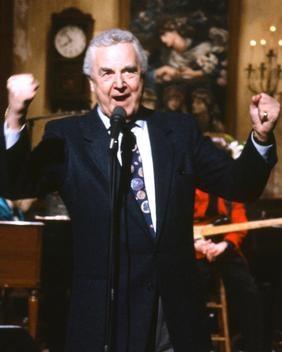
And then there was a case that I guess could be classified as fraud…at least to Don Pardo’s sister-in-law.
Don Pardo was originally known as an announcer on NBC game shows, and his distinctive voice could be heard on many of them, including (non-embeddable) parodies of them.
With his well-known voice, NBC jumped at the chance to employ him as the announcer for the decidedly non-game television show Saturday Night Live, where he traded dialogue with the likes of Frank Zappa.
Except for a brief period after he ran afoul of Michael O’Donoghue, Pardo was a fixture on SNL for decades, through the reigns of various producers and executive producers.
Until one night in 1999 when laryngitis got the best of Don Pardo, and the show had to turn to Bill Clinton.
No, not the real Bill Clinton.
I’m talking about the SNL cast member who did a voice impression of Bill Clinton (and Jeopardy loser Sean Connery), Darrell Hammond. Who proceeded to perform an impression of Don Pardo.
An impression that even fooled Don Pardo’s sister-in-law.
Pardo continued to be Saturday Night Live’s announcer for years after that, sometimes live from New York, sometimes on tape from his home in Arizona.
And when Pardo passed away in 2014, he was succeeded as SNL’s announcer by former cast member Darrell Hammond.
Who used his own voice.

I snuck a future-famous teenager into an Instagram reel I posted on Sunday. See the final scene in the reel. https://www.instagram.com/reel/DLfyc4HSBYh/
This scene is incredibly inaccurate. A teenage Napoleon was NOT looking on as George Washington presented a copy of the Declaration of Independence to King George III during the Treaty of Paris negotiations in 1783.
But at least the two Georges picture is more accurate than my picture of Thomas Jefferson eating a hot dog as a baseball game was played nearby.

I will talk about the Declaration of Independence, in a content marketing context, later this week. On Wednesday, of course.

There’s a biometric company that has been around for decades, and I recently received an email update about the latest post on its blog.
The title?
“How Automated Content Generation and Amplification Saves Marketing Hours.”
Odd, I thought. Not sure why a fingerprint device company would write stuff like this:
“AI Agent based automation could be the key to overcoming the bottlenecks in content creation and distribution. As a CEO, I am constantly seeking ways to optimize our operations, and this seemed like a promising avenue. The idea of automating content amplification intrigued me, especially considering the potential time savings and efficiency gains.”
Then I saw the author: “MIA.” (All caps.)
“MIA is CloudApper’s sales and solutions assistant, designed to help professionals and business leaders explore the future of workforce technology. MIA shares insights from real-world conversations with customers and CloudApper experts-bridging the gap between AI innovation and practical enterprise solutions.”
Curious, I started looking at the previous blog posts, all of which appeared to mention CloudApper, until I finally arrived at a post from May 20 that explicitly discussed biometric authentication.
But the post included a caveat:
“The M2SYS Blog was not involved in the creation of this content.”
The same caveat was present on an April 18 biometric post. And a post from April 1.
I subsequently discovered that CloudApper was co-founded by the same person who co-founded M2SYS.
So apparently CloudApper is publishing its posts on the M2SYS website.
Which led me to question: is M2SYS still a biometric concern?
I checked news articles, and the most recent mentions of the company are from so-called research reports of dubious value. Here’s the blurb for a 2021 report.
“The Key Players of the Global AFIS Market are 3M Cogent, Inc. (U.S.), Safran Identity & Security (U.S.), NEC Corporation (Japan), M2SYS Technology (U.S.), Afix Technologies Inc (U.S.), Biometrics4ALL (U.S.), Fujitsu (Japan), Cross Match Technologies, Inc. (U.S.), HID Global Corporation (U.S.), M2SYS Technology (U.S.).”
For those who don’t follow the biometric industry carefully, neither 3M Cogent nor Safran Identity & Security were involved in the global AFIS market in 2021. 3M and Safran sold their biometric holdings to Gemalto and Advent International, respectively. And Afix and Cross Match are no longer independent either…but I digress.
I did find a Biometric Update mention of M2SYS from 2019.
“American Green’s new AGM Beverage Vendor is an age-restricted vending machine to dispense beer and spirits, powered by finger vein biometric technology from M2SYS.”
And the aforementioned M2SYS blog has not used the “biometric” tag since March 2023.
But hey…they sure do have a lot of blog content.
But is it relevant?
If your identity/biometric company needs RELEVANT blog content…contact me by visiting https://bredemarket.com/cpa/.

June 2025 is almost over, so I can evaluate my performance against my goal.
So what is my goal for July? Stay tuned.

The Federal Trade Commission sort of got it wrong.
“If you want to use your driver’s license to fly, you’ll need a REAL ID. If you don’t have one yet, your state’s Department of Motor Vehicles (DMV) is the place to go, and they’re only taking in-person appointments.”
The FTC is attempting to warn against scammers who claim to offer REAL ID services and then defraud you.
But at least in California, you can START the REAL ID application process online. At the California DMV website, of course.
“During the online REAL ID application process, you will be prompted to upload documents that prove identity (e.g., valid passport or birth certificate) and residency (e.g., utility bill, bank statement).”
But you can’t do EVERYTHING online.
“Uploading images of these documents online will save you time when you visit the DMV office to complete your application so don’t skip this step. Bring the original documents submitted online to your REAL ID appointment.”
But whatever you do, don’t upload your documents to “the-real-id dot cn.”
Now it can be told.
Bredemarket hasn’t used paid advertising in years, but I recently ran a small ad for 4 days using Blaze, as offered by WordPress.
Even though Blaze was too broad for me to accurately specify my target audience.
So what were the final results?
But this did give me some ideas, should I want to conduct a more targeted paid campaign in the future.
Or a more targeted organic campaign.
But let me ask you about your experience:
And no, I’m not tired of the video yet.
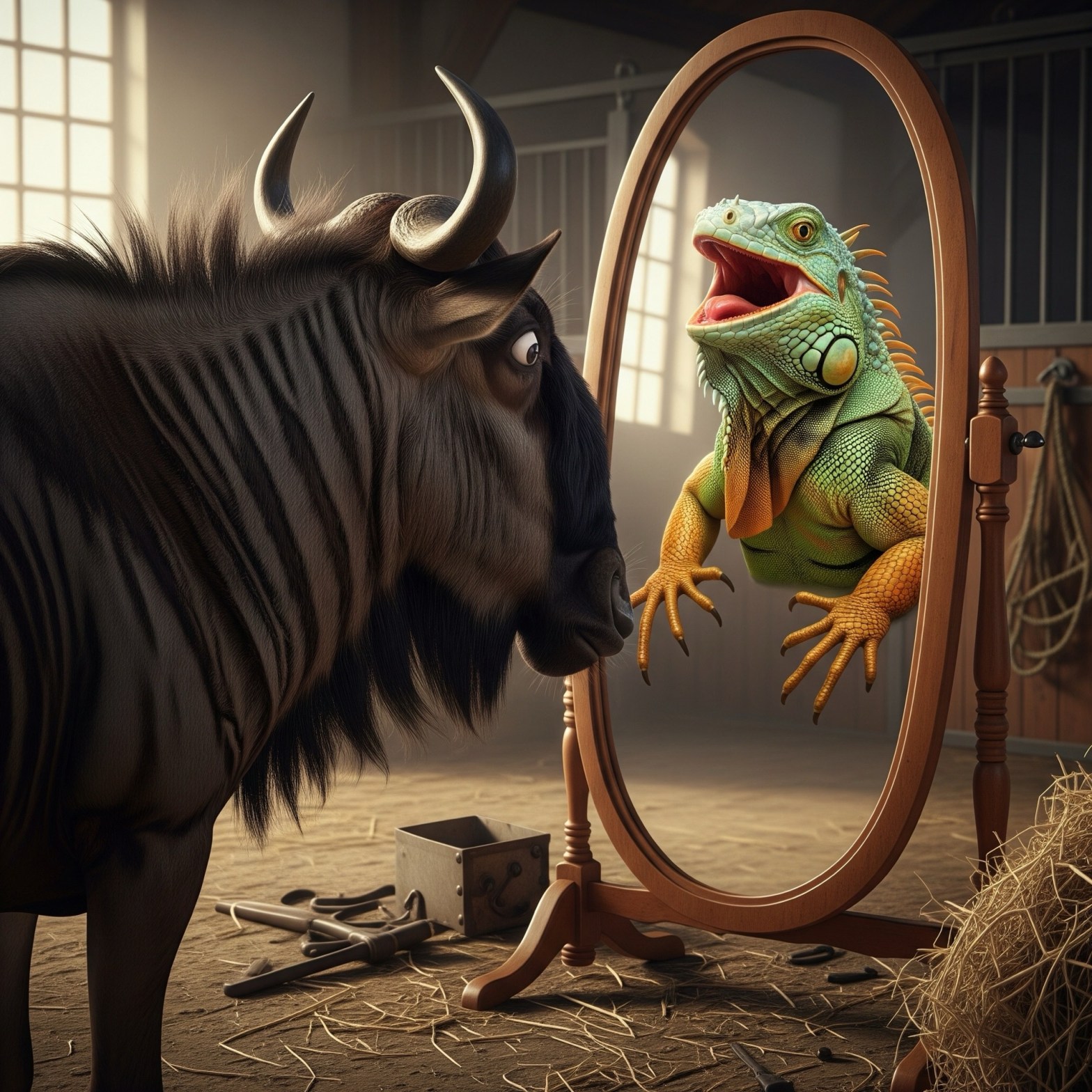
I generated this picture in Imagen 4 after reading an AI art prompt suggestion from Danie Wylie. (I have mentioned her before in the Bredemarket blog…twice.)
The AI exercise raises a question.
What if you are in the middle of an identity verification or authentication process, and only THEN discover that a fraudster is impersonating you at that very moment?

 Bredemarket