Californians, get the acronyms right: CCPA, CPRA, CPPA.
“Imagine having complete insight and control over how your personal information is collected, shared, and sold. That’s what the California Consumer Privacy Act (CCPA) brought in 2020. Then came the California Privacy Rights Act (CPRA), effective January 2023, expanding those rights and establishing the California Privacy Protection Agency (CPPA) to enforce them. These laws together position California at the forefront of privacy regulation in the United States.”
(Not to be confused with large language model. But I digress.)
And I’ve also noted that LMM can mean a large medical model.
But healthcare professionals aren’t the only ones adopting this acronym. Enter the marketers at WPP Media.
Large marketing model
“You might have heard us talking a lot lately about something pretty exciting: Open Intelligence, our new AI-powered data solution. And along with that, we’ve been dropping the term the world’s first Large Marketing Model (LMM)…”
Large multimodal, medical, and marketing models. Imagen 4.
Although marketers could clearly use large multimodal models. Oh well.
So why do we marketers need our own generative AI model?
“In the context of marketing, this can extend to understanding customers, audiences, channels, and creative.”
Large marketing model. Imagen 4.
Which I guess the general-purpose engines are too generic to handle.
“[Open Intelligence] has been trained to understand and predict audience behavior and marketing performance based on patterns derived from real-time data about how people engage with content, brands, platforms, and products.”
It has been trained on “trillions of signals across more than 350 partners in over 75 markets.” Trillions of signals sounds like an impressive feature, but what if there are actually quadrillions of signals?
Are there other LMMs?
And are we going to get more of these special purpose models?
This was never supposed to go on the Bredemarket blog, but here it is. Because when a product marketing consultant wants to improve his storytelling skills, he practices with…toilet paper.
Wylie likes to share art challenges, and she recently shared this one. The text below, including the emojis, is straight from the challenge.
📣 New Weekly Wednesday Challenge 📣
🌟 Glitch N’ Sass and AI Anonymous Present:
🎭✨ MESMERIZE THE MUNDANE ✨🎭
Where glitter drips from code and imagination struts in stilettos. @everyone 💥
Take the forgotten, the overlooked, the tragically basic —
and unleash the glam-core magic of AI.
Allow creativity to glitch the system, let sass polish the mundane, all while reshaping reality.
⸻
Flip the script on the everyday:
🥄 A spoon stirs time’s secrets
👟 A shoelace coils into cosmic scales
📎 A paperclip snaps open hidden realms
✨ Rewire purpose.
✨ Reframe presence.
✨ Reveal what the world forgets to see.
📌 Tag it: #AIAnonymous #GlitchNSass #MesmerizeTheMundane
⸻
💬 This isn’t an art drop — it’s an everyday clutch, transformed into a chasm of creativity .
A call to those who see depth in the digital, beauty in glitches, and freedom behind the mask.
We are not escaping the world — we are a reminder, to view it. For all the purposes they told us it never possessed. 🔥
✨ So go on… Mesmerize us, With glitter in one hand and encrypted vision in the other. ✨
Preparing my response
Now on the surface such an exercise has nothing to do with “know your business” or “biometric product marketing expert” or “content – proposal – analysis”…
…but it does.
In essence, written business communications are opportunities for storytelling. As I noted, case studies are inspiring stories about how a challenged company realized amazing success, all thanks to the wonderful Green Widget Gizmo.
Now that’s a riveting story.
Tell us about the Green Widget Gizmo again PLEASE PLEASE PLEASE! Imagen 4.
And of course I’ve performed AI image storytelling before: for example, with my three “Biometric product marketing expert” reels. Here’s the second:
Biometric product marketing expert, the content for tech marketers version.
But back to the “Mesmerize the Mundane” challenge. So to participate in the challenge I had to find something mundane. Now some of you think a single finger sensor is mundane…but I don’t. (There’s actually a connection between fingerprint sensors and art, but I’m under NDA.)
My response
So I picked a mundane topic: toilet paper.
What’s even better is that toilet paper is filled with emotion. Particularly relative to the ongoing debate about whether…
I’m not going to say it. I hope this reel—my entry into the “Mesmerize the Mundane” challenge—speaks for itself.
The over/under.
When I shared this reel on Facebook and elsewhere, I did so with the following text.
A storytelling exercise…and a challenge.
You can’t get more mundane than toilet paper, or spawn fiercer battles over orientation. But love conquers battles.
One of the challenges in multi-image storytelling is the need for consistency between the images. You can’t have the hero wildebeest wearing a blue cap in the first picture and a red one in the second.
So to enforce consistency, I’ve been bundling all my picture prompts into a single request to Google Gemini, and including instructions to enforce similarity between the pictures in the series.
AI art creation. This is the picture I use for the Bredemarket Picture Clubhouse Facebook group.
So here is the specific request used to create the four pictures in the reel above.
Draw realistic pictures based upon the following four prompts:
Prompt 1: Draw a realistic picture of a toilet paper holder on a blue tiled bathroom wall, next to the toilet. The toilet paper is white. The toilet paper end is hanging in front of the roll.
Prompt 2: Draw a realistic picture similar to the image in the previous prompt, a toilet paper holder on a blue tiled bathroom wall, next to the toilet. The toilet paper is still white. This time, however, the toilet paper end is hanging behind the roll.
Prompt 3: Draw a realistic picture similar to the image in the previous prompts, a toilet paper holder on a blue tiled bathroom wall, next to the toilet. Now the toilet paper is glowing in a neon red. Due to mesmerizing magic, there is a toilet paper end hanging in front of the roll, and there is also a duplicate toilet paper end hanging behind the roll. The presence of both toilet paper ends removes the conflict of whether to hang toilet paper in front of our behind the roll; now, both are simultaneously true.
Prompt 4: Draw a realistic picture similar to the image in the previous prompts, a toilet paper holder next to the toilet. But now the tiles on the bathroom wall are colored gold, vibrating, and throbbing. The toilet itself is glowing with a bright light. Now the toilet paper is glowing in red, green, and blue, and sparkles are shooting away from the toilet paper roll like fireworks. Again, due to mesmerizing magic, there is a toilet paper end hanging in front of the roll, and there is also a duplicate toilet paper end hanging behind the roll. The bathroom floor is covered in hundred dollar bills and shiny gold coins.
And here are the full square pictures, which do not completely display in the reel.
Now I just have to tell the riveting story of a single finger sensor.
“Well, I don’t know what will happen now. We’ve got some difficult days ahead. But it doesn’t matter with me now. Because I’ve been to the mountaintop. And I don’t mind. Like anybody, I would like to live a long life. Longevity has its place. But I’m not concerned about that now. I just want to do God’s will. And He’s allowed me to go up to the mountain. And I’ve looked over. And I’ve seen the promised land. I may not get there with you. But I want you to know tonight, that we, as a people, will get to the promised land. And I’m happy, tonight. I’m not worried about anything. I’m not fearing any man. Mine eyes have seen the glory of the coming of the Lord.”
Case studies are powerful marketing collateral for companies.
Why?
Because if you select your subjects carefully, your prospects will say, “That subject is just like me. And the company’s solution solved the subject’s problem. Perhaps the solution will solve my problem also.”
Imagen 4
Ideally a company would want to publish dozens of case studies, so their prospects could find one case study—or perhaps two or three—that describe the exact same problem the prospect is encountering.
It’s hard to create case studies
But case studies are by definition more difficult for a company to create.
For other types of content, the approval process resides completely within the company itself.
But case studies by definition require approval by two companies…even if the end customers in the case studies remain anonymous.
Perhaps that’s why there are so few published, recent case studies.
On Tuesday I had the occasion to visit four technology websites.
One had 5 case studies, all written in 2024.
One had 4 case studies, all written in 2023 and all anonymous.
One had 8 case studies, all written in 2021.
One had no case studies at all, even though the company had clients who could be referenced.
And the approvals don’t just involve the end customer.
Imagen 4
A former friend interviewed many customers but was only able to complete one case study; the approvals from company legal, other company executives, and the end customers were overwhelming, delaying the other case studies.
So how do you expedite case study creation and approval?
Three tips for creating case studies
Here are three tips to expedite the creation of case studies.
Creation tip 1: Get the facts first
If the sales rep, program manager, or the subject itself can provide the basic facts beforehand, then the interview can simply consist of confirming facts and filling gaps.
Creation tip 2: Outline the case study and tell your story
Imagen 4
Whether you use the STAR method (situation, task, action, result) or some other method (I prefer the simpler problem, solution, result), take the facts you gathered above. Then fit them into the outline and into the story you want to tell. Then see what pieces of the story are missing.
Creation tip 3: Obtain a meeting transcript
Since the subject has already consented to the case study, they should consent to the meeting being recorded.
The most efficient way to do this is with one of the popular AI note takers, which lets the case study writer review the actual words from the interview without going back and forth through a video recording.
Here are three tips to expedite the approval of case studies.
Approval tip 1: Read the contract
The language of the contract with the subject may have clauses regarding publicity.
If the subject wrote the contract, then it may prohibit any promotional publicity whatsoever, or it may dictate that any publicity must be approved by a high-level governing board in a foreign country.
If the provisions are onerous or impossible, don’t use that subject and find another.
Approval tip 2: Get pre-approvals, or at least grease the wheels
Let your approvers know what’s coming, and when you think it will come.
Once I submitted a case study for pre-approval even before the results were available. This subject had a lengthy approval process, so I wanted the approvers to see the first part of the case study as soon as possible.
Approval tip 3: Use every ethical method to get those approvals
Imagen 4
While the case study may be critically important to you, it may be merely important (or even inconsequential) to the lawyer with 50 other tasks.
From the lawyer’s perspective, it may be better if the company does NOT publish the case study. Fewer potential lawsuits that way.
Do everything you can to expedite the approval. If the CEO is demanding a published case study in three days, say so.
If not…well, that’s why you’re a salesperson. Oh, you’re NOT a salesperson? You are now.
One final tip
You don’t have to go it alone. If your staff is stretched, or if your staff has never written a case study before, Bredemarket can help. Visit my content for tech marketers page.
I’m asking for a connection favor from the people who read this, my street team.
The ask
Here is the ask:
If you know a technology Chief Marketing Officer or other leader…
…who faces challenges in content, proposals, or analysis…
…and can use consulting help:
Ask your marketing leader to visit https://bredemarket.com/mark/ to learn about Bredemarket’s marketing and writing services:
The why, how, what, and who about Bredemarket’s ability to drive content results.
What I can do for your marketing leader.
Who uses my services; I’ve worked in many technology industries.
My collaborative process with Bredemarket’s clients.
The connection
If they like what they see, they can connect with me by booking a free 30 minute content needs assessment meeting with me, right from the https://bredemarket.com/mark/ page.
The reward
Thank you, street team. No monetary commission, but I can give you a shout out and a personal AI-generated wildebeest picture on Bredemarket’s blog and social media empire. Yes, even TikTok (if it’s still legal).
Actually, I already owe a shout out to Roger Morrison, who has supported Bredemarket for years and has supported me personally for decades. Roger offers extensive experience in multiple biometric modalities (finger, face, Iris, voice), identity credentials, and broadband and other technologies. Despite attending the wrong high school in Arlington, Virginia (should have gone to Wakefield), he is very knowledgeable and very supportive. Warning: Roger is NOT bland or generic.
I’m revisiting the “we have no competition” topic, because I have another point to make. If you claim your firm’s product has no competition because of its robust unmatched feature set, why are you still broke?
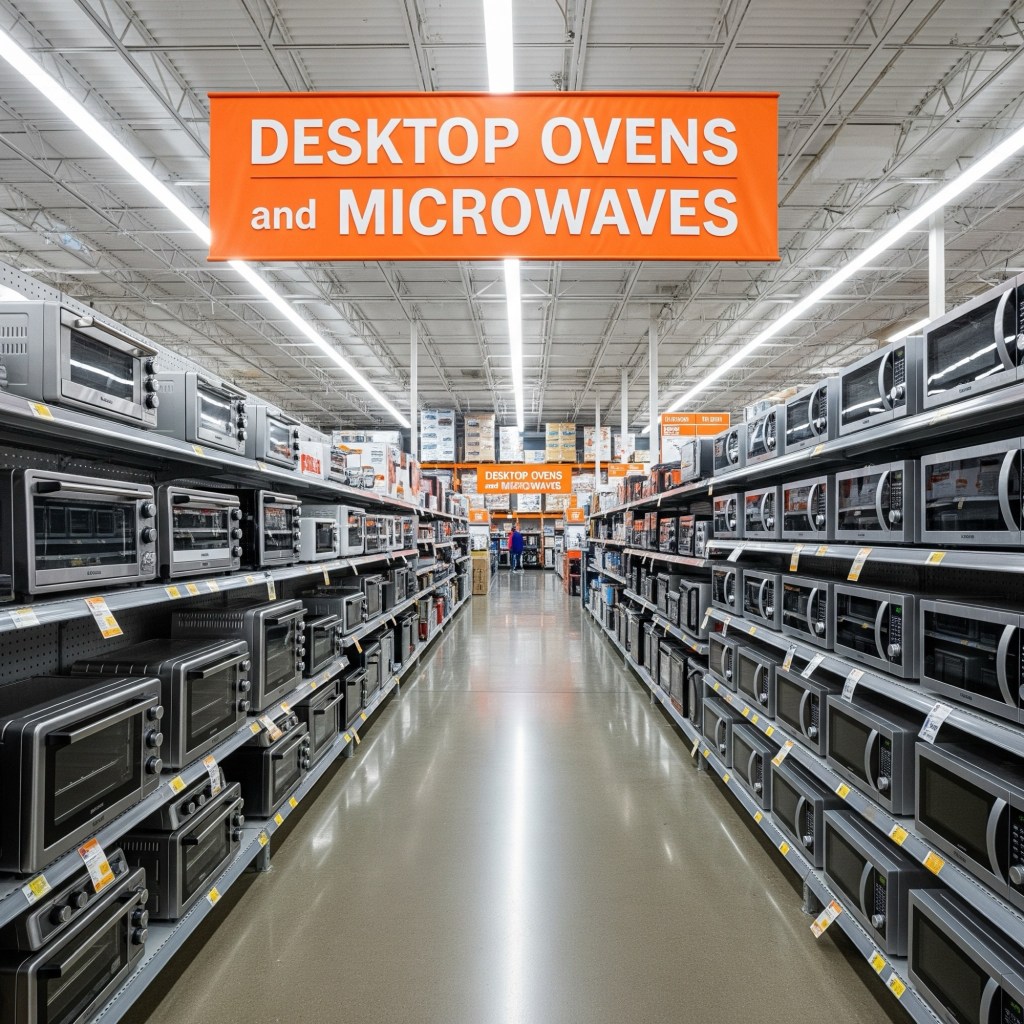
Take this example: the Uneek Combination Oven-Microwave.
A young woman left her family home and moved into her own apartment in the city.
A small studio apartment.
Her apartment was a very tiny studio apartment. Because of the lack of space, the woman equipped the apartment’s small kitchen area with a space-saving appliance that was a combination oven and microwave.
This was truly a product that had no competition, because its feature set was unequaled by most cooking appliances on the market. Everything else was either an oven or a microwave, not both.
The Uneek Combination Oven-Microwave.
So by logic this product should have commanded a 99% market share because of its extensive feature set, right?
Yet it didn’t.
Labor Day sale soon.
Because this product actually had competitors.
Stand-alone ovens.
Stand-alone microwaves.
Takeout food which ensured that you needed neither an oven nor a microwave.
And cold food.
No need to cook tonight.
The biggest competitor against ANY product is simply buying nothing at all.
After all, buying nothing at all has by far the lowest price.
“I am currently working as a Temporary Recruiting Assistant, assisting the company in finding a suitable candidate to fill an open position.
“After reading your background information, I believe that you have the experience and abilities that are highly qualified for this position.
“If you are interested in this opportunity, you are more than welcome to get back to me and I will be happy to provide you with more information about the position.
“Thank you for your time and look forward to your reply!
“Amanda Rodriguez
Temporary Recruitment Assistant | Administrative Support in Talent Acquisition”
I don’t know Spencer Stuart but they presumably wouldn’t hire a clown like this, even in a temporary capacity.
Here’s my reply, but the account disappeared before I could send it.
“If you are truly targeting anti-fraud identity verification product marketing professionals, your pitch itself sounds like it was written by a scammer fraudster. Even in his current condition, Kevin Mitnick wouldn’t fall for this scam.”
How can CMOs serve hungry prospects with expert biometric content?
(Imagen 4)
Biometric product companies offer a tasty mixture of fingerprint, face, iris, voice, DNA, and other biometric hardware and software. These companies employ Chief Marketing Officers (CMOs) responsible for their firms’ inbound product marketing. Hungry prospects devour any content the firm can provide, and the CMOs devour any employee or contractor who can provide the necessary content.
The CMO will appreciate this seasoned quote from Lee Densmer:
“Companies are outsourcing the writing at great expense….[I]t is a heavy lift to make sure daily content for the platform is useful, relevant, and align with your business. Outsourcing doesn’t really work unless the writer really knows your business, is in touch with corporate leaders, and stays on top of trends.”
So if you’re a content-devouring CMO at a biometric company, doesn’t it make sense to contract with Bredemarket’s biometric product marketing expert to serve a delicious dinner of your content needs?
I have positioned Bredemarket so I can fill the gaps in a Chief Marketing Officer’s existing content plan, or a Chief Revenue Officer’s proposal plan, or a Chief Strategy Officer’s existing analysis plan.
But what if you don’t have a plan?
Bredemarket can help you too.
This post describes how I can plug into your existing plan, or how I can help you create a plan if you don’t have one.
But first let’s dispense with the theory of how to properly do things, because it’s silly.
What theory says
If you read LinkedIn for any length of time, you will run across content marketers and copywriters and other Professional Content Experts.
These 17x certified PCEs are all too willing to tell you The Correct Way For Companies To Engage With Writing Contractors.
Because the way your company engages with contractors I s completely wrong.
Here is The Correct Way:
“When engaging with a contractor, you must provide the contractor with a detailed content brief that answers all 42 questions your contractor will ask or may ask. Failure to do this brands you as a failed substandard company.”
Bredemarket rarely receives any kind of brief from my clients. Sometimes we get a paragraph. Or sometimes we just get a couple of sentences:
“A local Utah paper ran an article about how our end customer used our solution to solve world hunger. Here’s the article; get additional information from the guy quoted in the article and write a blog post about it.”
These two sentences would drive a Professional Content Expert up a wall, because they don’t answer all 42 questions.
So what?
It’s a starting point. If I were given that, I could start.
So forget the theory of The Correct Way For Companies To Engage With Writing Contractors, and just start writing (but thinking first).
If you have a plan (or at least an idea)
Many of my clients have a content, proposal, or analysis plan—or at least an idea of what they need. There are many times when I simply plug in to a client’s existing plan. Here are some examples:
One client’s CMO needed a twice-a-month series of blog posts to promote one of their company’s services. The service featured multiple facets, so I had plenty to write about. So I plugged into the existing system and wrote.
Another client needed a series of case studies to grab the attention of their prospects. Again, the client’s product addressed multiple markets, and the variety of customer case studies gave me plenty to write about. So I plugged into the existing system and wrote.
Multiple clients have asked me to manage and/or write proposals for them. Two of the clients (one being SMA) had very well-defined capture management and proposal processes. The others didn’t—I was the de facto expert in the (virtual) room—but they knew which Request for Proposal (RFP) or Request for Information (RFI) required a response. So I plugged into the existing system and wrote.
Multiple clients (mainly in the identity/biometric realm) have asked me to perform analyses. Whether they had an established analysis process or not, they knew what they wanted. So I plugged into the existing system and wrote.
So I easily completed these one-off (or twelve-off) tasks, responding to my clients’ well-defined requests.
But others face the challenge of not knowing what they want.
The beautiful thing about the seven questions is that you can not only apply them to a particular piece of content such as a blog post, but to an entire content-proposal-analysis strategy.
And here I DO mean strategy, not tactics.
There are other methods to derive a strategy, but this is as good as any.
So if you book a free meeting with me to figure out a strategy, we can work through these questions to jointly understand your company, your products, and the material you need. I haven’t the slightest idea how our conversation will progress, but perhaps I may end up asking you questions like this:
WHY do your competitors suck?
HOW do your prospects make purchasing decisions?
WHAT do your salespeople need to close deals (conversion)?
What are your GOALS to move prospects through your funnel?
You get the idea. As we talk through things, perhaps you and I will get ideas about how Bredemarket can help you.
Or maybe not. Maybe it turns out you need a web designer, or a videographer, or a demand generation expert, or an accountant.
But if we determine that Bredemarket can help you, then we can create the plan and figure out how I can best execute on the plan. A competitor analysis? A series of blog posts? We will figure it out.
Then I’ll plug into the new existing system and write.
A call to action
Your content, proposals, and analyses will presumably incorporate a call to action.
It’s no surprise that this post also has one.
Visit my “content for tech marketers” page, read about what we can do together, and book a free 30 minute content needs assessment. You can book it at the top of the page or the bottom, whatever turns you on.
But let’s move. Your competitors are already moving.





















 Bredemarket