A tech journalist, writing on their personal social channels, noted that they recently bought a laptop bag luggage strap…and was immediately added to the company’s mailing list.
Because when you buy one laptop bag luggage strap, you obviously need seven more.
Google Gemini.
But it’s really bad when you buy a refrigerator and the seller thinks you want more of THOSE.
As I’ve said before, there may be many different stakeholders for a particular purchase opportunity.
For the purpose of this post I’m going to dramatically simplify the process by saying there are only two stakeholders for any RFP and any proposal responding to said RFP: “business” people, and “technical” people.
Google Gemini.
The business people are concerned about the why of the purchase. What pressing need is prompting the business (or government agency) to purchase the product or service? Do the alternatives meet the business need?
The technical people are concerned about the how of the purchase. Knowing the need, can the alternatives actually do what they say they can do?
Returning to my oft-repeated example of an automated biometric identification system purchase by the city of Ontario, California, let’s look at what the business and technical people want:
The business people want compliance with purchasing regulations, and superior performance that keeps citizens off the mayor’s back. (As of January 2026, still Paul Leon.)
The technical people want accurate processing of biometric evidence, proper interfaces to other ABIS systems, implementation of privacy protections, FBI certifications, iBeta or other conformance statements, and all sorts of other…um…minutiae.
So both parties are reading your proposal or other document, looking for these points.
So who is your “target audience” for your proposal?
Both of them.
Whether you’re writing a proposal or a data sheet, make sure that your document addresses the needs of both parties, and that both parties can easily find the information they’re seeking.
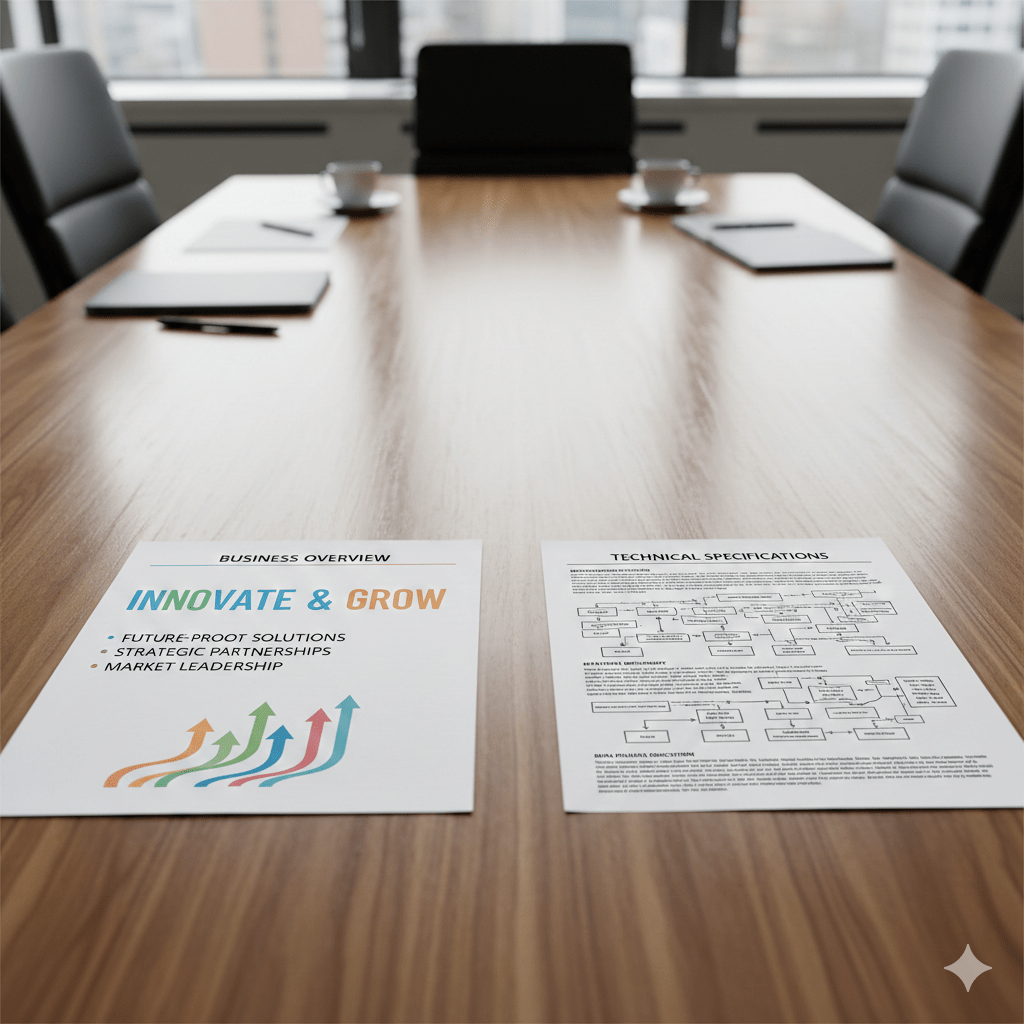
If I may take the liberty of stereotyping business and technical users, and if the document in question is a single sheet with printing on front and back, one suggestion is to put the business benefits on the front of the document with pretty pictures that resonate with the readers, and the technical benefits on the back of the document where engineers are accustomed to read the fine print specs.
Google Gemini. It took multiple tries to get generative AI to spell “innovate” correctly.
Or something.
But if both business and technical subject matter experts are involved in the purchase decision, cater to both. You wouldn’t want to write a document solely for the techies when the true decision maker is a person who doesn’t know NFIQ from OFIQ.
If your security software enforces a “no bots” policy, you’re only hurting yourself.
Bad bots
Yes, there are some bots you want to keep out.
“Scrapers” that obtain your proprietary data without your consent.
“Ad clickers” from your competitors that drain your budgets.
And, of course, non-human identities that fraudulently crack legitimate human and non-human accounts (ATO, or account takeover).
Good bots
But there are some bots you want to welcome with open arms.
Such as the indexers, either web crawlers or AI search assistants, that ensure your company and its products are known to search engines and large language models. If you nobot these agents, your prospects may never hear about you.
Buybots
And what about the buybots—those AI agents designed to make legitimate purchases?
Perhaps a human wants to buy a Beanie Baby, Bitcoin, or airline ticket, but only if the price dips below a certain point. It is physically impossible for a human to monitor prices 24 hours a day, 7 days a week, so the human empowers an AI agent to make the purchase.
Do you want to keep legitimate buyers from buying just because they’re non-human identities?
(Maybe…but that’s another topic. If you’re interested, see what Vish Nandlall said in November about Amazon blocking Perplexity agents.)
Nobots
According to click fraud fighter Anura in October 2025, 51% of web traffic is non-human bots, and 37% of the total traffic is “bad bots.” Obviously you want to deny the 37%, but you want to allow the 14% “good bots.”
Nobot policies hurt. If your verification, authentication, and authorization solutions are unable to allow good bots, your business will suffer.
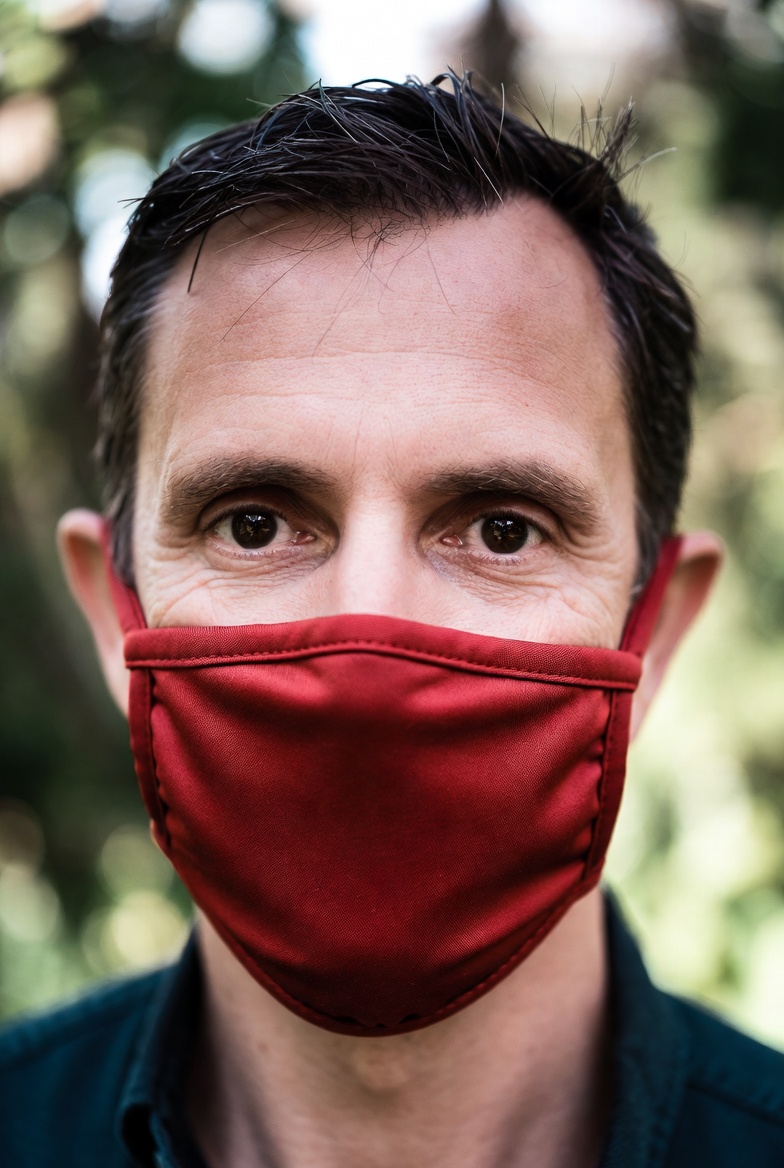
As you may know, I’ve often used Grok to convert static images to 6-second videos. But I’ve never tried to do this with an occluded face, because I feared I’d probably fail. Grok isn’t perfect, after all.
Facia’s 2024 definition of occlusion is “an extraneous object that hinders the view of a face, for example, a beard, a scarf, sunglasses, or a mustache covering lips.” Facia also mentions the COVID practice of wearing masks.
Occlusion limits the data available to facial recognition algorithms, which has an adverse effect on accuracy. At the time, “lower chin and mouth occlusions caused an inaccuracy rate increase of 8.2%.” Occlusion of the eyes naturally caused greater inaccuracies.
So how do we account for occlusions? Facia offers three tactics:
But those acronyms aren’t enough, so we’ll add one more.
At the 2025 Computer Vision and Pattern Recognition conference, a group of researchers led by Pratheba Selvaraju presented a paper entitled “OFER: Occluded Face Expression Reconstruction.” This gives us one more acronym to play around with.
Here’s the abstract of the paper:
“Reconstructing 3D face models from a single image is an inherently ill-posed problem, which becomes even more challenging in the presence of occlusions. In addition to fewer available observations, occlusions introduce an extra source of ambiguity where multiple reconstructions can be equally valid. Despite the ubiquity of the problem, very few methods address its multi-hypothesis nature. In this paper we introduce OFER, a novel approach for singleimage 3D face reconstruction that can generate plausible, diverse, and expressive 3D faces, even under strong occlusions. Specifically, we train two diffusion models to generate a shape and expression coefficients of face parametric model, conditioned on the input image. This approach captures the multi-modal nature of the problem, generating a distribution of solutions as output. However, to maintain consistency across diverse expressions, the challenge is to select the best matching shape. To achieve this, we propose a novel ranking mechanism that sorts the outputs of the shape diffusion network based on predicted shape accuracy scores. We evaluate our method using standard benchmarks and introduce CO-545, a new protocol and dataset designed to assess the accuracy of expressive faces under occlusion. Our results show improved performance over occlusion-based methods, while also enabling the generation of diverse expressions for a given image.
Cool. I was just writing about multimodal for a biometric client project, but this is a different meaning altogether.
In my non-advanced brain, the process of creating multiple options and choosing the one with the “best” fit (however that is defined) seems promising.
Although Grok didn’t do too badly with this one. Not perfect, but pretty good.
I unintentionally reveal my age when I use terms such as EXPLETIVE DELETED which date back to the Nixon Administration.
Or when the first “Sam” that comes to mind is Sam Winston, known for selling tires.
And you get Sam.
Sadly, Sam Winston passed away in 1995…in an automobile accident, no less.
But today I’m using SAM as an acronym for System Award Management.
The SAM.gov website is a centralized location to inform businesses of U.S. federal government procurements, saving businesses the trouble of visiting every single agency to find bidding opportunities.
When I started in government proposal management my employer focused on state and local opportunities, but today Bredemarket concentrates on federal ones. As a result I scan SAM.gov regularly. Not for me, but for my clients.
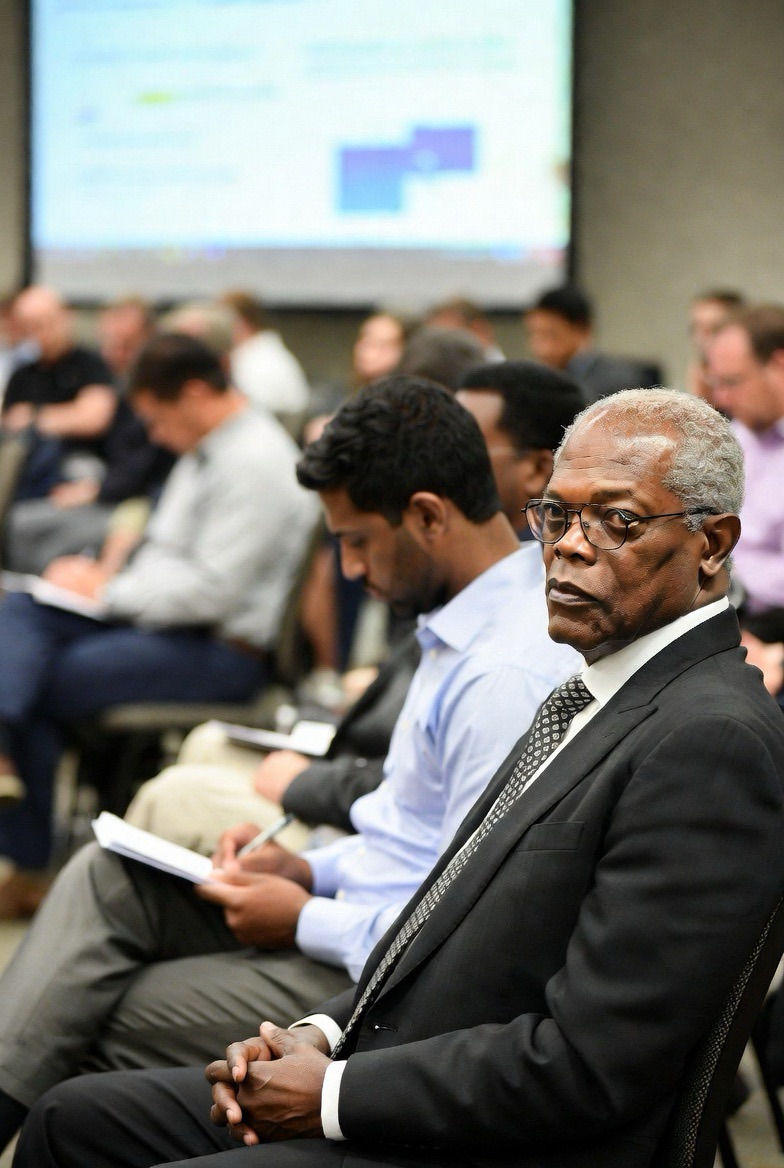
And for the record, there is one famous Sam (other than Altman) who is known to 21st century audiences: Samuel L. Jackson. Although I don’t know if Sam has the temperament to manage proposals.
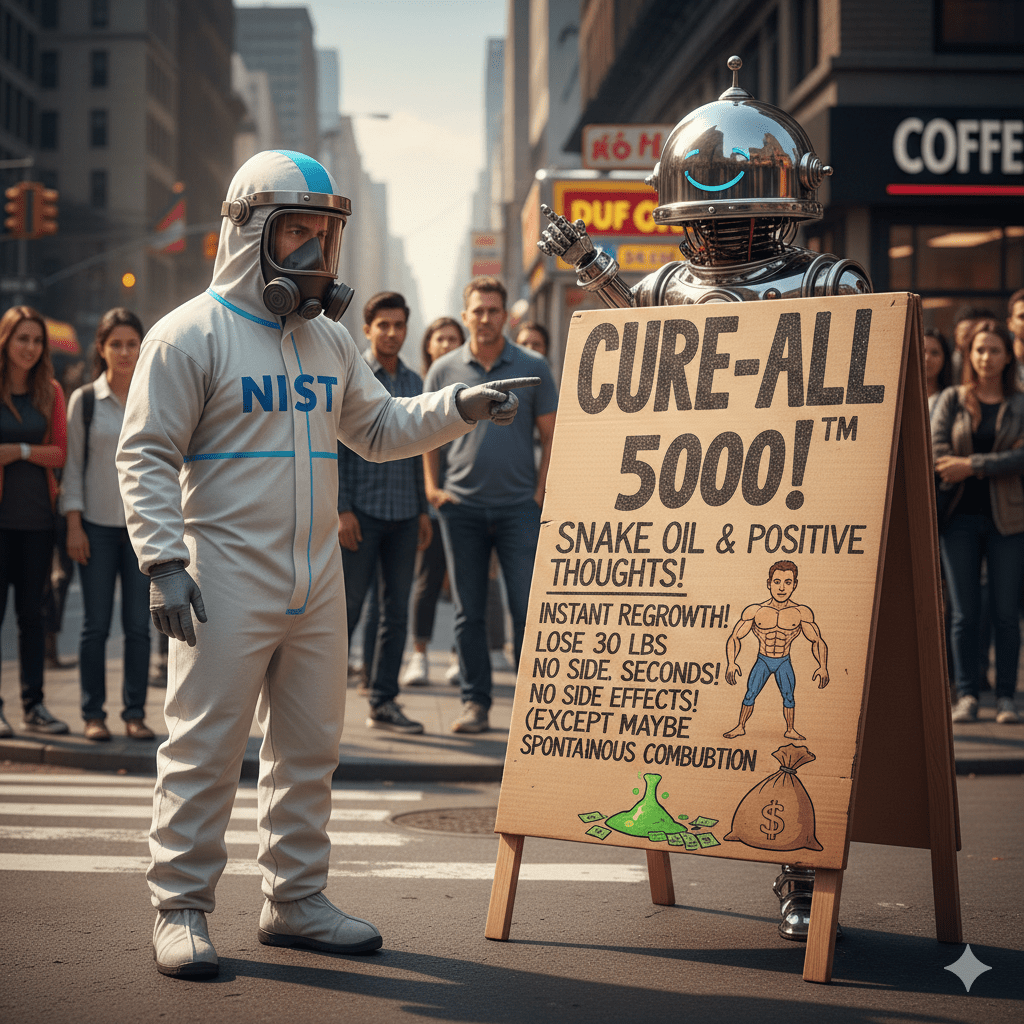
The U.S. National Institute of Standards and Technology (NIST) says that we should…drumroll…adopt standards.
Which is what you’d expect a standards-based government agency to say.
But since I happen to like NIST, I’ll listen to its argument.
“One way AI can prove its trustworthiness is by demonstrating its correctness. If you’ve ever had a generative AI tool confidently give you the wrong answer to a question, you probably appreciate why this is important. If an AI tool says a patient has cancer, the doctor and patient need to know the odds that the AI is right or wrong.
“Another issue is reliability, particularly of the datasets AI tools rely on for information. Just as a hacker can inject a virus into a computer network, someone could intentionally infect an AI dataset to make it work nefariously.”
So we know the risks, but how do we mitigate them?
“Like all technology, AI comes with risks that should be considered and managed. Learn about how NIST is helping to manage those risks with our AI Risk Management Framework. This free tool is recommended for use by AI users, including doctors and hospitals, to help them reap the benefits of AI while also managing the risks.”
“National Blonde Brownie Day on January 22nd recognizes a treat often referred to as blondies.”
Blondie and Blondies.
Now if you had asked me on January 21 what a blonde brownie is, I wouldn’t have known. Now I do…and you will also.
“[A] a blonde brownie is similar to a chocolate brownie. In place of cocoa, bakers use brown sugar when making this delicious brownie, giving it a sweet-tooth-satisfying molasses flavor!”
Just one change and you get something that looks and tastes different.
As you know, one of the seven questions I ask before writing client content is about the emotions that the piece should invoke.
Look at the seventh question I ask.
Should prospects be angry? Scared? Motivated?
Or, can a change in the emotional content of a written piece evoke great paralyzing fear?
(Maybe those tasty brownies contain deadly bacteria.)
If you change the emotion words in a piece of content, you get something that looks and tastes different.
This one’s in Schwyz, in Switzerland, which makes reading of the original story somewhat difficult. But we can safely say that “Eine unbekannte Täterschaft hat zur Täuschung künstliche Intelligenz eingesetzt und so mehrere Millionen Franken erbeutet” is NOT a good thing.
And that’s millions of Swiss francs, not millions of Al Frankens.
“Deploying audio manipulated to sound like a trusted business partner, fraudsters bamboozled an entrepreneur from the canton of Schwyz into transferring “several million Swiss francs” to a bank account in Asia.”
Cybersecurity professionals need to align their efforts with those of the U.S. National Institute of Standards and Technology’s (NIST’s) National Cybersecurity Center of Excellence (NCCoE). Download the NCCoE project portfolio, and plan to attend the February 19 webinar. Details below.
“The NIST National Cybersecurity Center of Excellence (NCCoE) is excited to announce the release of our inaugural Project Portfolio, providing an overview of the NCCoE’s research priorities and active projects.”
“The NCCoE serves as a U.S. cybersecurity innovation hub for the technologies, standards, and architectures for today’s cybersecurity landscape.
“Through our collaborative testbeds and hands-on work with industry, we build and demonstrate practical architectures to address real-world implementation challenges, strengthen emerging standards, and support more secure, interoperable commercial products.
“Our trusted, evidence-based guidelines show how organizations can reduce cybersecurity risks and confidently deploy innovative technologies aligned with secure standards.”
Formal and informal collaborations with other entities.
The NCCoE’s four pillars: Data Protection, Trusted Enterprise, Artificial Intelligence, and Resilient Embedded Systems.
The “forming,” “active,” and “concluding” projects within the pillars, with links to each project.
For example, one of the listed AI projects is the Cyber AI Profile:
“Recent advancements in Artificial Intelligence (AI) technology bring great opportunities to organizations, but also new risks and impacts that need to be managed in the domain of cybersecurity. NIST is evaluating how to use existing frameworks, such as the Cybersecurity Framework (CSF), to assist organizations as they face new or expanded risks.”
This group has published its roadmap, including workshops, working sessions, and document drafts.
And if you are a cybersecurity or identity company needing to communicate how your product protects your users, Bredemarket can help you bring your message to your prospects.
Book a free meeting with me and let’s discuss how we can work together.
Here are details on how Bredemarket works: its services, its process, and its pricing.








 Bredemarket