Easing the Pain of Case Study Creation and Approval

Case studies are powerful marketing collateral for companies.

Why?

Because if you select your subjects carefully, your prospects will say, “That subject is just like me. And the company’s solution solved the subject’s problem. Perhaps the solution will solve my problem also.”

Imagen 4

Ideally a company would want to publish dozens of case studies, so their prospects could find one case study—or perhaps two or three—that describe the exact same problem the prospect is encountering.

It’s hard to create case studies

But case studies are by definition more difficult for a company to create. 

  • For other types of content, the approval process resides completely within the company itself. 
  • But case studies by definition require approval by two companies…even if the end customers in the case studies remain anonymous.

Perhaps that’s why there are so few published, recent case studies.

On Tuesday I had the occasion to visit four technology websites.

  • One had 5 case studies, all written in 2024.
  • One had 4 case studies, all written in 2023 and all anonymous.
  • One had 8 case studies, all written in 2021.
  • One had no case studies at all, even though the company had clients who could be referenced.

And the approvals don’t just involve the end customer.

Imagen 4

A former friend interviewed many customers but was only able to complete one case study; the approvals from company legal, other company executives, and the end customers were overwhelming, delaying the other case studies.

So how do you expedite case study creation and approval?

Three tips for creating case studies

Here are three tips to expedite the creation of case studies.

Creation tip 1: Get the facts first

If the sales rep, program manager, or the subject itself can provide the basic facts beforehand, then the interview can simply consist of confirming facts and filling gaps.

Creation tip 2: Outline the case study and tell your story

Imagen 4

Whether you use the STAR method (situation, task, action, result) or some other method (I prefer the simpler problem, solution, result), take the facts you gathered above. Then fit them into the outline and into the story you want to tell. Then see what pieces of the story are missing.

Creation tip 3: Obtain a meeting transcript

Since the subject has already consented to the case study, they should consent to the meeting being recorded.

The most efficient way to do this is with one of the popular AI note takers, which lets the case study writer review the actual words from the interview without going back and forth through a video recording.

And AI note takers are more efficient than the way I used to transcribe case study interviews.

Three tips for approving case studies

Here are three tips to expedite the approval of case studies.

Approval tip 1: Read the contract

The language of the contract with the subject may have clauses regarding publicity.

If the subject wrote the contract, then it may prohibit any promotional publicity whatsoever, or it may dictate that any publicity must be approved by a high-level governing board in a foreign country.

If the provisions are onerous or impossible, don’t use that subject and find another.

Approval tip 2: Get pre-approvals, or at least grease the wheels

Let your approvers know what’s coming, and when you think it will come.

Once I submitted a case study for pre-approval even before the results were available. This subject had a lengthy approval process, so I wanted the approvers to see the first part of the case study as soon as possible.

Approval tip 3: Use every ethical method to get those approvals

Imagen 4

While the case study may be critically important to you, it may be merely important (or even inconsequential) to the lawyer with 50 other tasks.

From the lawyer’s perspective, it may be better if the company does NOT publish the case study. Fewer potential lawsuits that way.

Do everything you can to expedite the approval. If the CEO is demanding a published case study in three days, say so.

If not…well, that’s why you’re a salesperson. Oh, you’re NOT a salesperson? You are now.

One final tip

You don’t have to go it alone. If your staff is stretched, or if your staff has never written a case study before, Bredemarket can help. Visit my content for tech marketers page.

Is There a Calculator On That Slide Rule?

(Imagen 4)

Once again I’m painting a picture, this time of two people: the IT chick, deftly wielding her slide rule as she sizes up hardware and software, and the finance dude, deftly wielding his calculator as he tabulates profit, loss, and other money stuff. Each of them in their own little worlds.

Despite the thoughts of Norman Marks in his post “Cyber is one of many business risks.”

  • “Many years ago, my friend Ed Hill, a Managing Director with Protiviti at the time, coined the expression ‘there is no such thing as IT risk. There is only business risk.’”
  • “The [Qualsys] report reveals a persistent disconnect between cybersecurity operations and business outcomes. While 49% of respondents reported having formal risk programmes, only 30% link them directly to business objectives. Even fewer (18%) use integrated risk scenarios that consider both business processes and financial exposure.”

I admit that I often draw a clear distinction between technical risk and business risk. For example, the supposedly separate questions regarding whether a third-party risk management (TPRM) algorithm is accurate, and what happens if an end customer sues your company because the end customer’s personally identifiable information was breached on your partner company’s system.

Imagen 4.

So make sure that when your IT chick wields her slide rule, the tool has an embedded calculator on it to quantify the financial effects of her IT decisions.

Is There a Calculator On That Slide Rule?

When Pre-Acquisition Announcements Stalled Negative Activities Affecting Motorola and IDEMIA

When a company announces its intent to buy another company, certain activities at both firms may be stalled.

This can be a good thing, as certain Motorola employees and IDEMIA lawyers know.

Motorola layoffs on hold

In late 2008 and early 2009 Motorola was in trouble—so much trouble that it would eventually bifurcate. (Heh.) So Motorola was laying off employees throughout the company…

…except in the Biometric Business Unit where I resided. Safran had announced its intent purchase that unit, and Motorola was obligated to deliver that unit to Safran intact.

So I kept my job…for another 12 years anyway.

IDEMIA lawsuit on hold

Anyway, Motorola’s Biometric Business Unit became part of Safran and then IDEMIA. And according to ID Tech, IDEMIA is the beneficiary of new acquisition activity.

“A legal dispute between South African Black Economic Empowerment (BEE) firm INFOVERGE and French multinational IDEMIA has stalled, with INFOVERGE citing ongoing acquisition activity involving IDEMIA’s South African subsidiary as the reason for the delay. The firm is seeking R39 million in damages over what it describes as a breach of contractual obligations by IDEMIA.

“INFOVERGE told reporters that it had been informed IDEMIA’s South African division is undergoing a corporate transaction, which has effectively paused the litigation process. ‘We’ve been told that the South African arm of IDEMIA is under acquisition … which leaves our legal matter in some kind of limbo as we wait,’ an INFOVERGE spokesperson said, adding that the prolonged delay is impacting their ability to fulfill their empowerment mandate.”

I’m not sure whether the completed IN Groupe acquisition is the culprit, or if the possible public security sale is to blame.

I’m Bot a Doctor: Consumer-grade Generative AI Dispensation of Health Advice

In the United States, it is a criminal offense for a person to claim they are a health professional when they are not. But what about a non-person entity?

Often technology companies seek regulatory approval before claiming that their hardware or software can be used for medical purposes.

Users aren’t warned that generative AI is not a doctor

Consumer-grade generative AI responses are another matter. Maybe.

“AI companies have now mostly abandoned the once-standard practice of including medical disclaimers and warnings in response to health questions.”

A study led by Sonali Sharma analyzed historical responses to medical questions since 2022. The study included OpenAI, Anthropic, DeepSeek, Google, and xAI. It included both answers to user health questions and analysis of medical images. Note that there is a difference between medical-grade image analysis products used by professionals, and general-purpose image analysis performed by a consumer-facing tool.

Dharma’s conclusion? Generative AI’s “I’m not a doctor” warnings have declined since 2022.

But users ARE warned…sort of

But at least one company claims that users ARE warned.

“An OpenAI spokesperson…pointed to the terms of service. These say that outputs are not intended to diagnose health conditions and that users are ultimately responsible.”

The applicable clause in OpenAI’s TOS can be found in section 9, Medical Use.

“Our Services are not intended for use in the diagnosis or treatment of any health condition. You are responsible for complying with applicable laws for any use of our Services in a medical or healthcare context.”

4479

From OpenAI’s Service Terms.

But the claim “it’s in the TOS” sometimes isn’t sufficient. 

  • I just signed a TOS from a company, but was explicitly reminded that I was signing something that required binding arbitration in place of lawsuits.
  • Is it sufficient to restrict a “don’t rely on me for medical advice; you could die” warning to a document that we MAY only read once?

Proposed “The Bots Want to Kill You” contest

Of course, one way to keep generative AI companies in line is to expose them to the Rod of Ridicule. When the bots provide bad medical advice, expose them:

“Maxwell claimed that in the first message Tessa sent, the bot told her that eating disorder recovery and sustainable weight loss can coexist. Then, it recommended that she should aim to lose 1-2 pounds per week. Tessa also suggested counting calories, regular weigh-ins, and measuring body fat with calipers. 

“‘If I had accessed this chatbot when I was in the throes of my eating disorder, I would NOT have gotten help for my ED. If I had not gotten help, I would not still be alive today,” Maxwell wrote on the social media site. “Every single thing Tessa suggested were things that led to my eating disorder.’”

The organization hosting the bot, the National Eating Disorders Association (NEDA), withdrew the bot within a week.

How can we, um, diagnose additional harmful recommendations delivered without disclaimers?

Maybe a “The Bots Want to Kill You” contest is in order. Contestants would gather reproducible prompts for consumer-grade generative AI applications. The prompt most likely to result in a person’s demise would receive a prize of…well, that still has to be worked out.

My Appearances in Biometric Update in 2015, 2025…and 2035?

Depending upon your background, the fact that I’ve appeared in Biometric Update twice may or may not be a big deal to you. But I’m happy about it.

Biometric Update is a Canadian-based publication that…um…self-identifies as follows:

“We provide the world’s leading news coverage and information on the global biometric technology market via the web and an exclusive daily newsletter. Our daily biometrics updates, industry perspectives, interviews, columns and in-depth features explore a broad range of modalities and methods, from fingerprint, voice, iris, and facial recognition, to cutting-edge technologies like DNA analysis and gait recognition, related identification tools such as behavioral biometrics, and non-biometric identification methods such as identity document verification and telephone forensics. Our coverage touches on all applications and issues dealt with in the sector, including national security, mobile identity, and border control, with a special emphasis on UN Sustainable Development Goal 16.9 to provide universal digital identification and the ID4Africa movement.”

Over the last ten years, there have been two instances in which I have been newsworthy.

2015 with MorphoTrak

The first occurred in 2015, when my then-employer MorphoTrak exhibited an airport gate called MorphoWay at a conference then known as connect:ID. At the 2015 show, I demonstrated MorphoWay for Biometric Update’s videographer.

Me at connect:ID, 2015.

“In the video, Bredehoft scans his passport through the document reader, which checks the passport against a database to verify that it is, in fact, a CBP-authorized document.

“Once verified, the gates automatically open to allow Bredehoft to exit the area.”

2025 with Bredemarket

The second occurred ten years later in 2025, when I wrote a guest opinion piece entitled “Opinion: Vendors must disclose responsible uses of biometric data.” As I previously mentioned, I discussed the need to obtain consent for use of biometric data in certain instances, and noted:

“Some government agencies, private organizations, and biometric vendors have well-established procedures for acquiring the necessary consents.

“Others? Well…”

Biometric Update didn’t create a video this time around, but I did.

Biometric vendors…

2035???

So now that I’ve established a regular cadence for my appearances in Biometric Update, I fully expect to make a third appearance in 2035.

Because of my extensive biometric background, I predict that my 2035 appearance will concern the use of quantum computing to distinguish between a person and their fabricated clone using QCID (quantum clone identification).

No video yet, because I don’t know what video technology will be like ten years from now. So here’s an old fashioned 2D picture.

Imagen 4.

More On AI-Powered Electronic Health Records

(Imagen 4)

My prior post may have given the false impression that Tebra is the only company that employs artificial intelligence to improve the speed and accuracy of electronic health records (EHRs) and electronic medical records (EMRs).

There are actually several companies using AI or other technologies to improve EHR and EMR completion. Here’s a (woefully incomplete) list. Many of these companies also handle other practice management functions required by a medical practice, including intake, telehealth, and payments.

In addition, the really big bunch (Google, IBM, Microsoft, Oracle) all play in the space.

Who did I miss?

Oh, and if any of these companies need a product marketing consultant (or employee) to get the message out about your product, talk to me.

Increasing Speed and Accuracy of Electronic Health Record (EHR) Note Taking

(Imagen 4)

Electronic health records (EHRs) can be a pain in a particular body part. But Tebra and other firms offer ways to automate portions of the record keeping process. And if these automations work, they also increase EHR accuracy.

I’ve previously talked about how an EHR can incorporate a patient identifier, derived from the facial recognition of the patient. This prevents misidentification, which can cause severe problems if the EHR data is applied to the wrong patient.

But how do you populate the rest of the EHR?

According to Tebra, with EHR+.

“Tebra’s EHR+ platform connects care, billing, scheduling, and more. Built-in AI speeds up notes, handles reviews, and automates repetitive admin work.”

Tebra’s AI Note Assist claims to “[t]urn spoken or written words into structured notes,” presumably using natural language processing (NLP) and machine learning specifically trained on medical record keeping.

But always remember to comply with health, privacy, and other relevant laws.

“Before using AI-powered scribe tools, review applicable laws and regulations in your practice’s jurisdiction regarding electronic recordings, AI scribes, and informed consent. Some jurisdictions require verbal or written consent prior to any form of ambient documentation. Check your state board or consult legal counsel for guidance.”

And watch the video.

But Tebra and its competitors face a problem: you can only scream “AI” for so long before your prospects ask, “So what?” 

Bredemarket can create written content for tech marketers that attracts prospects.

Contact Bredemarket.

Content for tech marketers.

Crypto Transfers Without KYC

(Imagen 4)

Have you ever played a smartphone game that gives you a teeny bit of crypto?

So little crypto that it’s not measured in Bitcoin, but in satoshis (where 100 million satoshis equals one bitcoin)?

If so, you probably didn’t have to undergo a Know Your Customer (KYC) check to verify your financial identity.

Renno and Company explains why not:

“If a virtual currency transfer of $1,000 or more occurs, the client’s identity must be verified. This step is critical in the digital currency world, where anonymity can lead to misuse.

“If there is a virtual currency exchange of $1,000 or more, identity verification is also required. This helps ensure that all exchanges are transparent and not used for illegal purposes.”

If you find a smartphone game that pays more than $1,000 a pop…let me know.

And if you want to transact crypto, StealthEX supports no-KYC transactions:

“Thanks to StealthEX you can now purchase an amount of crypto without KYC if it’s less than $700 or the equivalent of this amount in other currencies. As long as your total purchases don’t exceed $700, you don’t have to verify your identity. You can make one big purchase or several small $20, $50 or $100 transactions. StealthEX allows users to seamlessly exchange their assets across chains in minutes without the need to verify their identity.”

Yeah, $700 rather than $1,000. StealthEX is…um…playing it safe.

What Are Fingerprint Minutiae?

(Imagen 4)

(Part of the biometric product marketing expert series)

Because many of the subscribers and followers of my Substack page aren’t fingerprint experts (although a few are), my posts on Substack tend to be more introductory. So I wrote this for Substack, but also decided to share it on the Bredemarket blog at some point.

So let’s define what fingerprint minutiae are. 

To do this, look at the tip of one of the fingers on your hand…but not too closely. (Or just Level 2, not Level 3.)

If you look sort of closely at your fingertip, you see one commonality between (most) fingers and Ruffles: both have ridges. For purposes of this exercise, take a close look at where the ridges go.

  • In some cases, the ridges just stop and go no further.
  • In other cases, a single ridge splits into two or more ridges. Or if you want to follow a different perspective, two or more ridges combine into a single ridge. But that perspective screws up the discussion later.
  • Ridges do other things which I will ignore for now.

The important things is that you can identify the specific point at which a ridge ending occurs. And you can identify the specific point of a bifurcation, where a ridge splits into two ridges. (If a ridge splits into three, that’s a trifurcation.)

Those ridge ending and bifurcation points? Those are the minutiae.

Human fingerprint examiners can identify these minutiae points.

So can the algorithms on an automated fingerprint identification system (AFIS) or an automated biometric identification system (ABIS).

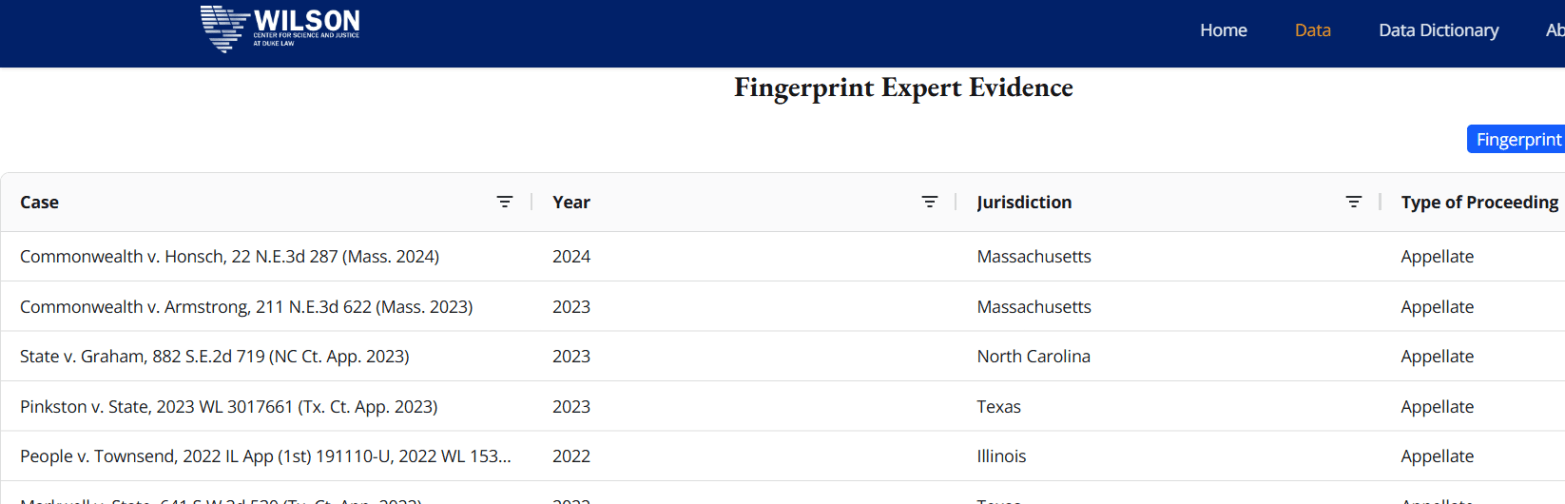
And if two fingers have minutiae in the same locations, and don’t have minutiae in one finger that are not present on the other finger…then they’re the same finger. (I’m simplifying here, since the quality of the prints and the way the skin bends affect the ability to find minutiae.)

Which means that if the police find a fingerprint on a stolen car that doesn’t belong to the owner…

…and the minutiae on your finger match the minutiae on the print from the car…

…you’d better have a good lawyer.

Oh, and one more thing: you also have ridges, ridge endings, and bifurcations on your palms and toes. So don’t try to steal a car while barefoot.

From the Summer of Privacy to California SB 690

Harry Chambers of OneTrust gave a far-reaching overview of the worldwide state of privacy legislation this morning. Chambers covered a ton of topics, but I’m going to focus on proposed changes to the California Invasion of Privacy Act, or CIPA.

As Fisher Phillips notes, this is not a new act. And that’s the problem.

“CIPA was originally enacted in 1967 to combat traditional wiretapping and eavesdropping, primarily in the context of telephone communications. It was never designed to address the complexities of the digital age or regulate how businesses track user interactions on the internet.”

But that didn’t stop the lawyers. As Chambers noted, a ton of lawsuits tried to apply 1967 law to modern use cases, including (Fisher Phillips) “routine website technologies such as cookies, pixels, search bar/form, chatbots, and session replay tools.”

Heck, back in 1967 cookies made you high. Whoops, that’s brownies.

Imagen 4.

You can imagine how California technology businesses felt about this. Chatbots as illegal wiretapping? Ouch.

Imagen 4.

Enter California SB 690 to stop what Fisher Phillips called a “shakedown” (settle or you’ll go to court). It proposed to align CIPA with the “commercial business purposes” definition under CCPA as amended.

Imagen 4. For the story behind this picture, see “AI Still Has Bias.”

On June 3, the California Senate unanimously approved SB 690.

But submission to the California Assembly is delayed:

“On July 2, the author of SB 690, State Senator Anna Caballero (D-14), announced she was pausing SB 690, holding it in the Assembly until at least 2026. Caballero cited ‘outstanding concerns around consumer privacy,’ and acknowledged continued opposition from consumer privacy advocates and attorneys’ groups.”

So the lawsuits can continue until morale improves.