Who are you?
What is that?
Identity and cybersecurity are pretty basic, when you think about it.
(Imagen 3)
Identity/biometrics/technology marketing and writing services
Who are you?
What is that?
Identity and cybersecurity are pretty basic, when you think about it.
(Imagen 3)
I recently discussed some proposed changes to the way in which beneficial ownership information (BOI) is collected. However, even after the changes are made, FinCEN will still collect BOI for foreign firms.
Biometric Update recently published a story about facial recognition in Hungary, and its use to identify people who display rainbows and dress in ways “that diverge from the gender they were assigned at birth.” I’m going to zero in on one portion of the story: the facial recognition provider involved.
The company FaceKom has been around under different names since 2010 but has seen significant growth during the past few years thanks to investments from the Central European Opportunity Private Equity Fund (CEOM). The fund has no direct links with [Prime Minister Orbán’s son-in-law, István] Tiborcz. However, it is registered on the same address in Budapest where several companies owned by Orbán ‘s son-in-law operate.
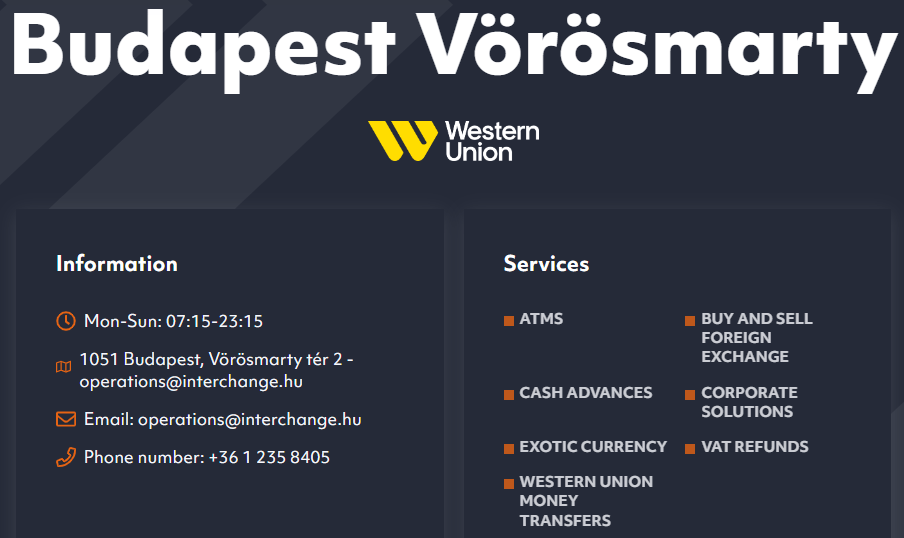
Ah, geolocation! The Chi Fu Investment Fund Management Zrt.’s address of record is 1051 Budapest, Vörösmarty tér 2.
And do you know what else is at that address?
A Western Union Currency Exchange.
Well, that’s enough to drive some conspiracy theorists crazy.
So I didn’t find the smoking gun, but I do want to take this opportunity to point out what BENEFICIAL ownership is. Investopedia:
A beneficial owner is a person who enjoys the benefits of ownership even though the title to some form of property is in another name.
Using the Hungarian example (without the Western Union part), it’s not enough to say that CEOM and/or Chi Fu Investment Fund Management Zrt. (I don’t know enough Hungarian to confirm they are one and the same) does not list István Tiborcz (or Victor Orbán) as an official owner or co-owner.
As Unit21 points out, you don’t have to literally own (either on your own or through a trust) 25% of an entity to be a beneficial owner. Here’s another criterion of a beneficial owner:
Any individual that holds a significant ability to control, manage, or direct the legal entity
De facto control without de jure control could very well be wielded by a powerful politician, or his son-in-law.
(Imagen 3)

A Bredemarket message about financial identity and anti-money laundering (AML) enforcement.
Tell your firm’s fraud-fighting story: https://bredemarket.com/cpa/
(Money laundering picture from Imagen 3)
AuthenticID shared the following:
“In March, the U.S. Treasury Department announced it would no longer enforce the Corporate Transparency Act, the anti-money-laundering law that requires millions of businesses to disclose the identity of their real beneficial owners.”
Not entirely accurate as we will see, but the details are gated. But not at JD Supra:
“On March 26, 2025, FinCEN issued an interim final rule and request for comments, removing the requirement under the Corporate Transparency Act (CTA) for both U.S. companies and U.S. persons to report beneficial ownership information to FinCEN. The rule is effective March 26, 2025. Thus, subject to additional rule changes, U.S. companies and U.S. individuals no longer have to file an initial Beneficial Ownership Information Report (BOIR) or otherwise update or correct a previously filed BOIR.”
As the interim rule itself clarifies, foreign companies still have to report.
“On March 2, 2025, Treasury announced the suspension of enforcement of the CTA against U.S. citizens, domestic reporting companies, and their beneficial owners, and Treasury further announced its intent to engage in a rulemaking to narrow the Reporting Rule to foreign reporting companies only.”
The interim rule itself addresses the convoluted history (one, two, three) of FinCEN’s attempts to enforce anti-money laundering (AML) laws as court challenges persist.
I will let you judge whether this is welcome relief from bureaucracy for American companies, or a huge FinCEN loophole that facilitates AML financial identity evasion by simply letting companies represent themselves as domestic, allowing them to launder as much money as they please for terrorists, drug dealers, and others.
Not that I have an opinion on that.
(Business terrorist image Imagen 3/Google Gemini)
Compelling CONTENT Creation
Winning PROPOSAL Development
Actionable ANALYSIS
Bredemarket’s “CPA” marketing and writing consulting services for identity and technology firms.
Schedule a Free 30 minute content needs assessment:
There’s a paper from Itiel Dror that I need to read. Its title is “Biased and Biasing: The Hidden Bias Cascade and Bias Snowball Effects.”
Here is a portion of the abstract:
“Cognitive bias…impacts each and every aspect of the justice and legal systems, from the initial engagement of police officers attending the crime scene, through the forensic examination, and all the way to the final outcome of the jurors’ verdict and the judges’ sentencing. It impacts not only the subjective elements in the justice and legal systems but also the more objective scientific elements, such as forensic fingerprinting and DNA….[S]uch errors in the final outcome rarely occur because they require that the shortcomings in each element be coordinated and aligned with the other elements. However, in the justice and legal systems, the different elements are not independent; they are coordinated and mutually support and bias each other, creating and enabling hidden bias cascade and bias snowball effects.”
I learned about the following story via the Identity Jedi, which leads me to my early and self-serving call to action:
If you’re interested in identity, The Identity Jedi Newsletter is a must-read. It’s packed with educational and insightful content. And if you would like to subscribe to the newsletter, please use my referral link: https://www.theidentityjedi.com/subscribe?ref=YoUVK0Uos1&_bhlid=7fecfad9eb7fd8bcdb529e945e11346b5897acdc I’m in the running to get an Identity Jedi mug. Thanks.
Enough self-serving content. Let’s get to what I learned about in the newsletter: namely, this article from CSO Online, “The urgent reality of machine identity security in 2025.”
As you know, I’ve been spending more and more time concentrating on identity issues when a person is not present. This is what the attribute-based access control folks refer to as “non-person entities” (NPEs).
In the article, CyberArk’s Scott Carter makes the following points:
What does this mean?
Well, for CyberArk, it means that it endorses technologies such as automating certificate lifecycle management. And by the strangest coincidence, CyberArk offers a solution…
But for us, it means that we don’t only need automation, but we also need governing processes to ensure that ALL the people and NPEs that are accessing our systems are properly managed, quickly commissioned, and quickly decommissioned.
(Image from Imagen 3. Yes, I’m falling into the habit of reusing images for multiple use cases. It’s easier that way.)
I’m admittedly fascinated by the parallels between people and non-person entities (NPEs), to the point where I asked at one point whether NPEs can use the factors of authentication. (All six. Long story.)
When I got to the “something you are” factor, which corresponds to biometrics in humans, here is what I wrote:
Something you are. For simplicity’s sake, I’ll stick to physical objects here, ranging from pocket calculators to hand-made ceramic plates. The major reason that we like to use “something you are” as a factor is the promise of uniqueness. We believe that fingerprints are unique (well, most of us), and that irises are unique, and that DNA is unique except for identical twins. But is a pocket calculator truly unique, given that the same assembly line manufactures many pocket calculators? Perhaps ceramic plates exhibit uniqueness, perhaps not.
But I missed one thing in that discussion, so I wanted to revisit it.
Now this doesn’t apply to ceramic plates or pocket calculators, but there are some NPEs that assert uniqueness.
Our smartphones, each of which has an International Mobile Equipment Identity (IMEI) number.
Let’s start off with the high level explanation.
IMEI stands for International Mobile Equipment Identity. It’s a unique identifier for mobile devices, much like a fingerprint for your phone’s IMEI number.
Now some of you who are familiar with biometrics are saying, “Hold it right there.”
But let’s stick to phones, Johnny.
Each IMEI number is a 15-digit code that’s assigned to every mobile phone during its production. This number helps in uniquely identifying a device regardless of the SIM card used.
This is an important point here. Even Americans understand that SIM cards are transient and can move from one phone to another, and therefore are not valid to uniquely identify phones.
What about IMEIs?
I won’t go into the specifics of the 15-digit IMEI number format, which you can read about here. Suffice it to say that the format dictates that the number incorporate the make and model, a serial number, and a check digit.
Why not? Because everyone says so.
It’s even part of the law.
Changing an IMEI number is illegal in many countries due to the potential misuse, such as using a stolen phone. Tampering with the IMEI can lead to severe legal consequences, including fines and imprisonment. This regulation helps in maintaining the integrity of mobile device tracking and discourages the theft and illegal resale of devices.
To all of the evidence above about the uniqueness of IMEI numbers, I only have two words:
So what?
A dedicated person can create or modify multiple smartphones to have the exact same IMEI number if desired. Here’s a recent example:
The Indore Police Crime Branch has dismantled two major digital arrest fraud rackets operating in different parts of the country, seizing a massive database containing private details of 20,000 pensioners in Indore….
A dark room in the flat functioned as the nerve centre of the cyber fraud operation, which had been active since 2019. The group specialised in IMEI cloning and used thousands of SIM cards from select mobile networks.
“Oh, but that’s India,” you say. “That couldn’t happen in a First World country.”
A Calgary senior is warning others after he was scammed out of $1,000 after buying what he thought was a new iPhone 15 Pro Max.
“I didn’t have any doubt that it was real,” Boyd told Global News….
The seller even provided him with the “original” receipt showing the phone had been purchased down east back in October 2023. Boyd said he also checked the phone’s serial number and the International Mobile Equipment Identity (IMEI). All checked out fine.
Boyd said the first sign of a problem was when he tried to update the phone with his own information and it wouldn’t update. It was only after he took it to a representative at a local Apple retailer, that he realized he had been duped.
Even IMEICheck.net, which notes that the threat of stealing one’s phone information is overrated, admits that it is possible (albeit difficult) to clone an IMEI number.
In theory, hackers can clone a phone using its IMEI, but this requires significant effort. They need physical access to the device or SIM card to extract data, typically using specialized tools.
The cloning process involves copying the IMEI and other credentials necessary to create a functional duplicate of the phone. However, IMEI number security features in modern devices are designed to prevent unauthorized cloning. Even if cloning is successful, hackers cannot access personal data such as apps, messages, photos, or passwords. Cloning usually only affects network-related functions, such as making calls or sending messages from the cloned device.
Again, NOTHING provides 100.00000% security. Not even an IMEI number.
So if you are claiming uniqueness of your smartphone’s IMEI, be aware that there are proven examples to the contrary.
Perhaps the shortcomings of IMEI uniqueness don’t matter in your case, and using IMEIs for individualization is “good enough.”
But I wouldn’t discuss war plans on such a device.
(Imagen 3 image. Oddly enough, Google Gemini was unable, or unwilling, to generate an image of three smartphones displaying the exact same 15-digit string of numbers, or even a 2-digit string. I guess Google thought I was a fraudster.)
Oh, and since I mentioned pocket calculators…excuse me, calcolatrici tascabili…
(Part of the biometric product marketing expert series)
Two Biometric Update stories that were published on March 27, 2025 reminded me of something I wrote before.
An announcement from Paravision says its biometric age estimation technology has achieved Level 3 certification from the Age Check Certification Scheme (ACCS), the leading independent certification body for age estimation. The results make it one of only six companies globally to receive ACCS’s highest-level designation for compliance.
San Francisco-based Paravision’s age estimation tech posted 100 percent precision in Challenge 25 compliance, with 0 subjects falsely identified as over 25 years old. It also scored a 0 percent Failure to Acquire Rate, meaning that every image submitted for analysis returned a result. Mean Absolute Error (MAE) was 1.37 years, with Standard Deviation of 1.17.
Now this is an impressive achievement, and Paravision is a quality company, and Joey Pritikin is a quality biometric executive, but…well, let me share the other story first, involving a Yoti customer (not Yoti).
Fenix responded that it set a challenge threshold at 23 years of age. Any user estimated to be that age or younger based on their face biometrics is required to use a secondary method for age verification.
Fenix had set OnlyFans challenge age, it turns out, at 20 years old. A correction to 23 years old was carried out on January 16, and then Fenix changed it again three days later, to 21 years old, Ofcom says.
Now Biometric Update was very clear that “Yoti provides the tech, but does not set the threshold.”
But do challenge thresholds have any meaning? I addressed that issue back in May 2024.
Many of the tests used a “Challenge-T” policy, such as “Challenge 25.” In other words, the test doesn’t estimate whether a person IS a particular age, but whether a person is WELL ABOVE a particular age….
So if you have to be 21 to access a good or service, the algorithm doesn’t estimate if you are over 21. Instead, it estimates whether you are over 25. If the algorithm thinks you’re over 25, you’re good to go. If it thinks you’re 24, pull out your ID card.
And if you want to be more accurate, raise the challenge age from 25 to 28.
NIST admits that this procedure results in a “tradeoff between protecting young people and inconveniencing older subjects” (where “older” is someone who is above the legal age but below the challenge age).
You may be asking why the algorithms have to set a challenge age above the lawful age, thus inconveniencing people above the lawful age but below the challenge age.
The reason is simple.
Age estimation is not all that accurate.
I mean, it’s accurate enough if I (a person well above the age of 21 years) must indicate whether I’m old enough to drink, but it’s not sufficiently accurate for a drinker on their 21st birthday (in the U.S.), or a 13 year old getting their first social media account (where lawful).

If you have a government issued ID, age verification based upon that ID is a much better (albeit less convenient) solution.
(Kid computer picture by Adrian Pingstone – Transferred from en.wikipedia, Public Domain, https://commons.wikimedia.org/w/index.php?curid=112727.)
(Fake driver license picture from https://www.etsy.com/listing/1511398513/editable-little-drivers-license.)
As you may have noticed, I have talked about both deepfakes and synthetic identity ad nauseum.
But perhaps you would prefer to hear from someone who knows what they’re talking about.
On a webcast this morning, C. Maxine Most of The Prism Project reminded us that the “Biometric Digital Identity Deepfake and Synthetic Identity Prism Report” is scheduled for publication in May 2025, just a little over a month from now.
As with all other Prism Project publications, I expect a report that details the identity industry’s solutions to battle deepfakes and synthetic identities, and the vendors who provide them.
And the report is coming from one of the few industry researchers who knows the industry. Max doesn’t write synthetic identity reports one week and refrigerator reports the next, if you know what I mean.
At this point The Prism Project is soliciting sponsorships. Quality work doesn’t come for free, you know. If your company is interested in sponsoring the report, visit this link.
And while you’re waiting for Max’s authoritative report on deepfakes and synthetic identity, you may want to take a look at Min’s (my) views, such as they are. Here are my current “five tops” posts on deepfakes and synthetic identity.