Bredemarket’s services are grouped into two distinct and separate functions: content marketing (blog posts, white papers, etc.) and proposals (RFI responses, RFP responses, sole source letters, etc.).
My division of my services makes sense in the real world. After all, in some employment situations, content marketing and proposals employ distinct and separate sets of employees.
But other companies are different. In fact, I’ve seen employment ads seeking marketing/proposals managers. Sounds like a lot of work, unless the company submits few proposals or performs minimal marketing.
And in many companies there are NOT dedicated proposals specialists. Which is why Bredemarket makes its money by helping the salespeople at these firms get the documents out.
Time for the truth
And if we’re truthful with ourselves, content marketing and proposals are pretty much the same thing.
I know this angers some people, who insist that they are content marketing professionals or proposal professionals, with all the proper certifications that a mere mortal could never attain. Or they did attain it, but it lapsed. Or is about to lapse unless I renew it in time.
But hear me out. I’m going to list four aspects of a particular document, and you tell me whether I’m talking about a piece of marketing content, or a proposal.
The document describes benefits the customer will realize.
The document targets one or more sets of people hungry for the solution.
The document shall be in Aptos 12 point, single spaced, with 1 inch margins, and shall not exceed 20 pages.
Guess what? From that description you CAN’T tell if it’s a piece of content or a proposal.
Yes, I know some of you thought item 4 was a dead giveaway because it sounded like an RFP requirement, but maybe some company’s brand guidelines dictate that the firm’s white papers must conform to that format. You never know.
And I know that when you get into the minutiae, there are certain things that proposal writers do that content marketers don’t have to worry about, and vice versa.
But at a high level, the content marketer already knows 90% of the things they need to know to write proposals. And vice versa.
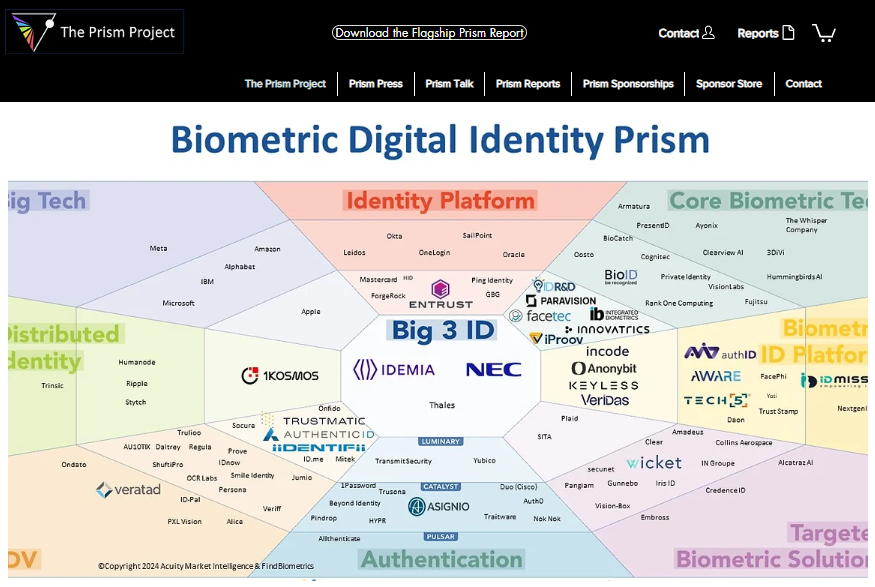
The Prism Project’s home page at https://www.the-prism-project.com/, illustrating the Biometric Digital Identity Prism as of March 2024. From Acuity Market Intelligence and FindBiometrics.
With over 100 firms in the biometric industry, their offerings are going to naturally differ—even if all the firms are TRYING to copy each other and offer “me too” solutions.
I’ve worked for over a dozen biometric firms as an employee or independent contractor, and I’ve analyzed over 80 biometric firms in competitive intelligence exercises, so I’m well aware of the vast implementation differences between the biometric offerings.
Some of the implementation differences provoke vehement disagreements between biometric firms regarding which choice is correct. Yes, we FIGHT.
Let’s look at three (out of many) of these implementation differences and see how they affect YOUR company’s content marketing efforts—whether you’re engaging in identity blog post writing, or some other content marketing activity.
The three biometric implementation choices
Firms that develop biometric solutions make (or should make) the following choices when implementing their solutions.
Presentation attack detection. Assuming the solution incorporates presentation attack detection (liveness detection), or a way of detecting whether the presented biometric is real or a spoof, the firm must decide whether to use active or passive liveness detection.
Age assurance. When choosing age assurance solutions that determine whether a person is old enough to access a product or service, the firm must decide whether or not age estimation is acceptable.
Biometric modality. Finally, the firm must choose which biometric modalities to support. While there are a number of modality wars involving all the biometric modalities, this post is going to limit itself to the question of whether or not voice biometrics are acceptable.
I will address each of these questions in turn, highlighting the pros and cons of each implementation choice. After that, we’ll see how this affects your firm’s content marketing.
(I)nstead of capturing a true biometric from a person, the biometric sensor is fooled into capturing a fake biometric: an artificial finger, a face with a mask on it, or a face on a video screen (rather than a face of a live person).
This tomfoolery is called a “presentation attack” (becuase you’re attacking security with a fake presentation).
And an organization called iBeta is one of the testing facilities authorized to test in accordance with the standard and to determine whether a biometric reader can detect the “liveness” of a biometric sample.
(Friends, I’m not going to get into passive liveness and active liveness. That’s best saved for another day.)
Now I could cite a firm using active liveness detection to say why it’s great, or I could cite a firm using passive liveness detection to say why it’s great. But perhaps the most balanced assessment comes from facia, which offers both types of liveness detection. How does facia define the two types of liveness detection?
Active liveness detection, as the name suggests, requires some sort of activity from the user. If a system is unable to detect liveness, it will ask the user to perform some specific actions such as nodding, blinking or any other facial movement. This allows the system to detect natural movements and separate it from a system trying to mimic a human being….
Passive liveness detection operates discreetly in the background, requiring no explicit action from the user. The system’s artificial intelligence continuously analyses facial movements, depth, texture, and other biometric indicators to detect an individual’s liveness.
Pros and cons
Briefly, the pros and cons of the two methods are as follows:
While active liveness detection offers robust protection, requires clear consent, and acts as a deterrent, it is hard to use, complex, and slow.
Passive liveness detection offers an enhanced user experience via ease of use and speed and is easier to integrate with other solutions, but it incorporates privacy concerns (passive liveness detection can be implemented without the user’s knowledge) and may not be used in high-risk situations.
So in truth the choice is up to each firm. I’ve worked with firms that used both liveness detection methods, and while I’ve spent most of my time with passive implementations, the active ones can work also.
A perfect wishy-washy statement that will get BOTH sides angry at me. (Except perhaps for companies like facia that use both.)
If you need to know a person’s age, you can ask them. Because people never lie.
Well, maybe they do. There are two better age assurance methods:
Age verification, where you obtain a person’s government-issued identity document with a confirmed birthdate, confirm that the identity document truly belongs to the person, and then simply check the date of birth on the identity document and determine whether the person is old enough to access the product or service.
Age estimation, where you don’t use a government-issued identity document and instead examine the face and estimate the person’s age.
I changed my mind on age estimation
I’ve gone back and forth on this. As I previously mentioned, my employment history includes time with a firm produces driver’s licenses for the majority of U.S. states. And back when that firm was providing my paycheck, I was financially incentivized to champion age verification based upon the driver’s licenses that my company (or occasionally some inferior company) produced.
But as age assurance applications moved into other areas such as social media use, a problem occurred since 13 year olds usually don’t have government IDs. A few of them may have passports or other government IDs, but none of them have driver’s licenses.
But does age estimation work? I’m not sure if ANYONE has posted a non-biased view, so I’ll try to do so myself.
The pros of age estimation include its applicability to all ages including young people, its protection of privacy since it requires no information about the individual identity, and its ease of use since you don’t have to dig for your physical driver’s license or your mobile driver’s license—your face is already there.
The huge con of age estimation is that it is by definition an estimate. If I show a bartender my driver’s license before buying a beer, they will know whether I am 20 years and 364 days old and ineligible to purchase alcohol, or whether I am 21 years and 0 days old and eligible. Estimates aren’t that precise.
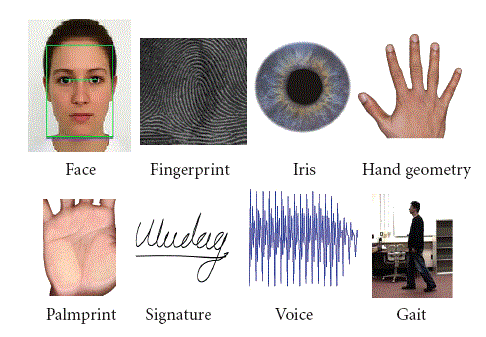
Fingerprints, palm prints, faces, irises, and everything up to gait. (And behavioral biometrics.) There are a lot of biometric modalities out there, and one that has been around for years is the voice biometric.
I’ve discussed this topic before, and the partial title of the post (“We’ll Survive Voice Spoofing”) gives away how I feel about the matter, but I’ll present both sides of the issue.
No one can deny that voice spoofing exists and is effective, but many of the examples cited by the popular press are cases in which a HUMAN (rather than an ALGORITHM) was fooled by a deepfake voice. But voice recognition software can also be fooled.
Take a study from the University of Waterloo, summarized here, that proclaims: “Computer scientists at the University of Waterloo have discovered a method of attack that can successfully bypass voice authentication security systems with up to a 99% success rate after only six tries.”
If you re-read that sentence, you will notice that it includes the words “up to.” Those words are significant if you actually read the article.
In a recent test against Amazon Connect’s voice authentication system, they achieved a 10 per cent success rate in one four-second attack, with this rate rising to over 40 per cent in less than thirty seconds. With some of the less sophisticated voice authentication systems they targeted, they achieved a 99 per cent success rate after six attempts.
Other voice spoofing studies
Similar to Gender Shades, the University of Waterloo study does not appear to have tested hundreds of voice recognition algorithms. But there are other studies.
The 2021 NIST Speaker Recognition Evaluation (PDF here) tested results from 15 teams, but this test was not specific to spoofing.
A test that was specific to spoofing was the ASVspoof 2021 test with 54 team participants, but the ASVspoof 2021 results are only accessible in abstract form, with no detailed results.
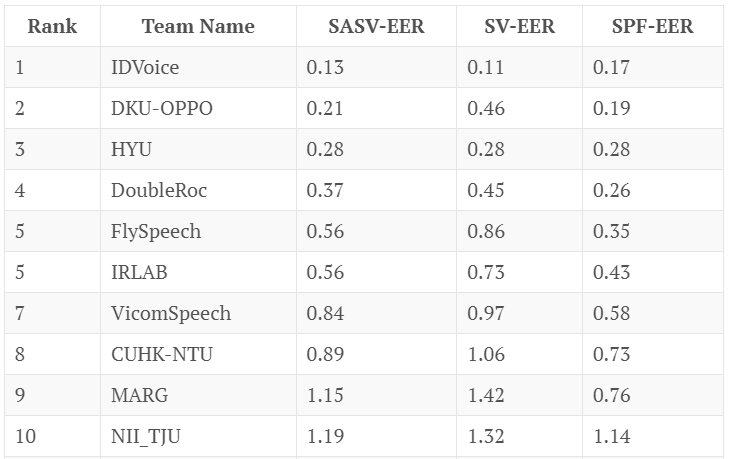
Another test, this one with results, is the SASV2022 challenge, with 23 valid submissions. Here are the top 10 performers and their error rates.
You’ll note that the top performers don’t have error rates anywhere near the University of Waterloo’s 99 percent.
So some firms will argue that voice recognition can be spoofed and thus cannot be trusted, while other firms will argue that the best voice recognition algorithms are rarely fooled.
What does this mean for your company?
Obviously, different firms are going to respond to the three questions above in different ways.
For example, a firm that offers face biometrics but not voice biometrics will convey how voice is not a secure modality due to the ease of spoofing. “Do you want to lose tens of millions of dollars?”
A firm that offers voice biometrics but not face biometrics will emphasize its spoof detection capabilities (and cast shade on face spoofing). “We tested our algorithm against that voice fake that was in the news, and we detected the voice as a deepfake!”
There is no universal truth here, and the message your firm conveys depends upon your firm’s unique characteristics.
And those characteristics can change.
Once when I was working for a client, this firm had made a particular choice with one of these three questions. Therefore, when I was writing for the client, I wrote in a way that argued the client’s position.
After I stopped working for this particular client, the client’s position changed and the firm adopted the opposite view of the question.
Therefore I had to message the client and say, “Hey, remember that piece I wrote for you that said this? Well, you’d better edit it, now that you’ve changed your mind on the question…”
Bear this in mind as you create your blog, white paper, case study, or other identity/biometric content, or have someone like the biometric content marketing expert Bredemarket work with you to create your content. There are people who sincerely hold the opposite belief of your firm…but your firm needs to argue that those people are, um, misinformed.
Let’s say that your identity/biometric firm has decided that silence ISN’T golden, and that perhaps your firm needs to talk about its products and services.
So you turn to your favorite generative AI tool to write something that will represent your company in front of everyone. What could go wrong?
Battling synthetic identities requires a multi-pronged approach. Layering advanced technology is key: robust identity verification using government-issued IDs and biometrics to confirm a person’s existence, data enrichment and validation from diverse sources to check for inconsistencies, and machine learning algorithms to identify suspicious patterns and red flags. Collaboration is crucial too, from financial institutions sharing watchlists to governments strengthening regulations and consumers practicing good cyber hygiene. Ultimately, vigilance and a layered defense are the best weapons against these ever-evolving digital phantoms.
From Google Bard.
Great. You’re done, and you saved a lot of money by NOT hiring an identity blog writing expert. The text makes a lot of important points, so I’m sure that your prospects will be inspired by it.
Bot-speak is not an optimal communication strategy either. Generated at craiyon.com.
Well…
…until your prospects ask what YOU do and how you are better than every other identity firm out there. If you’re the same as all the other “me too” solutions, then your prospects will just go with the lowest price provider.
So how do you go about intelligently writing about biometrics?
Intelligently writing about biometrics doesn’t only require some critical words such as “validation.”
Intelligently writing about biometrics doesn’t only require that you KNOW what those words mean, and that you’re conversant in basic biometric topics. (If you want to know five topics a biometric content marketing expert needs to understand, read my post on that subject.)
Intelligently writing about biometrics requires that you put all of this information together AND effectively communicate your message…
…including why your identity/biometrics firm is great and why all the other identity/biometric firms are NOT great.
If you’re doing this on your own, be sure to ask yourself a lot of questions so that you get started on the right track.
If you’re asking Bredemarket to help you create your identity/biometric content by intelligently writing about biometrics, I’ll take care of the questions.
Oh, and one more thing: if you noted my use of the word “no siree” earlier in this post, it was taken from the Talking Heads song “The Big Country.” Here’s an independent video of that song, especially recommended for people outside of North America who may not realize that the United States and Canada are…well, big countries.
Bredemarket spends a lot of its time on competitive analysis, either as part of client projects, or for my own personal edification. For example, right now I’m working on a client project and analyzing 20 of the client’s competitors in over 20 markets serving hundreds of customers.
But when I perform competitive analysis, I use entirely ethical and legal methods to obtain my competitive information. Nothing clandestine that will get me in trouble.
But sometimes the well of competitive information goes dry. Companies go silent and then come back, with no explanation of why its former communications were…um…incomplete.
Of course, I don’t know why a particular company suddenly decides that prospect/customer communication isn’t critically important.
But this got me thinking. How often DO companies go silent?
And I had an excellent way to conduct a mini-survey and find out.
Are the 40+ blogging identity firms still blogging?
Back in September, I identified over 40 identity firms that were blogging, some more frequently than others. Blogging provides quantifiable benefits, and these companies were obviously taking advantage of those benefits.
But that was back in September. How many of those companies were still actively blogging in mid-December? I wanted to find out, so I conducted a mini-survey of those identity blogs. Of the 40+ companies whose blogs and articles had identifiable posting dates:
21 had blogged at least once this month (December).
11 had last blogged in November.
3 had last blogged in October.
7 hadn’t blogged since the 3rd calendar quarter of 2023 (July – September).
4 hadn’t blogged since the 2nd calendar quarter (April – June).
1 hadn’t blogged since the 1st calendar quarter (January – March).
1 hadn’t blogged at all in 2023. Perhaps it forgot it had a blog, or a former employee never surrendered the password.
My mini-survey shows that of the 40+ identity firms with blogs, about one-third of them HAVEN’T SAID A SINGLE THING to their prospects and customers in the last two months.
To be fair, this is not a complete measure of corporate content marketing. While some of these companies hadn’t blogged on their own websites, they HAD communicated on Instagram (Mark Zuckerberg’s website), LinkedIn (Satya Nadella’s website), X (Elon Musk’s website), YouTube (Sundar Pichai’s website), and other websites controlled by other people. Great traffic for Zuck et al…not so great traffic for the companies.
More importantly, some of these companies communicate via email, which is a great way to find out what the company is doing…if the company has your email address.
If the company doesn’t have your email address, and if it isn’t blogging, then it’s going to be hard for prospects to find company information.
So why is your identity firm ignoring your customers?
Some identity companies with blogs and similar mechanisms are consciously making the choice to NOT communicate with their prospects and customers.
A couple of them have already been addressed by Bredemarket, such as “we don’t have the time.” (Bredemarket has the time.)
But I would like to dive into Full Funnel’s fourth reason: “we don’t have anything to say.” I encourage you to read Full Funnel’s response to that objection, because I agree with it. Your firm MUST have something to say if it wants to differentiate itself and remain viable. If you don’t have anything to say, prospects will go to your more talkative competitors.
When is your identity company going to start communicating with your prospects and customers?
If your identity company has fallen down on the blogging front, it’s best to restart the process as soon as possible. As I’ve said before, content marketing doesn’t yield immediate results. A particular piece of content may not result in a sale until six or twelve months later, or longer. Delaying the implementation simply delays the benefits I mentioned above.
So if your identity company is failing to reach your prospects and customers with content, why don’t you talk with Bredemarket now and develop a plan to reach them?
Yes, I know we’re right in the middle of the holidays, and some of you will put this off until next week, or probably the week after next.
For me, that’s just as well. That gives me more time to talk to your competitors and get their content process moving.
If you DON’T want your competitors to get in line ahead of you, click the image below and schedule a meeting. I’m available this week and most of next week.














 Bredemarket