The U.S. Census provides “quick facts” about U.S. jurisdictions, including business facts. While the business facts are ten years old, they still provide an indication of business health.
For Fontana, the U.S. Census Bureau has documented almost 14,000 firms, over $1 billion in manufacturers shipments, and over $2 billion in retail sales. These figures have presumably increased in the last ten years.
If you own or manage one of these thousands of businesses, and you need to let other businesses know about your offerings, perhaps you should turn to the Fontana, California content marketing expert. Bredemarket can assist your firm with the following:
Bredemarket presently offers its services to identity/biometrics, technology, and general business firms, as well as to nonprofits. I offer my services to firms in my hometown of Ontario, California, as well as firms in Eastvale, Fontana, Montclair, Rancho Cucamonga, Upland, other cities of the Inland Empire West, and throughout the United States.
This post concentrates on the services that Bredemarket can provide to businesses in my local area. Read on if you own a small, arty business in the Emporia Arts District of Ontario…
…or perhaps a larger, less arty business north of Holt in Ontario, or perhaps even a business in one of the other cities that I mentioned, or one of the ones I didn’t (sorry Narod).
There are a lot of local businesses out there
Even if you don’t count sole proprietors (such as myself) or freelancers, there are somewhere around 7.7 million businesses in the United States. (This figure is from 2016; I’m not sure if it’s gone up or gone down in the last five years.) Now if you include sole proprietors in the total, then you’re talking about 32 million businesses. (This particular number may have actually increased over time.)
Obviously I can’t target them all. Well, I could try, but it would be a little ridiculous.
So what if I took a subset of those 32 million businesses and tried to see if Bredemarket could serve that subset?
The local small business persona
When you want to market to a particular group, you develop a persona that represents that group. You can then develop a profile of that persona: the persona’s needs, aspirations, and expectations; the persona’s underlying goals and values; and perhaps some other elements. The persona may be developed via extensive research, or perhaps via…a little less quantification.
When I initially looked at this topic last September, I concentrated on a particular persona, but my thoughts on this topic have evolved over time. While I will still serve artists as I initially proposed last September, I’m now thinking of other businesses that can best use the type of content that I provide.
For example, the business may be an incorporated business that is based on the Inland Empire West, provides its products or services to customers in the local area, provides excellent service that is loved by its existing customers, and needs to get the word out to new potential customers by creating content that can be downloaded from a company website, shared via a company social media account, or handed out at a trade show or other in-person event.
Regarding the values of this particular persona, you can probably already deduce some of them based upon the customer love for the company.
The business puts the customer first and strives to provide services that satisfy its customers.
However, the business also prioritizes the well-being of its employees.
While the business may not have explicitly articulated a vision, its actions testify to a vision of excellent service, customer satisfaction, and care for employees.
But what does this business need in terms of types of content? For my example, these businesses are ones that need customer-facing content such as the following:
A document (online or printed) that explains the product(s) or service(s) that the business provides, and that discusses the benefits that the product(s)/service(s) offers to the customers. This document may take the form of a product/service description, or it may take the form of a white paper. For example, your business might issue a white paper entitled “Seven Mandatory Requirements for a Green Widget,” and the white paper just might happen to mention at the end that your green widget just happens to meet all seven mandatory requirements. (Coincidence? I think not.)
Portion of the concluding section of a white paper in which Bredemarket provided the text.
A document (online or printed) that tells a story about how an individual customer benefited from the product(s) or service(s) that the business provides. You could call such a document a case study, or you could call it a testimonial. Or you could call it a casetimonial.
These types of documents are more valuable to some businesses than to others. Your average convenience store has little need for a 3,000 word white paper. But perhaps your business has this sort of need.
How many words should your content contain?
When I originally wrote this last September, I started off by discussing my two standard packages, based on word length. But now that I’ve thought about it a bit more, there are some questions that you need to ask BEFORE deciding on the content length. (We’ll get to content length later.)
(Owen Lovejoy) “How long should a man’s legs be in proportion to his body?”
(Abraham Lincoln) “I have not given the matter much consideration, but on first blush I should judge they ought to be long enough to reach from his body to the ground.”
Abraham Lincoln. (Legs not shown.) By Hesler, Alexander, 1823-1895 – This image is available from the United States Library of Congress’s Prints and Photographs divisionunder the digital ID cph.3a36988.This tag does not indicate the copyright status of the attached work. A normal copyright tag is still required. See Commons:Licensing for more information., Public Domain, https://commons.wikimedia.org/w/index.php?curid=18705107
So how far away is the ground? Let’s ask some other questions first before we determine the answer to content length.
Bredemarket’s initial questions for you
Before I create a single word, I start by asking you some questions about your content to make sure our project starts on the right foot. (Even though I am left-footed.)
What is the topic of the content?
What is the goal that you want to achieve with the content?
What are the benefits (not features, but benefits) that your end customers can realize by using your product or service?
What is the target audience for the content?
Once I’ve asked you these and other questions (such as a potential outline), we will both have a good idea of how long the final piece needs to be.
The length of the content also dictates the length and complexity of the review process.
Returning to the content length question
Once we have a good idea of the content length, there are three options that we can pursue to actually create the content.
If your content is longer, say 2800 to 3200 words, then I create the content using a similar (but more detailed) process through my Bredemarket 2800 Medium Writing Service.
If your content falls between these two lengths, or is longer than 3200 words, or needs a more rapid delivery time, we’ll talk and come up with a solution.
(And we’ll even come up with a spiffy name if you like)
(Thanks to Route 66 News for sharing the links to the California Historical Route 66 Association/Beth Murray Facebook post and the Bono’s Restaurant and Deli Wikipedia link that I cite below.)
Those of us who live here know three things about California’s Inland Empire:
The Inland Empire has been heavily influenced by the citrus industry.
The Inland Empire has been heavily influenced by Route 66.
On occasion, those influences merged together.
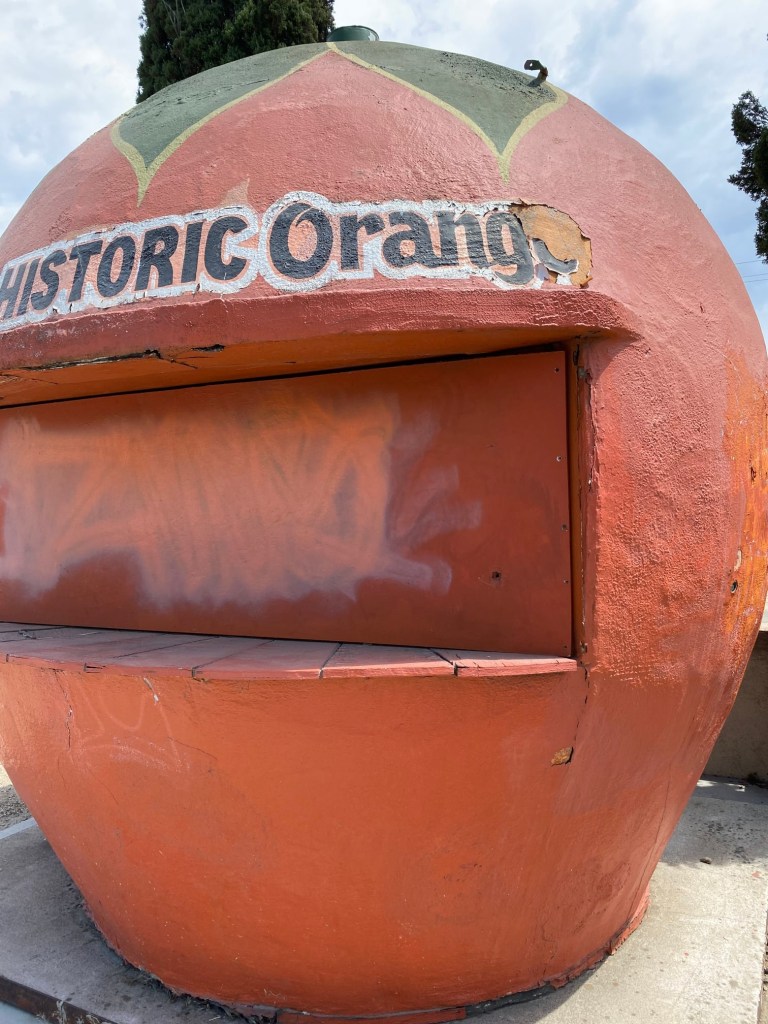
One of these “get your citrus kicks” Inland Empire mergers of the citrus industry and Route 66 occurred in 1936. In that year, Bob DeVries built a huge fruit stand that looked like an orange and placed it near Fontana, California. Because that’s what people did on Route 66.
“We squeezed oranges for 14 to 18 hours daily. We worked until 9 to 10 p.m. each day to make enough juice to see the next day. We would put it in gallon bottles and put them into Coca-Cola cases with ice. We picked the fruit and also got some at the citrus plant on Mango Avenue (still there). They paid $2 a trailer load.
“This was not the only thing sold at the stand. The large black olives and the pimento stuffed green olives were the first seen by the easterners. We made $20 a week, which was considered good in those days. The olives sold for 98 cents a gallon. Honey was from Colton, dates from Indio, and the Cherry Anne drink was sold by the gallon (or glass for a dime).”
Hey, twenty dollars a week wasn’t bad in the late 1930s.
But time passed, and the orange stand in Fontana, as well as similar orange stands throughout California, began to decline in the same way that Route 66 itself declined.
After the 1950’s the stands began to decline as roads were converted to higher speed freeways which made it more difficult to easily pull over and stop for a glass of orange juice. This combined with the emergence of air conditioning in cars, began the decline of the giant orange juice stands.
The Giant Orange ended up with the Fontana Historical Society, who gifted the orange to Joe Bono.
Perhaps you’ve heard of Joe Bono’s (claimed) cousin (I couldn’t substantiate the Wikipedia claim; Sonny was born in Detroit and moved to Los Angeles as a child, but to my knowledge never lived in Fontana—although of course he lived in Palm Springs later).
Coincidentally, the Bono family was a long-time competitor of the DeVries family, and had its own orange back in the day.
Anyway, Joe Bono placed the DeVries-built Giant Orange in front of his restaurant and promptly put his name on the orange. Eventually the restaurant closed, was reopened, and closed again.
According to Murray, the Fontana Historical Society reclaimed the Giant Orange, which is now in the parking lot of Fontana Public Works.
There are plans to restore the orange to its original 1936 glory. But the restored orange will not have Bono’s name on it. Apparently the “Bono’s” on the orange has been a point of contention for years.
THERE IS something of importance that needs to be corrected in the information in newspapers. The Orange (was in 2013) at Bono’s Restaurant and has the name “Bono’s” on it. This is incorrect. The Fontana Historical Society loaned it to him when it had to be moved from the Wal-Mart store. The Society cannot give it to an individual, only to another historical non-profit. The name on it should be “Fontana Historical Society Orange Stand.” The lady who donated the Orange has been very angry about the name situation.
A little postscript: if you own a giant orange, restaurant, or other Fontana business and need some help promoting it, you might want to contact the Fontana, California content marketing expert, Bredemarket.
And for those like me who now have an ear worm in their head, here’s a song from Joe’s purported cousin and his then-wife.







 Bredemarket