Justin Welsh’s Purple Squirrel Story

While I talk about wildebeests, iguanas, wombats, and friction ridge-equipped koalas, Justin Welsh talks about squirrels.

Purple squirrels.

Google Gemini,.

Welsh explains what a purple squirrel is:

“A purple squirrel is a candidate so rare and perfectly matched to what you need that finding one feels impossible. Someone who checks every single box, including boxes you didn’t even know you cared about.”

Then Welsh provided an example of a purple squirrel, a man named Sagar Patel who worked for him at PatientPop.

On paper pyramids

At the time PatientPop had less than $40,000 in annual revenue, so it didn’t have a huge marketing department. It didn’t even have Bredemarket as a product marketing consultant because Bredemarket didn’t exist yet. And anyway, at the time I knew next to nothing about PatientPop’s healthcare-centered hungry people, physicians who needed to attract prospects and clients via then-current search engine optimization (SEO) techniques.

Google Gemini.

Patel could have launched into a complex, feature-laden SEO discussion, but his target physicians would have responded, “So what?” Doctors want to doctor, not obsess over choosing trailing keywords…and understand the benefits of a solution immediately.

So Patel, without the resources of a marketing department, took another approach.

“So Sagar grabbed some notebook paper and drew five sides of a pyramid. He labeled each one, describing his ‘5 sides of local SEO for healthcare providers,’ and then taped them all together.

“He made himself a little paper pyramid to use in his sales pitches.”

Google Gemini. My prompt asked Nano Banana to create a “realistic” picture.

Was Patel’s paper pyramid an effective sales tool for PatientPop? Read Welsh’s article to find out.

What’s your paper pyramid?

Too many companies wait months for the perfect marketing solution instead of doing something NOW and refining it later.

Bredemarket’s different. I ask, then I act.

I ask, then I act.

Once I’ve set my compass, I get my clients a draft within days. Last week alone I turned out drafts for two clients, moving them forward so the content is available to their prospects and clients.

With my suggested schedule for short content—three day drafts, three day reviews, three day redrafts—your new content can become your online “secret salesperson” within two weeks or less.

Don’t believe me? This post alone is chock-full of links to other Bredemarket posts and Bredemarket pages, all of which are functioning as “secret salespeople” for me every single day.

If you want secret salespeople to work for you, talk to me and we’ll devise a plan to improve your product marketing awareness RIGHT NOW.

Features Sedate. Benefits Awaken. The Personal Version.

Features sedate. Benefits awaken.

Attract prospects to your product marketing materials. Turn to John E. Bredehoft for impact: https://www.linkedin.com/in/jbredehoft

And yes, this is an example of content repurposing from the original: https://bredemarket.com/2025/08/17/features-sedate-benefits-awaken/

Benefits. This time it’s personal.

When You Reduce a Product’s Feature Set

When engineers engineer products, they naturally pack in as many features as possible. Why? Because engineers, um, calculate that prospects desire a wide array of features.

Proposal managers and product marketers know the truth. Some prospects find too many features to be undesirable.

But first, a quote

From Biometric Update.

This quote from my Biometric Update guest post is pertinent. These are three of my recommendations to biometric vendors (and other identity vendors) to ensure responsible data use.

“Collect only the minimum necessary personal information. If you don’t need certain data, don’t collect it. If it’s never collected, fraudster hackers can never steal it.

“Store only the minimum necessary personal information. If you don’t need to keep certain data, don’t store it. I’m sure our decentralized identity friends will agree with this.

“Comply with all privacy laws and regulations. This should be a given, but sometimes vendors are lax in this area. If your firm violates the law, and you are caught, you will literally pay the price.”

Two of these three recommendations came into play shortly after I wrote those words.

When “feature-rich” is undesirable

I recently fulfilled two roles for a Bredemarket client: first a proposal manager, and rhen a requirements manager. And as my role shifted, my focus shifted also.

Bredemarket the proposal manager

Hundreds of proposals. Imagen 4.

Some time ago I helped a Bredemarket client manage and write a proposal for a prospect. I can’t identify the client or the prospect, but I will just say that the proposal was for a product that collected personally identifiable information (PII).

The proposal not only presented the features of my client’s product, but also the benefits. And it presented several alternative configurations to the prospect, including an array of value-added options.

Bredemarket the requirements manager

Fast forward after proposal submission, and after my Biometric Update guest post was published. 

The prospect wanted to hold further discussions with Bredemarket’s client, and Bredemarket shifted from consulting proposal manager to consulting requirements manager.

The prospect’s first request?

Remove ALL the proposal’s value-added options from the final deliverable.

Not because of cost, but because these value-added features would make the prospect’s life MORE difficult. 

While the prospect had no issue with the data that the supercharged value-added configured product collected, it had other concerns:

  • Some of the storage features of the value-added product ended up storing things the prospect didn’t need or want to store.
  • In addition, the value-added product caused privacy issues with the prospect’s own end customers.

An added benefit to removing these features: the slimmed-down product would be easier for the prospect to manage.

Reduce. Imagen 4.

Sometimes less is more, as a sculpture artist will tell you. A huge hunk of marble is less desirable than a sculpture in which much of the marble was taken away.

If you need Bredemarket to help shape your proposals, requirements, or other content or analysis, let’s talk.

Can Artificial Intelligence Reduce Healthcare Burnout?

Burnout in the healthcare industry is real—but can targeted artificial intelligence solutions reduce burnout?

In a LinkedIn post, healthcare company Artisight references an Advisory Board article with the following statistics:

(T)here were 7,887 nurses who recently ended their healthcare careers between 2018 and 2021….39% of respondents said their decision to leave healthcare was due to a planned retirement. However, 26% of respondents cited burnout or emotional exhaustion, and 21% cited insufficient staffing.

And this is ALL nurses. Not just the forensic nurses who have to deal with upsetting examinations that (literally) probe into sexual assault and child abuse. All nurses have it tough.

But the Artisight LinkedIn post continues with the following assertion:

At Artisight we are committed to reversing this trend through AI-driven technology that is bringing the joy back to medicine!!

Can artificial intelligence bots truly relieve the exhaustion of overworked health professionals? Let’s look at two AI solutions from 3M and Artisight and see whether they truly benefit medical staff.

3M and documentation solutions

3M. From mining and manufacturing to note-taking, biometrics, and artificial intelligence. By McGhiever – Own work, CC BY-SA 4.0, https://commons.wikimedia.org/w/index.php?curid=51409624

3M, a former competitor to MorphoTrak until 3M sold its biometric offerings (as did MorphoTrak’s parent Safran), has invested heavily into healthcare artificial intelligence solutions. This includes a solution that addresses the bane of medical professionals everywhere—keeping up with the paperwork (and checking for potentially catastrophic errors).

Our solutions use artificial intelligence (AI) to alleviate administrative burden and proactively identify gaps and inconsistencies within clinical documentation. Supporting completeness and accuracy every step of the way, from capture to code, means rework doesn’t end up on the physician’s plate before or even after discharge. That enables you to keep your focus where it needs to be – on the patient right in front of you.

Artisight and “smart hospitals”

But what about Artisight, whose assertion inspired this post in the first place?

A recent PYMNTS article interviewed Artisight President Stephanie Lahr to uncover Artight’s approach.

The Artisight platform marries IoT sensors with machine learning and large language models. The overall goal in a hospital setting is to streamline safe patient care, including virtual nursing. Compliance with HIPAA, according to Lahr, has been an important part of the platform’s development, which includes computer vision, voice recognition, vital sign monitoring, indoor positioning capabilities and actionable analytics reports.

In more detail, a hospital patient room is equipped with Al-powered devices such as high-quality, two-way audio and video with multiple participants for virtual care. Ultra-wideband technology tracks the movement and flow of assets throughout the hospital. Remote nurses and observers monitor patient room activity off-site and interact virtually with patients and clinicians.

At a minimum, this reduces the need for nurses to run down the hall just to check things. At a maximum, tracking of asset flows and actionable analytics reports make the job of everyone in the hospital easier.

What about the benefits?

As Bredemarket blog readers have heard ad nauseum, simply saying that your health solution uses features such as artificial intelligence makes no difference to the medical facility. The facility doesn’t care about your features or your product—it only cares about what benefits them. (Cool feature? So what?)

By Mindaugas Danys from Vilnius, Lithuania, Lithuania – scream and shout, CC BY 2.0, https://commons.wikimedia.org/w/index.php?curid=44907034.

So how can 3M’s and Artisight’s artificial intelligence offerings benefit medical facilities?

  • Allow medical professionals to concentrate on care. Patients don’t need medical professionals who are buried in paperwork. Patients need medical professionals who are spending time with them. The circumstances that land a patient in a hospital are bad enough, and to have people who are forced to ignore patient needs makes it worse. Maybe some day we’ll even get back to Welbycare.
  • Free medical professionals from routine tasks. Assuming the solutions work as advertised, they eliminate the need to double-check a report for errors, or the need to walk down the hall to capture vital signs.
  • Save lives. Yeah, medical professionals do that. If the Marcus Welby AI bot spots an error in a report, or if the bot detects a negative change in vital signs while a nurse is occupied with another patient, the technology could very well save a life.
I’m old enough to remember Welbycare. Robert Young (“Marcus Welby”) and Jane Wyatt (“Margaret Anderson” on a different show). By ABC Television. Public Domain,  https://commons.wikimedia.org/w/index.php?curid=16472486

Now I am not a doctor and cannot evaluate whether these artificial intelligence solutions actually work (unlike some other so-called artificial intelligence solutions that were in reality powered manually). But if the solutions truly work, wonderful.

What’s YOUR healthcare story? And who can tell your story?

Video: Differentiating Your Company and Your Products/Services

From the video below.

Last week I prepared a presentation for a conference organizer, thinking that I would give the presentation at the conference in question. Instead, the organizer emailed the presentation slides to selected conference attendees. The attendees probably liked it that way.

But I still wanted to give the presentation.

And I also wanted to generalize the presentation so that it applied to ALL technology companies, not just the ones who were attending the conference.

So I recorded myself giving the presentation “Differentiating Your Company and Your Products/Services.” It’s ten minutes long, and you can view it now.

Differentiating Your Company and Your Products/Services (April 9, 2024)

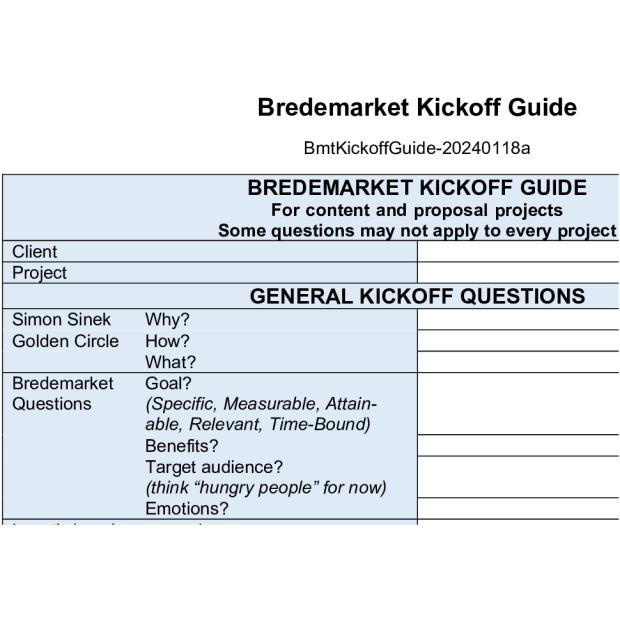
This video obviously discusses differentiation, but also discusses customer focus as well as the seven questions your content creator should ask you before writing (including benefits and target audience). Not only are the seven questions good for creating content, but they are also good for differentiating content. (For example, why is your product/service so great while all of your competitors’ products/services suck?)

If you’re watching this video on your laptop, be sure to keep your smartphone handy because at the end of the video I display a QR code to obtain more information. Just point your phone at the QR code.

Of course, if you’re watching this video on your smartphone, you can’t read the displayed QR code. So just go to https://bredemarket.com/drive-tech/ instead.

The Best Way to Talk About Complex Technology Features? Don’t.

Are you a product marketer or content marketer at an engineering-focused technology firm?

The ALMA correlator. The full system has four identical quadrants, with over 134 million processors, performing up to 17 quadrillion operations per second. By ESO – http://www.eso.org/public/images/eso1253a/, CC BY 4.0, https://commons.wikimedia.org/w/index.php?curid=23340651.

Have you been asked to tell your prospects about the marvelously complex features of your firm’s dazzling engineering products?

Well…why would you want to do that?

The complex product with a lengthy feature list

Many years ago I worked at a firm in which the products were driven by engineers, and therefore resulted in engineering marvels.

Two kinds of Segway PTs. By Source: aleehk82 [1]Derivative work: 丁 (talk) – https://www.flickr.com/photos/aleehk82/3144281707/, CC BY 2.0, https://commons.wikimedia.org/w/index.php?curid=11852469

I recall one product in particular (not a Segway, but a biometric product housed in a tower) that was an impressive fusion of algorithmic and mechanical excellence. The complex design that went into developing the tower product resulted in a device that performed its function superbly.

The complex engineering also caused the product to have such a high price that no one would ever buy it…but I digress.

But there was another issue with the product. I was writing proposals at the time, and we certainly could have written up a product description that emphasized the product’s lengthy set of features.

But the people receiving our proposals wouldn’t have cared one bit.

Prospects don’t care about lengthy feature lists

You see, prospects don’t care about lengthy feature lists.

And they don’t care about your product.

Altair 8800 advertisement. By MITS staff – Scanned from the May 1975 Radio-Electronics magazine by Michael Holley Swtpc6800, Public Domain, https://commons.wikimedia.org/w/index.php?curid=7219799

Frankly, they don’t even care about your company.

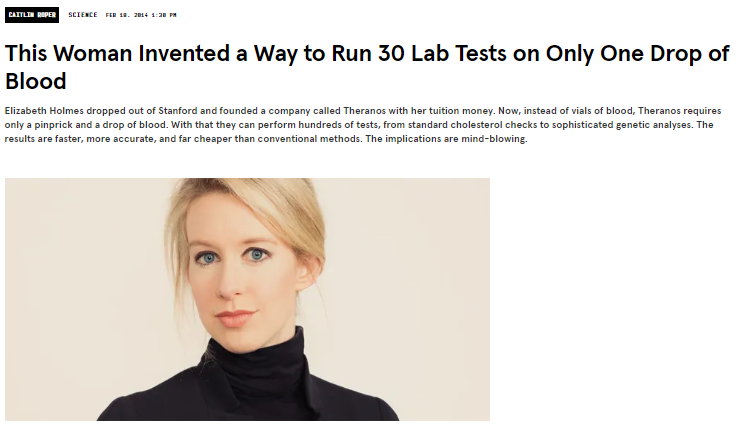
  • Even if your company has stellar engineers that develop wonderful products.
Elizabeth Holmes “invented a way to run 30 lab tests on only one drop of blood.” WIRED, February 2014, https://www.wired.com/2014/02/elizabeth-holmes-theranos/.
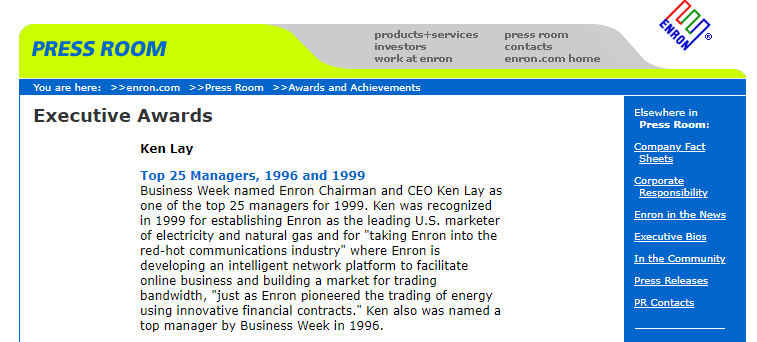
  • Even if your company has won prestigious awards for technical excellence, or as a great place to work, or whatever.
Business Week named Enron Chairman and CEO Ken Lay as one of the top 25 managers for 1999. From https://enroncorp.com/corp/pressroom/awards/executive.html
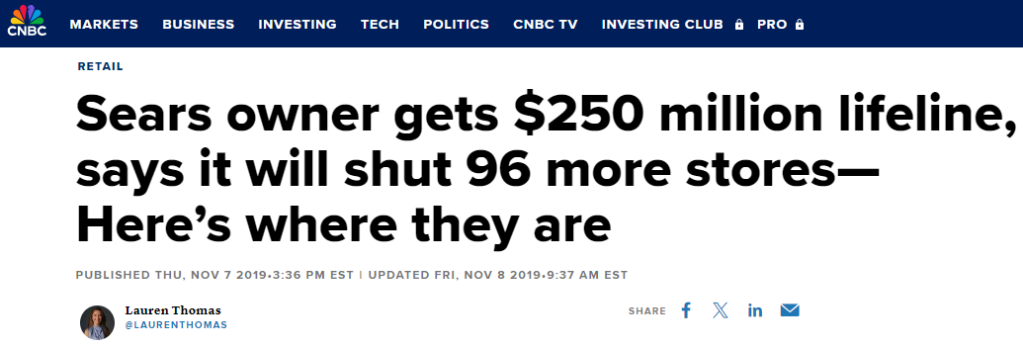
  • Even if your company just completed a successful funding round.
Transformco (post-bankruptcy parent of Sears and KMart) received $250 million in November 2019. From https://www.cnbc.com/2019/11/07/sears-owner-gets-250-million-lifeline-says-it-will-shut-another-96-stores.html.

It’s painful to admit it, but prospects only care about…themselves.

And the prospects focus on their problems, not your technical superiority.

For example, if your prospects work for certain government agencies, they really care about terrorists who try to board airplanes.

Aerial view of the Pentagon Building, September 14, 2001. By TSGT CEDRIC H. RUDISILL, USAF – http://www.dodmedia.osd.mil/Assets/Still/2004/Air_Force/DF-SD-04-12734.JPEG Alternate: http://www.af.mil/News/Photos/igphoto/2001289439/ archive, Public Domain, https://commons.wikimedia.org/w/index.php?curid=2152737

If your product stops terrorists from boarding airplanes, then and only then will they care about your company or your product.

If your product can’t stop terrorists from boarding airplanes, or if there is another product that is better at stopping terrorists from boarding airplanes, then your prospects won’t care about your product.

So how do you get prospects to care?

You don’t get prospects to care by talking about your extensive feature lists.

Let me give you a tip. If you find an employee at the prospect’s company who wants to spend a lot of time talking about your extensive feature lists, that employee probably DOESN’T have the authority to approve the purchase.

The people who DO have the authority to approve the purchase don’t have time to talk about extensive feature lists.

The approvers want to know, in 30 seconds or less, how your solution BENEFITS them.

Do you need help explaining your benefits?

Talking about benefits rather than features is just one tactic to successfully appeal to your prospects.

If you need help ensuring that your written materials (blog posts, white papers, web pages) resonate with your prospects, you can ask Bredemarket to help you.

Four Reasons Why Differentiators Fade Away

I’ve talked ad nauseum about the need for a firm to differentiate itself from its competitors. If your firm engages in “me too” marketing, prospects have no reason to choose you.

But what about companies that DO differentiate themselves…and suddenly stop doing so?

There are four reasons why companies could stop differentiating themselves:

  1. The differentiator no longer exists.
  2. The differentiator is no longer important to prospects.
  3. The market has changed and the differentiator is no longer applicable.
  4. The differentiator still exists, but the company forgot about it.

Let’s look at these in turn.

The differentiator no longer exists

Sometimes companies gain a temporary competitive advantage that disappears as other firms catch up. But more often, the company only pursues the differentiator temporarily.

 In 1985, amid anxiety about trade deficits and the loss of American manufacturing jobs, Walton launched a “Made in America” campaign that committed Wal-Mart to buying American-made products if suppliers could get within 5 percent of the price of a foreign competitor. This may have compromised the bottom line in the short term, but Walton understood the long-term benefit of convincing employees and customers that the company had a conscience as well as a calculator. 

From https://reclaimdemocracy.org/brief-history-of-walmart/.

Now some of you may not remember Walmart’s “Made in America” banners, but I can assure you they were prevalent in many Walmarts in the 1980s and 1990s. Sam Walton’s autobiography even featured the phrase.

But as time passed, Walmart stocked fewer and fewer “Made in America” items as customers valued low prices over everything else. And some of the “Made in America” banners in Walmarts in the 1990s shouldn’t have been there:

“Dateline NBC” produced an exposé on the company’s sourcing practices. Although Wal-Mart’s “Made in America” campaign was still nominally in effect, “Dateline” showed that store-level associates had posted “Made in America” signs over merchandise actually produced in far away sweatshops. This sort of exposure was new to a company that had been a press darling for many years, and Wal-Mart’s stock immediately declined by 3 percent. 

From https://reclaimdemocracy.org/brief-history-of-walmart/.

The decline was only temporary as Walmart stock bounced back. And 20 years later, the cycle would repeat as Walmart launched a similar “Made in USA” campaign in 2013, only to run into Federal Trade Commission (FTC) enforcement actions two years later.

The differentiator is no longer important

The Walmart domestic production episodes illustrate something else. If Walmart wanted to, it could have persevered and bought from domestic suppliers, even if the supplier price differential was greater than 5%.

But the buying customers didn’t really care.

Affordability was much more important to buyers than U.S. job creation.

So while labor leaders, politicians, and others may have complained about Walmart’s increasing reliance on Chinese goods, the company’s customers continued to do business with Walmart, bringing profitability to the company.

And before you decry the actions of consumers who act against their national self-interest…where was YOUR phone manufactured? China? Vietnam? Unless you own a Librem 5 USA, your phone isn’t from around here. We’re all Commies.

The market has changed

Sometimes the market changes and consumers look at things a little differently.

I’ve previously told the story of Mita, and its 1980s slogan “all we make are great copiers.” In essence, Mita had to adopt this slogan because, unlike its competitors, it did NOT have a diversified portfolio.

This worked for a while…until the “document solutions” industry (copiers and everything else) embraced digital technologies. Well, Fuji-Xerox, Ricoh and Konica did. Mita didn’t, and went bankrupt.

The former Mita is now part of Kyocera Document Solutions.

And stand-alone copiers aren’t even offered.

The company forgot

Before Walmart emphasized “Made in America” products, former (and present) stand-up comedian Steve Martin was dispensing tax advice.

“Steve.. how can I be a millionaire.. and never pay taxes?” First.. get a million dollars. Now.. you say, “Steve.. what do I say to the tax man when he comes to my door and says, ‘You.. have never paid taxes’?” Two simple words. Two simple words in the English language: “I forgot!”

From https://tonynovak.com/how-to-be-a-millionaire-and-not-pay-any-taxes/.

While the IRS will not accept this defense, there are times when people, and companies, forget things.

  • I know of one company that had a clear differentiator over most of its competition: the fact that a key component of its solution was self-authored, rather than being sourced from a third party.
  • For a time, the company strongly emphasized this differentiator, casting fear, uncertainty, and doubt against its competitors who depended upon third parties for this key component.
  • But time passes, priorities change, and the company’s website now buries this differentiator on a back page…making the company sound like all its competitors.

But the company has an impressive array of features, so there’s that.

Restore your differentiators

If your differentiators have faded away, or your former differentiators are no longer important, perhaps it’s time to re-emphasize them so that your prospects have a reason to choose you.

Ask yourself questions about why your firm is great, why all the other firms suck, and what benefits (not features) your customers enjoy that the competition’s customers don’t. Only THEN can you create content (or have your content creator do it for you).

A little postscript: originally I was only going to list three items in this post, but Hana LaRock counsels against this because bots default to three-item lists (see her item 4).