Why Do Enterprises Become Dust?

Hardly anything is permanent. And this applies to boxing AND to B2B sales.

Mike Tyson and legacy

Perhaps you heard what Mike Tyson said a few days ago.

I don’t know, I don’t believe in the word “legacy.” I just think that’s another word for ego. Legacy doesn’t mean nothing. It’s just some word everybody grabbed onto.

It means absolutely nothing to me. I’m just passing through. I’m going to die and it’s going to be over. Who cares about legacy after that?

We’re nothing. We’re just dead. We’re dust. We’re absolutely nothing. Our legacy is nothing.

With the life that Tyson has lived, it’s understandable why he’s echoing Ecclesiastes in this interview.

But you don’t have to have had Tyson’s experiences to realize that legacy does not last.

Neither wanted nor needed

In business (and in life), there are companies (and people) who don’t need you or want you.

This may be temporary. The company that doesn’t need you today may urgently (and importantly) need you tomorrow.

By White House – Eisenhower Presidential Library, Public Domain, https://commons.wikimedia.org/w/index.php?curid=3025709.

Or it may NOT be temporary. There are companies that will NEVER need you or want you.

I recently ran across three such companies that will never need Bredemarket.

Six weeks (now less than six weeks)

Six weeks, the still image version.

Perhaps you noticed Bredemarket’s “six weeks” promotion over the weekend. It was addressed to companies that may have a final project that they want to complete before the year ends in six weeks. (Now 5 1/2 weeks.) I emphasized that Bredemarket can help companies complete those content, proposal, and analysis projects.

The promotion included a blog post, a LinkedIn post, a Facebook reel, an Instagram reel, a YouTube short, and appearances in other online locations. Which is probably overkill, since the promotion is already outdated and can’t be used again until possibly November 2025.

I also included email in this campaign, targeting prospects whom I haven’t worked with recently, or whom I’ve never worked with at all. I didn’t go overboard in my emails; although I have over 400 contacts in Bredemarket’s customer relationship management system, I sent the email to less than 40 of them.

As of this morning, none of the recipients has booked a meeting with me to discuss their end of year needs.

  • Some explicitly told me that they were fine now and did not need or want Bredemarket’s services for end of year projects.
  • Some didn’t respond, which probably indicates that they did not need or want Bredemarket’s services either.

And I discovered that three companies (four contacts) will NEVER need or want Bredemarket’s services.

Delivery incomplete

How did I discover that?

Via four “delivery status notification” messages.

Delivery incomplete.

So I visited the web pages in question, and they no longer existed.
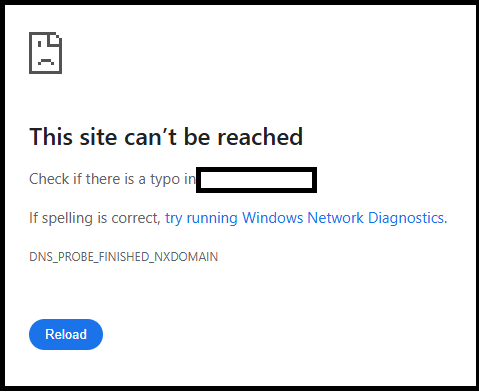
This site can’t be reached.

I’ve been building up my CRM for over four years, so it’s not shocking that some companies have disappeared.

But one of the companies (“Company X”) DID exist a mere eight months ago.

I know this because I prepared a presentation on differentiation (see version 2 of the presentation here), and two representatives from Company X received the presentation in advance of a conference.

After the conference organizer distributed the presentation, I offered to meet with the companies individually (no charge) to discuss their content and differentiation needs, or anything else they wanted to discuss.

While some conference attendees took advantage of my April offer, the representatives from Company X did not.

And now in November, Company X no longer exists.

A tumbleweed on a fence.
Tumbleweed image public domain.

Could Bredemarket have created the necessary content to keep Company X afloat? Who knows?

But EVERY company needs content to differentiate it from its competitors. Otherwise the competitors will attack you. And your competitors may not be as merciful with you as Jake Paul was with Mike Tyson.

If you need Bredemarket’s help with content, proposal, or analysis services, book a meeting with me.

Important and not urgent, but how important?

Whether and how you delegate something depends upon its importance, especially if you recognize three levels of importance. Sometimes the very important and critically important items require a CPA, or Content-Proposal-Analysis marketing professional. (I know one.)

When importance is simple

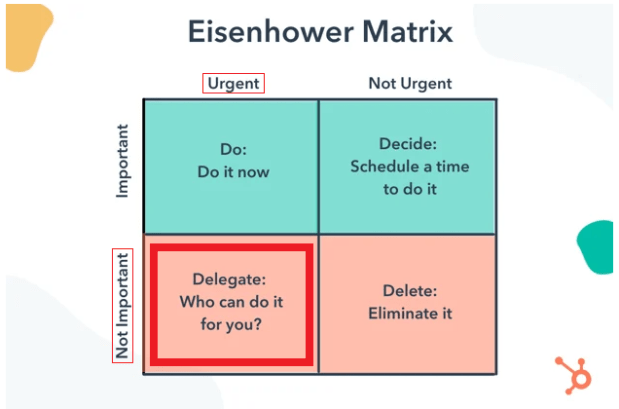
Last October I spent some time talking about the Eisenhower Matrix and its critical flaw, focusing upon the “important but not urgent” quadrant:

When you have a single level of importance, then decisions are pretty simple. For urgent things, do it yourself if it’s important, delegate it if it’s not.

When “importance” is more granular

But what if, instead of “Not Important” and “Important,” we had three levels of importance instead of just one? In other words, “Not Important,” “Important,” “Very Important,” and “Critically Important”?

A U.S. Navy plane flying over a Soviet ship in October 1962 is, um, classified as “Critically Important.” Oh, and it’s urgent. By USN – Dictionary of American Naval Aviation Squadrons Volume 2: The History of VP, VPB, VP(H) and VP(AM) Squadrons [4], Public Domain, https://commons.wikimedia.org/w/index.php?curid=7328539.

In that case, you not only consider whether to delegate something, but who should be delegated that thing. (Or, as you’ll see, WHAT should be delegated that thing.)

  • If the need is not important, delegate it, but it doesn’t really matter to whom or what you delegate it. ChatGPT or Bard is “good enough,” even if the result is awful.
  • If the need is important, delegate it to someone you trust to create very good content. Let them create the content, you approve it, and you’re done.
  • If the need is very important, then you may delegate some of the work, but you don’t want to delegate all of it. You need to be involved in the content creation process from the initial meeting, through the review of every draft, and of course for the final approval. The goal is stellar content.
  • If the need is critically important, then you probably don’t want to delegate the work and will want to do it yourself—unless you can find someone who is better than you in creating content.

As I noted in October, a more granular approach to importance increases the, um, importance of Bredemarket’s services.

  • In the simple Eisenhower Matrix model, Bredemarket handles the Not Important stuff while you handle the Important stuff.
  • In the “three levels of importance” model, Bredemarket handles the Very Important and Critically Important stuff. Because the merely Important stuff and the Not Important stuff doesn’t require my 30 years of technology, identity, and biometrics expertise.

Sometimes you need a CPA (but NOT a Certified Public Accountant)

But if your needs are critical, and you require the services of a CPA (Content-Proposal-Analysis marketing professional), then you need to learn what Bredemarket can do for you. Click on the image to learn more.

Bredemarket’s “CPA.”

Do You Know the “Three Levels of Importance” (TLOI)?

“Your call is important to us.” Oh, really? Will the CEO answer my call in the next ten seconds?

By Jonathan Mauer – Own work, CC BY-SA 4.0, https://commons.wikimedia.org/w/index.php?curid=50534668

All things are NOT equally important. In fact, there are THREE levels of importance (TLOI):

  1. IMPORTANT.
  2. VERY IMPORTANT.
  3. CRITICALLY IMPORTANT.

Maybe you use different words (perhaps “life-or-death important” or “DEFCON 1”), but the basic point remains. Some things are more important than others.

Make sure that everyone has a common understanding of how important a task is. If you think something is “important” but your partner thinks it is “very important,” your partner may think you are indifferent and have hurt emotions.

Enough theory; let’s apply this. Are you interested in an application of TLOI that answers the following questions?

  1. How is the Eisenhower Matrix flawed by its use of only a SINGLE level of importance?
  2. How does the correction of the Eisenhower Matrix with TLOI affect whether or not you will select Bredemarket as your content marketing expert?

The second question may not have ANY importance to you, but it’s critically important to me.

For the answers to these two questions, read “The Eisenhower Matrix is Flawed” at https://bredemarket.com/2023/10/25/the-eisenhower-matrix-is-flawed/.

#contentmarketing #contentmarketingexpert #eisenhowermatrix #importance #important #indifference

Image by Jonathan Mauer – Own work, CC BY-SA 4.0.

The Eisenhower Matrix is Flawed

I’ve been wanting to share my thoughts about this topic for a long time because it was important to me.

So now you’re probably asking, “John, if it’s important to you, why has it taken you so long to write the post?”

Read the post to find out!

Introduction

In past posts I’ve mentioned the Eisenhower Matrix, and I’ve also talked about how Bredemarket’s services fit into the Eisenhower Matrix.

Namely: if something is urgent, but not important enough for your own people to do, then perhaps Bredemarket can do it.

But in my previous discussions about the Eisenhower Matrix, I haven’t talked about the matrix gap. (Unrelated to the missile gap that Eisenhower’s successor claimed.)

Eisenhower Didn’t Invent the Eisenhower Matrix

Eisenhower’s half contribution to the Eisenhower Matrix

First, I guess most of you already know that Dwight D. Eisenhower never viewed an Eisenhower Matrix before his death in 1969, since the matrix didn’t appear until 1989. Eisenhower may have been (literally) a Supreme Commander, but he could not time travel. (His great-granddaughter? Maybe.)

By White House – Eisenhower Presidential Library, Public Domain, https://commons.wikimedia.org/w/index.php?curid=3025709

While the Eisenhower Matrix originates in something Eisenhower said, his statement ignores half of the matrix.

In a 1954 speech, Eisenhower quoted an unnamed university president when he said, “I have two kinds of problems, the urgent and the important. The urgent are not important, and the important are never urgent.” 

From https://asana.com/resources/eisenhower-matrix

If you were to illustrate what Eisenhower actually said, there would only be two boxes—one for the urgent tasks, and one for the important tasks. There would be no need for a matrix per se, since Eisenhower claimed that the two categories never overlapped.

Stephen Covey thought differently.

Covey’s full contribution to the Eisenhower Matrix

In essence Covey asked, “What if Ike was wrong and there IS an overlap between the urgent and important?” Or, in his words:

In a knowledge-worker world where we are paid to think, create, and innovate, our primary tool for creating value is our brain. There are two basic parts of the brain: the Reactive Brain and the Thinking Brain….

We make choices based on two factors:

  • Importance (how valuable is the result of doing it)
  • Urgency (how soon does it need to be done)

The Reactive brain chooses urgency over importance because it wants to quiet the pressing, noisy issue.  The Thinking brain chooses importance because it looks for high-payoff outcomes.

From https://www.franklincovey.com/the-5-choices/choice-1/

Covey then created the four-box matrix that indicates how items can have importance AND urgency, importance OR urgency, or neither. This created the Eisenhower Matrix we know and love, and which many of us find to be, um, “highly effective.”

The Eisenhower Matrix’s simplicity is its flaw

Part of the power of the Eisenhower Matrix is that it’s so simple to use. You just have to answer two questions to plug EVERY task into one of the four available boxes, and you’re then ready to do, decide, delegate, or delete as required.

But the simplicity of the matrix is misleading.

I’ll cite an example. How many times have you called a business and received an automated response saying, “Your call is important to us”?

By Jonathan Mauer – Own work, CC BY-SA 4.0, https://commons.wikimedia.org/w/index.php?curid=50534668

Now I don’t go as far as Jessica Lim and claim that the “Your call is important to us” statement is an outright lie. Similar statements can be found far from the customer service world.

Before LinkedIn. By Flickr user Dick Thomas Johnson (Dick Johnson) – https://www.flickr.com/photos/31029865@N06/6554188007/, CC BY 2.0, https://commons.wikimedia.org/w/index.php?curid=18130998

I am in the midst of a job hunt, and when I hold the first interview (usually with a Talent Acquisition Specialist), I make a point of asking when they expect to extend an offer and place someone in the position. Most of them respond, “As soon as possible,” and mean it. But they can’t provide an actual date.

Yes, it’s important for the customer service department to answer that phone, and it’s important for the talent acquisition department to fill that position.

But “importance” doesn’t mean that if all the customer service lines are busy that the VP of Customer Success will order new phone lines to be installed RIGHT NOW, and that everyone in the company will be mandated to answer phones RIGHT NOW until the backlog is cleared.

  • Is there no budget for new phone lines? Rob a bank if you must. This is important.
  • Is your Chief Financial Officer preparing for a quarterly earnings call tomorrow? Get to the phones. This is important.

And “importance” doesn’t mean that if a position needs to be hired, the Talent Acquisition Specialist is empowered to order every person in the interviewing and selection process to drop everything that they’re doing RIGHT NOW and devote 100% of their time to selecting a candidate.

  • Are you on vacation or holiday? It doesn’t matter. Put down your drink! This is important.
  • Are you in New Delhi? It doesn’t matter. Wake up! This is important.

In the Eisenhower Matrix, all “important” things are of equal importance, with no attempt to prioritize them.

Fixing the flaw

How do we solve the “everything is equally important” problem?

By defining four levels, including three levels of importance (TLOI).

  • Important.
  • Very important.
  • Critically important.
  • Not important.

(You can do the same with urgency and come up with gradations of urgency, but I’m not going to dive into that now. It’s…not important for what I want to say.)

Use of a more granular definition of importance provides benefits well beyond customer service and talent acquisition. Whenever you have to evaluate the importance of something, these more specific definitions will help.

Applying the correction to using Bredemarket

Let’s apply these gradations to my favorite topic—whether you should contract with Bredemarket to create your content marketing collateral. (OK, I doubt it’s your favorite topic, but trust me; there’s a “customer focus” issue here.)

For urgent content marketing needs, the existing Eisenhower Matrix provides only two choices:

  • If the need is not important, delegate by contracting with Bredemarket.
  • If the need is important, create the content yourself.
More…um…stories provide more choices. By Beyond My Ken – Own work, CC BY-SA 4.0, https://commons.wikimedia.org/w/index.php?curid=27173008

But when we apply the gradations, we have many more possible choices. In this case, we have four:

  • If the need is not important, delegate it, but it doesn’t really matter to whom or what you delegate it. ChatGPT or Bard is “good enough,” even if the result is awful.
  • If the need is important, delegate it to someone you trust to create very good content. Let them create the content, you approve it, and you’re done.
  • If the need is very important, then you may delegate some of the work, but you don’t want to delegate all of it. You need to be involved in the content creation process from the initial meeting, through the review of every draft, and of course for the final approval. The goal is stellar content. We’ll come back to this later.
  • If the need is critically important, then you probably don’t want to delegate the work and will want to do it yourself—unless you can find someone who is better than you in creating content.
Bredemarket logo

So where does Bredemarket fit in to this list of expanded choices?

Depending upon your own talents, I fall in either the very important or the critically important category. I collaborate with you throughout the content creation process to ensure that you receive the best content possible.

If you agree that Bredemarket’s content creation services are very important (or critically important) to expanding your firm, let’s talk.

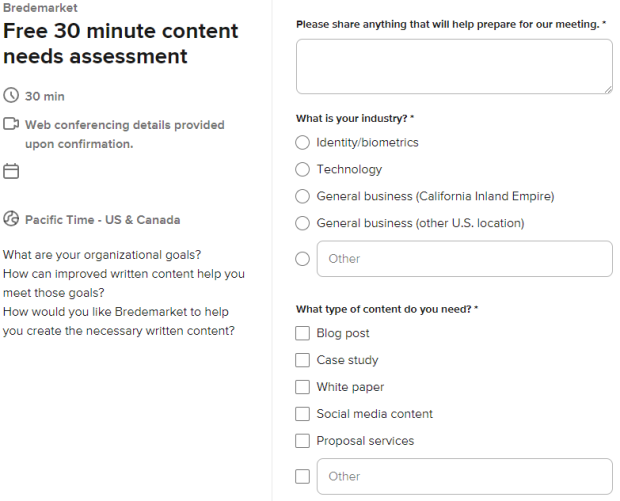
  • Book a meeting with me at calendly.com/bredemarket. Be sure to fill out the information form so I can best help you.

Nothing Bad Will Happen if You Don’t Update Your Content…Right?

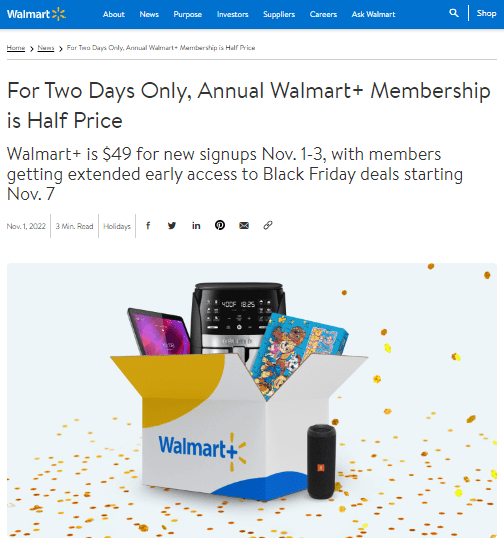
Before you rush to click https://corporate.walmart.com/news/2022/11/01/for-two-days-only-annual-walmart-membership-is-half-price, this half price deal was for 2022, not 2023. You missed out!

The marketing experts insist that calls to action must emphasize urgency.

The cover art can be obtained from the record label., Fair use, https://en.wikipedia.org/w/index.php?curid=2404116

If you want a prospect to do something, stir up the necessary emotions: fear, fear of missing out (FOMO), anger, whatever. The call to action should emphasize that they act NOW. TV Tropes provides a few examples of these calls to action:

“If you call before midnight tonight, we’ll give you a special bonus!”

“Call in the next 5 minutes for a special bonus!”

“Call quickly because we’re only giving this offer to the first 100 callers.”

From https://tvtropes.org/pmwiki/pmwiki.php/Main/IfYouCallBeforeMidnightTonight

Of course, you don’t need to advertise on television to use these lines. It’s just as easy to use these messages online, as in the Walmart example above, or in this example.

A lot of marketers (and for that matter, a lot of scam artists) listen to the advice of marketing experts. As a result, we are bombarded with “act now” advertising.

In fact, we are bombarded with so much of this junk that we end up tuning it out.

Designed by Freepik.

In the end, NOTHING is urgent.

Or is it?

Is a task important?

Urgency is one thing, but importance is another. Which is why the Eisenhower matrix distinguishes between the two.

For example, your firm’s website may be in urgent need of an upgrade. Perhaps the information on the website is out of date or completely incorrect. (Maybe you DON’T support Windows XP any more.)

But is that important?

  • If an issue is urgent and important, you would have updated your website already to avoid being fired.
  • If an issue is urgent but not important, then it’s something that you could delegate to a content marketing expert. (Ahem. We’ll revisit this later.)

Incidentally, I have some thoughts about the use of “importance” in the Eisenhower matrix, but I’ll save those for another post.

Is a task urgent?

Of course, this assumes that the issue is urgent. Perhaps it’s not urgent at all. As I said before, a lot of sellers like to create a false sense of urgency.

As a consultant, I often find prospects and clients who believe that a particular issue is NOT urgent. You can easily get that Walmart+ membership a few days later, at a minimally higher price. And you can easily wait on updating your online content.

If something is not urgent, then you have two choices depending upon the issue’s importance.

  1. If an issue is not urgent and not important, then why bother taking care of it at all? Let it slide.
  2. If an issue is not urgent but is important, then you had better do it…but there’s no rush. You don’t have to take care of it before midnight tonight. Next week will do…or the week after that.
Designed by Freepik.

Compounding the issue is that if you DO update your website, you’re NOT going to see an immediate return on investment.

It takes longer than three days for content marketing to yield results. One source estimates four to five months. Another source says six to twelve months. Joe Pulizzi (quoted by Neil Patel) estimates 15 to 17 months. And all the sources say that their estimates may not apply to your particular case.

From https://bredemarket.com/2023/08/26/on-trust-funnels/

So if a content marketing update isn’t going to yield immediate results, what’s the rush? Spending time making the updates, or even spending the time managing someone else to make the updates, takes away from tasks that yield financial results NOW.

Designed by Freepik.

If it’s not urgent but is important…

If your outdated content is not urgent but is important, then there’s no rush to take care of the issue.

You can delay it for weeks or even for months, and you’re NEVER going to have a problem.

Until…

By hughepaul from London, UK – Children trying to steal some more bikes from Evans Chalk Farm, CC BY 2.0, https://commons.wikimedia.org/w/index.php?curid=16042615

…a competitor with up-to-date and accurate content swoops in and loots your prospects AND your existing customers away from you.

(Are you worried?)

Why would old content cause you to lose a customer? Because your outdated information demonstrates that you don’t care about your customers. After all, you’re not focused on your customers’ need for up-to-date information on your products and services.

(Are you angry?)

And if you lose enough prospects and customers to result in a revenue drop, then you may lose your job. Then you won’t have to worry about the company’s outdated content any more. Problem solved!

(Are you scared?)

By El mundo de Laura from Puebla, Mexico – Resanadita… pero a nuestra economía!, CC BY 2.0, https://commons.wikimedia.org/w/index.php?curid=7744198

But if it’s urgent but is not important…

Of course, there’s the other alternative that I discussed earlier in this post, in which your content issues are urgent, but they’re not important enough to devote your own resources to them.

In that case, you can contract the work out to someone who will perform the majority of the work in updating your content.

(While retaining a say in your content. That should make you happy.)

And I know where you can contract that work. Bredemarket.

Bredemarket can help you create content that converts prospects and drives content results. Why?

If you’re sold on using Bredemarket to create customer-focused messaging, there are three ways to move forward with your content project. Or you can just join the Bredemarket mailing list to stay informed.

  • Book a meeting with me at calendly.com/bredemarket. Be sure to fill out the information form so I can best help you.

SEO NVI, HRF VVI (Search engine optimization not very important, human readable format very very important)

I’ve been trying to add more local (Inland Empire West) content to the Bredemarket blog. Obviously I’m attempting to promote Bredemarket’s services to local businesses by writing local-area content such as these two recent posts centered on Upland.

City Hall and Public Library, Upland, California.
By Rockero at English Wikipedia – Transferred from en.wikipedia to Commons., CC BY-SA 3.0, https://commons.wikimedia.org/w/index.php?curid=3949535

Old SEO

Back in the old days, I might have done optimized for my local audience by going to the bottom of relevant pages on the Bredemarket website and inserting hundreds of words in very small gray text that cite every single Inland Empire West community (yes, even Narod) and every single service that Bredemarket provides. In the old days, the rationale was that this additional text would positively affect search engine optimization (SEO), so that the next person searching for “case study writer in Narod, California” would automatically go to the page with all of the small gray text.

Of course, that doesn’t work any more, because Google penalizes keyword stuffers or content stuffers who make these unnatural pages.

More modern SEO

I use more acceptable forms of SEO. For example, I’ve devoted significant effort to make sure that the two phrases biometric content marketing expert and biometric proposal writing expert direct searchers to the relevant pages on this website. (Provided, of course, that someone is actually searching for a biometric content marketing expert or a biometric proposal writing expert.)

First two results (as of April 1, 2022) of a DuckDuckGo search for biometric content marketing expert. https://duckduckgo.com/?q=biometric+content+marketing+expert&t=h_&ia=web

I believe SEO is important.

However, SEO is not very important (NVI).

(As an aside, I commonly distinguish between “important” stuff and “very important” stuff. And you also have to distinguish between importance and urgency; see the Eisenhower matrix.)

What is very very important (VVI)? Human readable format (HRF).

The two audiences: the bots, and the real humans

And SEO-optimized content may differ from human-readable content because of their different audiences. SEO text is written for machines, not people. In extreme cases, SEO-optimized text is unreadable by humans, and human readable format cannot be interepreted by machine-based web crawlers.

Machine readable and human readable formats. Olav Ten Bosch. From https://www.researchgate.net/figure/Machine-readable-and-human-readable-formats_fig1_327385570

Here’s a comparison:

Machine readableHuman readable
Easily parsed and processed by systemsEasily read by humans
Hard for humans to readHard for machines to read
Adheres to FAIR principles (findable, accessible, interoperable, reusable)Communicates with humans via visual presentation
Example: machines have problems reading tables like this oneExample: humans can easily read and understand tables like this one
Google’s gonna hate me for putting this table into a post, but real human beings won’t. See https://control.com/technical-articles/machine-readable-vs-human-readable-data/ for a fuller explanation of the differences between machine-readable and human-readable data.

Here’s another example of how SEO-optimized text and human readable format sometimes diverge. I mentioned this example in a recent LinkedIn article:

I recently updated my proposal resume to include the headline “John E. Bredehoft, CF APMP,” under the assumption that this headline would impress proposal professionals. However, when I ran my resume through an ATS (applicant tracking system) simulator, it was unable to find my name because of its non-standard format. Because of this, there was a chance that a proposal professional would never even see my resume. I adjusted accordingly.

From https://www.linkedin.com/pulse/what-happens-when-proposal-evaluators-longer-human-bredemarket/
By Humanrobo – Own work, CC BY-SA 3.0, https://commons.wikimedia.org/w/index.php?curid=18947366

In this case, I had to cater to two separate audiences:

  • The computerized applicant tracking systems that read resumes and decide which resumes to pass on to human beings.
  • The human beings that read resumes, often after the applicant tracking systems have pre-selected the resumes to read.

I was able to come up with a workaround to satisfy both audiences, therefore ensuring that (a) my resume would get past the ATS, and (b) a human that viewed my ATS-approved resume could actually read it. It’s a clumsy workaround, but it works.

While that particular example is complicated by the gate-keeping ubiquity of applicant tracking systems in the employment industry, it is not unique. All industries are depending more on artificial intelligence, and almost all human beings are turning to Google, Bing, DuckDuckGo, and the like to find stuff.

These are our users (who use search engines for EVERYTHING)

There’s an old example of how dependent we are on search engines. In a famous case over a decade ago, people used the Google search engine to get to the Facebook login page, and were confused when a non-Facebook page made its way to the top of the search results. The original article that prompted the brouhaha is gone, but Jake Kuramoto’s summary still remains. TL;DR:

ReadWriteWeb posted “Facebook Wants to Be Your One True Login“.

Google indexed the post.

The post became the top result for the keywords “facebook login”.

People using Google to find their way to Facebook were misdirected to the post.

The comments on the post were littered with unhappy people, unable to login to Facebook.

There are more than 300 comments on this post, the majority of them from confused Facebook users.

Despite the fact that RWW added bold text to the post, directing users to Facebook, and the fact that the post is no longer the top result for “facebook login”, people continue to arrive there by accident, looking for Facebook.

From http://theappslab.com/2010/02/11/these-are-our-users/

What if we can only optimize for one of the two audiences?

So people who create content have to simultaneously satisfy the bots and the real people. But what if they couldn’t satisfy both? If you were forced to choose between optimizing text for a search engine, and optimizing text for a human, what would you choose?

If it were up to Google and the other search engine providers, you wouldn’t have to choose. The ultimate goal of Google Search (and other searches) is to mimic the way that real humans would search for things if they had all of the computing resources that the search engine providers have. It’s only because of our imperfect application of artificial intelligence that there is any divergence between search engines and human searches.

But until AI gets a lot better than it is now, there will continue to be a divergence.

And if I ever had to choose, I’d write for humans rather than bots.

By Bundesarchiv, Bild 102-13018 / CC-BY-SA 3.0, CC BY-SA 3.0 de, https://commons.wikimedia.org/w/index.php?curid=5480820

After all, a human is going to have to read the text at some point. Might as well make the human comfortable, since the bots aren’t making final binding decisions. (Yet.)