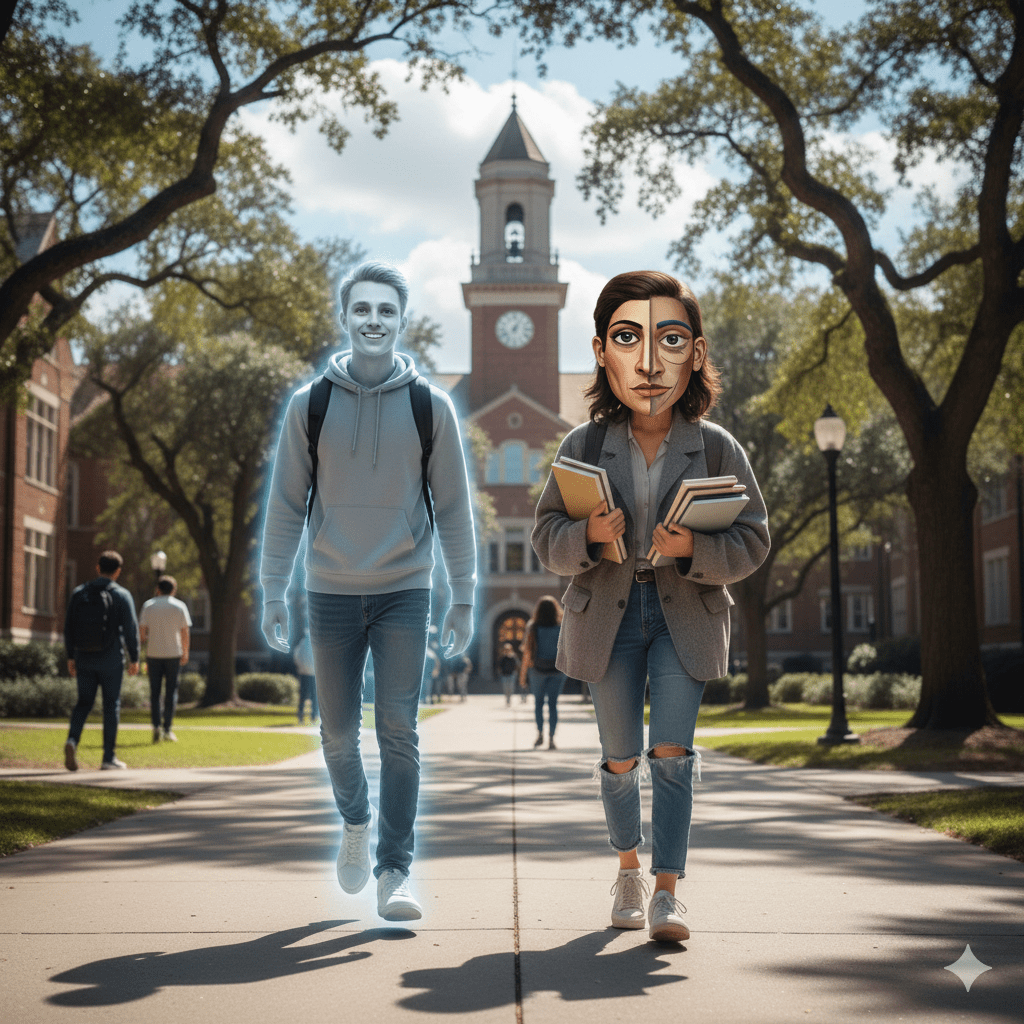
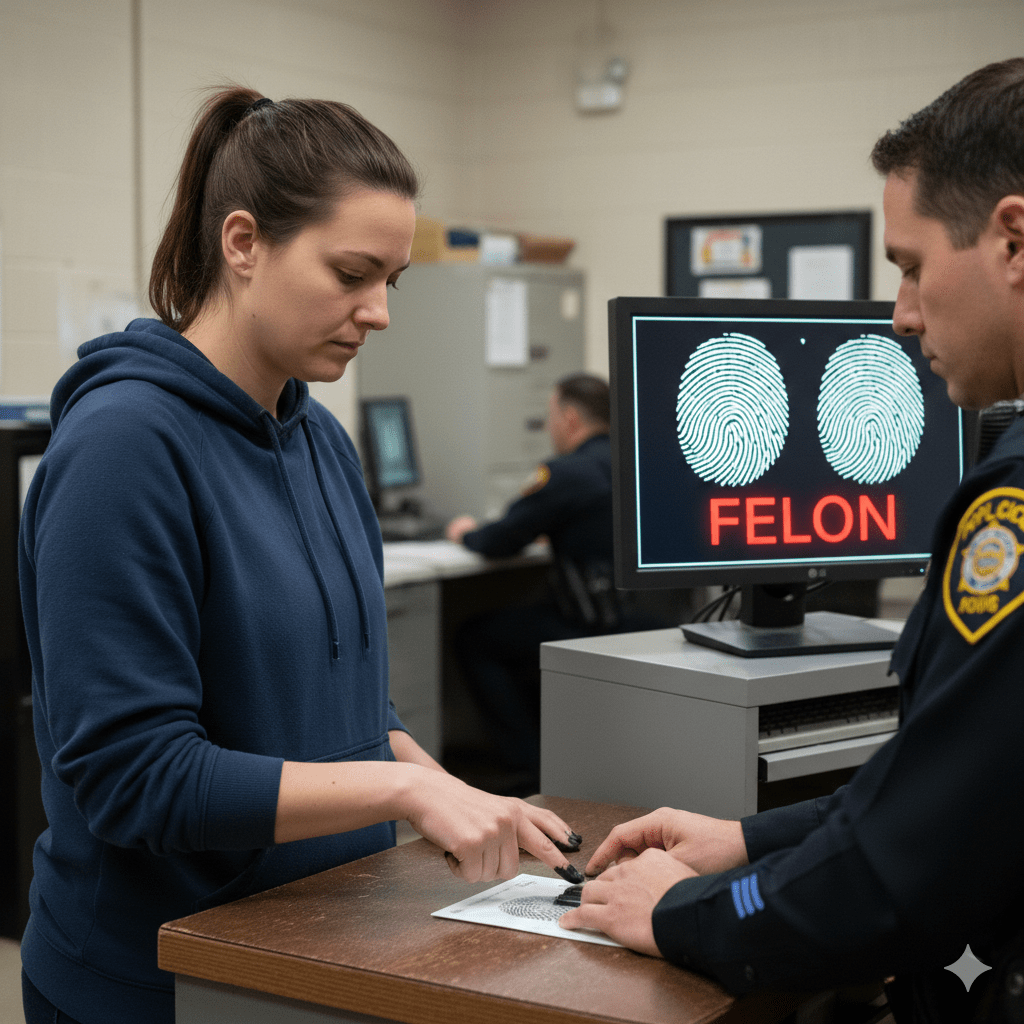
These are the no-good characters from my Bredemarket blog post earlier today, “Why is Educational Identity Important?” That post quoted from 1Kosmos and Fischer Identity:
“Higher education institutions are increasingly targeted by identity fraud schemes, including “ghost students,” synthetic identities, and financial aid fraud.”
Don’t let these fraudsters rip your university off.
“Higher education institutions are increasingly targeted by identity fraud schemes, including “ghost students,” synthetic identities, and financial aid fraud. At the same time, universities must support digital access for students, alumni, faculty, and staff across fragmented IAM environments that span legacy systems, modern cloud platforms, and third-party services.”
Let’s look at the what.
Verify student, alumni, and staff identities using high-assurance proofing and biometric verification
Reduce financial aid and enrollment fraud caused by synthetic or stolen identities
Strengthen assurance across fragmented IAM environments spanning legacy and modern systems
Enable strong, passwordless authentication based on verified digital identity that is reusable and persists across enrollment, academic access, and alumni engagement
If your company provides educational identity solutions, and your message isn’t getting out to your prospects, perhaps you need to talk to the biometric product marketing expert, Bredemarket.
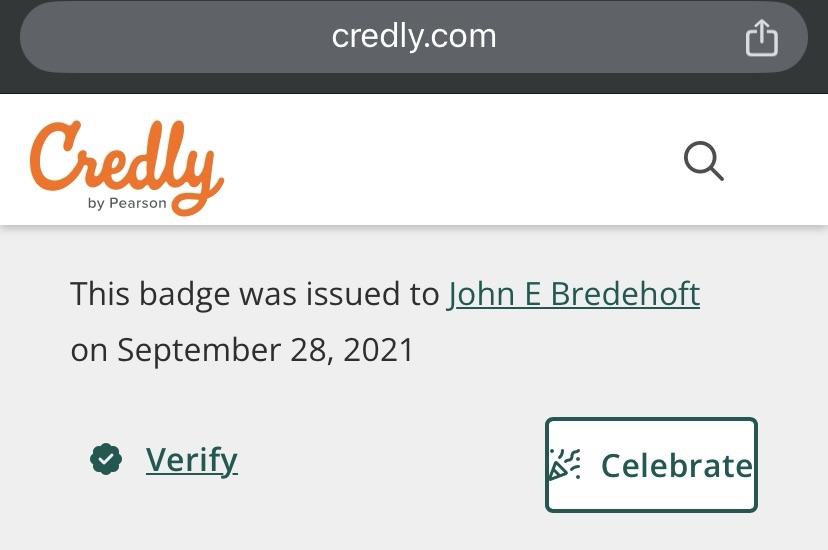
Now if you click on that link, you will see a “Verify” link at the top left.
From Credly.
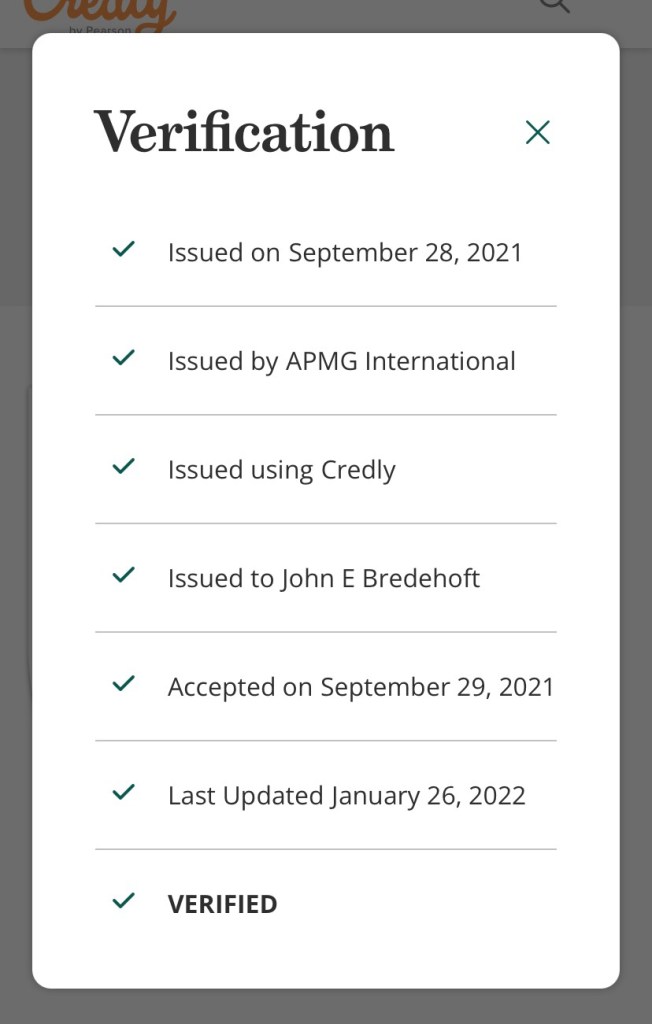
And if you click on that”Verify,” this is what you get.
The verification.
So I have verified that I am allowed to call myself John E. Bredehoft, CF APMP. It’s allowed:
In the same manner, those who have achieved one of the APMP certifications can append the appropriate certification. In the case of APMP Foundation certification, that means that I can style myself as “John E. Bredehoft, CF APMP.” (Or “John E. Bredehoft, MBA, CF APMP, RSBC” if I want to be thorough. But I probably won’t, since “RSBC” stands for “Radio Shack Battery Club.”)
But have I REALLY verified that I have achieved this accomplishment? (Not the battery club one, the proposal one. Although it would be good to know whether I really have that MBA educational accomplishment.)
The identity problem
You see, despite how impressive that Credly link is, it doesn’t prove nothing.
Sure, somebody who claimed to be John E. Bredehoft sat down in 2021 and took an online exam.
But was that person truly John E. Bredehoft?
And even if he was, am I the same John E. Bredehoft who received the certification?
Maybe there were fraudsters along the way. Maybe someone else took the test and pretended to be Bredehoft. Or maybe I’m not Bredehoft.
Sure, at one point I whipped out a credit card with Bredehoft’s name on it. But that doesn’t prove identity.
You probably know the things that prove identity. A biometric modality, including the liveness of that modality. A government-issued identity document that matches the biometric. A sensible location (was the test taker in Ontario, California as expected?).
Now perhaps this is overkill for authenticating a proposal writer, but it may not be if you need a certified plumber.
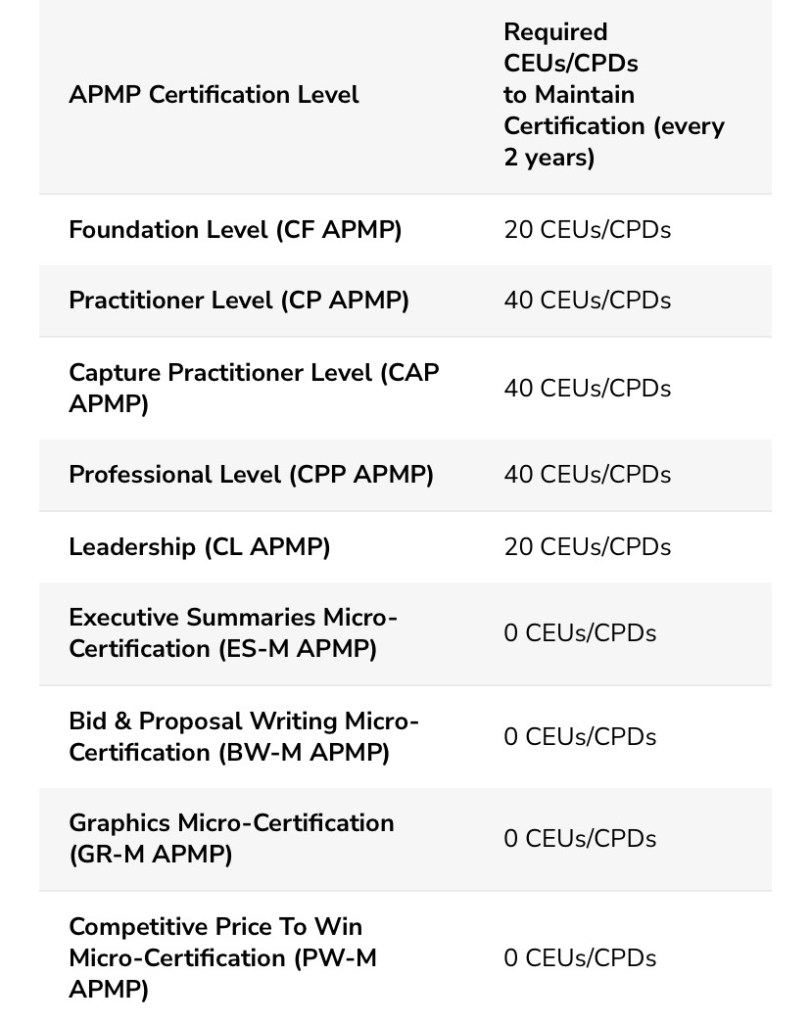
And because I truly am me, I know I didn’t meet the CEU/CPD requirement by September 2023. I don’t know how many I did achieve; the APMP was changing its CEU/CPD tracking system in early 2022, and then I joined Incode and theoretically wasn’t writing proposals any more. Theoretically.
So in truth, my shiny badge only represents a dated accomplishment. John E. Bredehoft can no longer use the CF APMP designation.
Unless I add “Emeritus” or something.
And as for those cases in which the certifications and identities truly matter…
As Identity and biometrics solution providers know, their applications are found in a variety of vertical markets.
A LARGE variety of vertical markets.
Seven of these markets include financial services, travel and hospitality, government services, education, health, criminal applications, and venues. (Among others.)
Which three vertical markets does the Prism Project examine?
To start this post, I’m going to cheat and “appropriate” the work already performed by the Prism Project.
This effort is managed by Maxine Most’s Acuity Market Intelligence and supported by a variety of partners (including industry partners).
The Prism Project has identified 3 (so far) critical vertical markets for identity and biometrics. While this doesn’t pretend to be a comprehensive list, it’s a good starting point to illustrate the breadth of markets that benefit from identity and biometrics.
The Prism Project has already released its report for financial services, which businesses can download here.
The Prism Project has started to develop its report for travel and hospitality. You can preview the report here.
Finally, the Prism Project plans to release a report addressing government services later in the year. For the latest status of this report, visit the Prism Project home page.
As you can see, identity and biometrics apply in wildly diverging vertical markets. You can use identity verification to open a bank account, enter your hotel room, or pay your taxes.
But those aren’t the only markets that use identity and biometrics.
Let me school you on two other markets, education and health
Let’s look at two markets that the Prism Project hasn’t covered…yet.
Education
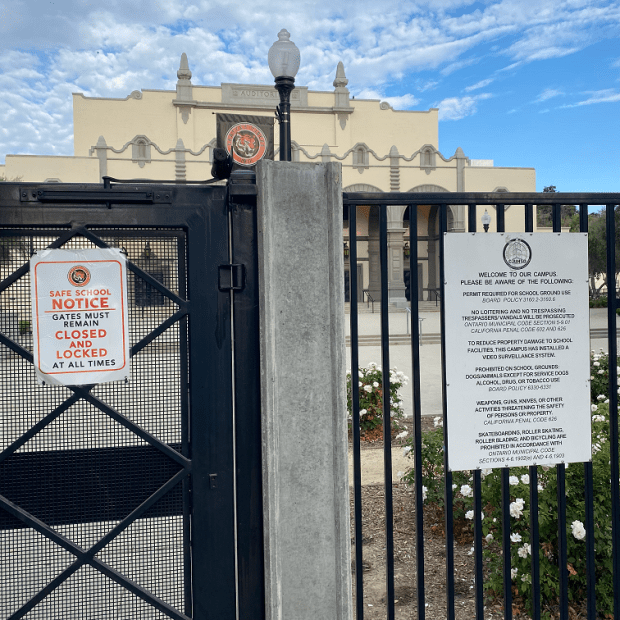
Chaffey High School, Ontario, California.
Another example of a market that uses identity and biometrics is the education market.
Who is allowed on a physical campus? Students? Teachers? Staff? Parents and guardians?
Who is NOT allowed on a physical campus? Expelled students? Fired faculty and staff?
Who is taking that remotely-administered online test?
Bredemarket has written several posts about educational applications for identity and biometrics. You can read all my education writing on Bredemarket’s “Educational Identity” information page.
Health
What, did you expect me to post a Marcus Welby picture here? I’m sharing a real medical professional: Jonas Salk administering the polio vaccine. By Yousuf Karsh, photographer – Wisdom Magazine, Aug. 1956 (Vol 1, No. 8), PD-US, https://en.wikipedia.org/w/index.php?curid=27746788.
Similarly Bredemarket has written several posts about healthcare applications for identity and biometrics, including some that dwell on the unique privacy legislation that covers healthcare. You can read all my health writing on Bredemarket’s “Health” information page. (It’s not called “Health Identity” because healthcare has both identity and technology aspects.)
Another source on finance
By the way, Bredemarket also has a page on “Financial Identity,” but the Prism Project’s content is more comprehensive.
But wait…there’s more!
So this is the point where Ed McMahon intones, “So Acuity Market Intelligence and Bredemarket have identified all five of the markets that benefit from the use of identity and biometrics!”
So let’s look at two more markets that benefit from the use of identity and biometrics-two markets that I know very well from the beginning and end of my time at Printrak/Motorola/MorphoTrak/IDEMIA.
Criminal applications
There are government services, and then there are government services.
I started my biometric journey over 29 years ago when I wrote proposals addressed to law enforcement agencies who wanted to find out who left their fingerprints on a crime scene, and whether the person being arrested was who they said they were.
I don’t know if Maxine Most is going to classify criminal applications as a subset of government services, but there are clear reasons that she may not want to do this.
When you pay your taxes or apply for unemployment benefits, you WANT the biometric system to identify you correctly.
When you steal a car or rob a bank, you do NOT want the biometric system to identify you correctly.
Big difference.
Stadiums, concert halls, and other venues
If someone asked me in late 2019 what my career five year plan was, I would have had a great story to tell.
As I was wrapping up over 24 years in identity and biometrics, I was about to help my then-employer IDEMIA enter a new market, the venue market. This market, which CLEAR was already exploring at the time, replaced the cumbersome ticketing process with the use of frictionless biometrics to enter sports stadiums, concert halls, trade shows, and related venues. Imagine using your face or IDEMIA’s contactless fingerprint solution MorphoWave to enter a venue, enter secure restricted areas, or even order food and beverages.
Imagine the convenience that benefit consumer and venue operator alike.
What could go wrong? I mean, the market was robust, and we certainly would NEVER face a situation in which all the stadiums and all the concert halls and all the trade shows would suddenly close down.
Since early 2020 when a worldwide pandemic DID shut down a lot of things, many identity/biometric firms have entered the venue market with a slew of solutions to benefit fans, teams, and venues alike.
And still more
There are many more vertical markets than these seven, ranging from agriculture to automobile access to computer physical/logical access to construction to customer service (mainly voice) to critical infrastructure to gaming (computer gaming) to gaming (gambling) to the gig economy to manufacturing to real estate to retail to telecommunications to transportation (planes, trains, buses, taxis, and cruise ships).
And all these markets have a biometric story to tell.
Can Bredemarket help you describe how your identity/biometric solution addresses one or more of these markets?
I won’t give away all the information about the Fischer Identity-AWS effort at Baylor—you have to opt in to access a gated case study to obtain that—but I will say that the case study claims a 12-week implementation of an IAM system that stores “several hundred thousand identities.”
I assume the alumni at Baylor are a generous segment of the university community.
When education vendors say that they protect the identities of their customers, but they don’t, bad things can happen. Illuminate Education discovered this the hard way.
Two attempted class action lawsuits against Illuminate Education have been defeated. But there has still been fallout:
(The Future of Privacy Forum) initiated a review, seeking to determine whether (Illuminate Education’s) practices were and are consistent with its Pledge commitments, specifically with respect to technological safeguards in place to protect the security of data. Publicly available information appears to confirm that Illuminate Education did not encrypt all student information while at rest and in transit. Such a failure to encrypt would violate several Pledge provisions…
As a result of its inability to confirm that Illuminate Education practiced recommended data encryption practices, the Future of Privacy Forum “removed Illuminate Education from the list of Student Privacy Pledge signatories.” As of January 23, 2024, Illuminate Education’s status as a signatory has not been restored.
Can a company’s status as a Future of Privacy Forum signatory guarantee that they take all necessary steps to protect educational identity data? Of course not; perhaps there are unknown data protection failures by a signatory, and conversely a company may implement stellar policies but just never bothered to sign on the dotted line.
But presence or absence on the FPF signatories list can serve as a positive or negative risk indicator.
At the highest level, debates regarding government and enterprise use of biometric technology boil down to a debate about whether to keep people safe, or whether to preserve individual privacy.
In the state of Montana, school safety is winning over school privacy—for now.
The state Legislature earlier this year passed a law barring state and local governments from continuous use of facial recognition technology, typically in the form of cameras capable of reading and collecting a person’s biometric data, like the identifiable features of their face and body. A bipartisan group of legislators went toe-to-toe with software companies and law enforcement in getting Senate Bill 397 over the finish line, contending public safety concerns raised by the technology’s supporters don’t overcome individual privacy rights.
School districts, however, were specifically carved out of the definition of state and local governments to which the facial recognition technology law applies.
At a minimum Montana school districts seek to abide by two existing Federal laws when installating facial recognition and video surveillance systems.
Without many state-level privacy protection laws in place, school policies typically lean on the Children’s Online Privacy Protection Act (COPPA), a federal law requiring parental consent in order for websites to collect data on their children, or the Family Educational Rights and Privacy Act (FERPA), which protects the privacy of student education records.
If a vendor doesn’t agree to abide by these laws, then the Montana School Board Association recommends that the school district not do business with the vendor.
The Family Educational Rights and Privacy Act was passed by the US federal government to protect the privacy of students’ educational records. This law requires public schools and school districts to give families control over any personally identifiable information about the student.
(The Sun River Valley School District’s) use of the technology is more focused on keeping people who shouldn’t be on school property away, he said, such as a parent who lost custody of their child.
(Simms) High School Principal Luke McKinley said it’s been more frequent to use the facial recognition technology during extra-curricular activities, when football fans get too rowdy for a high school sports event.
Technology (in this case from Verkada) helps the Sun River School District, especially in its rural setting. Back in 2022, it took law enforcement an estimated 45 minutes to respond to school incidents. The hope is that the technology could identify those who engaged in illegal activity, or at least deter it.
What about other school districts?
When I created my educational identity page, I included the four key words “When permitted by law.” While Montana school districts are currently permitted to use facial recognition and video surveillance, other school districts need to check their local laws before implementing such a system, and also need to ensure that they comply with federal laws such as COPPA and FERPA.
I may be, um, biased in my view, but as long as the school district (or law enforcement agency, or apartment building owner, or whoever) complies with all applicable laws, and implements the technology with a primary purpose of protecting people rather than spying on them, facial recognition is a far superior tool to protect people than manual recognition methods that rely on all-too-fallible human beings.
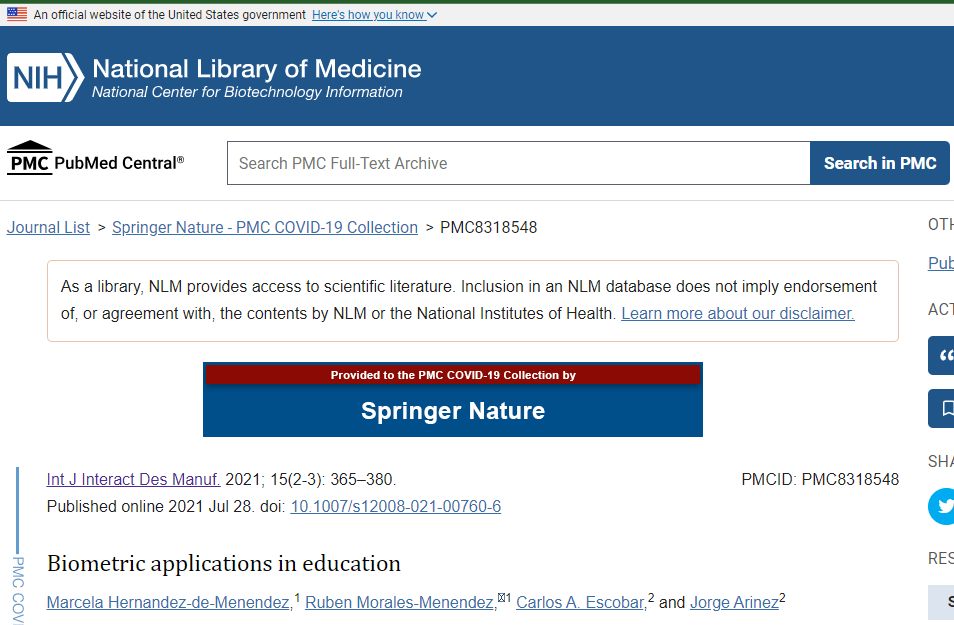
While searching for a post-COVID article that discussed the use of biometrics in education (to supplement my existing educational identity information), I found an entire scientific paper on the topic.
Educational institutions are acquiring novel technologies to help make their processes more efficient and services more attractive for both students and faculty. Biometric technology is one such example that has been implemented in educational institutions with excellent results. In addition to identifying students, access control, and personal data management, it has critical applications to improve the academic domain’s teaching/learning processes. Identity management system, class attendance, e-evaluation, security, student motivations, and learning analytics are areas in which biometric technology is most heavily employed.
Hmm…I didn’t even think about class attendance. But a camera capturing faces that walk into the classroom or join the online webinar should do the trick.









 Bredemarket