Bredemarket creates content.
If you want me to create yours, talk to me. https://bredemarket.com/mark/
(Grok)

Identity/biometrics/technology marketing and writing services

Bredemarket creates content.
If you want me to create yours, talk to me. https://bredemarket.com/mark/
(Grok)

Biometric marketing leaders, do your firm’s product marketing publications require the words of authority?

Can John E. Bredehoft of Bredemarket—the biometric product marketing expert—contribute words of authority to your content, proposal, and analysis materials?
I offer:
To embed Bredemarket’s biometric product marketing expertise within your firm, schedule a free meeting with me.

What is a drug? Here’s what the U.S. Food and Drug Administration said to Ancestral Supplements in April 2025.
“This letter is to advise you that the U.S. Food and Drug Administration (FDA) reviewed your website at http://ancestralsupplements.com in March 2025 and has found that you take orders there for Ancestral Grassfed Beef Thyroid. Various claims and statements made on your website and/or in other labeling establish that this product is a drug as defined in 21 U.S.C. § 321(g)(1)(B) because it is intended for the treatment, cure, mitigation, or prevention of disease. For example, your website recommends or suggests the use of Ancestral Grassfed Beef Thyroid to treat or prevent hypothyroidism and Grave’s disease. As explained further below, the introduction of this product into interstate commerce for such uses violates the Federal Food, Drug, and Cosmetic Act.”

A client recently asked me to perform some research. After initially performing one aspect of the research manually, I performed the second part of the research automatically using Google Gemini. I informed the client of my use of AI for the second part of the research.
This particular use case is separate from using AI for CONTENT, something I’ve been discussing for years. However, since part of Bredemarket’s services include ANALYSIS, I felt it best to disclose when someone other than me performed the analysis.
This post describes the two parts of my research (manual and automated), what I disclosed to my client, and why I disclosed it.
My client required assistance in identifying people with a particular skill set (which I cannot disclose). To fulfill this request, I went into LinkedIn, performed some searches, read some profiles, and selected people who may possess the skills my client required.
After spending some time collecting the research, I forwarded it to the client.

Several hours after sending the initial research to my client, I thought about taking a separate approach to my client’s need. Rather than identifying people with this skill set, I wanted to identify COMPANIES with this skill set.
But this time, I didn’t manually perform the research. I simply created a Google Gemini prompt asking for the companies with this skill set, their website URLs, their email addresses, and their phone numbers.
I, or rather my AI assistant, performed all of this well within my self-imposed 5-minute time frame.
Once this was done, I created an email straight from Google Gemini, and sent this information to my client…
…including the prompt I used, and ALL the language that Google Gemini provided in its response.
Now some argue that I’m shooting myself in the foot by disclosing my use of generative AI to answer the second part of my client’s question.
They would claim that I should have just
Don’t do that.
Deloitte did that…and paid for it in the long run.
“Deloitte’s member firm in Australia will pay the government a partial refund for a $290,000 report that contained alleged AI-generated errors, including references to non-existent academic research papers and a fabricated quote from a federal court judgment.”
Now in this case the refund was due to hallucinations in the AI-generated document.
But what of the fact that at least one of Deloitte’s report writers was the Deloitte equivalent of Bredebot?
Personally, I think that disclosure in this instance is required also.

When it looks like no one is at your business, no prospects will come.
Fix this with Bredemarket prospect-targeted content. https://bredemarket.com/mark/
By the way, note Google Gemini’s artificial imitation of a sense of humor by designating one of the open businesses as the City Lights Bookstore.

When your content bucket is empty, Bredemarket can help your identity, biometric, and technology marketing leaders fill it.
Because your prospects want some content from you, or they will go elsewhere.
Schedule a free meeting: https://bredemarket.com/mark/

I performed some slight edits to my “Content For Tech Marketers” brochure.
For more information, visit this page.
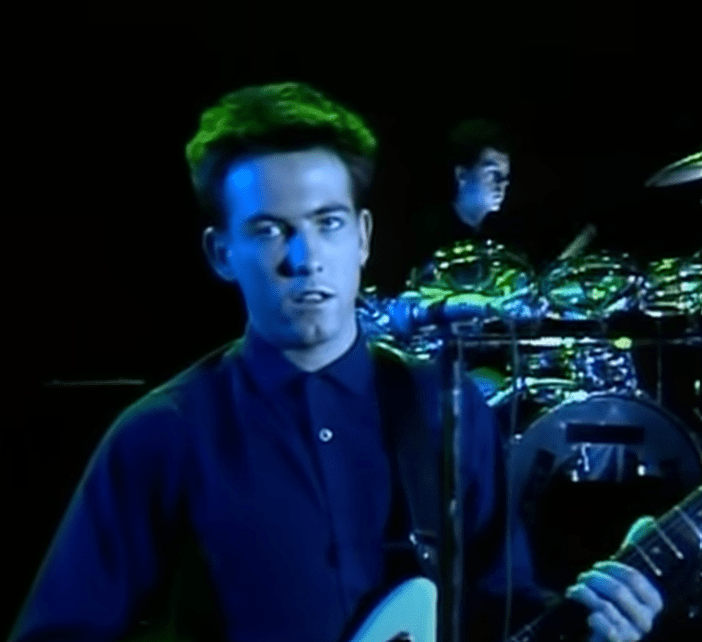
Repurposing can be found all over the place. Let’s look at the history of the Cure song “A Forest.”
Somehow I escaped hearing “A Forest” until decades after it was released, when the song was used on the old Fox Soccer Channel. This song was originally released in 1980, very early in the Cure’s career, and was a goth-yet-driving track that fit in with the times. And Robert Smith had not yet become Edward Scissorhands.
But then another Robert, Robert Palmer, would inject himself into the story.
Palmer had not yet become The Mannequin Guy (that would come four years later), but he was still pretty big. Big enough to rank higher than the Cure in the lineup for the Rock Werchter Festival on July 5, 1981. And when you’re a supporting act like the Cure was on that day, things don’t always go your way.
“The day before in Torhout the band had been able to play 15 songs, in Werchter they would only play 13 songs skipping “Three Imaginary Boys” and “Faith”. The Cure, consisting of Robert Smith, Simon Gallup and Laurence Tolhurst, was scheduled to play just before Robert Palmer and while they were playing, they were told to cut their set short by Robert Palmer’s managers.”
So the Cure was only allowed to play one more song. Robert Smith announced to the crowd:
“This is the final song because we’re not allowed to carry on anymore, cause everybody want’s to see Robert Palmer I think. It’s called ‘A Forest.'”
Cue malicious compliance.
The band starts playing the slow introduction to the song…with a few extra flourishes that stretched the intro out a bit.
After a minute-long introduction, the song finally picks up at the normal tempo. Well, with a little more of an instrumental introduction before Smith starts singing.
He sings the verses of the song, through the final words “again and again and again and again and again.” And five minutes in, it appears that the Cure has “a bad case of loving” the song, because they keep on playing.
And playing.
And playing.
With less of a drum beat and bass line as Smith explores every chord, and every note, on his guitar.
Six and a half minutes in, as you start to see backstage activity, Smith begins to sing new lyrics, “parting is such sweet sorrow” among them.
But the Cure didn’t part. They kept on playing. And at seven and a half minutes in, they picked up the pace again.
By the 8 minute mark, Smith is channeling his inner Hendrix/Townshend as the band finally concludes the song, “encouraged” by Robert Palmer’s roadies.
You can see the performance for yourself. Language warning at the end.
This sudden, provoked improvisation permanently affected future live performances of “A Forest.” Here’s a 1992 example, in which the song stretched for over 13 minutes. Minute-long slow intro, four-minute song proper, and a coda as long as the entire Werchter performance.
So feel free to repurpose YOUR content, longer or shorter as you wish. The original piece may resonate with some, while the newer pieces may resonate with others.
If the Fox Soccer Channel had played “A Forest” more often, maybe it would still be around today.

I haven’t mentioned the Bredemarket 4444 Partner Retainer in a while (since May, in fact), but since I recently proposed it to a prospect I thought I’d mention it again.
Originally envisioned as a service for clients who wanted a flat monthly rate for high-volume content creation, I have since extended the Bredemarket 4444 Partner Retainer to also apply to Bredemarket’s analysis services and related strategic services. Embed me for the month and I’ll handle your strategy.
The structure: you pay a flat fee, in advance, and I give you a certain number of prepaid base hours for the following calendar month. In exchange for prepayment, you get a discount from my standard hourly rate.
Benefits to you include an “embedded partner” relationship.

And easier budgeting.
Benefits to me include a more predictable income and a better understanding of your needs.
The brochure at the end of this post includes sample pricing for 15, 30, or 45 hour per month increments. Any additional hours above the maximum are billed at Bredemarket’s standard hourly rate.
Interested? Book a free meeting.
“Embedded” picture: By Staff Sgt. Michael L. Casteel – [1], Public Domain, https://commons.wikimedia.org/w/index.php?curid=2407244.

Are you a technology marketing leader who lies awake at night worrying about the following?
“Keeping up with the speed and complexity of the digital landscape.”
Well, maybe not that exact phrase. That sounds like something generative AI would write.
And in fact, my buddy Bredebot wrote it when answering a question about Chief Marketing Officer pain points relative to content.

But I’m not going to let Bredebot write an entire post about it, because I’m going to write it myself.
The human way to reflect the sentiment above is to ask whether your content is up-to-date, or is as dated as a Pentium.
And that’s something that a marketing leader DOES worry about, because they (usually) want their firms to be perceived as innovative, not old fashioned.
Let me give you an example of outdated content that persists today.
For years we have been discussing search engine optimization, or SEO. The whole point of SEO is to ensure that your content appears at the top of results when you use Google or Bing or another search engine to launch a search. (Ignore “sponsored content” for a minute here.)
In case you haven’t noticed, fewer and fewer people are using search engines. Instead, they are searching for answers from their favorite generative AI tool, and now the new term the kids are using is answer engine optimization, or AEO. Or perhaps you can follow the lead of Go Fish and refer to generative engine optimization, or GEO.
Now some people are continuing to use SEO when they mean AEO and GEO, under the theory that it’s all just optimization, and it’s all just searching but just with a different tool. Personally, I believe that continuing to refer to SEO is confusing because the term has always been associated with search engines.
Plus, the concept of keywords is fading away, as Lisa Garrud noted in May.
“Unlike traditional SEO, which focuses on ranking for keywords, AEO concentrates on providing comprehensive, authoritative answers that AI systems can easily process and deliver to users….
“Think about how you use AI tools today. You don’t ask for ‘electrician Auckland residential services’, you ask, ‘What’s causing the flickering in my kitchen lights?’ or ‘How much should it cost to rewire a 1970s house?’ You want answers, not search results.”
But forget about XEO and let’s return to the content YOU create.
Let’s say that you’ve reached the point in your content calendar where you have to write a blog post about pop music.
And let’s also say that you’re old enough to remember the 20th century.
You may have a problem.
For example, when you see the words “pop music,” you may immediately spell the second word with a “z” and a “k” when you TALK ABOUT.
Or if someone mentions INTERPOL, you immediately respond with Deutsche Bank, FBI, and (und?) Scotland Yard.
And now that I’ve lost half my reading audience, you can see my point. While personas are approximations, you need to refer to them when crafting your content. If your hungry people (target audience) tend to be in their 20s and 30s, they’re probably not going to understand or respond to songs from M (Robin Scott) or Kraftwerk.
There are other things you can write that are obviously old, such as “fingerprint identification decisions are infallible.” That statement was questioned back in 2003…BEFORE the whole Brandon Mayfield thingie.
So how does a marketer ensure that their content is not dated? By remembering to ask, then act. Question your assumptions, do your research, write your content, then check your content.
Before you write your content, ensure your premise is correct. For example, I didn’t assume without questioning that “keeping up with the speed and complexity of the digital landscape” was a pressing issue. I KNEW that it was a pressing issue, because I encounter it daily.
Next, take a moment and check what you are about to say. Was your assumption about fingerprint examiner infallibility affected by the NAS report? Was your assumption affected by activities that occurred after the NAS report?
At some point you have to stop asking and start acting, writing your content. Write your draft 0.5 to get your thoughts down, then write your draft 1.0. And keep your personas in mind while you do it.
Once it’s drafted, check it again. Have your dated assumptions crept into your writing? Did you use the term “SEO” out of habit, by mistake? Fix it.
If you do all these things, you’ll ensure that your competitors don’t laugh at your content and tell you how out of touch you are.
Ideally, you want your competitors to show how out of date they are.
“Look at WidgetCorp, who doesn’t even know how to spell! Their writer’s left finger slipped while typing, and they typed the so-called word ‘AEO’ rather than ‘SEO’! Everybody know the term is SEO!”
Which gives you the opportunity to write a succinct reply to your bozo competitor.
I’ll give you the joy of writing it yourself.
Unless you want Bredemarket to write it, or other content. Book a free meeting to discuss your needs. https://bredemarket.com/mark/

 Bredemarket