I’ve previously written about the “messy middle,” or the way that people REALLY decide on what to purchase. It’s not as logical as the theories suggest.
Kevin Indig’s article touches upon a lot of topics, most of which I won’t discuss. Read his article. Instead, I’m going to focus on the second of Indig’s three items (on attribution model limitations) because it intersects with my interests, including the trust funnel.
Instead of trying to figure out where to be, try to be everywhere. It’s more important to understand where your competitors are, and you’re not….The surround sound approach seems intuitive but is a very different approach to what’s happening at companies today….Surround Sound doesn’t mean to do everything, but to carefully observe where competitors are and pull even.
At this point I only want to interject that you should also carefully observe where competitors AREN’T.
But what are the analysts going to analyze? What they can.
We should also rethink the numbers we look at. Recurring visits and the average number of visits until conversion reflect user behavior and improvements better than bounce rate or pages per visit since users hop around so much.
While much of the activity remains invisible to us, we can still look at the activity that we CAN see.
Some things remain secret
And yes, much of the activity does remain invisible. A former coworker messaged me on Sunday with a question, and he closed his message with the following.
Btw, enjoy your posts
From a private message.
I’m tossing that message over to Bredemarket’s chief analyst.
For example, during my most recent stint as a product marketing employee at a startup, the firm had no official content marketers, so the product marketers had to create a lot of non-product related content. So we product marketers were the de facto content marketers for the company too. (Sadly, we didn’t get two salaries for filling two roles.)
Why did the product marketers end up as content marketers? It turns out that it makes sense—after all, people who write about your product in the lower funnel stages can also write about your product in the upper funnel stages, and also can certainly write about OTHER things, such as company descriptions, speaker submissions, and speaker biographies.
Unlike some other attractions that bombard you with sight, sound, and speed, Storybook Land asks you to board a slow-moving boat while your host or hostess…tells stories.
And many businesses depend on storytelling. My consultancy Bredemarket has helped many of them tell their stories.
Over the last month, Bredemarket has told the following stories for its clients:
Once upon a time, a faraway country passed legislation to protect its citizens from evil robbers. Here’s how [COMPANY]’s solution can help the country and its citizens stay safe from the big bad wolves. (Online content)
Once upon a time, a couple’s son disappeared and went on a long journey. Here’s how [COMPANY]’s solution helped reunite the family. (Online content)
Once upon a time, a firm paid a lot of money for some beans that appeared to be worthless. Here’s how [COMPANY]’s solution helped the beans to grow. (Online content)
Once upon a time, [COMPANY]’s solution was offered to some people, but [COMPANY] wanted to offer it to many more people. Here are some other people who could benefit from the solution. (Private market/competitor analysis)
It’s too early to tell if everyone lived happily ever after, but hopefully they will.
Identity/biometrics firms don’t just create social media channels for the firms themselves. Sometimes they create social media channels dedicated to specific products and services.
That’s the good news.
Here’s the bad news.
[REDACTED]
As I write this, it’s March 3. A firm hasn’t updated one of its product-oriented social media channels since February 20.
That’s February 20, 2020…back when most of us were still working in offices.
It’s not like the product no longer exists…but to the casual viewer it seems like it. As I noted in a previous post, a 2020 survey showed that 76% of B2B buyers make buying decisions primarily based on the winning vendor’s online content.
Whether I’m creating content for Bredemarket or creating product marketing material for an employer (past or future), it’s important to ask some critical questions first.
My LinkedIn profile contains the three simple words “why customers benefit.” Not “what producers feature”—why customers benefit. Those three words encapsulate my approach to marketing…well, until I come up with three different words. Or two.
Song by Annie Lennox. Original reel on the Bredemarket Instagram account.
Normally I talk about CONtent, but today I’m talking about conTENT. (OK, a little bit about CONtent also.)
There are many prospects that may be CRITICALLY IMPORTANT (the highest of my three levels of importance) to your firm—perhaps too many. You can reduce your firm’s list of critically important prospects without losing them altogether. The extra time you receive benefits your firm and your TRUE critically important prospects. And eventually the other prospects may come around anyway.
But what if the identity/biometric prospects are not HUNGRY to satisfy that need? (Hungry people = true target audience.) Addressing the need may even be “important” to the prospects—but not CRITICALLY important.
Now I can create (and have created) content addressing this need and how to fill it. If a prospect searches for this content, they will find it.
I can even proactively initiate direct contact with these prospects, and maybe even contact them a second time.
But in most cases a prospect may respond with a “not interested” message—if the prospect even responds at all.
When you “Let Them” do whatever it is that they want to do, it creates more control and emotional peace for you and a better relationship with the people in your life.
And at the same time move the prospect from your “critically important” category down to your “important” category. Focus on the critically important prospects, and be content (conTENT) with them rather than stressing out over the uncontrollable prospects.
But don’t eliminate the merely important prospects entirely, because some day they may become hungry for your services. Continue creating content (CONtent) such as your own blogs, plus social media without messaging the merely important people directly. When they DO get hungry, they will emerge from your trust funnel and contact YOU, asking for your services.
Becoming conTENT
What happens when you, in the words of Mel Robbins, “let them”?
You’re focused, your true critically important prospects are happy that you’re paying attention to them, your merely important prospects are happy that you’re no longer pestering them…
Leftover pizza is the best pizza. Preparation credit: Pizza N Such, Claremont, California. Can I earn free pizza as a powerful influencer? Probably not, but I’ll disclose on the 0.00001% chance that I do.
Now that it’s time to write the “separate post,” I really don’t want to get into the mechanics of how posts that attract prospects (hungry people, target audience) increase awareness and help you convert prospects for your products and services.
So forget that. I’m going to tell a story instead about two executives at a fictional company that has a real problem. The executives’ names are Jones and Smith.
The story
Jones was troubled. Sales weren’t increasing, prospects weren’t appearing, and if this malaise continued the company would have to conduct a second round of layoffs. Jones knew that “rightsizing” would be disastrous, so the company needed another solution.
So Jones videoconferenced Smith and asked, “How can we make 2024 better than 2023?”
Smith replied, “Increasing sales calls could help, and ads could help, but there’s another way to increase our awareness with our prospects. We could create content on our website and on our social channels that spreads knowledge of our products and services.”
Jones exclaimed, “That’s great! We could get generative AI to create content for us!”
“No, not that!” Smith replied. “Generative AI text sounds like a bot wrote it, and makes us sound boring, just like everyone else using generative AI text. Do we want to sound like that and put our prospects to sleep?”
“So we need a human writer,” Jones realized, “one who can describe all of the features of our products.”
“Absolutely not,” Smith emphasized. “Customers don’t care about our features. They care about the benefits we can provide to them. If we just list a bunch of features, they’ll say, ‘So what?'”
“OK, we’ll go with benefits,” said Jones. “But why is content so important?”
“Take blogging,” replied Smith. “The average company that blogs generates 55% more website visitors. B2B marketers that use blogs get 67% more leads than those who do not. Marketers who have prioritized blogging are 13x more likely to enjoy positive ROI. And 92% of companies who blog multiple times per day have acquired a customer from their blog.”
“Wow.” Jones was silent for a moment. “How do you know all of this stuff, Smith?”
“Because of the content that I’ve read online from a marketing and writing services company called Bredemarket. The company creates content to urge others to create content. Bredemarket eats its own wildebeest food.”
As we close out 2023, I’ve been thinking about a lot of things.
Will 2024 be like 2021, in which the new year (2024) offers mimimal improvement over the preceding year (2023)? Reply hazy, try again later. (“And while tech layoffs slowed down in the summer and fall, it appears that cuts are ramping up yet again.”)
What new ways will we develop to better ghost people? Or will the old ways of ghosting continue to dominate the (lack of) conversation? (And if the person who ghosts is the ghoster, and the person who is ghosted is the ghostee…who is the ghost?)
Most importantly for this post, I’ve been thinking about the following: why are target audiences TARGETS, and why are they AUDIENCES? And is the term “target audience” the best description? (TL;DR: No.) If not, what’s a better description? (TL;DR: I don’t know.)
So let’s look at target audiences. And if you don’t mind, I’ve asked William Tell, Cheap Trick, Steve Dahl, Google Bard, Andrew Loog Oldham, and others to help me examine the topic, which will probably be Bredemarket’s last blog post of 2023.
But first I’ll explain where I’m coming from. Rather than diving into great detail, I’ll take a more, um, targeted approach and just quote a bit from the relevant information page.
There are roughly 8 billion people in the world. Most businesses don’t care about 7.99999 billion of these people; the businesses only care about 0.00001 billion (or fewer) people who will buy or recommend the business’ product or service.
Your content (or proposal) needs to resonate with these people. The others don’t matter.
Daily Copywriting’s use of the word “target” as a pejorative got me thinking about my fave phrase “target audience.”
Let’s start with the first word. At its worst, “target” implies something that you shoot, in a William Tell sort of way. If your weapon hits the target, you and your son don’t die. If your weapon misses low, you kill your son. Is that what we marketers do? Hopefully not.
Even at its best, “target” is just something that you get right. You’ve narrowed the 8 billion people to the few that really matter. So what?
Then we move to the second word of the fave phrase “target audience.” An audience is a group of people that sit in chairs while you perform your song and dance in front of them. (“These are the seven questions your content creator should ask you. Thank you for coming to my BRED talk.”)
Sometimes the audience just sits. Not good.
Sometimes the audience claps. A little better.
If you’re the Beatles or Cheap Trick, the audience screams. But still not enough.
Clapping or screaming is nice, but this doesn’t count as true engagement. I mean, in a way it would be nice if you scream with joy at this post, but it counts for nothing if you don’t actually buy Bredemarket’s marketing and writing services.
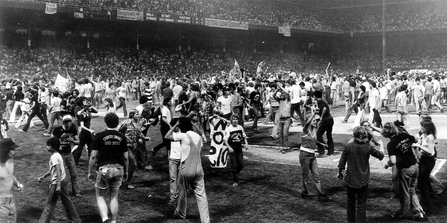
I’m forced to admit that there was one time where someone truly engaged his target audience—and that was during Steve Dahl’s “Disco Demolition Night.”
Dahl was not a disco fan, since he lost his WDAI radio job when his then-employer switched to a disco format. As a counter-reaction to disco, Dahl entertained baseball fans on Disco Demolition Night by destroying disco records between two games of a doubleheader. 7,000 fans stormed the field in delirious joy, wrecking the field, and the second game of the doubleheader was never played. This was NOT a good thing. But the White Sox survived, and even celebrated the 40th anniversary of the promotion. Dahl threw out the first pitch. Nothing exploded. But nothing was accomplished.
So if “target audience” isn’t the right term to use, what is?
I’ll grant that “needy people” has a negative connotation, like the person who is sad when people forget their birthday. (Not “ghosting” per se, but perhaps a little “boo.”) But “needy people” is certainly better than “target audience.”
“Needy” is stronger than “target.” Rather than just representing a demographic, it actually represents people who truly NEED things. Just because a company needs content for its website doesn’t necessarily mean that it needs Bredemarket. Many companies have their own people to create content.
And for the reasons stated by Daily Copyrighting, “people” is stronger than “audience.” You are not a faceless audience that claps (or screams) when Bredemarket does its song and dance. You are people who work in a certain way, which I why I talk to people before creating content for them.
This “needy people” phrase sounded good a few days ago, but now that I’ve thought about it some more I see some problems with this formulation also. In addition to the negative connotations of the phrase, the mere fact that someone is “needy” doesn’t necessary mean that they will buy Bredemarket’s services. Take my identification of “needy people” from a few days ago:
My mini-survey shows that of the 40+ identity firms with blogs, about one-third of them HAVEN’T SAID A SINGLE THING to their prospects and customers in the last two months.
Yes, these companies are damaging their future prospects and need Bredemarket. But none of these companies has approached Bredemarket, or any other marketing and writing consultant, or their in-house people.
Perhaps they don’t see the problem at all.
Perhaps they see the problem, but don’t want to spend money (even a few hundred dollars) to fix it.
Perhaps they see the problem but don’t consider it as critically important as the other problems they face. Rather than spending a few hundred dollars, some companies are saving millions of dollars by “rightsizing” by 10-20% and cutting marketing budgets. They’re just fine with spiderweb-covered blog pages.
Because “needy people” doesn’t capture my meaning, I’ll do the recommended thing and use this blog post to throw up another idea.
The problem with the term “hungry people”
My latest iteration of “target audience” is “hungry people.” I figure that unlike “needy people,” “hungry people” are more inspired to act on their needs. They don’t just clap or scream; they are motivated to search for something to eat.
Using my example of the non-blogging identity firms, perhaps some of those quiet firms are troubled by their lack of communication with their prospects and clients. Rather than doing nothing, these firms are ready to plug their communications gap. But will they plug it with healthy food, or with junk food?
Even without writers, companies can unleash a content creation boom with generative AI. By feeding the AI brand guidelines, target audience data, and product specifics, they can churn out blog posts, ad copy, product descriptions, and even social media snippets. This AI assistant generates captivating headlines, outlines engaging narratives, and drafts basic texts, all while maintaining brand voice and SEO optimization. AI handles the heavy lifting, freeing up resources for strategic planning and audience engagement, boosting content output from silence to symphony.
I know this may surprise you, but I didn’t write the paragraph above. Google Bard did. And perhaps some hungry companies will opt for the free route and let generative AI write their content rather than contracting or employing a content marketer. Silence to symphony for a $0 budget! I consider this bittersweet.
I let the melody shine, let it cleanse my mind, I feel free now. Even though the melody was from Andrew Loog Oldham, uncredited, resulting in a decades-long copyright dispute between the Verve and the Rolling Stones. From https://www.youtube.com/watch?v=1lyu1KKwC74.
So “hungry” doesn’t quite cut it, since I seek the people who are not only hungry, but who will pay for quality fare such as Bredemarket’s marketing and writing services.
To be continued
In this case, the blog post IS a temporary expression of thought. I’ve determined that “target audience” is an imperfect phrase and that I need to replace it with SOMETHING, but I haven’t figured out what that “something” is yet.
Until I get a better idea, I’ll use “hungry people” in my internal work, but I won’t change my customer-facing work (such as the e-book) until I come up with an effective alternative to “target audience.”
And one more thing
And unless I get a sudden brainstorm, this will probably be the last Bredemarket blog post for 2023, and I’m currently ruminating about the first question I asked in this post regarding prospects for 2024. While there were some positive things that happened this year, the negatives during the last seven months tended to outweigh the positives. A lot of other people are also experiencing this, so I’m sharing this song for those who are glad that 2023 is almost over, and who hope that 2024 isn’t more of the same.
















 Bredemarket
.jpg)