One Product You Cannot Get at Amazon Fresh

I went back to the Upland Amazon Fresh at noon, primarily to see how Amazon incorporates technology into its services.

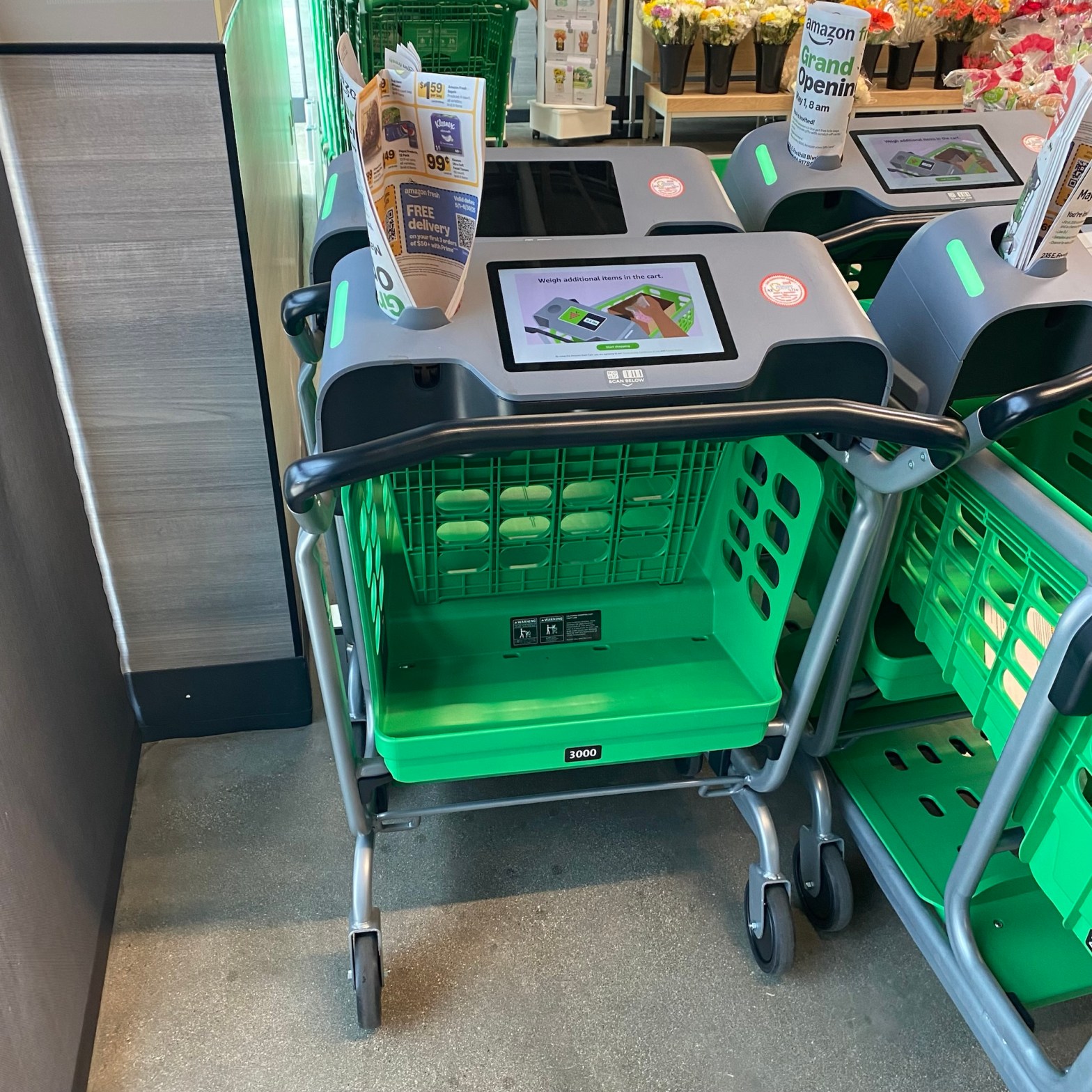
Amazon Fresh supports the Dash Carts I discussed in a previous post. (The Whole Foods I visited this morning does not.) These let you scan your items as you take them from the shelves, speeding your checkout.

Dash Cart in the wild.

Another device speeds your checkout by weighing your produce before checkout. Looks like you have to manually input the item number, though.

Weigh now and check out later.

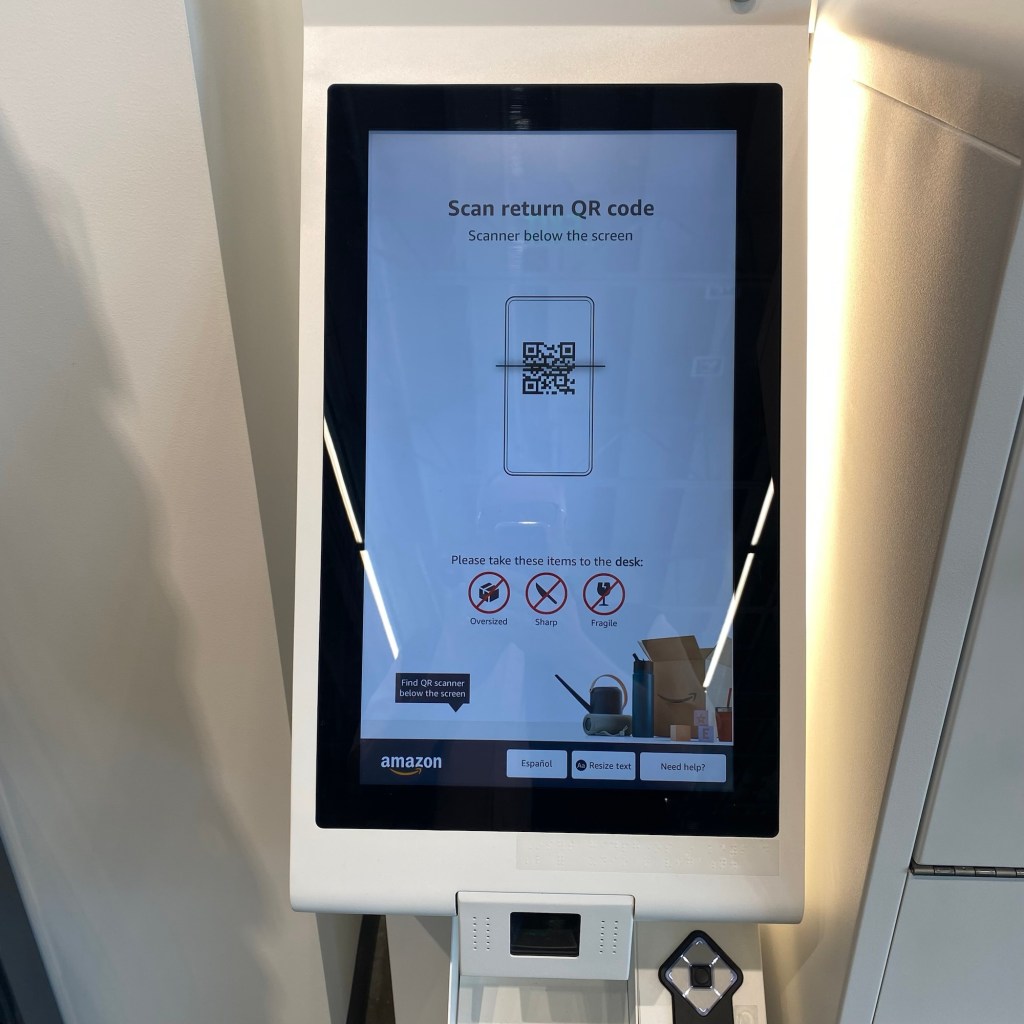
This device appeared to be for returns, but I wasn’t really sure.

QR code for…something.

As I wandered through the store, I was impressed with the variety of groceries offered.

But I was unable to find one item in Amazon Fresh—something that is readily available at the Dollar Tree next door.

The missing item?

Books.

Remember when Amazon was only a book seller?

Amazon One Biometrics Worked. Maybe.

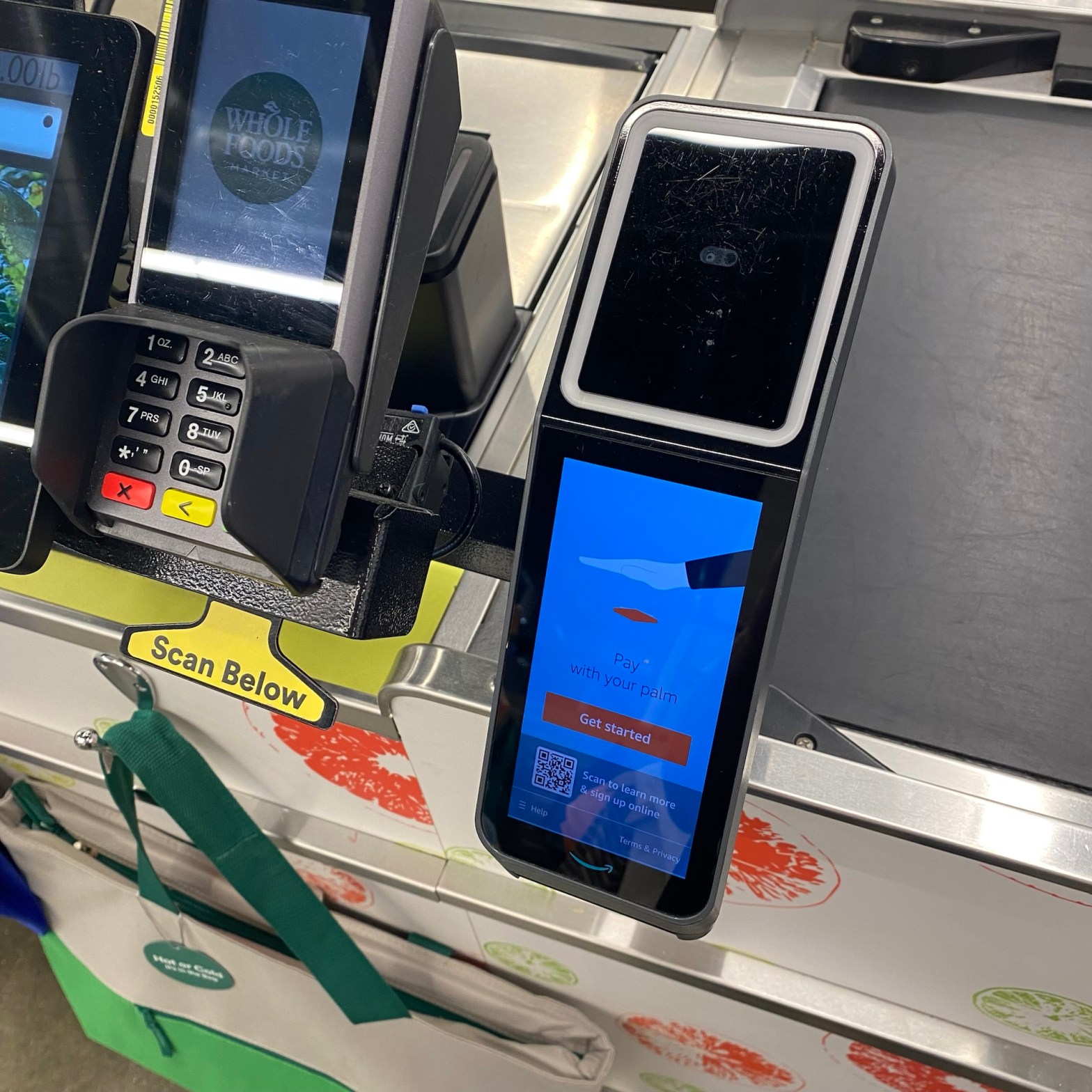
Because of the long line at the Upland Amazon Fresh, I didn’t want to wait around to activate my new Amazon One account. So I went to the Whole Foods on the other side of town. Then the fun began.

I had previously designated a payment card to use with Amazon One (Card #1). When I went to check out and provided my palm, I was asked to insert this card.

The reader said there was a problem with this card, so I inserted a different card (Card #2) and the payment processed on that card.

After my purchase I went back to my Amazon One app…which still showed Card #1 as my purchase card.

Not sure what’s going on.

Enrolling in the Amazon One Palm System via Smartphone

I think I’ve already mentioned that the Amazon Fresh in Upland, California is holding its grand opening in about an hour.

So I figured I should pre-investigate what was necessary to enroll in the Amazon One palm vein system once I arrived at the store.

My first discovery was that Amazon One has its own app, separate from the Amazon app. I don’t know how many apps Amazon has, but if Amazon and Meta ever merge (Amameta?), I will need a separate phone just for its apps.

So I downloaded Amazon One, linked it to my Amazon account, and waited for the instructions on how to enroll my palm at an Amazon location…

…only to find that Amazon One wanted to take pictures of both my palms, right there on my smartphone. Just like any contactless fingerprint app.

Enrolled in Amazon One.

So I am now enrolled, and I have confirmed that my local Amazon Fresh accepts Amazon Go.

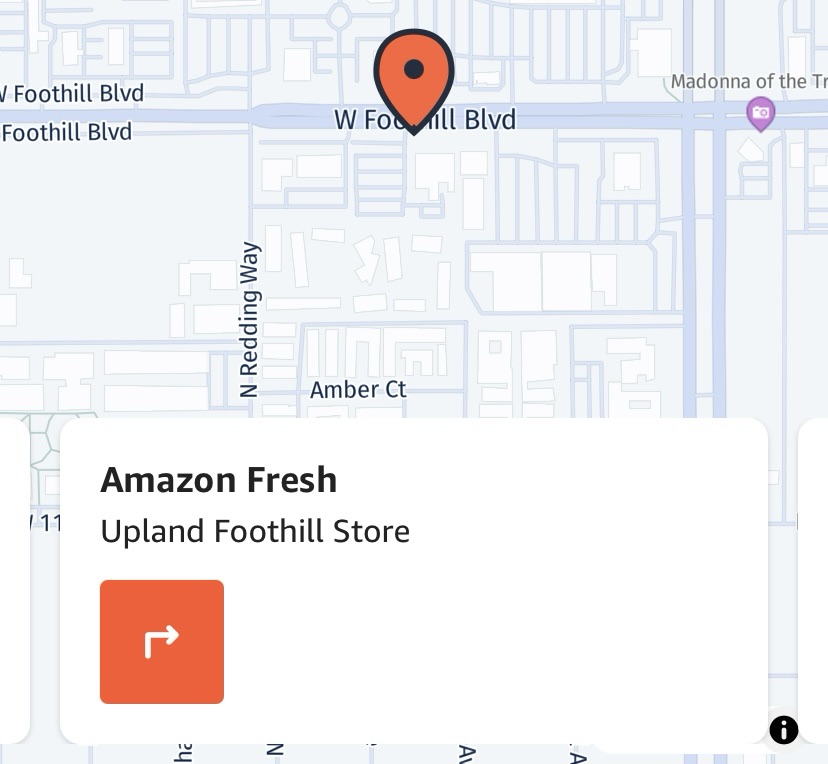
Um…that is not East Foothill.

However, as even non-locals will realize, this is NOT 235 East Foothill, but WEST Foothill. So much for geolocation. (And the location of the Madonna of the Trail statue is wrong also, but I digress.)

Now let’s see if it all works.

Amazon Fresh, Just Walk Out, and Reducing Automation

Between the Upland store grand opening, my musings on Amazon One, and a combination of the two, I have focused on the Amazon Fresh retail chain lately.

But I haven’t touched on the demise of Just Walk Out.

Not because of shrinkage, but because shoppers want control…and Just Walk Out took control away.

It’s masterful, really. You just throw your purchases into your cart, and a battery of cameras record and price everything automatically.

In reality, a battery of cameras and third world workers record and price everything semi-automatically. But I digress.

Anyway, all your purchases are recorded and totaled, and your payment method is charged as you just walk out.

THEN you find out how much you just spent.

Guess what? Customers didn’t like the surprises. They wanted to know how much they were spending BEFORE they were charged.

Customers wanted a better solution:

“Shoppers said they preferred being able to track their spending during a shop, access receipts instantly, and easily find products—all things that are harder with a fully automated system.

“The new solution—smart trolleys known as Dash Carts—lets customers scan items as they shop, view their basket total in real time, and pay using contactless payment at the end.”

The love for Amazon Dash Carts horrifies engineers, who are shocked that customers rejected the technological marvel that was Just Walk Out.

Except that customers don’t want features. They want benefits…such as being able to control their spending.

And if the manual Dash Carts offer better benefits than the automated Just Walk Out…then Just Walk Out does exactly that and leaves the premises.

And if you need to communicate the benefits of your technology solution…

Bredemarket can help:

  • compelling content creation
  • winning proposal development
  • actionable analysis

Book a call: https://bredemarket.com/cpa/ 

Amazon in Upland: Is a Bear a Non-Person Entity?

So the day approaches, and the Upland Amazon Fresh will hold its grand opening on Thursday, May 1.

Amazon Fresh, Upland, California.

Wonder if the bear will show up.

Image from https://abc7.com/amazon-driver-bear-delivery-in-upland-caught-on-video/11503470/

What? You forgot about the bear?

“Yes, that’s an Amazon driver in the foreground, raising his hands to try to scare a bear away so he can make his delivery. He was successful. 

“The full Storyful video can be found here. (And of course it’s a Ring video. You didn’t expect a Nest video, did you?)”

I wonder if the bear’s paw will work with the palm vein reader.

Imagen 3. What’s the Amazon One error rate for THIS demographic group?

By the way, this is a reminder that Bredemarket provides its services to local Inland Empire businesses also. I can offer

  • compelling content creation
  • winning proposal development
  • actionable analysis

If Bredemarket can help your stretched staff, book a free meeting with me: https://bredemarket.com/cpa/

And one more thing…

After I wrote the main body of this post, I realized that I accidentally wrote the Bredemarket trifecta, covering all three of my concentrations:

  • Identity (Amazon)
  • Technology (Amazon)
  • Inland Empire (Amazon)

If you’re concerned about Amazon taking over everything, don’t fear. It will eventually fail.

But until it does, I’m gonna make some money!

#fakefakefake

Revisiting Amazon One

Because my local Amazon Fresh post is taking off, it’s a good time to revisit the “one” thing Uplanders will encounter when they get there.

I’ve talked about Amazon One palm/vein biometrics several times in the past.

Meanwhile, Amazon One is available at over 400 U.S. locations, with more on the way.

And it’s also available (or soon will be) on TP-Link door locks. But the How-To Geek writer is confused:

“TP-Link says that these palm vein patterns are so unique that they can even tell the difference between identical twins, making them safer than regular fingerprint or facial recognition methods.”

Um…fingerprints? Must be a Columbia University grad.

And the TP-Link page for the product has no sales restrictions. Even Illinois residents can buy it. Presumably there’s an ironclad consent agreement with every enrollment to prevent BIPA lawsuits.

(Picture from Imagen 3)

Upland California Amazon Fresh Opening May 1

Finally.

Amazon Fresh, April 6, 2025.

Oh, and they’re hiring. Sort of.

Work Address: 235 E. Foothill Blvd, Upland, CA, 91786  

Pay Rate: $17.80 per hour

Availability Requirements: Shift availability is dependent on operational needs.

Part-time: Shift availability required 3 days per week, including Saturday and Sunday

Flex-time: Must be available 2 weekdays between Monday-Friday and 1 weekend day/evening between Saturday-Sunday. May be scheduled up to 8 hours weekly, with additional shifts offered based on store availability.

Shifts are between 4 a.m. and 12 a.m. and may be up to 8 hours long

Amazon One and Palm/Vein Identity Scanning in Healthcare: Does It Work?

If you create your own test data, you’re more likely to pass the test. So what data was used for Amazon One palm/vein identity scanning accuracy testing?

(Part of the biometric product marketing expert series)

(Image from Imagen 3)

I’ve previously discussed Amazon’s biometric palm/vein identity scanning efforts. But according to Dr. Sai Balasubramanian, M.D., J.D. in Forbes, Amazon is entering a new market, healthcare.

“Amazon announced that it is partnering with NYU Langone to launch Amazon One, a contactless palm screening technology, throughout the health system.”

Which makes sense, as long as the medical professional isn’t wearing gloves. I don’t know if Amazon One can read veins through medical gloves.

As I reflected upon this further, I realized something:

  • NIST has tested fingerprint verification and identification.
  • NIST has tested facial recognition. (Not that Amazon participated.)
  • NIST has tested iris recognition.

But NIST has never conducted regular testing of palm identification in general, or palm/vein identity scanning in particular. Not for Amazon. Not for Fujitsu. Not for Imprivata. Not for Ingenico. Not for Pearson. Not for anybody.

So how do we know that Amazon One works?

Because Amazon said so.

“Amazon One is 100 times more accurate than scanning two irises. It raises the bar for biometric identification by combining palm and vein imagery, and after millions of interactions among hundreds of thousands of enrolled identities, we have not had a single false positive.”

Claims may dazzle some people, but (as of 2023) Jim Nash was not among them:

“The company claims it is 99.999 percent accurate but does not offer information supporting that statistic.”

And so far I haven’t found any either.

Since the company trains its algorithm on synthetically generated palms, I would like to make sure the company performs its palm/vein identity scanning accuracy testing on REAL palms. If you actually CREATE the data for any test, including an accuracy test, there’s a higher likelihood that you will pass.

I think many people would like to see public substantiated Amazon One accuracy data. ZERO false positives is a…BOLD claim to make.

Kindle Books: You Don’t Own Me

(AI images from Imagen 3)

Perhaps one of the biggest changes over the last several decades is that we no longer possess physical things.

Old and new music 

When some of us were younger, we would always go to “the record store” to buy a CD or cassette or vinyl (the “record”) or maybe an 8 track. We would put the physical media on a playback device. And unless the media were damaged or stolen, you always had it. RCA wouldn’t come to your house and take your Elvis record.

Let me be your teddy wildebeest.

Then services from Napster 1.0 to Apple to Spotify started to provide music in digital form.  And now your music COULD be taken away. When Neil Young got mad at Spotify, I couldn’t listen to Neil any more. (They subsequently kissed and made up.)

This is true of many other things: TV shows, movies, even computer software.

Which brings us to books. 

Old and new books

You could once buy books at your local bookstore, or from an online bookstore called Amazon. But then Amazon developed the Kindle e-reader. And as The Verge points out, something on the Kindle today may not be there tomorrow.

“Amazon has occasionally removed books from its online store and remotely deleted them from Kindles or edited titles and re-uploaded new copies to its e-readers. In 2009, the company removed copies of George Orwell’s Nineteen Eighty-Four and Animal Farm, explaining the books had been mistakenly published. More recently, many of Roald Dahl’s books, including Charlie and the Chocolate Factory, were replaced with updated copies featuring modified language on various ebook platforms. It’s a reminder that you don’t actually own much of the digital content you consume, and without the ability to back up copies of ebooks, you could lose them entirely if they’re banned and removed.”

New and improved edition.

But there is a workaround. If your Kindle has a copy of Mein Kampf or a book about gay hotspots near the Gulf of Mexico and you don’t want to lose it, you can save it outside of the Amazon ecosystem.

“(The feature is) still accessible through Amazon’s website by accessing your “Content Library” while logged into your account. For purchased books you select the “More actions” menu, choose “Download & transfer via USB,” select a Kindle device you have registered, and a copy of the book will be downloaded to your computer.”

A nice feature…especially if you want to make sure you don’t lose your purchased content. And it’s really nice if you want to put your Amazon content on a non-Amazon e-reader. Because the Kindle only has a minuscule 72% share of the e-reader market, this is a gargantuan threat to Amazon’s ability to sell hardware.

You can see where this is going.

Ch-ch-ch-ch-changes

Amazon has made a change, according to The Verge:

“Starting February 26, 2025, the ‘Download & Transfer via USB’ option will no longer be available. You can still send Kindle books to your Wi-Fi enabled devices by selecting the ‘Deliver or Remove from Device’ option.”

February 25.

To clarify, you can still access your books on the Kindle app.

Just not outside of it.

How does this affect your content?

This serves as a reminder about technological change, walled gardens, and obsolescence.

Which ties in with one of Bredemarket’s favorite topics, repurposing.

You can take content from one platform and place it on another. For example, a (mostly) text post can become a video reel.

Now Bredemarket doesn’t create videos for clients, but if you need your identity/biometric or technology text repurposed in another format, I can help.

CPA