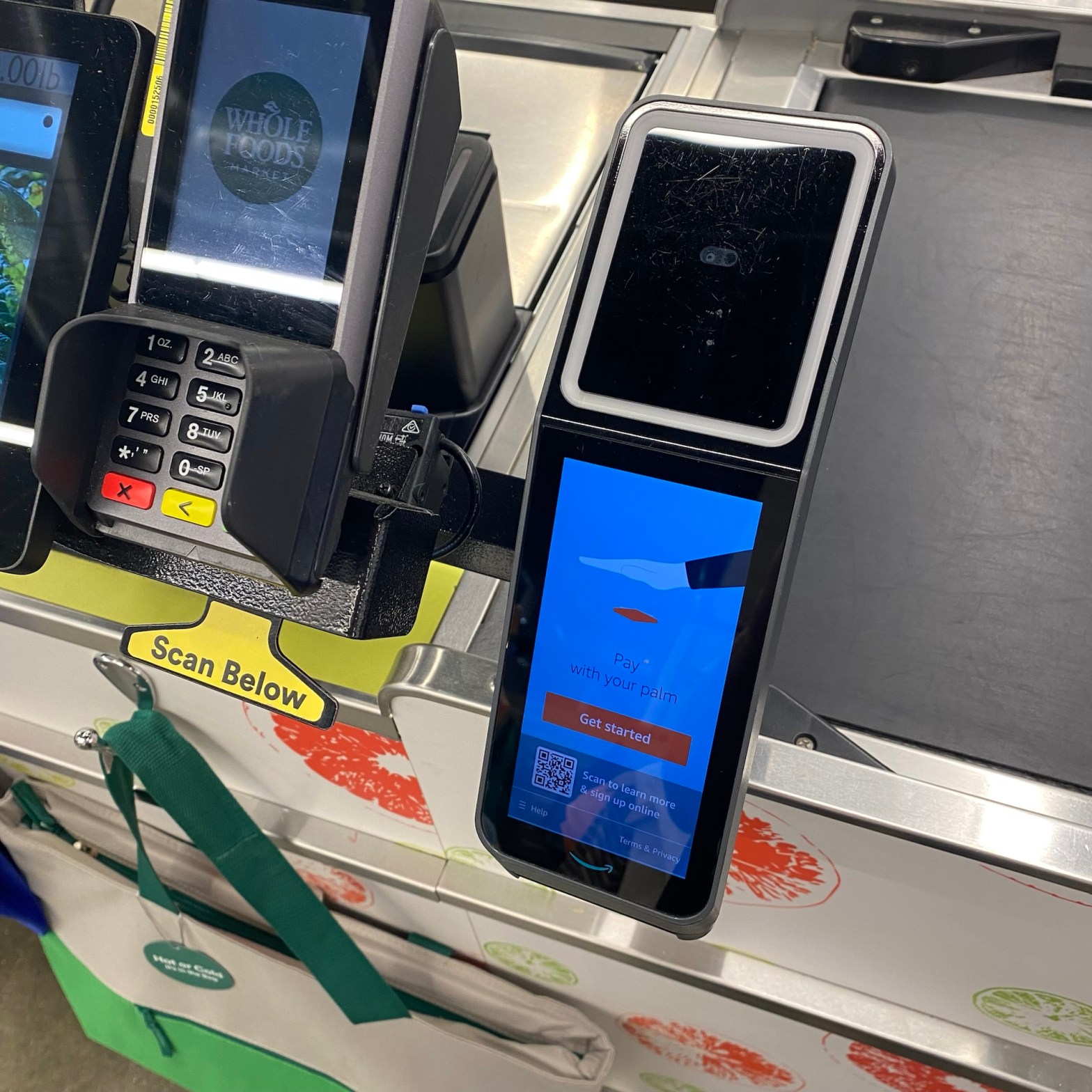
I had previously designated a payment card to use with Amazon One (Card #1). When I went to check out and provided my palm, I was asked to insert this card.
The reader said there was a problem with this card, so I inserted a different card (Card #2) and the payment processed on that card.
After my purchase I went back to my Amazon One app…which still showed Card #1 as my purchase card.
So I figured I should pre-investigate what was necessary to enroll in the Amazon One palm vein system once I arrived at the store.
My first discovery was that Amazon One has its own app, separate from the Amazon app. I don’t know how many apps Amazon has, but if Amazon and Meta ever merge (Amameta?), I will need a separate phone just for its apps.
So I downloaded Amazon One, linked it to my Amazon account, and waited for the instructions on how to enroll my palm at an Amazon location…
…only to find that Amazon One wanted to take pictures of both my palms, right there on my smartphone. Just like any contactless fingerprint app.
Enrolled in Amazon One.
So I am now enrolled, and I have confirmed that my local Amazon Fresh accepts Amazon Go.
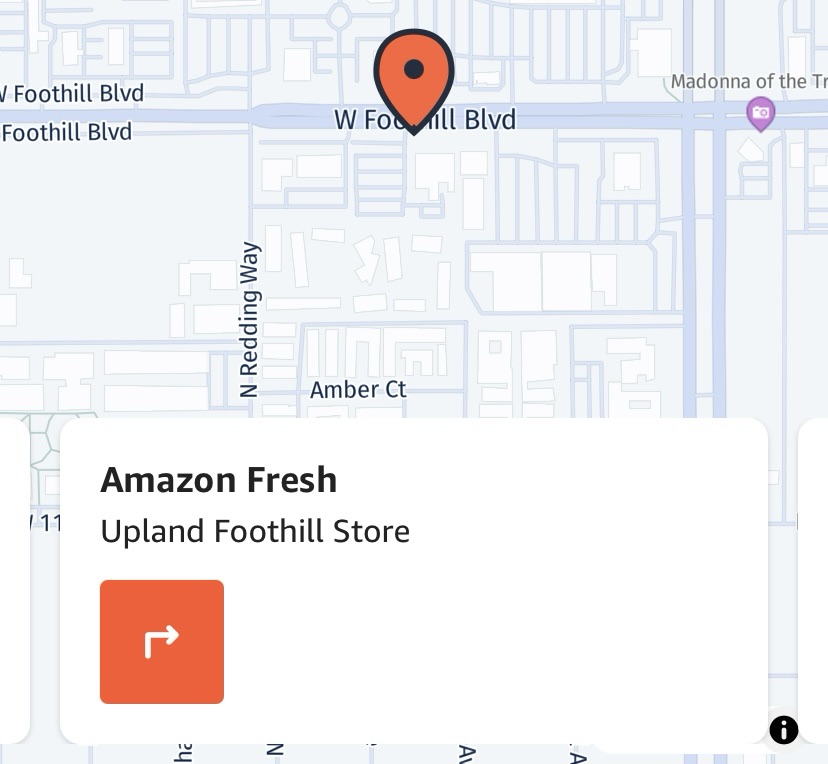
Um…that is not East Foothill.
However, as even non-locals will realize, this is NOT 235 East Foothill, but WEST Foothill. So much for geolocation. (And the location of the Madonna of the Trail statue is wrong also, but I digress.)
“Shoppers said they preferred being able to track their spending during a shop, access receipts instantly, and easily find products—all things that are harder with a fully automated system.
“The new solution—smart trolleys known as Dash Carts—lets customers scan items as they shop, view their basket total in real time, and pay using contactless payment at the end.”
Because my local Amazon Fresh post is taking off, it’s a good time to revisit the “one” thing Uplanders will encounter when they get there.
I’ve talked about Amazon One palm/vein biometrics several times in the past.
The August 2021 post about Amazon paying $10 for your biometrics, long before World (Worldcoin) did something similar. Hmm…wonder if the $10 deal is still on?
And it’s also available (or soon will be) on TP-Link door locks. But the How-To Geek writer is confused:
“TP-Link says that these palm vein patterns are so unique that they can even tell the difference between identical twins, making them safer than regular fingerprint or facial recognition methods.”
And the TP-Link page for the product has no sales restrictions. Even Illinois residents can buy it. Presumably there’s an ironclad consent agreement with every enrollment to prevent BIPA lawsuits.
Work Address: 235 E. Foothill Blvd, Upland, CA, 91786
Pay Rate: $17.80 per hour
Availability Requirements: Shift availability is dependent on operational needs.
Part-time: Shift availability required 3 days per week, including Saturday and Sunday
Flex-time: Must be available 2 weekdays between Monday-Friday and 1 weekend day/evening between Saturday-Sunday. May be scheduled up to 8 hours weekly, with additional shifts offered based on store availability.
Shifts are between 4 a.m. and 12 a.m. and may be up to 8 hours long
If you create your own test data, you’re more likely to pass the test. So what data was used for Amazon One palm/vein identity scanning accuracy testing?
But NIST has never conducted regular testing of palm identification in general, or palm/vein identity scanning in particular. Not for Amazon. Not for Fujitsu. Not for Imprivata. Not for Ingenico. Not for Pearson. Not for anybody.
“Amazon One is 100 times more accurate than scanning two irises. It raises the bar for biometric identification by combining palm and vein imagery, and after millions of interactions among hundreds of thousands of enrolled identities, we have not had a single false positive.”
“The company claims it is 99.999 percent accurate but does not offer information supporting that statistic.”
And so far I haven’t found any either.
Since the company trains its algorithm on synthetically generated palms, I would like to make sure the company performs its palm/vein identity scanning accuracy testing on REAL palms. If you actually CREATE the data for any test, including an accuracy test, there’s a higher likelihood that you will pass.
I think many people would like to see public substantiated Amazon One accuracy data. ZERO false positives is a…BOLD claim to make.
Perhaps one of the biggest changes over the last several decades is that we no longer possess physical things.
Old and new music
When some of us were younger, we would always go to “the record store” to buy a CD or cassette or vinyl (the “record”) or maybe an 8 track. We would put the physical media on a playback device. And unless the media were damaged or stolen, you always had it. RCA wouldn’t come to your house and take your Elvis record.
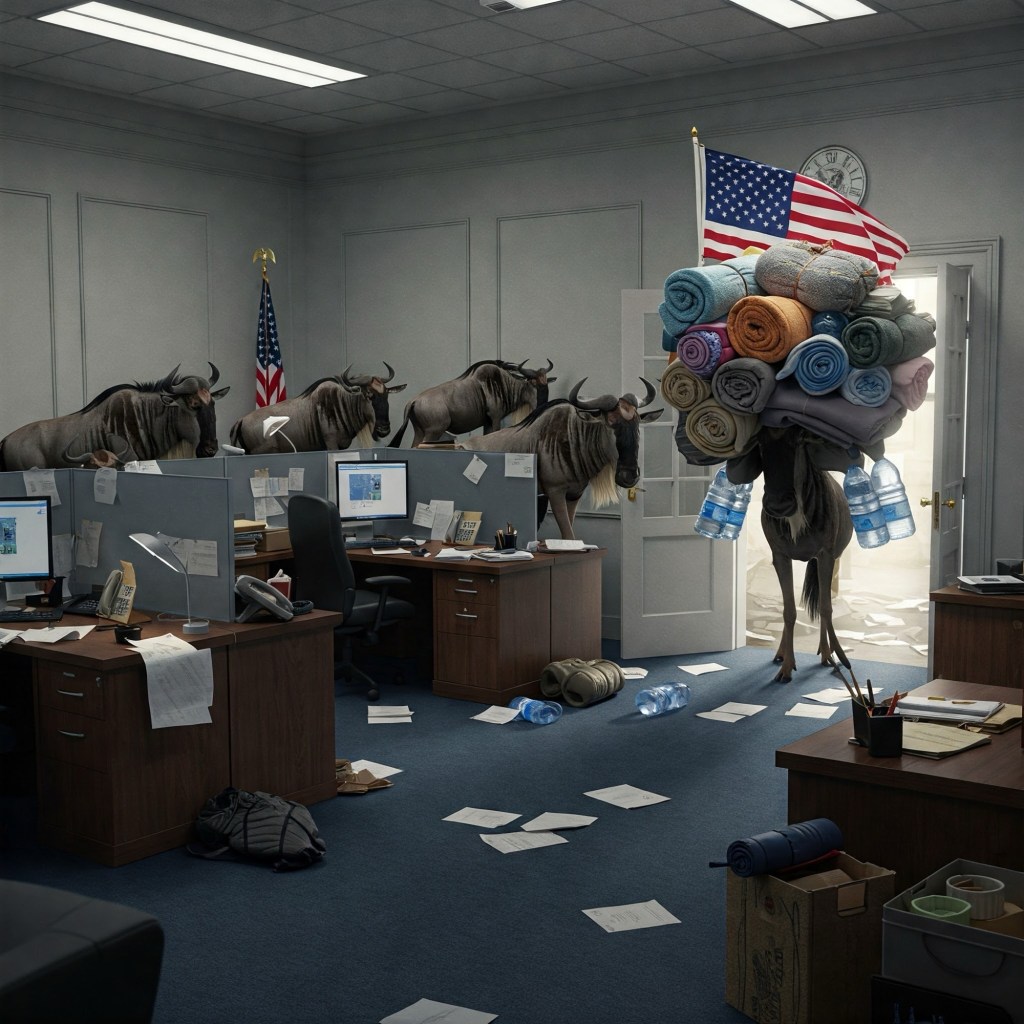
Let me be your teddy wildebeest.
Then services from Napster 1.0 to Apple to Spotify started to provide music in digital form. And now your music COULD be taken away. When Neil Young got mad at Spotify, I couldn’t listen to Neil any more. (They subsequently kissed and made up.)
This is true of many other things: TV shows, movies, even computer software.
Which brings us to books.
Old and new books
You could once buy books at your local bookstore, or from an online bookstore called Amazon. But then Amazon developed the Kindle e-reader. And as The Verge points out, something on the Kindle today may not be there tomorrow.
“Amazon has occasionally removed books from its online store and remotely deleted them from Kindles or edited titles and re-uploaded new copies to its e-readers. In 2009, the company removed copies of George Orwell’s Nineteen Eighty-Four and Animal Farm, explaining the books had been mistakenly published. More recently, many of Roald Dahl’s books, including Charlie and the Chocolate Factory, were replaced with updated copies featuring modified language on various ebook platforms. It’s a reminder that you don’t actually own much of the digital content you consume, and without the ability to back up copies of ebooks, you could lose them entirely if they’re banned and removed.”
New and improved edition.
But there is a workaround. If your Kindle has a copy of Mein Kampf or a book about gay hotspots near the Gulf of Mexico and you don’t want to lose it, you can save it outside of the Amazon ecosystem.
“(The feature is) still accessible through Amazon’s website by accessing your “Content Library” while logged into your account. For purchased books you select the “More actions” menu, choose “Download & transfer via USB,” select a Kindle device you have registered, and a copy of the book will be downloaded to your computer.”
A nice feature…especially if you want to make sure you don’t lose your purchased content. And it’s really nice if you want to put your Amazon content on a non-Amazon e-reader. Because the Kindle only has a minuscule 72% share of the e-reader market, this is a gargantuan threat to Amazon’s ability to sell hardware.
You can see where this is going.
Ch-ch-ch-ch-changes
Amazon has made a change, according to The Verge:
“Starting February 26, 2025, the ‘Download & Transfer via USB’ option will no longer be available. You can still send Kindle books to your Wi-Fi enabled devices by selecting the ‘Deliver or Remove from Device’ option.”
February 25.
To clarify, you can still access your books on the Kindle app.
Just not outside of it.
How does this affect your content?
This serves as a reminder about technological change, walled gardens, and obsolescence.
Which ties in with one of Bredemarket’s favorite topics, repurposing.
Now Bredemarket doesn’t create videos for clients, but if you need your identity/biometric or technology text repurposed in another format, I can help.
When you market to your prospects and customers, will they believe what you say? Or will you be exposed as a liar?
The Bredemarket blog has talked incessantly about customer focus from a marketing perspective, noting that an entity’s marketing materials need to speak to the needs of the customer or the prospect, not the selling entity.
But customer focus alone is not enough. When the customers sign up, they have to deal with someone.
Unless the customer is stuck in answer bot hell (another issue entirely), they will deal with an employee.
The expendables
And some employees are not happy, because they feel they are expendable.
“Every area should be looking to be 10% more efficient. If I was running a department with a hundred people, I guarantee you, if I wanted to, I couldn’t run it with 90 and be more efficient. I guarantee you, I could do it.”
So J.P. Morgan Chase is doing very well, Dimon is doing very well, but he’s implicitly saying that his people suck.
“This is going to be an intense year, and I want to make sure we have the best people on our teams. I’ve decided to raise the bar on performance management and move out low performers faster.”
You may have noticed my intentional use of the word “entity” at the beginning of this post. Because while businesses have attracted much attention in the current culture of “layoffs will continue until morale improves,” these businesses are themselves “low performers” in the shedding people category. Chief DOGE Elon Musk, fresh from reducing X’s headcount, is coordinating layoffs in the public sector.
“Federal agencies were ordered by Donald Trump to fire mostly probationary staff, with as many as 200,000 workers set to be affected and some made to rush off the premises.”
Zuckerberg could only dream of saying “you’re fired” to 200,000 people. That dream would certainly increase his masculine energy, but for now Musk has trumped Zuckerberg on that front.
Do J.P. Morgan Chase’s employees matter to Jamie Dimon?
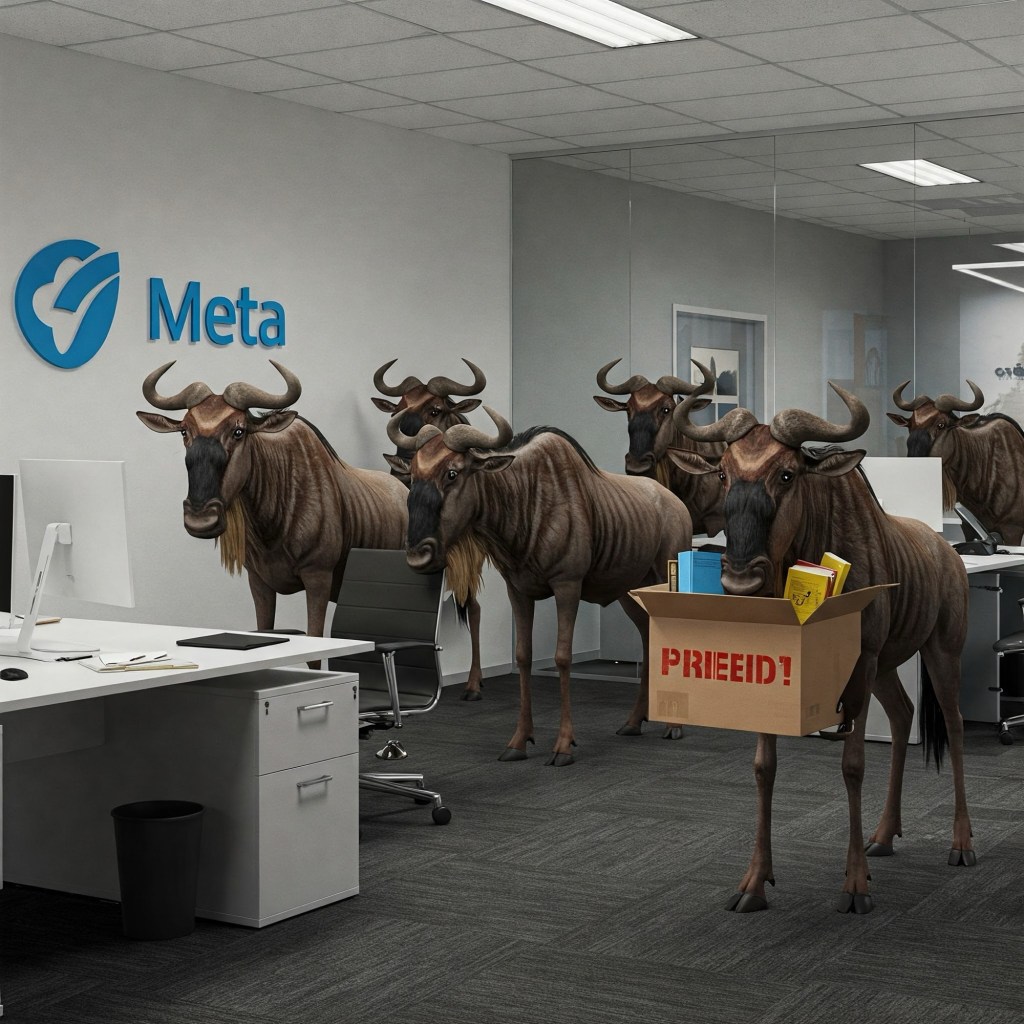
Do Meta’s employees matter to Mark Zuckerberg?
Do federal employees matter to Elon Musk and Donald Trump?
Regardless of the answer (and one could assert that they like the “good” employees and don’t want them to be harmed by the bad apples), their views are not universal.
The other extreme
Richard Branson (reportedly) does not put his needs first at the Virgin companies he runs.
Nor does he prioritize investors.
Oh, and if you’re one of Virgin’s customers…your happiness isn’t critically important either.
“So, my philosophy has always been, if you can put staff first, your customer second and shareholders third, effectively, in the end, the shareholders do well, the customers do better, and yourself are happy.”
You could argue that this is a means to an end, and that employee focus CAUSES customer focus. What if employee focus is missing?
“If the person who’s working for your company is not given the right tools, is not looked after, is not appreciated, they’re not gonna do things with a smile and therefore the customer will be treated in a way where often they won’t want to come back for more.”
Think about this the next time you have a problem with your Facebook account or at a Chase Bank or with your tax return.
Whether back office issues matter to customers
Of course I may be over reading into this, because I have said that the customer doesn’t care about your company. If you solve their problems, they don’t care if you’re hiring 200,000 people or firing 200,000 people.
If you solve their problems.
I can’t cite the source or the company, but I heard a horror story about an unhappy customer. The company had heavily bought into the “layoffs will continue until morale improves” philosophy, resulting in turnover in the employees who dealt with customers. When the customer raised an issue with the company, it made a point of saying that employee John Jones (not the employee’s real name) could have solved the customer’s problem long ago if the company hadn’t removed Jones from the account.
What about your company’s marketing?
So think about this in your marketing. Before you brag about your best places to work award, make sure that your prospect will see evidence of this in the employees they encounter.
“Our 8th annual LinkedIn Top Companies list highlights the 50 best large workplaces to grow your career in the U.S. right now. Fueled by unique LinkedIn data, the methodology analyzes various facets of career progression like promotion rates, skill development and more among employees at each company.”
Number 1 on LinkedIn’s April 2024 list? J.P. Morgan Chase.








 Bredemarket