On Communities

My written content usually targets a PRIMARY channel:

This content has a new target: my Substack “subscriber chat” https://open.substack.com/pub/johnebredehoft/chat

Because unlike the others, Substack subscriber chat is DESIGNED as a community.

A community that I’m not currently utilizing, but one that I should in the future.

By the way, if you want to read my Substack, visit https://substack.com/@johnebredehoft

Authenticity, Generative Artificial Intelligence, and Product Marketing: Two Versions

When you’re…um…surfing the web, do you say to yourself, “I really hope I encounter something written by ChatGPT”?

Maybe you want to learn about a particular product and you’re hoping to find a page that begins with the words “in the ever-changing landscape of handheld gaming advances…”

Or you’re dying to read text that could be written by anybody…or by nobody.

Generative AI text is, after all, the “professional” tone.

When the CEO asks the product marketers to write just like the competitors, it’s possible that you could write exactly like the competitors by using the exact same generative AI tool (ChatGPT, because everybody uses it) and the exact same prompts to get the exact same content. This brands you as a respected member of the industry.

But whatever you do, act professionally.

Don’t randomly blow off steam like I just did.

Don’t loudly proclaim silly antiquated thoughts like “a bot should never write the first draft.”

In fact, forget that you read any of this.

Because I’m going to have it rewritten with a professional tone.

Because while your readers claim that they want to read authentic text rather than AI-generated text, they don’t know what’s good for them.

So I’m going to rewrite this the way it’s supposed to be done…with one exception. I’m going to use Google Gemini rather than ChatGPT. I know I’ll get in trouble for doing it this way.

But the text below is what readers WANT to read…right?

Navigating AI in Product Marketing: Authenticity vs. Efficiency

The increasing prevalence of generative AI in content creation presents a critical challenge for product marketers: balancing the pursuit of efficiency with the imperative of authenticity. While AI tools offer significant advantages in content generation, their widespread adoption raises questions about brand differentiation and genuine engagement.

A common misconception is that a “professional tone” inherently aligns with the output of generative AI. However, relying solely on AI, particularly popular platforms like ChatGPT, can lead to generic content that lacks unique brand voice and fails to resonate deeply with target audiences. When product marketing teams are tasked with mirroring competitor messaging, using the same AI tools and prompts as competitors can result in indistinguishable content, ultimately eroding a brand’s distinct identity within the industry.

This scenario underscores a fundamental tension: while consumers often express a preference for authentic, human-generated content, the demand for high-volume, rapid content creation pushes marketers towards AI solutions. The challenge lies in strategically integrating AI without compromising the unique elements that define a brand’s communication.

Product marketers are encouraged to consider the following:

  • Strategic AI Implementation: Instead of viewing AI as a complete content solution, leverage it for specific tasks that enhance efficiency without sacrificing originality. This could include initial research, data synthesis, or generating diverse content formats that human marketers can then refine and personalize.
  • Prioritizing Distinctive Brand Voice: Invest in developing a clear and consistent brand voice that transcends generic AI output. This involves defining unique terminology, storytelling approaches, and a tone that reflects the brand’s values and personality.
  • Authenticity and Connection: While AI can streamline content production, fostering genuine connections with audiences still requires human insight and empathy. Focus on creating content that addresses real customer needs, shares authentic brand stories, and encourages meaningful interaction.

The objective for product marketers is not to abandon AI, but to wield it judiciously. By understanding its capabilities and limitations, and by consciously prioritizing authenticity and unique brand expression, marketers can leverage AI as a powerful tool to enhance their efforts without sacrificing the crucial human element that drives true engagement.

Do you believe the future of product marketing lies in a complete embrace of AI, or a more nuanced integration that prioritizes human oversight and authentic brand voice?

On Complexity (the Ray Ozzie quote)

I recently referred to a nearly 20 year old memo (remember memos?) from Ray Ozzie, then-Chief Technical Officer at Microsoft.

Perhaps you remember this quote:

“Complexity kills. It sucks the life out of developers, it makes products difficult to plan, build and test, it introduces security challenges, and it causes end-user and administrator frustration. Moving forward, within all parts of the organization, each of us should ask “What’s different?”, and explore and embrace techniques to reduce complexity.”

Happy Independence Day?

(Richard Henry Lee)

It was Saturday, June 28, and I was looking over Bredemarket’s scheduled posts. And I saw that I had posts scheduled through Tuesday, July 1 and needed a post for Wednesday the 2nd.

That’s easy, I thought.

Since Bredemarket offers its marketing and writing services to identity/biometric and technology firms in the United States, July 2 is the perfect day for an Independence Day post.

But wait!

But…you heard me right. From the Constitution Center:

“Officially, the Continental Congress declared its freedom from Great Britain on July 2, 1776, when it voted to approve a resolution submitted by delegate Richard Henry Lee of Virginia, declaring ‘That these United Colonies are, and of right ought to be, free and independent States, that they are absolved from all allegiance to the British Crown, and that all political connection between them and the State of Great Britain is, and ought to be, totally dissolved.’”

That day was so momentous that John Adams predicted:

“The Second Day of July 1776, will be the most memorable Epocha, in the History of America.

“I am apt to believe that it will be celebrated, by succeeding Generations, as the great anniversary Festival. It ought to be commemorated, as the Day of Deliverance by solemn Acts of Devotion to God Almighty. It ought to be solemnized with Pomp and Parade, with Shews, Games, Sports, Guns, Bells, Bonfires and Illuminations from one End of this Continent to the other from this Time forward forever more.”

Well, Adams ALMOST got it right.

Then what?

So what happened on July 4, if we actually declared independence on July 2?

You see, it’s one thing to declare independence from the United Kingdom. It’s another to let the United Kingdom know about it. 

As John Adams knew all too well, a committee of five was working on a declaration to address the latter. But the committee’s work still required approval. And some in the Continental Congress were troubled by one part of Thomas Jefferson’s Declaration:

“He [King George III] has waged cruel war against human nature itself, violating its most sacred rights of life & liberty in the persons of a distant people who never offended him, captivating & carrying them into slavery in another hemisphere or to incur miserable death in their transportation thither.”

Delegates from Southern and Northern colonies alike objected to the clause: Southerners like Jefferson himself who profited from slaves, and Northerners who profited from transporting them from Africa to here.

But that’s boring, so let’s listen to a song about it.

Anyway, the troublesome clause was removed from the Declaration of Independence, settling the slavery issue for all time so that the country would never have to deal with it again…until 1787. And 1820. And 1850. And 1861.

After all the edits were completed to the Declaration of Independence, the Continental Congress followed up on its momentous July 2 act with a minor bookkeeping detail two days later, actually approving the declaration.

Except…that the printed versions of the document included the July 4 date, not the date of Richard Henry Lee’s resolution on July 2.

So no red, white, and blue soup for you today. Wait a couple of days.

And marvel at how a single piece of written content resulted in profound changes to this country…and many others.

Agentic AI NPEs, Ephemeral and Non-Individual

People are people, and why should it be that non-person entities (NPEs) are treated the same? The girl is NOT the robot.

Imagen 4.

Non-static

In a June 30 LinkedIn post, Eric Olden of Strata caused me to realize that my approach to NPEs is too uniform and needs to be more nuanced.

“Agentic identity isn’t just a new type of NHI. AI agents might functionally fall under the “non-human identity” umbrella—but that label doesn’t really cut it since we’re not talking about static service accounts or API keys.”

In a table published in the original post, Olden semantically defines NHIs as the persistent entities with unchanging privileges. Agentic identities, in Olden’s cosmos, are ephemeral.

But Olden identifies one additional distinction that has nothing to do with lifespan.

“AI agents are digital actors that can reason and make decisions across systems.”

Olden notes that the characteristics of agentic AI offer both power and risk.

Impermanent

From ConductorOne.

ConductorOne shares Olden’s observations on agentic AI:

“Often ephemeral, existing for just seconds or minutes depending on the task.

“Requires role-based or task-specific access, rather than broad or persistent permissions.

“Capable of autonomous decision-making and executing actions in real-time.

“Built to integrate with existing systems and interact securely with other agents.

“Expands the potential for AI solutions by enabling action—not just insight or content.”

Unaccountable

Imagen 4.

So how do you set up individual accounts for these extremely powerful non-person entities that appear and disappear?

According to Juan Ignacio Torres Durán, you don’t.

“Modern architectures — cloud-native, ephemeral workloads, APIs, containers, robotic processes — don’t fit neatly into the account model. They’re fast, dynamic, and short-lived. They need access right now, based on who or what they are, where they run, and what they do.

“And here’s the shift: We don’t need to create an account for each of them. We just need to recognize the entity, validate it, and project a governed identity that can be used for access decisions.”

So no distinct individuality for NPEs. That’s an interesting…um…world.

Does Zero Knowledge Equal Zero Privacy?

Perhaps you’ve heard the joke about an anonymous survey managed by a company’s personnel department. In the joke, one employee received two emails:

  • The first was from HR, announcing the anonymous survey.
  • The second was from the employee’s supervisor, reporting that HR says that the employee is the only person who hasn’t completed the “anonymous” survey.

But maybe it’s not a joke.

Is the zero knowledge/World dream of one unique identity per person actually a curse? According to Biometric Update, Vitalik Buterin of Ethereum fame claims it REMOVES privacy.

“[U]nder one-per-person ID, even if ZK-wrapped, we risk coming closer to a world where all of your activity must de-facto be under a single public identity….

“[T]here can’t be an easily legible hard limit on how many identities you can easily get. If you can only have one identity, you do not have pseudonymity, and you can be coerced into revealing it.”

Buterin believes multiple identities, managed separately, provide concurrent identity and privacy.

Some Voice Deepfakes Are NOT Fraudulent

(Part of the biometric product marketing expert series)

I’ve spent a ton of time discussing naughty people who use technology to create deepfakes—including voice deepfakes—to defraud people.

But some deepfakes don’t use technology, and some deepfakes are not intended to defraud.

Take Mark Hamill’s impersonation of fellow actor Harrison Ford.

Mark Hamill as Harrison Ford, and Harrison Ford reacting to Mark Hamill.

And then there was a case that I guess could be classified as fraud…at least to Don Pardo’s sister-in-law.

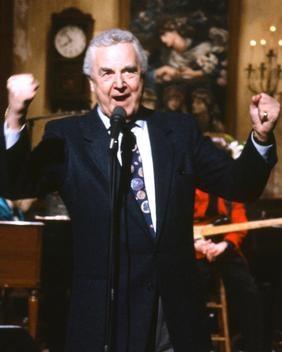
Don Pardo was originally known as an announcer on NBC game shows, and his distinctive voice could be heard on many of them, including (non-embeddable) parodies of them.

With his well-known voice, NBC jumped at the chance to employ him as the announcer for the decidedly non-game television show Saturday Night Live, where he traded dialogue with the likes of Frank Zappa.

“I’m the Slime.”

Except for a brief period after he ran afoul of Michael O’Donoghue, Pardo was a fixture on SNL for decades, through the reigns of various producers and executive producers.

Until one night in 1999 when laryngitis got the best of Don Pardo, and the show had to turn to Bill Clinton.

No, not the real Bill Clinton.

I’m talking about the SNL cast member who did a voice impression of Bill Clinton (and Jeopardy loser Sean Connery), Darrell Hammond. Who proceeded to perform an impression of Don Pardo.

An impression that even fooled Don Pardo’s sister-in-law.

This is Don Pardo saying this is Don Pardo…

Pardo continued to be Saturday Night Live’s announcer for years after that, sometimes live from New York, sometimes on tape from his home in Arizona.

And when Pardo passed away in 2014, he was succeeded as SNL’s announcer by former cast member Darrell Hammond.

Who used his own voice.