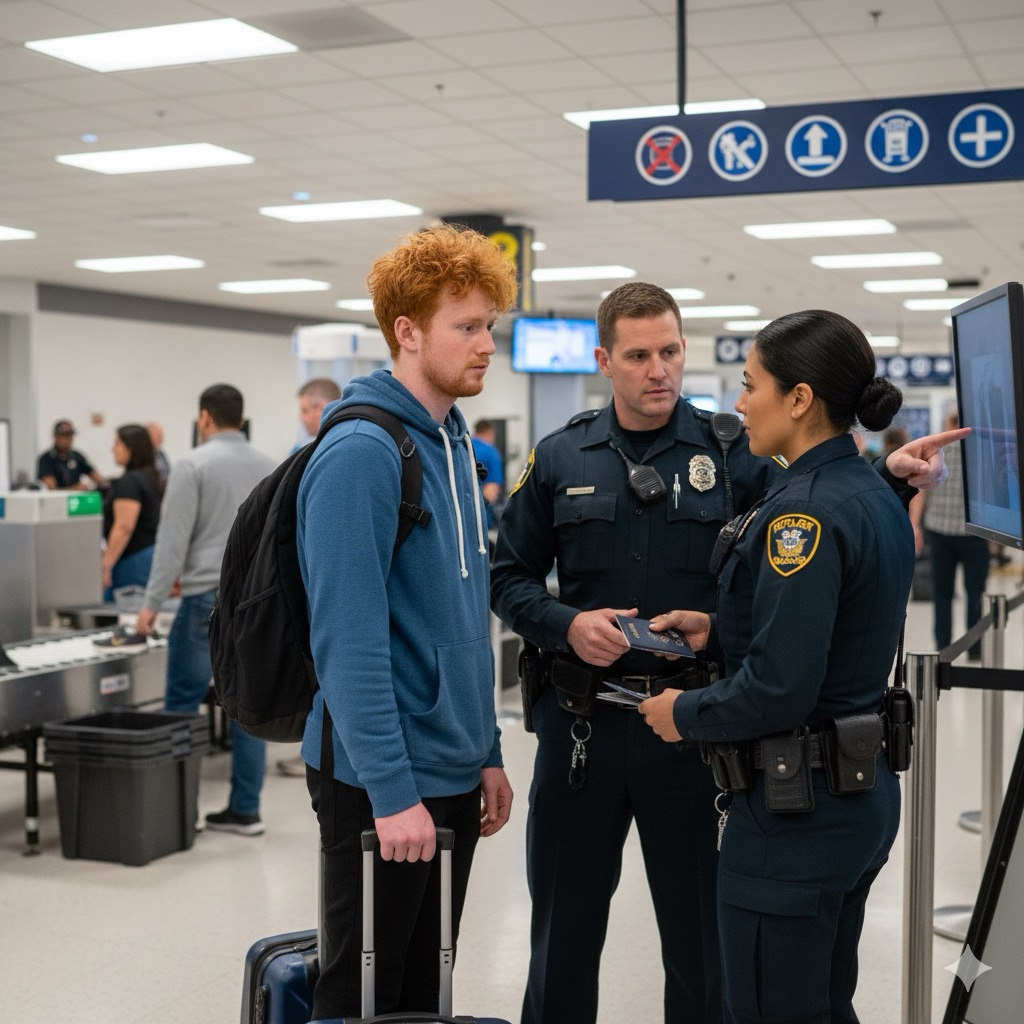
The End of Human Resources

I admit to being old enough to remember that a particular corporate department was always called “Human Resources.”

Times have changed.

This hit me when I saw a reference to a “People Manager.”

I initially thought to myself, aren’t ALL managers People Managers?

Then I remembered that we live in the days where AI helps companies jettison people…I mean, rightsize corporate outcomes to maximize efficiencies.

At the rate we’re going, hardly any managers will actually manage people.

Stop Making Sense

When I created the AI-generated imagery for my most recent reel, I tried to instruct Google Gemini to have Theodore Roosevelt wear the suit from the film Stop Making Sense.

From the Wikipedia entry for Stop Making Sense. Fair use.

I didn’t quite get there.

Imagen 4.

If you haven’t seen the reel, here it is. The music is not “Girlfriend is Better,” but from an older song by Brian Eno and David Byrne entitled “Mea Culpa.”

As you can see from the Instagram caption text, I still have Panama on my mind.

Imagen 4.

Graber Olives is in Foreclosure…But There’s a GoFundMe

So it looked like Graber Olives was going to reopen.

Then it didn’t.

Here is the latest on Graber Olives, from a GoFundMe organized by Kelsey Graber.

“As many of you know, the property is currently closed and now in the foreclosure process.”

The GoFundMe is trying to raise $26,000.

“Even though foreclosure has begun, it is not yet final. With your support, we still have a chance to preserve the property and cover urgent expenses. Every donation will go directly toward utilities, loan payments, and essential operating costs needed to try to reopen its doors…”

The Missing Piece to Solve Your Firm’s Product Marketing Puzzle

Technology marketing leaders know that product marketing is a puzzle that your firm can solve…with the proper resources.

Think of these four product marketing puzzle pieces:

  1. Product marketing strategy (not tactics), including why, how, what, and process.
  2. Product marketing environment, including the market and competitive intelligence, the customer feedback loop, and the company culture.
  3. Product marketing content, both internal and external, including positioning, personas, go-to-market, sales enablement, launches, pricing, packaging, and proposals.
  4. Product marketing performance, including metrics, objectives, and key results.

Does your firm have all four puzzle pieces? Or are one or more of the pieces lacking?

Imagen 4.

Can a technology product marketing expert with proven content, proposal, and analysis skills help your firm move forward?

Proven expertise from Printrak BIS, MorphoWay, and a recent launch for a Bredemarket client?

Recent Go-to-market.

If you are ready to move your firm’s product marketing forward with Bredemarket’s content-proposal-analysis services for technology firms, let’s discuss your needs and how Bredemarket can help you solve them. Book a free meeting at https://bredemarket.com/mark/.

Content for tech marketers.

A Californian, an Illinoisan, and a Dane Walk Into a Videoconference

I was recently talking with a former colleague, whose name I am not at liberty to reveal, and they posed a question that stymied me.

What happens when multiple people join a videoconference, and they all reside in jurisdictions with different privacy regulations?

An example will illustrate what would happen, and I volunteer to be the evil party in this one.

The videoconference

Let’s say:

On a particular day in April 2026, a Californian launches a videoconference on Zoom.

Imagen 4.

The Californian invites an Illinoisan.

Imagen 4.

And also invites a Dane.

Imagen 4.

And then—here’s the evil part—records and gathers images from the videoconference without letting the other two know.

The legal violations

Despite the fact that the Illinois Biometric Information Privacy Act, or BIPA, requires written consent before acquiring Abe’s facial geometry. And if Cali John doesn’t obtain that written consent, he could lose a lot of money.

And what about Freja? Well, if the Danish Copyright Act takes effect on March 31, 2026 as expected, Cali John can get into a ton of trouble if he uses the video to create a realistic, digitally generated imitation of Freja. Again, consent is required. Again, there can be monetary penalties if you don’t get that consent.

But there’s another question we have to consider.

The vendor responsibility 

Does the videoconference provider bear any responsibility for the violations of Illinois and Danish law?

Since I used Zoom as my example, I looked at Zoom’s EULA Terms of Service.

TL;DR: not our problem, that’s YOUR problem.

“5. USE OF SERVICES AND YOUR RESPONSIBILITIES. You may only use the Services pursuant to the terms of this Agreement. You are solely responsible for Your and Your End Users’ use of the Services and shall abide by, and ensure compliance with, all Laws in connection with Your and each End User’s use of the Services, including but not limited to Laws related to recording, intellectual property, privacy and export control. Use of the Services is void where prohibited.”

But such requirements haven’t stopped BIPA lawyers from filing lawsuits against deep pocketed software vendors. Remember when Facebook settled for $650 million?

So remember what could happen the next time you participate in a multinational, multi-state, or even multi-city videoconference. Hope your AI note taker isn’t capturing screen shots.

Marketing Mashups

I am a fan of song mashups…when they’re done right. Such as Mike Jones vs. the Cure in “Mr. Jones in a Forest.” Or a recent discovery of mine, Blondie vs. the Doors in “Rapture Riders.”

At their best, song mashups attract the hungry people for each component song and bring them together to appreciate the whole.

And in this case there IS a lesson for B2B marketing. While most marketers prefer emphasizing a single uncluttered message, a well-structured marketing mashup can be powerful. Take Tide and Bud Light.

By the way, I’m also a fan of shreds, such as “I Get Around.” But I haven’t found a B2B marketing lesson in shreds yet.

I’m a Barbie Girl

So I just finished writing some technical content for a blog post, and for other purposes.

The content relates to a publication (the 2017 version of Special Publication 800-63A) from the National Institute of Standards and Technology, or NIST.

(Note to self: gotta check the new version.)

I figure that after the work day is done, the NISTies turn to less strenuous tasks.

And so shall I.

Bredemarket Identity Assurance Level 3 (IAL3) Posts Over the Years

I’m preparing to promote four of my Identity Assurance Level 3 (IAL3) Bredemarket blog posts on my social media channels. You know, the posts that discuss in-person and remote supervised identity proofing. But I said to myself, “Self, why not re-promote them on the blog also?”

12/3/2020 IAL3 post

From the Bredemarket blog, December 2020:

“The U.S. National Institute of Standards and Technology has defined ‘identity assurance levels’ (IALs) that can be used when dealing with digital identities. It’s helpful to review how NIST has defined the IALs.”

“Identity assurance levels (IALs) and digital identity”: https://bredemarket.com/2020/12/03/identity-assurance-levels-ials-and-digital-identity/

7/19/2023 IAL3 post

From the Bredemarket blog, July 2023:

“If we ignore IAL1 and concentrate on IAL2 and IAL3, we can see one difference between the two. IAL2 allows remote, unsupervised identity proofing, while IAL3 requires (in practice) that any remote identity proofing is supervised.”

“The Difference Between Identity Assurance Levels 2 and 3”: https://bredemarket.com/2023/07/19/ial2-vs-ial3/

8/11/2025 IAL3 post

From the Bredemarket blog, August 2025:

“I’ve talked about Identity Assurance Levels 1, 2, and 3 on several occasions…..But as usually happens, IAL2 is yesterday’s news. Because biometric tech always gets harder better faster stronger.”

“Identity Assurance Level 3 (IAL3): When Identity Assurance Level 2 (IAL2) Isn’t Good Enough”: https://bredemarket.com/2025/08/11/ial3-when-ial2-isnt-good-enough/

9/17/2025 IAL3 post

From the Bredemarket blog, September 2025:

“Governments aren’t the only entities that need to definitively know identities in critically important situations.

“What about banks and other financial institutions, which are required by law to know their customers?

“Now the bank assumed a level of risk by [accepting a Bredemarket client check in a remote unsupervised manner] especially since the deposited check would not be in the bank’s physical possession after the deposit was completed.

“But guess what? The risk was acceptable for my transactions. I’m disclosing Bredemarket company secrets, but that client never wrote me a million dollar check.

“What about remote supervised transactions at financial institutions, where you are not physically present, but someone at the bank remotely sees you and everything you do?

“It turns out that the identity verification providers support video sessions between businesses (such as banks) and their customers.”

“Unlocking High-Value Financial Transactions: The Critical Role of Identity Assurance Level 3 (IAL3)”: https://bredemarket.com/2025/09/17/financial-ial3/

Proof of IAL3

I was up bright and early to attend a Liminal Demo Day, and the second presenter was Proof. Lauren Furey and Kurt Ernst presented, with Lauren assuming the role of the agent verifying Kurt’s identity.

The mechanism to verify the identity was a video session. In this case, Agent Lauren used three methods:

  • Examining Kurt’s ID, which he presented on screen.
  • Examining Kurt’s face (selfie).
  • Examining a credit card presented by Kurt.

One important note: Agent Lauren had complete control over whether to verify Kurt’s identity or not. She was not a mere “human in the loop.” Even if Kurt passed all the checks, Lauren could fail the identity check if she suspected something was wrong (such as a potential fraudster prompting Kurt what to do).

If you’ve been following my recent posts on identity assurance level, you know what happened next. Yes, I asked THE question:

“Another question for Proof: does you solution meet the requirements for supervised remote identity proofing (IAL3)?”

Lauren responded in the affirmative.

It’s important to note that Proof’s face authentication solution incorporates liveness detection, so there is reasonable assurance that the person’s fake is not a spoof or a synthetic identity.

So I guess I’m right, and that we’re seeing more and more IAL3 implementations, even if they don’t have the super-duper Kantara Initiative certification that NextgenID has.