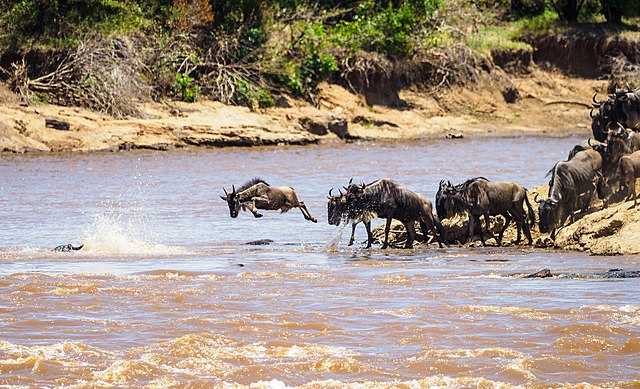
Bredemarket, the curious wildebeest, wanted to learn more about LinkedIn Audio Events. So I hosted my own. Based upon my now-extensive experience in this medium, I can share my five secrets to hosting a successful LinkedIn Audio Event.
Don’t start early
Um…I failed to do this. The event was supposed to start at 8:00 am Pacific Daylight Time, and I started at 7:58.
Meticulously plan
I didn’t do this either. I scheduled the event at 7:41, 19 minutes before it was supposed to start, and only 17 minutes before it actually started.
Use the best audio equipment for stellar sound
Um…this was on my phone, with no headset.
Host from a quiet place with no distractions
I definitely failed here. I started the event outside the (former) Yangtze Reataurant on very busy Euclid Avenue in Ontario, California. If anyone had joined the last-minute event, they would have heard all sorts of traffic noises.
Have a purpose for the event
This is the only thing I did right. My purpose? To learn the mechanics behind LinkedIn Audio Events. I didn’t learn everything—since I was the only attendee, I couldn’t channel my inner Anna Morgan and invite another speaker to the stage. But I figured out some of the mechanics.
Lessons learned
(Personal preference: I don’t refer to this as a “post mortem.” No one died.)
In addition to the lessons implied above (plan, ensure a superior audio experience, etc.), I learned that you will never get to listen to this morning’s event. LinkedIn doesn’t post recordings of the event after the fact. So I can lie and say that I shared the most scintillating details, even though I didn’t.
But I achieved my purpose, and maybe I will host a real audio event some day.
I did some more experimentation this morning, but my other experiments were live video tests on Facebook, on the Bredemarket page (not the groups; another lesson learned).
In August, a hacker dumped 2.7 billion data records, including social security numbers, on a dark web forum, in one of the biggest breaches in history.
The data may have been stolen from background-checking service National Public Data at least four months ago. Each record has a person’s name, mailing address, and SSN, but some also contain other sensitive information, such as names of relatives…
Note that 2.7 billion data records does not equal 2.7 billion people, since a person may have multiple data records.
Was your data leaked?
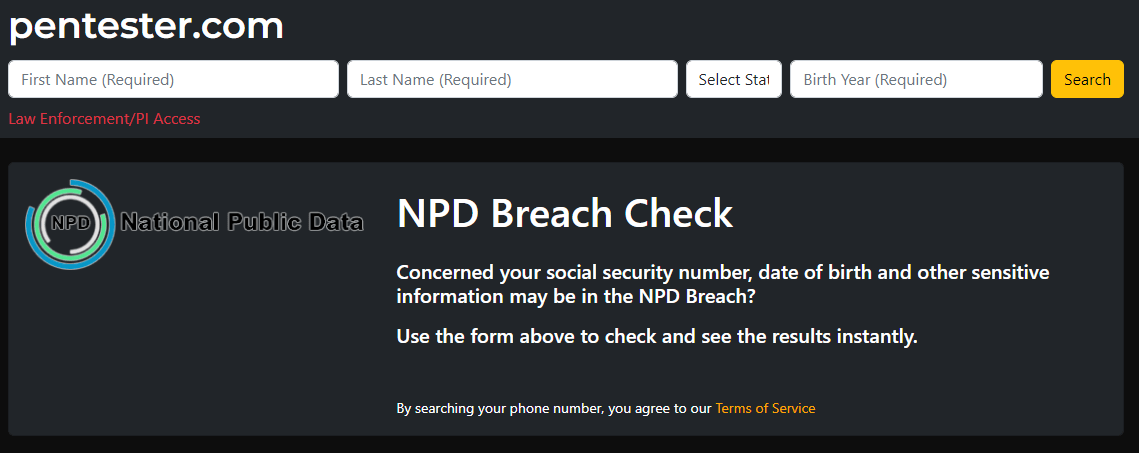
Rich DeMuro posted a link to see if your data was leaked. If you want to check, go to https://npd.pentester.com/, enter the requested information (you will NOT be asked for your Social Security Number), and the site will display a masked list of the matching information in the breach.
One lesson from the National Public Data breach should have been obvious long ago: anyone who relies on a Social Security Number as a form of positive identification is a fool.
But a recent pitch excelled in its, um, genericism. Here’s the relevant part:
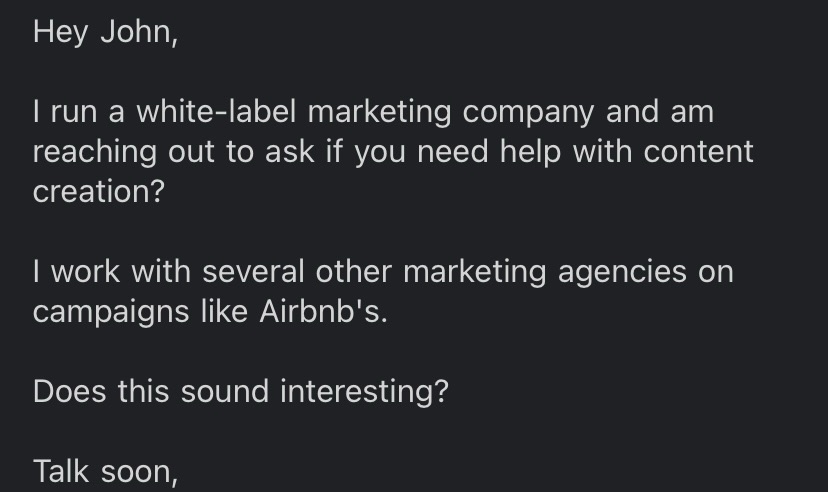
I run a white-label marketing company and am reaching out to ask if you need help with content creation? I work with several other marketing agencies on campaigns like Airbnb’s.
I’m not sure how Bredemarket relates to Airbnb, but it really doesn’t matter because they have worked on campaigns LIKE Airbnb. So I do not know what they’ve done. (Although ghostwriters have this problem.)
Ghostwriters like me. But I’ve never worked for companies like Airbnb.
I recently sent out a mailing that was hopefully much more targeted. I knew my hungry people (target audience), so even though it was a mass mailing (OK, not “mass”), it was relevant.
If you didn’t receive the mailing, you can view the repurposed version here.
Contact Bredemarket if you need content that benefits from my 29+ years of identity/biometrics experience.
With over 29 years of identity/biometric experience, John Bredehoft of Bredemarket is the biometric product marketing expert that can move your company forward.
A single loss does not define your entire life. As the sporting world teaches us, Olympic losers and other competitive losers can become winners—if not in sports, then elsewhere.
The human drama of athletic competition
When I was young, the best variety show on television didn’t involve Bob Mackie dresses. It instead featured Jim McKay, introducing the show as follows.
Spanning the globe to bring you the constant variety of sport…the thrill of victory…and the agony of defeat…the human drama of athletic competition…This is ABC’s Wide World of Sports!
A technological marvel when originally introduced, this variety show brought sporting events to American viewers from all over the world.
And these viewers learned that in competitions, there are winners and losers.
But since Wide World of Sports focused on the immediate (well, with a bit of tape delay), viewers never learned about the losers who became winners.
Jim McKay and his colleagues were not retrospective, but were known for the moment. In one instance that was NOT on tape delay, Jim McKay spoke his most consequential words, “They’re all gone.”
Vinko Bogataj
(Note: some of this content is repurposed because repurposing is cool.)
Turning to less lethal sporting events, remember Jim McKay’s phrase “the agony of defeat”?
For American TV watchers, this phrase was personified by Vinko Bogataj.
The agony of defeat.
Hailing from a country then known as Yugoslavia (now Slovenia), Bogataj was competing in the 1970 World Ski Flying Championships in Oberstdorf, in a country then known as West Germany (now Germany). His daughter described what happened:
It was bad weather, and he had to wait around 20 minutes before he got permission to start. He remembers that he couldn’t see very good. The track was very bad, and just before he could jump, the snow or something grabbed his skis and he fell. From that moment, he doesn’t remember anything.
While Bogataj suffered a concussion and a broken ankle, the accident was captured by the Wide World of Sports film crew, and Bogataj became famous on the “capitalist” side of the Cold War.
“He didn’t have a clue he was famous,” (his daughter) Sandra said. That changed when ABC tracked him down in Slovenia and asked him to attend a ceremony in New York to celebrate the 20th anniversary of “Wide World of Sports” in 1981.
At the gala, Bogataj received the loudest ovation among a group that included some of the best-known athletes in the world. The moment became truly surreal for Bogataj when Muhammad Ali asked for his autograph.
Bogataj is now a painter, but his 1970 performance still follows him.
Over 20 years after the infamous ski jump, Terry Gannon interviewed Bogataj for ABC. As Gannon recounted it on X (then Twitter), Bogataj “got in a fender bender on the way. His first line..’every time I’m on ABC I crash.'”
Some guy at the Athens Olympics in 2004
Since the Paris Olympics is taking place as I write this, people are paying a lot of attention to present and past Olympics.
The 2004 Olympics in Athens was a notable one, taking place in the country where the original Olympics were held.
But during that year, people may have missed some of the important stories that took place. We pay attention to winners, not losers.
Take the men’s 200 meter competition. It began with 7 heats, with the top competitors from the heats advancing.
Within the 7 heats, Heat 4 was a run-of-the-mill race, with the top four sprinters advancing to the next round. If I were to read their names to you you’d probably reward me with a blank stare.
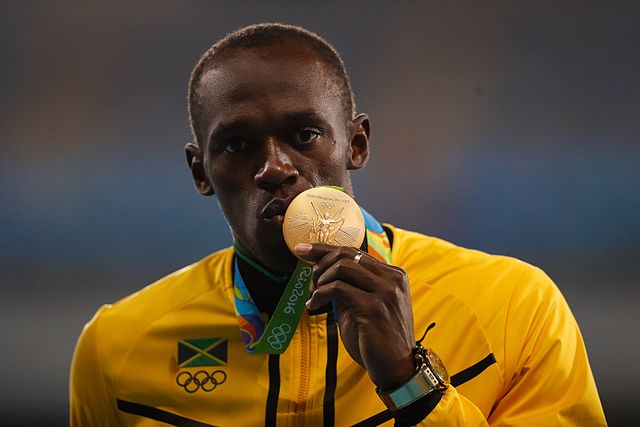
But if I were to read the 5th place finisher to you, the guy who failed to advance to the next round, you’d recognize the name.
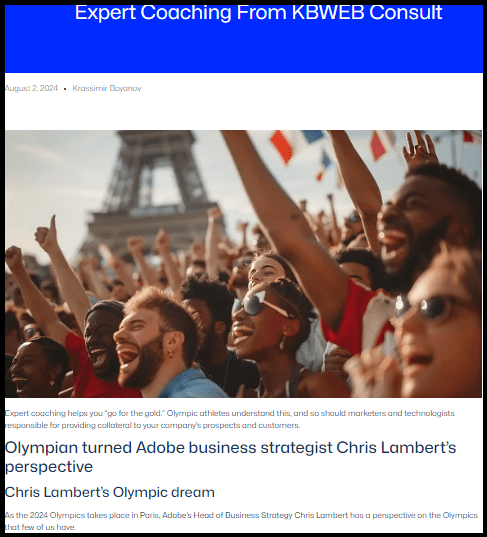
KBWEB Consult tells the story of another competitor in the same 200 meter event in Athens. Chris Lambert participated in Heat 3, but didn’t place in the first four positions and therefore didn’t advance.
Nor did he place in the fifth position like Usain Bolt did in Heat 4.
Actually, he technically didn’t place at all. His performance is marked with a “DNF,” or “did not finish.”
You see, at about the 50 meter point of the 200 meter event, Lambert pulled a hamstring.
And that ended his Olympic competition dreams forever. By the time the Olympics were held in Lambert’s home country of the United Kingdom in 2012, he was not a competitor, but a volunteer for the London Olympics.
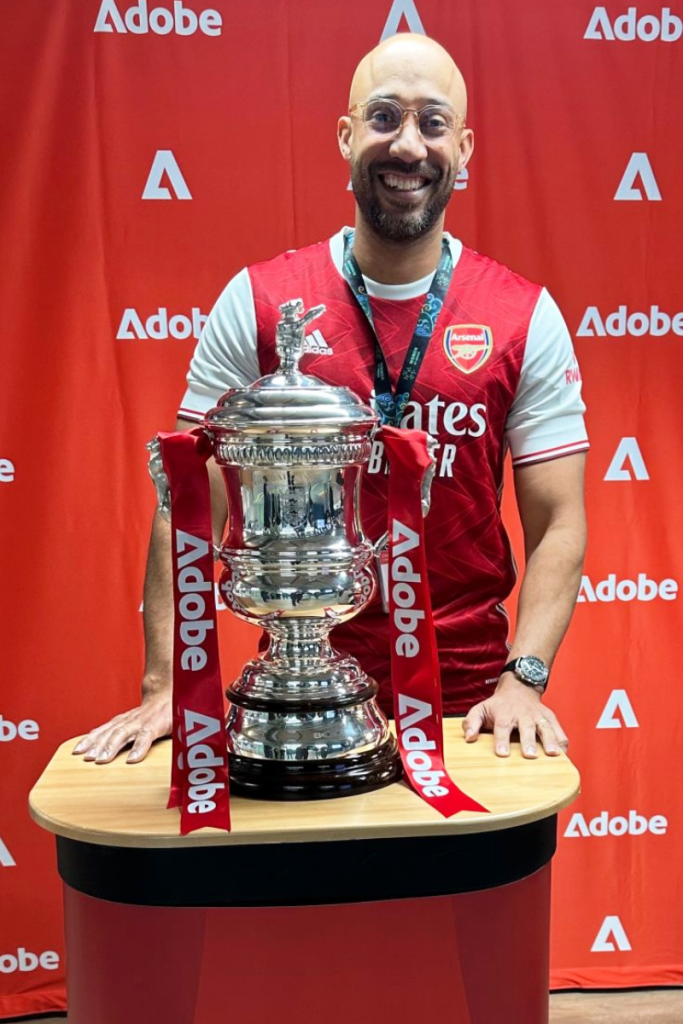
But Lambert learned much from his competitive days, and now works for Adobe.
KBWEB Consult (who consults on Adobe Experience Manager implementations) tells the full story of Chris Lambert and what he learned in its post “Expert Coaching From KBWEB Consult.”
I haven’t done one of these in a while, but it’s important to remember that just because you lost a particular competition doesn’t mean that all is lost. We need to remember this whether we are a 200 meter runner who didn’t advance from their heat, or whether we are a job applicant receiving yet another “we are moving in a different direction” form letter.
In the meantime, take care of yourself, and each other.
Expect heavy large business lobbying against this proposed ballot measure in Upland. Because if they have to pay a debilitating $865 in fees, they’ll shutter their business and join Elon and Chevron in Texas.
“Under the existing system, each $20,000 a business makes is taxed in $54 increments. Businesses reach the $864 cap when they have roughly $320,000 in gross sales….
“If approved by voters, the Nov. 5 measure would mean businesses would pay $50 for every $100,000 they generate in revenue….Meanwhile, the measure would increase the cap on business license taxes to $29,500.”
For the record, Bredemarket is based in Ontario, and I’m glad I’m not subject to Upland’s current licensing fees.
You’ve probably noticed that I’ve created a lot of Bredemarket videos lately.
My longer ones last a minute. That’s the length of a video I haven’t shared in the Bredemarket blog (it’s on Instagram) summarizing my client work over the last four years. My early July identity and Inland Empire reels are almost a minute long.
Researchers in Canada surveyed 2,000 participants and studied the brain activity of 112 others using electroencephalograms (EEGs). Microsoft found that since the year 2000 (or about when the mobile revolution began) the average attention span dropped from 12 seconds to eight seconds.
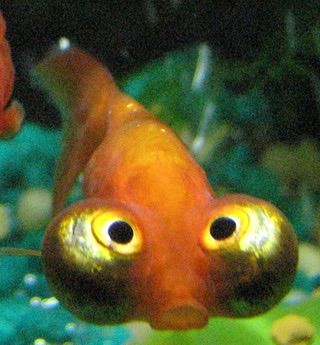
As many noted, a goldfish’s attention span is 9 seconds.
Some argue that the 8 second attention span is not universal and varies according to the task. For example, a 21 minute attention span has been recorded for drivers. If drivers had an 8 second attention span, we would probably all be dead by now.
But watching a video is not a life-or-death situation. Viewers will happily jump away if there’s no reason to watch.
So I have my challenge.
Ironically, I learned about the 8 second rule while watching a LinkedIn Learning course about the 3 minute rule. I haven’t finished the course yet, so I haven’t yet learned how to string someone along for 22.5 8-second segments.
I use both text generators (sparingly) and image generators (less sparingly) to artificially create text and images. But I encounter one image challenge that you’ve probably encountered also: bizarre misspellings.
This post includes an example, created in Google Gemini, that was created using the following prompt:
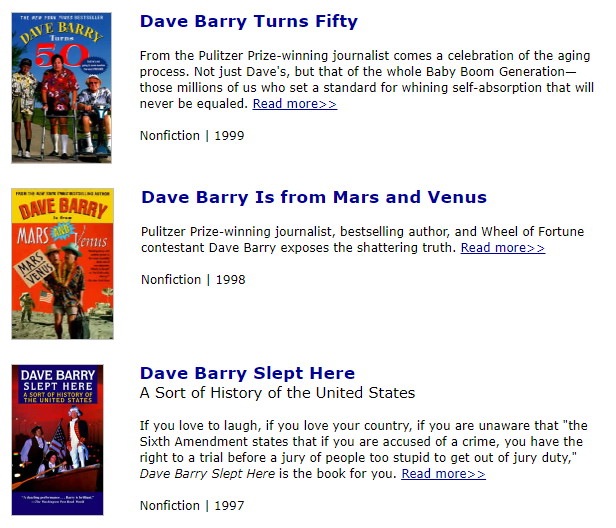
Create a square image of a library bookshelf devoted to the works authored by Dave Barry.
Now in the ideal world, my prompt would completely research Barry’s published titles, and the resulting image would include these book titles (such as Dave Barry Slept Here, one of the greatest history books of all time maybe or maybe not).
In the mediocre world, at least the book spines would include the words “Dave Barry.”
Why can’t your image generator spell words properly?
It always mystified me that AI-generated images had so many weird words, to the point where I wondered whether the AI was specifically programmed to misspell.
It wasn’t…but it wasn’t programmed to spell either.
TechCrunch recently published an article in which the title was so good you didn’t have to read the article itself. The title? “Why is AI so bad at spelling? Because image generators aren’t actually reading text.”
This is something that I pretty much forgot.
When I use an AI-powered text generator, it has been trained to respond to my textual prompts and create text.
When I use an AI-powered image generator, it has been trained to respond to my textual prompts and create images.
Two very different tasks, as noted by Asmelash Teka Hadgu, co-founder of Lesan and a fellow at the DAIR Institute.
“The diffusion models, the latest kind of algorithms used for image generation, are reconstructing a given input,” Hagdu told TechCrunch. “We can assume writings on an image are a very, very tiny part, so the image generator learns the patterns that cover more of these pixels.”
The algorithms are incentivized to recreate something that looks like what it’s seen in its training data, but it doesn’t natively know the rules that we take for granted — that “hello” is not spelled “heeelllooo,” and that human hands usually have five fingers.
For a long time, each ML (machine learning) model operated in one data mode – text (translation, language modeling), image (object detection, image classification), or audio (speech recognition).
However, natural intelligence is not limited to just a single modality. Humans can read and write text. We can see images and watch videos. We listen to music to relax and watch out for strange noises to detect danger. Being able to work with multimodal data is essential for us or any AI to operate in the real world.
So if we ask an image generator to create an image of a library bookshelf with Dave Barry works, it would actually display book spines with Barry’s actual titles.
So why doesn’t my Google Gemini already provide this capability? It has a text generator and it has an image generator: why not provide both simultaneously?
Because that’s EXPENSIVE.
I don’t know whether Google’s Vertex AI provides the multimodal capabilties I seek, where text in images is spelled correctly.
You may remember the May hoopla regarding amendments to Illinois’ Biometric Information Privacy Act (BIPA). These amendments do not eliminate the long-standing law, but lessen its damage to offending companies.
The General Assembly is expected to send the bill to Illinois Governor JB Pritzker within 30 days. Gov. Pritzker will then have 60 days to sign it into law. It will be immediately effective.
While the BIPA amendment has passed the Illinois House and Senate and was sent to the Governor, there is no indication that he has signed the bill into law within the 60-day timeframe.
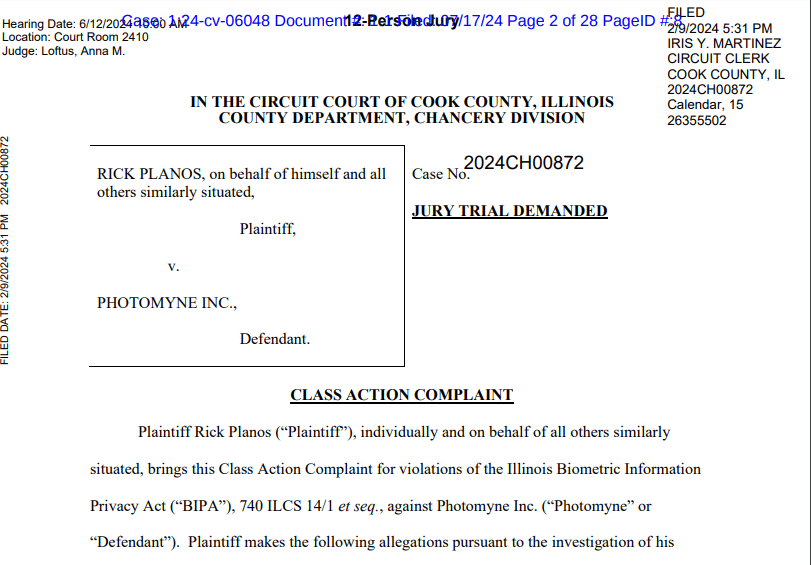
A proposed class action claims Photomyne, the developer of several photo-editing apps, has violated an Illinois privacy law by collecting, storing and using residents’ facial scans without authorization….
The lawsuit contends that the app developer has breached the BIPA’s clear requirements by failing to notify Illinois users of its biometric data collection practices and inform them how long and for what purpose the information will be stored and used.
In addition, the suit claims the company has unlawfully failed to establish public guidelines that detail its data retention and destruction policies.








 Bredemarket