You’ve probably seen the joke posts in which someone details a stupid accomplishment, but for the LinkedIn audience.
The same holds true for brand archetypes. Whether your company is a sage, maverick, hero, or something else, you can easily go overboard in aligning with the archetype.
I asked generative AI to rewrite a piece of text for the sage archetype. After reading the result, I am now convinced that you should not only prohibit generative AI from writing the first draft, but you should also prevent it from writing the second.
Seriously.
“The wisdom of the Sage tells us that true strength lies in knowledge, not just its acquisition, but its unwavering protection.”
Um, no. I’m not going to sell security software like that.
Over Sage.
But the exercise was not a complete failure. As I reviewed the non-person entity output, I found one word that I liked.
One word.
Which is better than no words at all.
But if you want words for human beings, let me know.
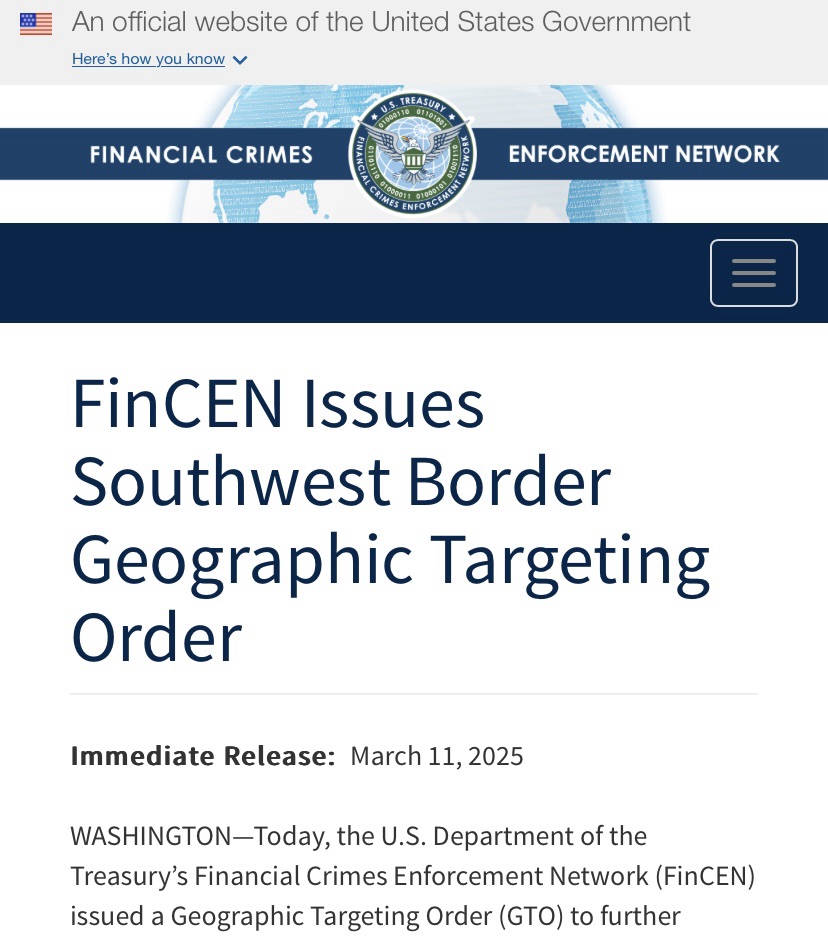
“The GTO requires all money services businesses (MSBs) located in 30 ZIP codes across California and Texas near the southwest border to file Currency Transaction Reports (CTRs) with FinCEN at a $200 threshold, in connection with cash transactions.”
Of course, the targeted “cartels, drug traffickers, and other criminal actors along the Southwest border” can easily evade the reporting requirements by going a little north, east, or west. After all, there are more than 40,000 ZIP codes….
Content, proposal, and analysis (“CPA”) marketing and writing services.
But what in the heck does Bredemarket DO?
During the first 21 days of March, my biometric, identity, and technology clients received blog posts, an ebook, emails, a landing page, slides, a press release, a Request for Information (RFI) response, a process, and other things.
Can I help your firm? Let me know on my “CPA” page.
This week, well-known privacy advocate Alvaro Bedoya is not happy.
““The president just illegally fired me. This is corruption plain and simple,” Bedoya, who was appointed [to the Federal Trade Commission] in 2021 by President Joe Biden and confirmed in May 2022, posted on X.
“He added, “The FTC is an independent agency founded 111 years ago to fight fraudsters and monopolists” but now “the president wants the FTC to be a lapdog for his golfing buddies.””
The other ousted FTC Commissioner, Rebecca Kelly Slaughter, had been appointed by…Donald Trump.
In business, it is best to use a three-legged stool.
A two-legged stool obviously tips over, and you fall to the ground.
A four-legged stool is too robust for these cost-conscious days, where the jettisoning of employees is policy at both the private and public level.
But a three-legged stool is just right, as project managers already know when they strive to balance time, cost, and quality.
Perhaps the three-legged stool was in the back of Yunique Demann’s mind when she wrote a piece for the Information Systems Audit and Control Association (ISACA) entitled “The New Triad of AI Governance: Privacy, Cybersecurity, and Legal.” If you only rely on privacy and cybersecurity, you will fall to the ground like someone precariously balanced on a two-legged stool.
“As AI regulations evolve globally, legal expertise has become a strategic necessity in AI governance. The role of legal professionals now extends beyond compliance into one that is involved in shaping AI strategy and legally addressing ethical considerations…”
Proposals are not the biggest part of my Bredemarket consulting work, but I still enjoy the satisfaction when my client submits a persuasive, compliant proposal. A day before the due date, even.
And yes, the Imagen 3 AI picture includes the number 96, in homage to Bredemarket’s very popular “96 Smiles” post about the Shipley Business Development Lifecycle.
But if you need proposal assistance, or content assistance, or analysis assistance, contact me.
“[T]he alleged spy, when confronted last Friday at Rippling’s Dublin office with a court order to hand over his phone, fled to the bathroom and locked the door. When repeatedly warned not to delete materials from his device and that his non-compliance could result in jail time, the spy responded: ‘I’m willing to take that risk,’ and fled the premises.”
So far we have only heard one side. We will see what Deel says, and if it will claim that the honeypot email (claiming Rippling had a d-defectors (where d stands for Deel) Slack channel) was sent to more than three people.
My own post referenced the Auriemma Group estimate of a $6 billion cost to U.S. lenders.
McKinsey preferred to use a percentage estimate of “10–15% of charge offs in a typical unsecured lending portfolio.” However, this may not be restricted to synthetic identity fraud, but may include other types of fraud.
Thomson Reuters quoted Socure’s Johnny Ayers, who estimated that “20% of credit losses stem from synthetic identity fraud.”
Oh, and a later post that I wrote quoted a $20 billion figure for synthetic identity fraud losses in 2020. Plus this is where I learned the cool acronym “SIF” to refer to synthetic identity fraud. As far as I know, there is no government agency with the acronym SIF, which would of course cause confusion. (There was a Social Innovation Fund, but that may no longer exist in 2025.)
Never Search Alone, not National Security Agency. AI image from Imagen 3.
Back to synthetic identity fraud, which reportedly resulted in between $6 billion and $20 billion in losses in 2020.
The financial toll of AI-driven fraud is staggering, with projected global losses reaching $40 billion by 2027 up from US12.3 billion in 2023 (CAGR 32%)., driven by sophisticated fraud techniques and automation, such as synthetic identities created with AI tools.
Again this includes non-synthetic fraud, but it’s a good number for the high end. While my FTC fraud post didn’t break out synthetic identity fraud figures, Plaid cited a 2023 $1.8 billion figure for the auto industry alone, and Mastercard cited a $5 billion figure.
But everyone agrees on a figure of billions and billions.
The real Carl Sagan.
The deepfake Carl Sagan.
(I had to stop writing this post for a minute because I received a phone call from “JP Morgan Chase,” but the person didn’t know who they were talking to, merely asking for the owner of the phone number. Back to fraud.)
Reducing SIF in 2025
In a 2023 post, I cataloged four ways to fight synthetic identity fraud:
Private databases.
Government documents.
Government databases.
A “who you are” test with facial recognition and liveness detection (presentation attack detection).
Ideally an identity verification solution should use multiple methods, and not just one. It doesn’t do you any good to forge a driver’s license if AAMVA doesn’t know about the license in any state or provincial database.
If you create your own test data, you’re more likely to pass the test. So what data was used for Amazon One palm/vein identity scanning accuracy testing?
But NIST has never conducted regular testing of palm identification in general, or palm/vein identity scanning in particular. Not for Amazon. Not for Fujitsu. Not for Imprivata. Not for Ingenico. Not for Pearson. Not for anybody.
“Amazon One is 100 times more accurate than scanning two irises. It raises the bar for biometric identification by combining palm and vein imagery, and after millions of interactions among hundreds of thousands of enrolled identities, we have not had a single false positive.”
“The company claims it is 99.999 percent accurate but does not offer information supporting that statistic.”
And so far I haven’t found any either.
Since the company trains its algorithm on synthetically generated palms, I would like to make sure the company performs its palm/vein identity scanning accuracy testing on REAL palms. If you actually CREATE the data for any test, including an accuracy test, there’s a higher likelihood that you will pass.
I think many people would like to see public substantiated Amazon One accuracy data. ZERO false positives is a…BOLD claim to make.








 Bredemarket