(Imagen 4)
SEO experts—I mean AEO (ANSWER engine optimization) experts—are like fashionistas.
Everything is seasonal.
“This fall, hems and carousels are up, and bright red and hashtags are down!”

Identity/biometrics/technology marketing and writing services

(Imagen 4)
SEO experts—I mean AEO (ANSWER engine optimization) experts—are like fashionistas.
Everything is seasonal.
“This fall, hems and carousels are up, and bright red and hashtags are down!”


Need an impact?

Made an impact.
Contact me below.
(All pictures Imagen 4)

(Imagen 4)
Bredemarket asks a lot of questions.
But by the end of a project such as a content project, you and I better have some answers.
Because conversion fails if the prospect doesn’t think we know what we are doing.

(Imagen 4)
There is no such thing as a free lunch.
This applies to our incessant use of generative AI, as Micah Willbrand found out the hard way.
Willbrand, a product expert who has worked for multiple identity companies, started his story by saying that he uses Perplexity AI.
I realize that many of you just fell off your chairs in shock. Because the first rule of Generative AI is that you ALWAYS talk about ChatGPT. Well, there are other generative AI tools. Deal with it.

Anyway, Willbrand was prompting Perplexity about shoes, and awaiting the responses.
Which were unreadable.
“Every result forced inserted an Apple map with shoe stores onto the response page. It was 2/3rds the screen. Now as a text based app primarily this is super annoying because you can’t see … The …. Text.”
Should we be surprised? No.
Now I don’t fault software vendors for trying to make money. I have no sympathy for those who complain that Threads should never ever have ads because Facebook makes a bajillion dollars. If Threads isn’t making money for Meta, then Meta will kill it.
Where I DO have a problem is when a software vendor’s monetization efforts infringe with my ability to use the software.
This applies to some smartphone games in which you play the game for 30 seconds before you’re locked in to watching 60 seconds of ads.
And this also applies to what I fear will be the future format for generative AI responses.
“The best way to overcome a marketing challenge is to do something, rather than surrendering to paralysis. But before you begin…what would you do for a Klondike bar?”

And yes, this blog post was repurposed from something I wrote on the Bredemarket Technology Firm Services LinkedIn page. Now I just need an idea for a video…

You are the CMO, marketing leader, or other leader at an identity, biometric, or technology firm.
You’ve made the decision to work with Bredemarket to create your content, proposal, or analysis.
You’ve gone to the https://bredemarket.com/cpa/ page and scheduled a “Free 30 minute content needs assessment” with me on my Calendly calendar. We will talk via Google Meet.
You’ve answered the preliminary questions I asked in the meeting request, including:
So…what now?
I will make it real simple. I will ask you a single simple question:
“Why?”
We have 30 minutes to chat, and at the end of that time you and I will jointly determine
See you soon.

Let Bredemarket help you create it.
Because I have talked about differentiation ad nauseum, I’m always looking for ways to see how identity/biometric and technology vendors have differentiated themselves. Yes, almost all of them overuse the word “trust,” but there is still some differentiation out there.
And I found a source that measured differentiation (or “unique positioning”) in various market segments. Using this source, I chose to concentrate on vendors who concentrate on identity verification (or “identity proofing & verification,” but close enough).
My source? The recently released “Biometric Digital Identity Deepfake and Synthetic Identity Prism Report” from The Prism Project, which you can download here by providing your business address.
Before you read this, I want to caution you that this is NOT a thorough evaluation of The Prism Project deepfake and synthetic identity report. After some preliminaries, it focuses on one small portion of the report, concentrating on ONLY one “beam” (IDV) and ONLY one evaluation factor (differentiation).
First, the report is comprehensive. It’s not merely a list of ranked vendors, but also provides a, um, deep dive into deepfakes and synthetic identity. Even if you don’t care about the industry players, I encourage you to (a) download the report, and (b) read the 8 page section entitled “Crash Course: The Identity Arms Race.”

Second, the report is comprehensive. Yeah, I just said that, but it’s also comprehensive in the number of organizations that it covers.
Third, the report is comprehensive. In a non-lunatic way, the report categorizes each organization into one or more “beams”:
Fourth, the report is comprehensive. Yes I’m repetitive, but each of the 200+ organizations are evaluated on a 0-6 scale based upon seven factors. In listed order, they are:
In essence, the wealth of data makes this report look like a NIST report: there are so many individual “slices” of the prism that every one of the 200+ organizations can make a claim about how it was recognized by The Prism Project. And you’ve probably already seen some organizations make such claims, just like they do whenever a new NIST report comes out.
So let’s look at the tiny slice of the prism that is my, um, focus for this post.
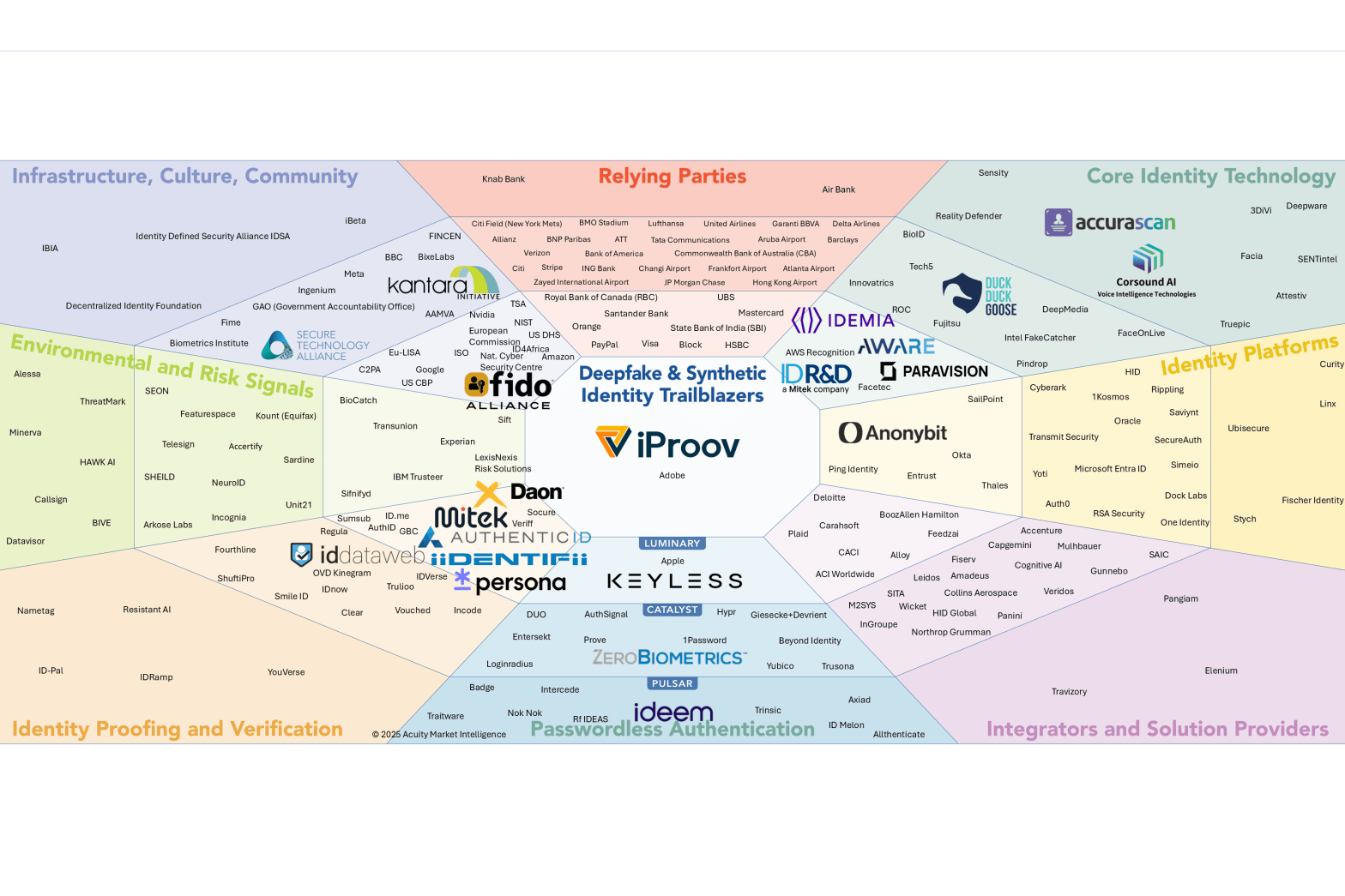
So, here’s the moment all of you have been waiting for. Which organizations are in the Biometric Digital Identity Deepfake and Synthetic Identity Prism?

Yeah, the text is small. Told you there were a lot of organizations.
For my purposes I’m going to concentrate on the “identity proofing and verification” beam in the lower left corner. But I’m going to dig deeper.
In the illustration above, organizations are nearer or farther from the center based upon their AVERAGE score for all 7 factors I listed previously. But because I want to concentrate on differentiation, I’m only going to look at the identity proofing and verification organizations with high scores (between 5 and the maximum of 6) for the “unique positioning” factor.
I’ll admit my methodology is somewhat arbitrary.
So, here’s my list of identity proofing and verification organizations who scored between 5 and 6 for the unique positioning factor:
Using the report as my source, these three identity verification companies have offerings that differentiate themselves from others in the pack.
Although I’m sure the other identity verification vendors can be, um, trusted.
Oh, by the way…did I remember to suggest that you download the report?

For Bredemarket insiders: there was panic on the streets of Ontario a moment ago.
I was testing the links in my just-published post. Clicking on one link, I ended up at…the original post.
Then I realized that I had actually ended up at the page listing all posts tagged with “emotions.”
My panic turned into relief.
(Imagen 4)
I spend a lot of time on LinkedIn and therefore endure the regular assault from the so-called LinkedIn “experts.”
You know them.
But that’s not the worst thing they say.
When they’re not commanding you to avoid the em dash, the LinkedIn “experts” remind us that LinkedIn is a professional network. And that our communications must be professional.
The ideal personal communication is this: “I am thrilled and excited to announce my CJIS certification!”
The ideal business communication is this:
Yes, the “experts” wish that businesses said nothing at all. But if they do say something, a statement like this optimizes outcomes: “WidgetCorp is dedicated to bettering the technology ecosystem.”
Such a statement is especially effective if all your competitors are saying the same thing. This unity of messaging positions you as an industry leader.
Which enables you to…argh, I can’t do this any more. I am hating myself more and more with each word I type. Can I throw up now? This is emotionally painful.
Derek Hughes just sent me an email that describes this generic pablum. It read, in part:
“Everything reads like it was written by a robot on decaf.
“Same recycled tips. Same recycled tone. Somehow, it’s all… grey.”
If your company wants conversions—and I assume that you do—avoid the generic pablum and say something.
This will bring your hungry people (target audience) to you.
And for the prospects that despise humanness and glory in generic pablum…if their focus is elsewhere, your focus won’t impede. Let them roam in the distance.

 Bredemarket