A Bredemarket message about financial identity and anti-money laundering (AML) enforcement.
Tell your firm’s fraud-fighting story: https://bredemarket.com/cpa/
(Money laundering picture from Imagen 3)

Identity/biometrics/technology marketing and writing services

A Bredemarket message about financial identity and anti-money laundering (AML) enforcement.
Tell your firm’s fraud-fighting story: https://bredemarket.com/cpa/
(Money laundering picture from Imagen 3)

AuthenticID shared the following:
“In March, the U.S. Treasury Department announced it would no longer enforce the Corporate Transparency Act, the anti-money-laundering law that requires millions of businesses to disclose the identity of their real beneficial owners.”
Not entirely accurate as we will see, but the details are gated. But not at JD Supra:
“On March 26, 2025, FinCEN issued an interim final rule and request for comments, removing the requirement under the Corporate Transparency Act (CTA) for both U.S. companies and U.S. persons to report beneficial ownership information to FinCEN. The rule is effective March 26, 2025. Thus, subject to additional rule changes, U.S. companies and U.S. individuals no longer have to file an initial Beneficial Ownership Information Report (BOIR) or otherwise update or correct a previously filed BOIR.”
As the interim rule itself clarifies, foreign companies still have to report.
“On March 2, 2025, Treasury announced the suspension of enforcement of the CTA against U.S. citizens, domestic reporting companies, and their beneficial owners, and Treasury further announced its intent to engage in a rulemaking to narrow the Reporting Rule to foreign reporting companies only.”
The interim rule itself addresses the convoluted history (one, two, three) of FinCEN’s attempts to enforce anti-money laundering (AML) laws as court challenges persist.
I will let you judge whether this is welcome relief from bureaucracy for American companies, or a huge FinCEN loophole that facilitates AML financial identity evasion by simply letting companies represent themselves as domestic, allowing them to launder as much money as they please for terrorists, drug dealers, and others.
Not that I have an opinion on that.
(Business terrorist image Imagen 3/Google Gemini)

In an article with a clickbait title, Newsweek reported on the indictment of Massachusetts state Representative Christopher Flanagan on various fraud charges. One of the allegations:
“Beyond the five wire fraud counts, the grand jury also indicted him on one count of falsifying documents related to a campaign flier. The mailer from “Conservatives for Dennis” endorsed Flanagan….[He attributed] “the source of the Mailer to a false persona, ‘Jeanne Louise,'” whom he created for the endorsement….In October 2023, he admitted to OCPF that Jeanne Louise “was fake” and he was the source of the mailer.”
There is so much effort to identify voters. What about identifying the sources of political endorsements?
Does your company have a solution to this? I can help you tell your story. Go to https://bredemarket.com/cpa/.
(Picture from Imagen 3)

H/T Donal Greene for this story of non-person entities that were really people.
“The nate app purported to take care of the remainder of the checkout process through AI: selecting the appropriate size, entering billing and shipping information, and confirming the purchase….In truth, nate relied heavily on teams of human workers—primarily located overseas—to manually process transactions in secret, mimicking what users believed was being done by automation.”
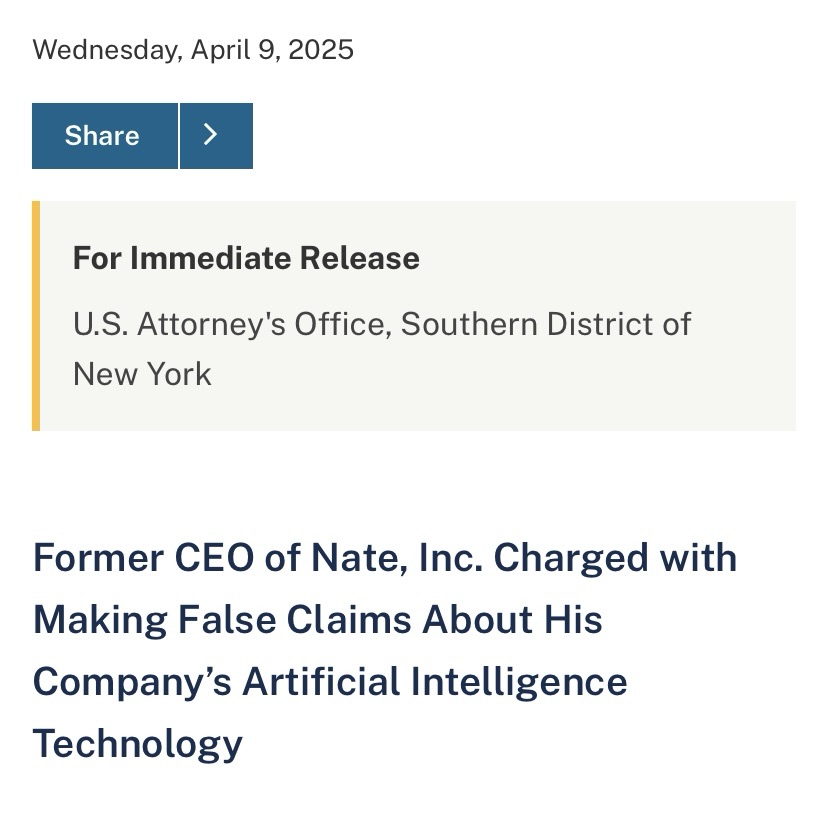
Now the DOJ is indicting Albert Saniger for defrauding investors: https://www.justice.gov/usao-sdny/pr/tech-ceo-charged-artificial-intelligence-investment-fraud-scheme
(Picture from Imagen 3)

Because my local Amazon Fresh post is taking off, it’s a good time to revisit the “one” thing Uplanders will encounter when they get there.
I’ve talked about Amazon One palm/vein biometrics several times in the past.
Meanwhile, Amazon One is available at over 400 U.S. locations, with more on the way.
And it’s also available (or soon will be) on TP-Link door locks. But the How-To Geek writer is confused:
“TP-Link says that these palm vein patterns are so unique that they can even tell the difference between identical twins, making them safer than regular fingerprint or facial recognition methods.”
Um…fingerprints? Must be a Columbia University grad.
And the TP-Link page for the product has no sales restrictions. Even Illinois residents can buy it. Presumably there’s an ironclad consent agreement with every enrollment to prevent BIPA lawsuits.
(Picture from Imagen 3)

Technology marketers, do your prospects know who you are?
If they don’t, then your competitors are taking your rightful revenue.
Don’t let your competitors steal your money.
Before I tell you how Bredemarket can solve your technology company’s awareness problem, let me spill the secret of why I’m asking the question in the first place.
Normally I don’t let non-person entities write Bredemarket content, but today I’m making an exception.

My usual generative AI tool is Google Gemini, so I sent this prompt:
“What are the five most important types of marketing content to create for a technology software company?”
A little secret: if you want generative AI to supply you with 3 things, ask for more than that. Some of the responses will suck, but maybe the related ones are insightful.
In this case I only wanted ONE type of marketing content, but I reserve the right to “co-author” four more posts based upon the other responses.
Of the 5 responses from Google Gemini, this was the first:
“In-depth Problem-Solving Content (Think Blog Posts, White Papers, Ebooks): Your potential customers are likely facing specific challenges. Content that dives deep into those problems and offers insightful solutions (even if it doesn’t directly pitch your product) builds trust and positions you as a thought leader. Think “The Ultimate Guide to [Industry Challenge]” or a white paper on “Navigating [Complex Technical Issue].””
Now you see where I got the idea for the title of this post. Normally I shy away from bombastic words like “ultimate,” but this sage is going a little wild.
So the bot tells me that the most important type of marketing content for a technology software company is short-form or long-form problem-solving content.
Let’s get a little meta (small m) here.
If your prospects don’t know who you are, create customer-focused content that explains how your company can solve their problems.

Now let’s get meta meta.
If you need help creating this content, whether it’s blog posts, articles, white papers, case studies, proposals, or something else, Bredemarket can help you solve your problem.
Let’s talk about your problem and how we can work together to solve it. Book a free meeting via the https://bredemarket.com/cpa/ URL.
(All AI illustrations from Imagen 3 via Google Gemini, of course)

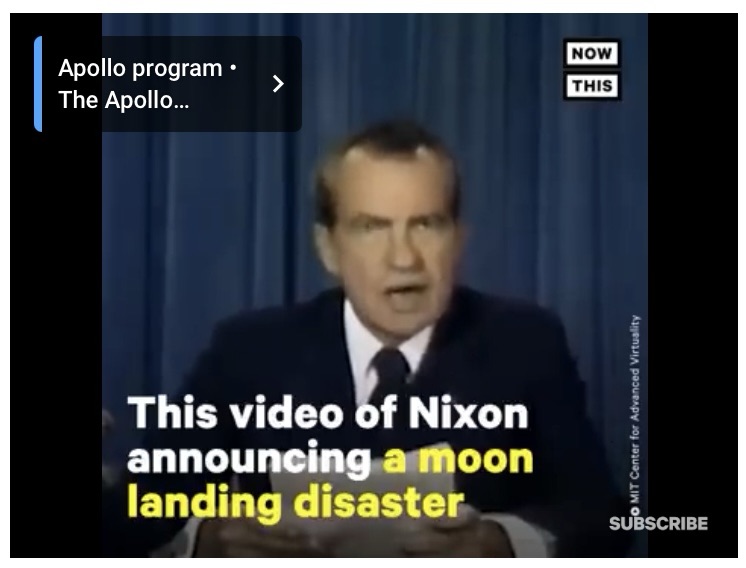
I previously described how technology from the Coalition for Content Provenance and Authenticity protects you from voice deepfakes.
But as Krassimir Boyanov of KBWEB Consult notes, C2PA technology provides the “provenance” of other types of assets.
Adobe is implementing C2PA-compliant content credentials in AEM [Adobe Experience Manager]. These can tell you the facts about an asset (in C2PA terms, the “provenance“): whether the image of a product from a particular manufacturer was created by that manufacturer, whether a voice recording of Anil Chakravarthy was created by Anil Chakravarthy, or whether an image of a peaceful meadow was actually generated by artificial intelligence (such as Adobe Firefly).
(AI generated image of Richard Nixon from https://www.youtubehttps://www.youtube.com/watch?v=2rkQn-43ixs)

This post has two purposes:
Let’s start the bragging by announcing that one of Bredemarket’s consulting clients was recently notified of an award by a federal agency.
I won’t name the client or the agency, other than to clarify that the agency is NOT the U.S. Department of Education, the Agency for International Development, the Voice of America, or similar agencies that have taken a beating over the last 2 1/2 months. So the award is fairly safe.
So what do I have to brag about?
To be honest, not much.
Yes, I made sure that the proposal was compliant and persuasive, that it addressed all the required points, that it went to the correct person, that it stayed within the mandated page and word limits, and that it was delivered before the due date and time.
But if the client had proposed an inferior solution, questionable implementation plan, or unqualified personnel, there would NOT have been an award regardless of whether the text was in 12-point Times New Roman with the appropriate margins.
Like all Bredemarket projects, I collaborated with the client to submit the proposal, which in the end was a winning proposal.
I’ve told the story before, but I kind of fell into the proposals world in October 1994 when I began consulting for the Proposals Department at a company called Printrak International. After several acquisitions, the company became part of IDEMIA 23 years later.
During my time at Printrak, Motorola, MorphoTrak, and IDEMIA I spent two separate stints in Proposals, primarily focusing on state and local opportunities with various international opportunities thrown in.
Things changed in 2020 when Bredemarket started offering proposal services. With one exception (a State of California healthcare-related proposal), all my proposal work has been at the federal level.
I’ve worked at various proposal maturity levels, ranging from working via SMA in a mature proposal development process, to cases in which I was the sole proposal expert. But the keys always remain the same: work with the client, do great work, and turn the thing in on time.
If your organization has the need to submit a technology software proposal, perhaps I can help. I can plug into your existing proposals organization, or if necessary I can BE your proposals organization.
If you’d like to talk about it, schedule a free consultation via my “CPA” page (the “P” stands for Proposal) and check the “Proposal services” check box.
(Wildebeest proposal picture from Imagen 3)

Unified identity platform.
Originally posted on Instagram: https://www.instagram.com/share/_94gnxtmi
The song is “Unified” by Unified Highway.
This is painful, but it has to be done.
I’ve spent 30 years working with the identities of PEOPLE and ensuring that all PEOPLE accessing a system are properly identified.
In other words, leaving a huge GAPING security hole.
Look at what Okta is doing;
“[N]ew Okta Platform capabilities…help businesses secure AI agents and other non-human identities with the same level of visibility, control, governance, and automation as human ones. The Okta Platform will now bring a unified, end-to-end identity security fabric to organizations for managing and securing all types of identities across their ecosystem, from AI agents to API keys to employees.”
I think that “unified” will take the place of “trust” as the identity buzzword. Thankfully.
If you’re only selling biometrics, or maybe biometrics and ID cards, where will your customers go to get the rest of their systems? Or will you just be a commodity supplier to the companies that provide the REAL systems?
(Unified security AI picture from Imagen 3)

 Bredemarket