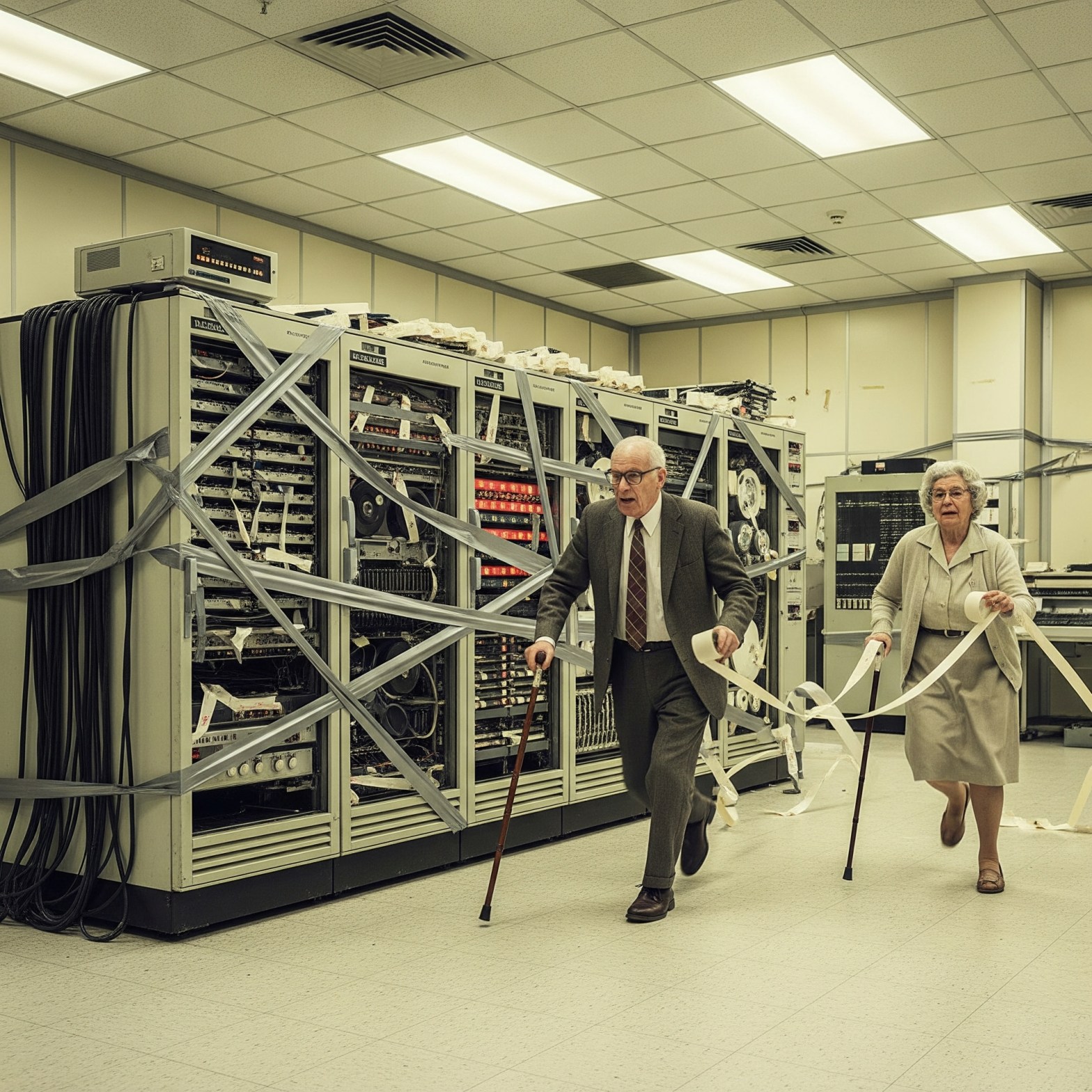
Gripping my Conference Planning Papers

While Bredemarket as an entity has only officially worked one trade show, my personal trade show, conference, and exhibition experience extends back years.

My years of session and speaker coordination 

For example:

In a past life I was tasked with session and speaker coordination for an annual conference. Dozens of sessions, dozens of speakers, probably about a dozen rooms, a myriad of microphone and table and cable setups, a little under a week…plus a dozen planners and dozens of employees and third-party conference staff.

There were many ways in which things could go wrong:

  • What if a demonstrator wanted to show an application on their iPhone, but you only had one-stage cables for a Windows laptop?
  • What if a keynote speaker wanted to show an application video as part of their remarks, but the audio-visual staff hadn’t tested the video yet? (Back in the day I worked with Sardis Media. They are magicians.)
  • What if an executive had an inspired idea to move one of our main room speakers to Wednesday morning…right when the speaker was conducting a workshop? (Human cloning was not an option.)
  • Worst yet, what if a speaker fell ill before boarding their flight to the conference venue…and we now had a big gaping hole the next morning?

Some of these things didn’t happen, but they could have…and if they did, it meant disruption of my “three chairs and 2 mics on the main stage on Tuesday at 8:45” meticulously made plans.

I excelled at session and speaker coordination

Yes, plans. I had them.

This was one of the times in which I fell back to Excel as my go-to project management tool, capturing all the necessary data, making it filterable and sortable. 

The years have faded my memories of the details I tracked, but I needed to know session titles, dates and times, rooms, speakers, panelists, presentations, videos, live demos, on-stage chairs and tables, handouts, and other things besides. 

This speaker could use the podium mic. And he had the conference app.

And that was just for DURING the conference. BEFORE the conference I needed to ensure that session abstracts and speaker biographies were written and found their way to the printed conference program, the registration website, and the conference app.

This was also one of the times that I heavily relied on the color printer that was hidden away in the conference organizers’ area. And it had to be color, because some schedule items were green, some yellow…and some red.

The schedule was constantly revised. And as the week wore on and the days dwindled down to a precious few, I would hide the older rows on my schedule and literally lighten my workload.

I would grip the latest iteration of my private master schedule and race around the conference hotel—sometimes the Hilton Orange County/Costa Mesa, sometimes another—checking things off my checklist. (All names are fictional.)

  • Hey, John, could you get your presentation to the Sardis folks by noon today? And you decided not to show that video, right?
  • Paul, the handouts for your workshop should be in the Guasti Room…I’m sorry, your session is in the Etiwanda Room. The handouts will be in the Etiwanda Room a half hour before your workshop.
  • George, you will be mic’ed up before the session…right?
  • Ringo! Side room. Five minutes. We need a raffle winner before 10:30.

By mid afternoon Thursday the last large sessions were done, the last workshops were wrapping up, the last raffle prizes were given away, and all that was left was the final banquet. Plenty could go wrong there, also, but that’s not part of this story.

And Ringo’s real name was Sharon.

Stealing and Awareness

The reason that I redirected the purpose of my Substack posts is because much of my audience there isn’t familiar with the…um…minutiae of biometrics and identity. (For example, my reference to minutiae would probably go right past all but two of my Substack subscribers.)

My Substack audience is best served with awareness content.

But awareness content is not only informative and educational.

Awareness of you

It also makes prospects aware of your company…which is critically important.

Last month I said the following about awareness:

“Technology marketers, do your prospects know who you are?

“If they don’t, then your competitors are taking your rightful revenue.

“Don’t let your competitors steal your money.”

Perhaps steal is a harsh word, but it’s accurate. 

Or perhaps a better word is indifference: your actions indicate that you don’t care whether customers buy from you or not. If you cared, you’d actually market your products.

Who needs marketing?

“Nonsense, John! We have a sales staff. Who needs marketers?”

Especially when content marketing may take up to 17 months to convert. That doesn’t help the current quarter.

But your sales staff cannot be everywhere. If your prospects don’t know about you and aren’t reaching out to you, then you have to reach out to them.

And the calls? “Hi, I’m Tom with WidgetCorp.” “With who?”

So how is that current quarter looking now?

You need marketing, now

Your current quarter and future quarters would look better if your secret salesperson were working for you. As Rhonda Salvestrini said:

“Content for your business is one of the best ways to drive organic traffic. It’s your secret salesperson because it’s out there working for you 24/7.”

But the secret salesperson won’t engage your prospects until you act to create that content.

Talk to Bredemarket about your content, proposal, and analysis needs: https://bredemarket.com/cpa/

Before your competitors steal more from you.

Razor and Blades as a Service: HP Instant Ink

You know the razor and blades business model, where you can buy the razor very cheaply, and then you spend a lot of money over the years buying the blades.

Of course, this business model also applies to other complementary products, such as game consoles and video games, and printers and ink.

Ink as a Service

And companies can extend the business model. Rather than buying individual razor blades, video games, and ink cartridges, you can obtain the complementary products “as a Service.”

For example, HP Instant Ink:

“HP Instant Ink is the hassle-free, money-saving ink subscription service that automatically delivers ink only when you’re running low. Plans start at $1.79 a month.”

Of course that price assumes you only print 10 pages a month, but whatever.

I won’t dwell on the specifics on the plan (charging by the page rather than the ink used, reducing your privacy by letting HP and whoever else know when you print 900 pages, etc.). 

Vendor benefits from as a Service

But I will note that HP instant Ink has the same vendor advantage as any other “as a Service” offering:

Increased customer lock-in.

I will speak from my own experience. 

  • When my company sold on-premise solutions to government agencies, they paid from their capital budget and the contract was for a fixed term. After 5 or 7 years or whatever when the contract term expired, the agency’s hardware would be antiquated and it would have to go out to bid again.
  • Later, when my company sold cloud solutions, there was more budgetary flexibility. Some agencies didn’t have to use capital funds; this was a service, after all. And if the vendor was really fortunate, there was no contract term limit either, so the agency could stay with the vendor forever. Obsolescence wasn’t an issue because Amazon or Microsoft took care of that behind the scenes.

HP Instant Ink isn’t a perfect parallel, since it doesn’t include obsolete printer replacement. (But it could.) But the Ink as a Service (IaaS) offering certainly helps lock you in to HP…and to using HP ink rather than third-party ink.

And it’s yet another move from people owning things to people licensing things.

But if it provides a benefit (HP Instant Ink claims “up to” 50% cost savings), then it may be worthwhile.

(Imagen 3)

Can Non-productive Weeks Be Productive?

This has been a weird week.

Productivity-wise, I started off on the wrong foot because of pre-scheduled personal appointments on Monday and Tuesday afternoon.

No sweat, I thought, I will make up the time on Wednesday.

Until I fell ill mid-morning Wednesday and spent most of the rest of the day doing nothing.

With limited work yesterday and today.

Which reminded me that the best-laid plans can derail quickly.

But I still completed some critically important tasks…so that’s good.

Consider the Ethical Ramifications (7/7)

This is the last of seven vendor suggestions I made in my Biometric Update guest post.

“Consider the ethical ramifications. Sometimes we as an industry are so intent on getting things done that we don’t pause to consider the ramifications of our actions. Those companies that address the ethical ramifications of biometrics, artificial intelligence, machine learning, and other technologies are well-positioned for future challenges.”

Ideally ethical considerations should happen in the executive suite, not in some superfluous subcommittee that could get axed any day. As a positive example, Tony Porter OBE QPM LLB has served as Chief Privacy Officer of Corsight AI since January 2021.

(Imagen 3)

Employ Security (6/7)

This is the sixth of seven vendor suggestions I made in my Biometric Update guest post.

“Employ comprehensive security measures. Ensure protection for the data on your systems, your customer systems, and the systems integrated with those systems. Employ third-party risk management (TPRM) to minimize the risk when biometric data is stored with cloud providers, application partners, and companies in the supply chain.”

If you don’t already know this, whenever you read a Bredemarket-authored article, always click the links. This includes the articles I write for others…such as Biometric Update. If you clicked a particular link at the end of my guest post, you found out which third party behaved badly with Customs and Border Protection (CBP) data:

“Facial images of travelers and license plate data have been stolen from a U.S. Customs and Border Protection (CBP) subcontractor….While the agency did not identify the subcontractor to the Post, it did provide a statement titled “CBP Perceptics Public Statement.”…Perceptics was hacked in May, and The Register reported thousands of files…were available on the dark web.”

As I concluded my guest post,

“Do not let this happen to your business.”

But here’s a positive example:

“ID.me will transfer your Biometric Information to our third party partners only when required by a subpoena, warrant, or other court ordered legal action.”

(Imagen 3)

Evading State Taxes: Non-Person Automotive Entities and Geolocation

When a person is born in the United States, they obtain identifiers such as a name and a Social Security Number.

When a non-person entity is “born,” it gets identifiers also. For automobiles, the two most common ones are a Vehicle Identification Number (VIN) and a license plate number. (There is also title, which I’ve discussed before, but that’s not really an identifier.)

In my country license plates and the associated vehicle registrations, like driver’s licenses, are issued at the state level. Montana, for example, has 2.3 million registered vehicles…which is odd, because the state only has 879,000 licensed drivers.

How can this be? Jalopnik explains:

“All that wealthy car owners have to do is spend around $1,000 to open an LLC in Montana, then use the LLC to purchase a car with no sales tax — and said car is not subject to vehicle inspections or emissions testing.”

That explains things. The Montana LLCs need multiple cars for all their LLC-related travel between Billings, Bozeman, and Butte. That’s a ton of miles on the Montana highways.

Um…no.

“According to Bloomberg, former Montana revenue director Dan Bucks said there are likely more than 600,000 vehicles registered in Montana but operated in other states.”

Like California. Where people don’t want to pay the fees associated with vehicle registration here, so they say their vehicles are Montana vehicles. Only problem is, license plate readers on California freeways can identify the movements of a car with Montana plates. And if that “Montana” car is moving in California, expect a visit from the tax authority.

But it’s not just the money hungry loony liberal Commies in California. Jalopnik reports that the money hungry loony liberal Commies in…um…Utah are mad also.

“This is really an abuse of our tax system,” said Utah tax commissioner John Valentine. “They pay nothing to support our state, just a small fee to Montana for the opportunity to evade taxes in Utah.”

Because in the end it doesn’t matter if you’re blue or red. What matters is the green. And the geolocation.

(2002 Ford Excursion image public domain)

Disclose Data Uses (5/7)

This is the fifth of seven vendor suggestions I made in my Biometric Update guest post.

“Disclose the specific uses for all biometric data you control and/or collect. The law often requires this anyway, but even if it isn’t, educate your customers and their users regarding why you collect what you do.”

As an example, Built In notes that Illinois’ Biometric Information Privacy Act (BIPA) has strict consent requirements, including the following:

“Informing the individual of the company’s purpose for collecting, storing, and using the biometric information.”

(Imagen 3)